


If your bowel movements have become unpredictable, infrequent, or uncomfortable, you are far from alone. Population studies estimate that constipation affects roughly 14 to 16% of adults worldwide at any given time, and that number climbs higher in older adults and women.
For people who have already adjusted their diet and lifestyle but still struggle with regularity, the right supplements for regular bowel movements can close the gap. The good news is that the options with the strongest research behind them are also some of the simplest: fiber, probiotics, and well-studied natural options like magnesium and prebiotics.
This guide explains how each of these works, why they matter for regularity, and how to use them safely. If you’re also dealing with hard, difficult-to-pass stools, our guide on how to soften stool naturally pairs well with the strategies below.
At a Glance: Our Best Supplements for Regular Bowel Movements
If your bowel movements are still irregular despite diet and lifestyle changes, here are the most evidence-backed supplements — one for each category covered in this guide:
- Best fiber supplement (strongest overall evidence): Konsyl Daily Psyllium Fiber Powder — 100% pure psyllium husk, unflavored, sugar-free, no additives, the most clinically studied fiber type for improving bowel frequency and stool consistency
- Best probiotic (multi-strain, clinically studied): Seed DS-01 Daily Synbiotic — 24 clinically studied strains plus built-in prebiotic outer capsule, measured in AFUs for viability accuracy, designed for daily long-term gut support
- Best for faster osmotic relief: Natural Vitality CALM Magnesium Citrate Powder — well-absorbed citrate form, works within hours to 1-2 days, individual sachets available, best for occasional rather than daily use
- Best standalone prebiotic (to feed gut bacteria): NOW Foods Organic Inulin Powder — 100% pure chicory root inulin, certified organic, non-GMO, no fillers, start at 2-3g daily and increase gradually to avoid bloating
Why Are Bowel Movements Irregular?
Bowel movements depend on several factors working together: enough fiber and fluid intake, a functioning gut microbiome, regular physical movement, and properly coordinated muscle contractions (motility) along the digestive tract.
When one or more of these breaks down, stool moves too slowly through the colon. The colon then reabsorbs more water than it should, and stool becomes harder and more difficult to pass. Common contributors include:
- A low-fiber, highly processed diet
- Inadequate hydration
- Sedentary habits and lack of movement
- Certain medications, including opioids, some antidepressants, and iron supplements
- Hormonal shifts and travel-related routine changes
- An imbalanced gut microbiome
- Chronic stress or regularly ignoring the urge to go
This is exactly why fiber, probiotics, and osmotic options like magnesium each work so well: each one targets a different piece of the puzzle. Fiber adds the physical bulk and moisture stool needs to move. Probiotics support the bacterial balance that drives motility. Magnesium draws water into the intestines to speed up transit when faster relief is needed.
If your symptoms have lasted more than a few weeks or come with red-flag signs like rectal bleeding or unintended weight loss, read our explainer on what chronic constipation actually is and when to see a doctor.

Fiber: The Foundation of Regular Bowel Movements
Fiber is the single most important nutrient for bowel regularity, and it is usually the first thing a doctor or dietitian recommends. Most American adults get only 15 to 16 grams of fiber a day. That falls well short of the 22 to 34 grams per day recommended by the current U.S. Dietary Guidelines (2020–2025), with the exact target varying by age and sex. Closing that gap is often enough on its own to restore regularity.
Why fiber matters so much
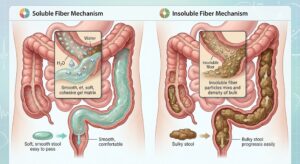
Fiber works through two complementary mechanisms, and understanding the difference helps explain why some fiber sources work better than others for constipation:
- Soluble fiber dissolves in water and forms a gel-like substance in the gut. This gel softens stool and adds moisture that makes it easier to pass. Psyllium husk, oats, and beans are rich in soluble fiber.
- Insoluble fiber does not dissolve in water. Instead, it adds physical bulk to stool and speeds up how quickly waste moves through the intestines. Wheat bran, vegetable skins, and whole grains are good sources.
Most high-fiber foods and supplements contain a mix of both types, but for constipation specifically, soluble, gel-forming fiber like psyllium tends to outperform purely insoluble sources, since it adds water content as well as bulk.
Psyllium husk: the best-studied fiber supplement
Psyllium husk is the most researched fiber supplement for constipation, and the evidence behind it is unusually strong for a supplement category.
A randomized, placebo-controlled trial in both constipated patients and healthy controls found that psyllium measurably increased intestinal water content and was associated with faster gut transit, with the most pronounced microbiota and stool changes occurring in the constipated group (Jalanka et al., 2019). A separate trial in women with chronic constipation found that psyllium relieved core symptoms, including infrequent bowel movements, hard stool, and a sense of incomplete evacuation, while also shifting gut microbiota composition in a favorable direction (Jiang et al., 2021).
A broader meta-analysis of fiber trials confirmed that psyllium and pectin had the strongest, most consistent effects among all the fiber types studied, with 66% of participants responding to fiber treatment compared with 41% on placebo (Van Der Schoot et al., 2022).
Typical dose:
- Range: 5 to 10 grams, once or twice daily, mixed into a full glass of water
- 5 grams ≈ 2 level teaspoons of psyllium husk powder
- 10 grams ≈ 4 level teaspoons
- Check your product’s own label, since density varies between brands and between whole husk and powder forms
How to use it well:
- Increase your dose gradually over 1 to 2 weeks rather than starting at full strength, to avoid bloating and gas.
- Always drink a full glass of water with each dose. Without enough fluid, psyllium can worsen constipation instead of helping it.
- Take it consistently rather than only on bad days. Fiber works best as a daily habit, not a rescue remedy.
- Timing matters too. Our guide on the best time of day to take fiber supplements walks through how to fit it into your routine for the most consistent results.
Who should be cautious: Talk to a doctor or pharmacist before starting if you:
- Have a history of bowel obstruction or swallowing difficulties
- Take medications that need to be spaced apart from fiber, since fiber can interfere with drug absorption

Probiotics: Restoring the Gut Bacteria Behind Regularity
The gut microbiome plays a far bigger role in bowel regularity than most people realize. Beneficial bacteria influence how quickly waste moves through the colon and how much water stool retains. They also affect the release of gut hormones like serotonin that help coordinate bowel contractions. When this bacterial balance is disrupted, by a low-fiber diet, antibiotics, stress, or illness, motility often slows down as a result.
Why probiotics matter for bowel movements
Probiotics work differently than fiber. Instead of adding bulk or water directly, they recolonize the gut with beneficial bacteria that ferment fiber into short-chain fatty acids. These fatty acids nourish the cells lining the colon and help stimulate the muscle contractions that move stool along. This is why probiotics tend to work more gradually than fiber, but can address the underlying microbial imbalance that keeps constipation coming back.
Importantly, not all probiotics are equal. The research shows that specific, well-studied strains, rather than probiotics as a broad category, produce the clearest benefit:
- A systematic review and meta-analysis of probiotic compounds found that strains including Limosilactobacillus reuteri, Lactiplantibacillus plantarum, and Lacticaseibacillus rhamnosus improved gastrointestinal transit time and stool frequency, with some strains successfully colonizing the gut (Wen et al., 2022).
- In adults with functional constipation, a double-blind, randomized, placebo-controlled trial found that probiotic therapy increased the number of weekly bowel movements and improved stool quality compared with placebo (Martinez-Martinez et al., 2021).
- A review focused specifically on chronic constipation found that Bifidobacterium lactis and Lacticaseibacillus paracasei Shirota were among the strains most consistently linked to increased defecation frequency and improved stool consistency (Ribeiro et al., 2023). (L. paracasei Shirota was previously known as Lactobacillus casei Shirota, before a 2020 genus reclassification.)
What to look for in a probiotic supplement
- Choose a product that lists specific, named strains rather than a vague “probiotic blend.”
- Look for a CFU count in the 1 to 20 billion range, ideally backed by human clinical research on that exact strain.
- Check that the product guarantees live cultures through the expiration date, not just at the time of manufacture.
- Refrigerated products are not always necessary, but check the label since some strains require cold storage to stay viable.
For a deeper dive into which strains have the best evidence and how to compare products, see our breakdown of the best probiotic supplements and our explainer on whether probiotics can help with chronic constipation.
Realistic expectations: Probiotics typically take 2 to 4 weeks of consistent use to show meaningful change, and results vary based on each person’s existing gut bacteria. They work best as a long-term complement to fiber and hydration, not a fast-acting fix for an urgent problem.
Magnesium and Prebiotics: Additional Tools for Regularity
Beyond fiber and probiotics, magnesium and prebiotics can play a useful supporting role, each working through a different mechanism. Magnesium acts as an osmotic agent for faster, short-term relief. Prebiotics work more gradually by feeding the beneficial bacteria that sustain motility over time.
Magnesium: a fast-acting osmotic option
Magnesium, particularly in forms like magnesium citrate or magnesium oxide, draws water into the intestines through an osmotic effect. This softens stool and stimulates bowel movements, often within hours to a day or two. Because it works this way, magnesium is technically classified as an osmotic laxative, though it is gentler and more naturally occurring than stimulant laxatives.
In a randomized, double-blind, placebo-controlled trial of adults with mild to moderate chronic constipation, 4 weeks of magnesium oxide produced an overall symptom improvement response rate of 70.6%, compared with just 25% in the placebo group. The treatment also shortened colonic transit time and softened stool form (Mori et al., 2019). Magnesium oxide has also been studied head-to-head against prescription medications for opioid-induced constipation, performing comparably on several measures (Ozaki et al., 2020).
Typical dose:
- Magnesium oxide: ~1.5 grams per day (about 900 mg of elemental magnesium) — the dose used in the main chronic constipation trials
- Magnesium citrate: 200 to 400 mg of elemental magnesium per day — a smaller total dose, but citrate absorbs more efficiently (~57% bioavailability vs. ~25% for oxide), so less is needed and it tends to act faster
In short: citrate is the faster-acting, better-absorbed option, while oxide has more direct constipation trial data behind it. See our full guide to the best magnesium supplements for constipation for product comparisons.
Who should be cautious: Check with a healthcare provider before starting if you:
- Have reduced kidney function or a heart conduction issue
- Take certain antibiotics, bisphosphonates, or diuretics
- Are pregnant or breastfeeding, since safe upper limits differ during pregnancy
Magnesium is best suited to short-term or as-needed use, not as a daily, long-term replacement for fiber.
Prebiotics: feeding the bacteria that keep you regular
Prebiotics are non-digestible fibers and compounds, such as inulin, fructooligosaccharides (FOS), and galactooligosaccharides (GOS), that selectively feed beneficial gut bacteria. As these bacteria ferment prebiotics, they produce short-chain fatty acids that support motility and stool consistency. In this way, prebiotics and probiotics work hand in hand: probiotics supply the bacteria, and prebiotics give them something to eat.
A review on prebiotics, probiotics, and synbiotics in chronic constipation found that inulin was the most promising prebiotic studied in humans, with prebiotic and synbiotic supplementation linked to decreased colonic transit time and increased stool water content (Ribeiro et al., 2023).
Typical dose: 5 to 10 grams per day of inulin or FOS. Start low and increase gradually, since prebiotics commonly cause gas and bloating at full dose. Products that combine a prebiotic with a probiotic — sometimes labeled a “synbiotic” — may offer a modest added benefit over either alone.
Who should be cautious: People with IBS who are sensitive to FODMAPs, across all IBS subtypes (IBS-C, IBS-D, or IBS-M), may find prebiotic fibers worsen bloating and gas rather than helping. This is because inulin and FOS are high-FODMAP fermentable carbohydrates. If that describes you, a low-FODMAP-friendly fiber like psyllium is usually a better starting point.
The Basics Still Matter: Hydration, Movement, and Whole Foods
Supplements work best when the basics are already in place. Adequate water intake keeps the fiber you eat or supplement with properly hydrated as it moves through the colon. Regular movement, even a daily walk, stimulates the natural muscle contractions that push stool forward. And whole, fiber-rich foods add nutrients and plant compounds that no single supplement fully replicates. Our guides to natural laxatives for constipation and fiber-rich foods that support gut health cover these foundational strategies in more depth.
Digestive Enzymes: A Note of Caution
Not every popular gut supplement deserves a place in a constipation routine. Digestive enzyme supplements, containing ingredients like amylase, protease, or lipase, are often marketed for bloating and digestive discomfort. The evidence linking them directly to constipation relief is much thinner than the evidence for fiber, probiotics, or magnesium.
Enzymes can help people with diagnosed conditions like exocrine pancreatic insufficiency or specific food intolerances, such as lactase for lactose intolerance. For general constipation, though, enzymes are not considered a well-evidenced first-line treatment, since most healthy adults already produce sufficient digestive enzymes on their own.
How the Best Supplements for Regular Bowel Movements Compare
Each supplement works through a different mechanism and suits a different need. The table below summarizes the key differences at a glance.Comparison of the best supplements for regular bowel movements: evidence, onset, and best use
| Supplement | Typical Dose | Evidence Level | Time to Work | Best Used For | Safe for Daily Long-term Use? |
|---|---|---|---|---|---|
| Fiber (psyllium husk) | 5–10 g, 1–2x daily, with a full glass of water | Strongest overall — multiple RCTs and meta-analyses | 1 to 3 days | Daily, long-term regularity; addressing low dietary fiber intake | Yes — well suited for daily use |
| Probiotics | 1–20 billion CFU/day of a clinically studied strain | Strain-specific — strong for select strains | 2 to 4 weeks | Ongoing gut health; constipation tied to microbiome imbalance | Yes — best as a long-term complement to fiber |
| Magnesium (citrate or oxide) | Citrate: 200–400 mg elemental/day. Oxide: ~900 mg elemental/day (~1.5 g magnesium oxide) | Strong short-term evidence — RCT-supported | Hours to 1–2 days | Occasional, faster relief; opioid-related or acute constipation | Caution — best for short-term or as-needed use |
| Prebiotics | 5–10 g/day of inulin or FOS, increased gradually | Moderate — strongest for inulin | 1 to 3 weeks | Supporting probiotic effectiveness; increasing stool water content | Yes, with gradual introduction to avoid bloating |
| Digestive enzymes | Variable by product; no established constipation-specific dose | Weak for constipation — limited direct evidence | Variable | Bloating or specific enzyme deficiency conditions only | Not recommended as a primary constipation tool |
Building a Supplement Routine That Actually Works
Rather than trying everything at once, most people do better starting with one change at a time and building from there:
- Start with psyllium husk and consistent water intake for about 2 weeks. This addresses the foundation: bulk and moisture.
- If bowel frequency hasn’t normalized, add a clinically studied probiotic strain to support the underlying gut bacteria.
- Reserve magnesium for days when you need a faster, more reliable nudge, rather than as a daily habit.
- Layer in a prebiotic or synbiotic if you want to support your probiotic’s effectiveness further, watching for bloating along the way.
Pairing supplements with everyday habits, like regular movement and consistent meal timing, tends to produce better and more lasting results than relying on any single product.
If you have tried fiber, probiotics, and magnesium consistently for several weeks without improvement, or if you are experiencing severe pain, rectal bleeding, or unexplained weight loss, it is time to talk with a doctor rather than continuing to self-treat. Chronic constipation can sometimes signal an underlying condition that needs a different approach.
Frequently Asked Questions
How long does it take for fiber or probiotic supplements to regulate bowel movements?
Psyllium husk often produces noticeable results within 1 to 3 days, while probiotics typically take 2 to 4 weeks of consistent use to show meaningful change, since they work by gradually shifting gut bacteria populations.
Can I take psyllium husk, magnesium, and probiotics together?
Many people combine them safely, but it is best to introduce one at a time so you can tell what is helping and watch for side effects like bloating or loose stools. Space fiber supplements away from medications by at least 1 to 2 hours, since fiber can interfere with drug absorption.
Are natural supplements safer than OTC laxatives?
Natural does not automatically mean risk-free. Magnesium is an osmotic laxative and carries its own interaction and overuse risks, particularly for people with kidney problems. Fiber and well-studied probiotic strains generally have the most favorable long-term safety profiles for daily use.
What is the single best supplement to start with?
For most people, psyllium husk has the strongest and most consistent research behind it. It addresses the root mechanical issue, low stool bulk and water content, that drives most everyday constipation.
Is it safe to take a fiber supplement and a probiotic at the same time?
Yes, and the two can work well together, since fiber, especially prebiotic-containing fiber, helps feed beneficial bacteria. Introduce them on different days if you are sensitive to bloating, so you can identify which one is causing any discomfort.
Can supplements cause dependency, the way some laxatives can?
Bulk-forming fiber and probiotics are not associated with the bowel dependency seen with long-term stimulant laxative misuse. Magnesium is generally safe for occasional use, but relying on it daily for months without medical supervision is not advisable. The underlying cause of constipation should also be addressed.
This article is for general educational purposes and is not a substitute for personalized medical advice. If constipation is severe, persistent, or accompanied by warning signs such as rectal bleeding, unintended weight loss, or severe abdominal pain, please consult a healthcare provider.
Affiliate Disclosure: This article contains affiliate links. If you purchase through our links, we may earn a small commission at no extra cost to you. Our editorial recommendations are based on research and are never influenced by affiliate relationships.
References
- Jalanka J, et al. The Effect of Psyllium Husk on Intestinal Microbiota in Constipated Patients and Healthy Controls. Int J Mol Sci. 2019. PubMed
- Jiang T, et al. The effects of psyllium husk on gut microbiota composition and function in chronically constipated women of reproductive age. Aging (Albany NY). 2021. Aging-US
- Van Der Schoot A, Drysdale C, Whelan K, Dimidi E. The Effect of Fiber Supplementation on Chronic Constipation in Adults: An Updated Systematic Review and Meta-Analysis of RCTs. Am J Clin Nutr. 2022. AJCN
- Wen Y, et al. Efficacy of Probiotic Compounds in Relieving Constipation and Their Colonization in Gut Microbiota. PMC. 2022. PMC
- Martinez-Martinez MI, et al. The effect of probiotics on functional constipation in adults: a double-blind, randomized, placebo-controlled study. PMC. 2021. PMC
- Ribeiro BD, et al. Probiotics, prebiotics, and synbiotics in chronic constipation: outstanding aspects to be considered for the current evidence. PMC. 2023. PMC
- Mori S, Tomita T, et al. A Randomized Double-blind Placebo-controlled Trial on the Effect of Magnesium Oxide in Patients With Chronic Constipation. J Neurogastroenterol Motil. 2019. PMC
- Ozaki A, et al. Comparing the effectiveness of magnesium oxide and naldemedine in preventing opioid-induced constipation (MAGNET study). Trials. 2020. PubMed