

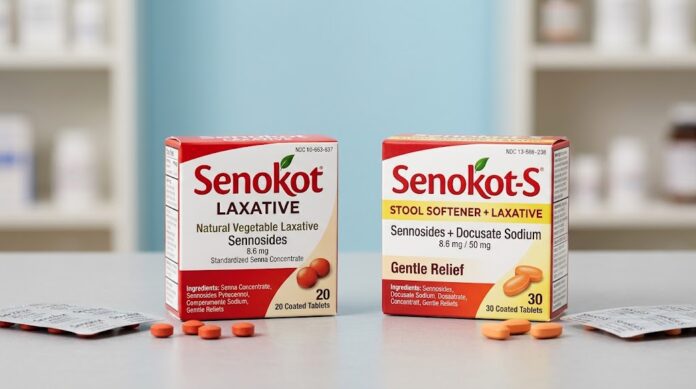
Quick answer: In the Senokot vs Senokot-S question, the laxative is identical: 8.6 mg of sennosides per tablet. The main active-ingredient difference is that Senokot-S also contains 50 mg of docusate sodium, a stool softener.[1][2] Both are labeled to work in 6 to 12 hours. Neither is meant for use beyond 1 week without a doctor’s advice.
The Senokot shelf can look confusing at first. One box says Senokot, another says Senokot-S, and the names differ by a single letter. It is natural to assume the “S” means stronger, or that the extra ingredient must make it work better. The label facts and the research tell a more nuanced story, and this guide walks through it, including doses and side effects.
We compare the two products side by side, look at what studies say about adding docusate to senna, and explain the differences that matter when you choose. If you want to see how senna stacks up against other options first, our guide to the best OTC laxatives for constipation covers the full field.
| Feature | Senokot Regular Strength | Senokot-S Dual Action |
|---|---|---|
| Active ingredients | Sennosides 8.6 mg | Sennosides 8.6 mg plus docusate sodium 50 mg |
| Labeled purpose | Laxative | Stool softener and laxative |
| Typical time to work | 6 to 12 hours | 6 to 12 hours |
| Adult starting dose | 2 tablets once a day | 2 tablets once a day |
| Adult maximum dose | 4 tablets twice a day | 4 tablets twice a day |
| Use limit on label | Not longer than 1 week unless directed by a doctor | Not longer than 1 week unless directed by a doctor |
| Mineral oil taken separately | No mineral oil warning on the label (MedlinePlus lists mineral oil as a possible senna interaction, so tell your pharmacist) | Do not use while taking mineral oil unless directed by a doctor |
| Color additive | No dye listed among inactive ingredients | Contains FD&C Yellow No. 5 Lake (tartrazine) and Yellow No. 6 Lake |
| Minerals listed per tablet | Calcium 20 mg | Calcium 7 mg, sodium 4 mg (labeled very low sodium) |
Sources: manufacturer labels for Senokot Regular Strength and Senokot-S Dual Action, and the DailyMed label for Senokot-S.[1][2][3]
What Is Senokot (Regular Strength)?
Senokot Regular Strength tablets contain a single active ingredient, sennosides, at 8.6 mg per tablet. They are labeled to relieve occasional constipation. A bowel movement generally follows in 6 to 12 hours, which is why the manufacturer suggests taking them at bedtime.[1] The brand also sells an Extra Strength tablet with 17.2 mg of sennosides, plus gummies and soft chews, so check the label of the exact box you buy.[4]
Senna is a stimulant laxative that works by increasing activity in the intestines to cause a bowel movement.[5] In plain terms, it nudges the colon to contract rather than simply softening what is already there.

What Is Senokot-S?
Senokot-S, sold as Senokot-S Dual Action, takes that same 8.6 mg senna dose and adds 50 mg of docusate sodium to each tablet.[2] Docusate is classed as a stool softener. It is meant to increase the amount of water in the stool so it is softer and easier to pass.[6]
The adult directions match regular Senokot. Two differences are worth knowing. First, the DailyMed label says not to use Senokot-S while taking mineral oil unless a doctor tells you to.[2] Health Canada’s product monograph explains why.
The docusate may increase absorption of mineral oil from the gut.[7] Second, Senokot-S contains the color additives FD&C Yellow No. 5 Lake (tartrazine) and Yellow No. 6 Lake, which matters if you react to those dyes.[3]

Does the Docusate in Senokot-S Actually Help?
This is the question that matters most. Available studies have not demonstrated a clear added benefit from combining docusate with senna, although the evidence is limited and may not apply to everyone with occasional constipation. The best evidence comes from two studies that compared senna alone with senna plus docusate. Both involved seriously ill patients.
The randomized trial was a 10 day, double blind, placebo controlled study in which 74 hospice patients were randomized (35 to docusate, 39 to placebo). Everyone received senna tablets (8.6 mg each), plus either docusate or a placebo.
The authors concluded there was no significant benefit from adding docusate to senna for managing constipation. The study did report one small difference in stool form on the Bristol Stool Form Scale, but it did not translate into an overall benefit.[8]
The second was a smaller, non randomized study of 60 hospitalized patients with cancer. Two groups followed their hospital’s bowel protocols one after the other, one using senna alone and one adding docusate.[9] The authors reported that adding docusate did not reduce cramps and was less effective at inducing a bowel movement.
In a supportive care subgroup, an evidence review noted that 57% of patients on the docusate protocol needed extra help, such as lactulose, suppositories or enemas, versus 40% on senna alone.[10] Because it was small and not randomized, it is a signal rather than proof.
An American College of Gastroenterology evidence summary adds that earlier guidelines found small trials of docusate with methodological limitations, reporting no advantage over placebo and poorer results than psyllium. It also calls for properly designed trials to settle the question.[11]
There are fair caveats. The hospice and cancer patients were often on opioids, which cause their own type of constipation. The hospice trial used a docusate regimen that differed from the amount supplied by the usual Senokot-S starting dose. The results therefore should not be assumed to establish the effect of every possible dose.[8]
If your main concern is hard, dry stool, our breakdown of the best stool softeners for constipation looks at how docusate compares with polyethylene glycol and psyllium.
Senokot and Senokot-S Dosage
Both products are taken by mouth, preferably at bedtime or as a doctor directs. The labels give the same adult dose.[1][3] Start with the starting dose rather than the maximum. The maximum is a ceiling, not a target.
| Age group | Senokot Regular Strength | Senokot-S Dual Action |
|---|---|---|
| Adults and children 12 and over | Start: 2 tablets once a day. Maximum: 4 tablets twice a day | Start: 2 tablets once a day. Maximum: 4 tablets twice a day |
| Children 6 to under 12 | Start: 1 tablet once a day. Maximum: 2 tablets once a day | Start: 1 tablet once a day. Maximum: 2 tablets twice a day |
| Children 2 to under 6 | Start: 1/2 tablet once a day. Maximum: 1 tablet once a day | Start: 1/2 tablet once a day. Maximum: 1 tablet twice a day |
| Children under 2 | Ask a doctor | Ask a doctor |
Doses above follow the manufacturer’s directions charts and the DailyMed label. Label wording can differ slightly between package versions, so always follow the box you are holding, and check with a doctor or pharmacist before giving any laxative to a child.[1][2][3]
- Extra Strength is dosed differently. Each Extra Strength tablet has 17.2 mg of sennosides, and the adult starting dose is 1 tablet once a day, with a maximum of 2 tablets twice a day. Do not assume the dose matches regular Senokot.[4]
- Timing: Because senna usually works within 6 to 12 hours, a bedtime dose is meant to produce a bowel movement the next day.[5]
- Duration: Labels say not to use laxative products for longer than 1 week unless a doctor directs it.[1][2]
- Missed dose: MedlinePlus says senna is usually taken as needed. If a doctor has told you to take it regularly, take a missed dose when you remember, skip it if the next dose is almost due, and never double up.[5]
- Fluids and food: MedlinePlus recommends a high fiber diet and about eight glasses of liquid a day alongside senna.[5]
- Older adults: MedlinePlus advises people 65 and older to talk with a doctor about risks and benefits, because senna products are generally not meant for long periods in this age group.[5]
- Children: Check with a pediatrician or pharmacist before giving any laxative to a child, even though the label lists child doses.
Side Effects and Safety Precautions
Senna is widely used and often well tolerated, but it is a stimulant laxative, so side effects are real and mostly come from the bowel being pushed to contract.
Common side effects
- Stomach discomfort or cramps
- Nausea
- Diarrhea
- Faintness or weakness in some people[5][6]
- Brown discoloration of urine. This may be harmless, but seek medical advice if it persists or you have other symptoms.[5]
Tell a doctor if these are severe or do not go away.[5]
Stop and call a doctor if
- You have rectal bleeding.[1][5]
- You do not have a bowel movement after using a laxative. The label says to stop and ask a doctor, since this can point to a more serious problem.[1]
- You develop nausea, vomiting or diarrhea that does not stop, muscle cramps or weakness, an irregular heartbeat, or dizziness. Kaiser Permanente’s drug guide lists these among the symptoms to report.[6]
- You notice signs of a serious allergic reaction, which is rare.[6]
Ask a doctor before using it if you have
- Stomach pain, nausea or vomiting
- A sudden change in bowel habits that has lasted 2 weeks[1]
- Pregnancy or breastfeeding, where the label says to ask a health professional first[1]
Interactions and other precautions
- Tell your doctor and pharmacist about all prescription and nonprescription medicines, vitamins and herbal products you take. MedlinePlus specifically names mineral oil as a possible interaction with senna.[5]
- Stimulant laxatives, including senna, do not help with weight loss, according to the leaflet for a senna product.[12]
- Keep tablets out of reach of children. In case of overdose, call Poison Control at 1-800-222-1222 in the United States, or call 911 if the person has collapsed or has trouble breathing.[5]
Long term use
The product labels advise against using Senokot or Senokot-S for longer than 1 week unless directed by a doctor.[1][2] MedlinePlus warns that frequent or continued use of senna may lead to laxative dependence.[5] However, evidence on the long term safety of senna remains limited.
The 2023 AGA-ACG guideline notes that longer term use is probably appropriate, but more data are needed to understand tolerance and side effects.[13] If you regularly need a laxative, talk with a healthcare professional about the cause of your constipation and a suitable long term plan.
Where Senna Fits in Current Guidelines
In 2023 the American Gastroenterological Association and the American College of Gastroenterology published a joint guideline on drug treatment for chronic idiopathic constipation in adults. It conditionally suggests senna, based on low certainty evidence. It also notes that the trials ran for 4 weeks and used higher doses than are commonly taken in everyday practice.[13]
Bisacodyl received a strong recommendation only for short term or rescue use. Among the over the counter therapies evaluated, PEG received a strong recommendation for adults with chronic idiopathic constipation, while senna received a conditional recommendation based on low certainty evidence.[11][13]
The guideline’s methods said docusate would be evaluated, but no assessment of stool softeners was provided.[11] So there is no guideline verdict on the docusate in Senokot-S either way. If constipation keeps returning, it is worth asking a clinician about options such as PEG rather than relying on a stimulant. For a closer look at senna on its own, see our Senokot review. We compare those options in MiraLAX vs Dulcolax and bisacodyl vs milk of magnesia vs MiraLAX.
Senokot vs Senokot-S: Which One Should You Choose?
The two products differ mainly in one active ingredient, so the choice comes down to the facts above rather than a clear winner.
Regular Senokot provides senna alone. It may be a reasonable option for occasional constipation when a stimulant laxative is appropriate and you do not need an additional stool softener. It also avoids the dye and the mineral oil warning that come with Senokot-S.
Senokot-S provides both a stimulant laxative and a stool softener in one tablet. However, evidence has not established that adding docusate improves constipation relief compared with senna alone.[2][8] It contains very little sodium.
Neither may be the right answer if you are reaching for a laxative often. In that case, speak with a healthcare professional about the cause and the options.
Products to Consider
These are the specific products discussed in this guide. Prices and pack sizes change, so check the current listing before you buy.
- Senokot Regular Strength tablets (100 count) contain senna only, at 8.6 mg of sennosides per tablet.
- Senokot-S Dual Action tablets (30 count) contain 8.6 mg of sennosides plus 50 mg of docusate sodium per tablet.
- MiraLAX laxative powder (30 dose) is a PEG 3350 powder, the type of laxative the 2023 guideline strongly recommends for chronic idiopathic constipation.
Want to compare more categories before you decide? Our roundup of the best constipation products on Amazon sorts them by how they work.
Affiliate disclosure: we may earn a small commission if you buy through the links above, at no extra cost to you. This does not affect which products we discuss.
The Bottom Line
Senokot and Senokot-S share the same senna dose, the same adult directions and the same 6 to 12 hour timeline. Senokot-S adds docusate, and studies so far have not shown a clear added benefit from it. Whichever you pick, take the starting dose at bedtime and keep it to 1 week unless a doctor says otherwise. Speak with a doctor or pharmacist if you see rectal bleeding or keep needing a laxative.
Frequently Asked Questions
What is the difference between Senokot and Senokot-S?
Senokot contains only senna (8.6 mg of sennosides per tablet). Senokot-S contains the same 8.6 mg of sennosides plus 50 mg of docusate sodium, a stool softener. The senna triggers the bowel movement, and both products generally work in 6 to 12 hours.
Is Senokot-S stronger than Senokot?
Not in terms of the laxative itself. Both tablets carry 8.6 mg of sennosides. Senokot-S adds a different type of ingredient, a stool softener, rather than more senna. Senokot Extra Strength is the version with more senna, at 17.2 mg per tablet.
How long do Senokot and Senokot-S take to work?
Both labels say they generally produce a bowel movement in 6 to 12 hours. That is why they are usually taken at bedtime, so relief arrives the next morning.
What is the usual adult dose of Senokot and Senokot-S?
Adults and children 12 and older start with 2 tablets once a day, preferably at bedtime. The maximum is 4 tablets twice a day. Starting at the lower dose and following the box is safer.
What are the side effects of Senokot and Senokot-S?
The most common are stomach discomfort, cramps, nausea, and diarrhea. Senna can also cause brown discoloration of urine, which may be harmless, but seek medical advice if it persists or you have other symptoms. Rectal bleeding is a reason to stop and call a doctor.
Can I take Senokot or Senokot-S every day?
The labels advise against using laxative products for longer than 1 week unless a doctor directs it. If you need a laxative more often than that, talk with a doctor or pharmacist about the cause and a longer term plan.
Can I take Senokot and Senokot-S together?
There is little reason to. Both already contain the same senna ingredient, and doubling up can push you past the maximum dose on the label. Choose one product and follow its directions.
Which is better for hard stools, Senokot or Senokot-S?
Senokot-S is the one that contains a stool softener, so it is the logical option if hard stools are your main complaint. That said, studies in hospice and cancer patients did not show a clear added benefit from adding docusate to senna. For ongoing hard stools, polyethylene glycol has stronger guideline support.
This article is for general information only and is not medical advice. Always read the product label and speak with a doctor or pharmacist about your own situation.
References
- Senokot. Senokot Regular Strength [Internet]. Atlantis Consumer Healthcare Inc.; [cited 2026 Oct 24]. Available from: https://senokot.com/laxatives/senokot-regular-strength/
- DailyMed. Senokot-S (standardized senna concentrate and docusate sodium) tablet: drug label [Internet]. Bethesda (MD): National Library of Medicine; [cited 2026 Oct 24]. Available from: https://dailymed.nlm.nih.gov/dailymed/fda/fdaDrugXsl.cfm?setid=c24cdc5e-62e0-41a6-8afb-512202a569f4
- Senokot. Senokot-S Dual Action [Internet]. Atlantis Consumer Healthcare Inc.; [cited 2026 Oct 24]. Available from: https://senokot.com/laxatives/senokot-dual-action/
- Senokot. Senokot Extra Strength [Internet]. Atlantis Consumer Healthcare Inc.; [cited 2026 Oct 24]. Available from: https://senokot.com/laxatives/senokot-extra-strength/
- MedlinePlus. Senna: drug information [Internet]. Bethesda (MD): National Library of Medicine; last revised 2024 Jun 20 [cited 2026 Oct 24]. Available from: https://medlineplus.gov/druginfo/meds/a601112.html
- Kaiser Permanente. Sennosides 8.6 mg docusate sodium 50 mg tablet: drug encyclopedia [Internet]. Kaiser Permanente; [cited 2026 Oct 24]. Available from: https://healthy.kaiserpermanente.org/health-wellness/drug-encyclopedia/drug.sennosides-8-6-mg-docusate-sodium-50-mg-tablet.186644
- Health Canada. Senokot-S (senna and docusate sodium tablets): product monograph [Internet]. Ottawa: Health Canada Drug Product Database; [cited 2026 Oct 24]. Available from: https://pdf.hres.ca/dpd_pm/00058143.PDF
- Tarumi Y, Wilson MP, Szafran O, Spooner GR. Randomized, double-blind, placebo-controlled trial of oral docusate in the management of constipation in hospice patients. J Pain Symptom Manage. 2013;45(1):2-13. doi:10.1016/j.jpainsymman.2012.02.008. PMID: 22889861. Available from: https://pubmed.ncbi.nlm.nih.gov/22889861/
- Hawley PH, Byeon JJ. A comparison of sennosides-based bowel protocols with and without docusate in hospitalized patients with cancer. J Palliat Med. 2008;11(4):575-81. doi:10.1089/jpm.2007.0178. PMID: 18454610. Available from: https://pubmed.ncbi.nlm.nih.gov/18454610/
- Canadian Agency for Drugs and Technologies in Health. Dioctyl sulfosuccinate or docusate (calcium or sodium) for the prevention or management of constipation: a review of the clinical effectiveness [Internet]. Ottawa: CADTH; [cited 2026 Oct 24]. Available from: https://www.ncbi.nlm.nih.gov/books/NBK259247/
- Schoenfeld P. Joint AGA-ACG clinical practice guideline on chronic idiopathic constipation treatments: parsing benefits and risks [Internet]. Evidence-Based GI. American College of Gastroenterology; 2023 Jun 13 [cited 2026 Oct 24]. Available from: https://gi.org/journals-publications/ebgi/schoenfeld2_june2023/
- electronic Medicines Compendium. Senokot Max Strength Tablets 12 Years Plus: package leaflet [Internet]. Datapharm; [cited 2026 Oct 24]. Available from: https://www.medicines.org.uk/emc/files/pil.11549.pdf
- Chang L, Chey WD, Imdad A, Almario CV, Bharucha AE, Diem S, et al. American Gastroenterological Association-American College of Gastroenterology clinical practice guideline: pharmacological management of chronic idiopathic constipation. Gastroenterology. 2023;164(7):1086-106. doi:10.1053/j.gastro.2023.03.214. Also published in: Am J Gastroenterol. 2023;118(6):936-54.