

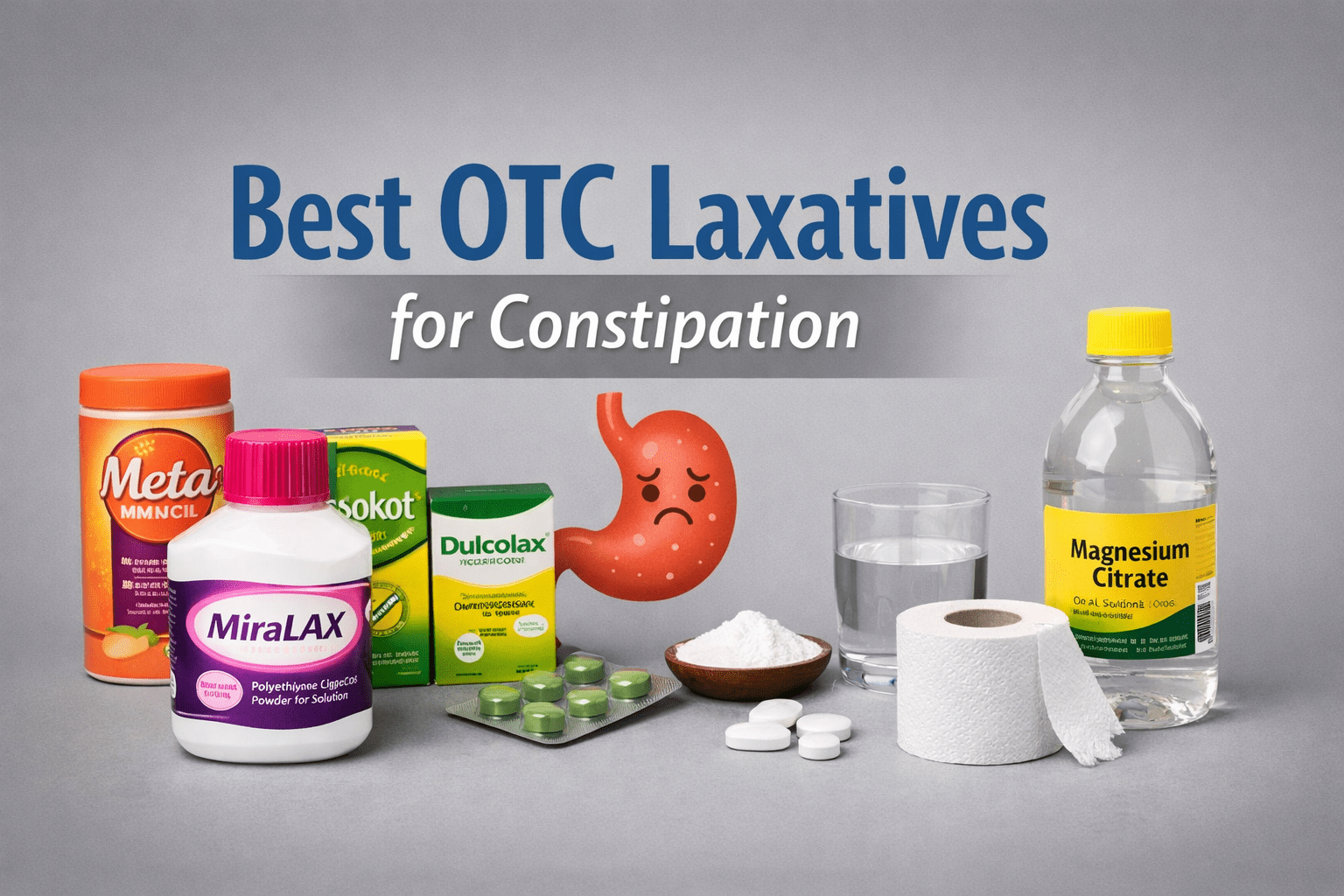
Walk down any pharmacy aisle and you’ll find a dozen boxes promising fast, gentle, or overnight relief from constipation. They don’t all work the same way, though, and they’re not all backed by the same quality of evidence. Some are osmotic, some are stimulant, some are bulk forming, and some are stool softeners, and knowing which category a laxative falls into tells you almost everything about how fast it works, how safe it is for daily use, and what side effects to expect.
The kind of constipation that keeps coming back without an obvious cause has a name, chronic idiopathic constipation, and according to the 2023 AGA/ACG Guideline it affects between 8% and 12% of adults in the US. To rank the major OTC options below, we weighed three sources that carry real weight in the gastroenterology world:
- Rao & Brenner (2021), a systematic review in the American Journal of Gastroenterology that screened nearly 1,300 studies and ultimately analyzed 41 qualifying clinical trials from 2004 to 2020.
- The 2023 AGA/ACG Clinical Practice Guideline, a joint statement from the two leading US gastroenterology societies, built on the GRADE evidence framework.
- Mayo Clinic, for practical, patient-facing safety guidance.
Disclosure: This article contains affiliate links. If you purchase through our links, we may earn a small commission at no extra cost to you. Our rankings are based solely on clinical evidence — not affiliate relationships.
Quick Answer: Best OTC Laxatives for Constipation — Ranked by Evidence
MiraLAX (PEG) comes out on top for anyone dealing with ongoing constipation. It’s the only OTC option with a strong recommendation for daily, long-term use.
Dulcolax (Bisacodyl) is the better choice when you need relief fast and don’t plan to use it regularly.
Senokot (Senna) also works quickly and has solid short-term evidence, though it ranks a notch below bisacodyl once you apply the stricter 2023 guideline.
Metamucil (Psyllium) is the pick for daily prevention rather than acute relief.
Magnesium-based products, Milk of Magnesia and magnesium citrate, are reasonable for occasional, gentle relief, with an important caveat for anyone with kidney disease.
Kiwi and prunes hold up surprisingly well in head-to-head trials, sometimes outperforming fiber supplements.
Colace (Docusate), despite being one of the best-selling stool softeners in the country, has limited evidence supporting its effectiveness for routine constipation.

What constipation actually looks like
Mayo Clinic defines constipation simply: fewer bowel movements than what’s normal for you, or stools that are hard, dry, and difficult to pass. Most doctors use a rough benchmark of fewer than three bowel movements a week, though what’s “normal” varies from person to person. Some people go daily, others every two or three days, without either pattern being a problem on its own.
The symptoms people describe most often are straining, hard or lumpy stools, a sense of incomplete emptying, and bloating. It shows up more in women than men, and becomes noticeably more common after age 60, often tied to slower gut motility, medication side effects (opioids, some antidepressants, iron supplements, and calcium channel blockers are common culprits), or simply moving around less.
Before you even think about a laxative, Mayo Clinic’s advice is worth taking seriously: aim for 25 to 31 grams of fiber a day, drink 8 to 10 glasses of water, and stay physically active. These changes alone resolve constipation for a lot of people within a couple of weeks. If dehydration might be part of your picture, our guide on how dehydration affects constipation goes into more detail.
How researchers actually grade these treatments
The 2021 Rao & Brenner review didn’t just list which laxatives exist. It graded the quality of evidence behind each one, using a scale that’s now become something of a standard reference point in the field:
| Grade | What It Means | Plain English |
|---|---|---|
| Grade A | Good evidence from multiple well-designed trials | Strongly recommended |
| Grade B | Moderate evidence; fewer or smaller trials | Recommended |
| Grade C | Poor evidence from weak trials | Not routinely recommended |
| Grade I | Not enough data to make a recommendation | Insufficient evidence |
Two years later, the AGA and ACG published a joint guideline using GRADE methodology, which sorts recommendations into two tiers: strong (most patients should use this; the benefits clearly outweigh the risks) and conditional (a reasonable option, but one to decide on with your doctor based on your specific situation). GRADE also separately rates the certainty of evidence as high, moderate, low, or very low, a different axis than the 2021 letter grades.
This explains an odd-looking detail in our ranking above: bisacodyl sits at #2 and senna at #3, even though senna actually earned the higher letter grade in 2021 (Grade A, versus bisacodyl’s Grade B). The reason is that the 2023 guideline gave bisacodyl (grouped with sodium picosulfate) a strong recommendation for short-term or rescue use, but only a conditional recommendation to senna.
Under the more rigorous GRADE framework, bisacodyl’s evidence held up better, largely because more recent trials specifically tested it against the outcomes doctors care about most, like complete spontaneous bowel movements per week.
In short, senna scored better on the older letter-grade system, but bisacodyl scored better on the newer, stricter guideline, which is why bisacodyl edges ahead in this ranking.
How the major options compare
| Product | Type | 2021 Grade | 2023 AGA/ACG | Onset | Best For | Buy |
|---|---|---|---|---|---|---|
| MiraLAX (PEG) | Osmotic | Grade A | Strong, moderate certainty | 24 to 72 hrs | Chronic constipation | MiraLAX price |
| Dulcolax (Bisacodyl) | Stimulant | Grade B | Strong, moderate certainty (short term) | 6 to 12 hrs oral; 15 to 60 min suppository | Rescue/occasional | Dulcolax price |
| Senokot (Senna) | Stimulant | Grade A | Conditional, low certainty | 6 to 12 hrs | Short-term relief | Senokot price |
| Metamucil (Psyllium) | Fiber/Bulk-forming | Grade B | Conditional, low certainty | 12 to 72 hrs | Daily prevention | Metamucil price |
| Milk of Magnesia | Osmotic/Magnesium | Grade B | Conditional, very low certainty (MgO) | 6 to 12 hrs | Gentle overnight | Milk of Magnesia price |
| Magnesium Citrate | Saline/Osmotic | Grade B | Not separately graded | 30 min to 6 hrs | Fast occasional relief | Magnesium citrate price |
| Colace (Docusate) | Stool Softener | Grade I | No recommendation issued | 12 to 72 hrs | Not recommended for constipation | N/A |
MiraLAX (Polyethylene Glycol): the safest choice for everyday use
MiraLAX’s active ingredient, polyethylene glycol 3350, works by pulling water into the colon so stool stays soft and moves more easily. Mayo Clinic describes this class of osmotic laxatives as drawing water into the colon to allow easier passage of stool. What makes PEG particularly appealing is that it isn’t absorbed into the bloodstream. It does its job locally in the gut and then passes through, which is part of why it’s considered safe for long-term, everyday use, unlike stimulant laxatives that act directly on nerve endings in the intestinal wall.
It’s also the most heavily studied laxative on this list. The 2021 review gave it a Grade A rating, the highest possible, based on nine separate clinical trials, and it’s the only OTC option with both short-term and long-term data behind it. The 2023 AGA/ACG Guideline went a step further, giving PEG a strong recommendation with moderate certainty of evidence, making it the only OTC laxative to earn a strong GRADE recommendation specifically for chronic daily use.
The tradeoff is speed: PEG typically takes 24 to 72 hours to work, so it’s not what you reach for when you need relief tonight. It’s unflavored and dissolves into virtually any drink (water, juice, coffee, tea), which makes daily use easier since there’s no distinctive taste or gritty texture to get used to. A standard adult dose is typically one capful (about 17 grams) mixed into 4 to 8 ounces of liquid, once daily, though you should always follow the specific product label. Side effects, when they happen, tend to be mild bloating or looser stools at higher doses, and they usually settle down once your body adjusts or the dose is reduced slightly.
Clinical guidelines generally point to this as the first option for chronic constipation, and it’s also considered appropriate for elderly adults and pregnant women under a doctor’s guidance. See our guide on constipation relief for elderly adults for more.
Dulcolax (Bisacodyl): what to reach for when you need results today
Bisacodyl works very differently from PEG. It’s a stimulant laxative, meaning it directly triggers the muscles lining your intestines to contract and push stool along. Mayo Clinic describes this mechanism as triggering rhythmic contractions of intestinal muscles. It comes in both tablet and suppository form, with the suppository acting noticeably faster because it bypasses digestion entirely and works directly on the rectal lining.
Its evidence trajectory is interesting: bisacodyl and its close cousin sodium picosulfate were graded a C in an earlier 2005 review, then upgraded to Grade B in 2021 as more trial data accumulated. The 2023 AGA/ACG Guideline gave the pair a strong recommendation with moderate certainty of evidence for short-term use (up to four weeks) or as a rescue option. That strong rating is notably better than the conditional recommendation senna received under the same framework, which is the main reason bisacodyl edges out senna in our overall ranking despite a lower 2021 grade.
The downside is that it’s not gentle. Cramping and diarrhea are common, especially with the first few doses, and it isn’t meant for daily, long-term use. A typical adult tablet dose is 5 to 15 mg taken orally, usually at bedtime since it takes 6 to 12 hours to work. The suppository form is faster, often producing a bowel movement within an hour, which makes it a reasonable option before a procedure or trip when timing matters.
Senokot (Senna): fast, natural, but not for everyday use
Senna comes from the leaves and pods of Senna alexandrina, and like bisacodyl, it’s a stimulant that gets the intestines contracting. Its active compounds, called sennosides, are broken down by gut bacteria in the colon before they take effect, part of why it tends to act a bit slower than bisacodyl suppositories. The 2021 review gave it Grade A based on two trials showing better bowel movement frequency than placebo, though it’s worth noting one of those trials used doses higher than what’s typically used in practice.
Where senna falls short is under the newer, stricter GRADE system: the 2023 guideline gave it only a conditional recommendation with low certainty of evidence, placing it behind both PEG and bisacodyl.
Beyond the cramping and urgency that often come with stimulant laxatives, senna can also turn your urine a harmless shade darker, worth knowing so it doesn’t catch you off guard. Standard adult doses run around 8.6 to 17.2 mg of sennosides, usually taken at bedtime for a morning bowel movement.
Metamucil (Psyllium Husk): the gentlest daily option
Psyllium is a soluble fiber pulled from the seeds of Plantago ovata, and it’s the closest thing on this list to how your gut naturally handles digestion. Mayo Clinic describes bulk-forming laxatives like Metamucil as absorbing water to form soft, bulky stool that prompts normal intestinal contractions, rather than forcing anything the way a stimulant does.
It’s worth being upfront about the evidence here: two placebo-controlled trials found psyllium performed no better than placebo on overall symptom scores, and in direct comparisons it actually lost out to mangoes and prunes. Despite that, it earned a Grade B rating because it consistently improves stool bulk and consistency, has an excellent long-term safety record, and comes with genuine side benefits: it can help lower LDL cholesterol and support blood sugar control, a rare combination for a constipation product. The 2023 guideline recommends it as a conditional first-line option, particularly for people whose diets are low in fiber to begin with.
A typical starting dose is one tablespoon (about 5 to 6 grams) mixed into at least 8 ounces of water or juice, taken up to three times daily, gradually increasing intake to avoid gas and bloating. Increase your water intake alongside psyllium; without enough fluid, it can actually worsen a blockage rather than relieve it.
For a broader look at fiber options, see our guide to natural fiber supplements for chronic constipation.
Magnesium-based laxatives: gentle relief, with one important caveat
Magnesium products work osmotically, much like PEG, drawing water into the colon. Mayo Clinic groups Milk of Magnesia (magnesium hydroxide) alongside PEG in the “oral osmotics” category. You’ll typically see three forms on shelves: magnesium oxide tablets (the form most studied in trials), magnesium citrate liquid (the fastest acting, though not separately graded in the 2021 review), and magnesium hydroxide, the classic Milk of Magnesia.
Magnesium salts collectively earned a Grade B in 2021, largely based on magnesium oxide trials that outperformed placebo and held up as well as senna in at least one study. The 2023 guideline, though, gave magnesium oxide only a conditional recommendation with very low certainty, the weakest confidence rating of any agent evaluated.
Milk of Magnesia is typically dosed at 30 to 60 mL for adults, usually taken at bedtime. Magnesium citrate, sold as a ready-to-drink liquid, is often used as a single full-bottle dose, and because it acts so quickly, it’s commonly used before certain medical procedures as well as for occasional constipation relief.
For a closer look at which magnesium form might suit you, see our guide to magnesium supplements for constipation.
Kiwi and prunes: the food-first option that actually holds up
It’s easy to dismiss “eat more fruit” as generic advice, but the data here is genuinely interesting. The 2021 review gave Grade B recommendations to four fruits: kiwi, prunes, mango, and figs, all of which contain fiber, sorbitol, and natural sugars that help retain water in the colon and encourage movement.
Kiwi has the strongest evidence of the four, backed by two clinical trials, with typical study doses around two kiwifruits per day. Prunes have one trial behind them, but in a direct head-to-head comparison, they beat psyllium on stool frequency, a genuinely notable result given how often psyllium gets recommended as the default. A common serving used in research is about 100 grams of prunes daily, roughly 10 to 12 pieces. Mango and figs each have a single supporting study.
If a food-based approach appeals to you, our guide on fiber foods and gut health covers this in more depth.
Colace (Docusate): a popular product with weak evidence behind it
Docusate sodium, sold as Colace and Dulcolax Stool Softener, is genuinely one of the best-selling stool softeners in the country. It’s supposed to work by lowering stool’s surface tension so water and fat can soak in and soften it from the inside, a mechanism sometimes called a “surfactant” effect.
The clinical evidence provides limited support for that specific benefit in constipation. The 2021 review gave it Grade I, insufficient evidence to make any recommendation at all, and the 2023 AGA/ACG Guideline didn’t issue a recommendation for it either. Mayo Clinic states plainly that there’s no evidence it improves symptoms in controlled trials.
There is one context where it’s still commonly used: post-surgical patients and new mothers, where the goal isn’t treating constipation but simply avoiding the strain of a bowel movement during recovery from surgery or childbirth. That’s a different use case entirely, and one where a physician might still reasonably recommend it. If you’re dealing with actual constipation, though, PEG or psyllium are much better supported.
Safety, side effects, and drug interactions
Across all 41 trials in the 2021 review, no serious adverse events turned up for any of these laxatives. The side effects people report, including bloating, cramping, gas, and loose stools, are generally mild and tend to scale with dose.
That said, Mayo Clinic cautions that overusing laxatives can cause electrolyte imbalances serious enough to affect the heart, muscles, and nervous system. A few practical rules worth following:
- Stimulant laxatives like senna and bisacodyl aren’t meant for daily, long-term use without a doctor’s involvement. They’re effective short term, but chronic overuse carries a real risk of dependency and, in rare cases, a condition sometimes called “lazy bowel,” where the colon loses some of its natural ability to contract on its own.
- Anyone with kidney disease should avoid magnesium-based laxatives entirely.
- Drink plenty of water no matter which laxative you use. Dehydration makes constipation worse and can amplify side effects. Our guide on dehydration and constipation has more on this.
- Oral laxatives can interfere with the absorption of certain antibiotics, heart medications, and bone density drugs. As a rule of thumb, avoid taking other medications within two hours of a laxative dose unless your doctor says otherwise.
- If a laxative hasn’t produced results within the expected onset window, resist the urge to immediately double the dose or add a second product. Overlapping different laxative types can cause severe cramping and unpredictable effects.
Who needs to be more careful
A few groups warrant extra caution. Elderly adults are more prone to side effects and drug interactions, and PEG is generally the preferred starting point. See our guide on constipation relief for elderly adults. Pregnant women are usually steered toward psyllium or PEG, with stimulant laxatives reserved for cases where a doctor specifically prescribes them. More in our guide on pregnancy constipation.
People with hemorrhoids generally do better with PEG or psyllium, since these avoid the straining that can aggravate the condition. Anyone with kidney disease should steer clear of magnesium products.
For children, check with a pediatrician before giving any laxative at all, since dosing is quite different from adult guidelines and some products, like stimulant laxatives, aren’t recommended for young children at all.
When it’s time to call a doctor instead
Mayo Clinic recommends reaching out to a healthcare provider promptly if you notice severe stomach cramps or pain, a change in bowel patterns that’s lasted more than two weeks, constipation that hasn’t budged after seven days of laxative use, blood in your stool, unexplained weight loss, or unusual weakness or fatigue.
None of these are things a stronger laxative will fix. They can point to something else going on entirely, such as hypothyroidism, IBS, a colon obstruction, or diabetes, and deserve a proper diagnosis rather than more self-treatment.
Frequently asked questions
What’s the #1 doctor recommended OTC laxative for constipation?
PEG (MiraLAX) comes out on top based on the evidence. It’s the only OTC laxative to hold both a Grade A rating from the 2021 review and a strong recommendation from the 2023 AGA/ACG Guideline.
Which laxative works the fastest?
Magnesium citrate is the quickest, typically working within 30 minutes to 6 hours. Bisacodyl suppositories act in 15 to 60 minutes. Oral stimulant laxatives, bisacodyl and senna tablets, generally kick in within 6 to 12 hours. PEG takes longer, 24 to 72 hours, but that slower pace is part of why it’s so much safer for regular use.
Is Colace (docusate) actually effective for constipation?
Not really. Mayo Clinic states there’s no evidence it improves symptoms in controlled trials, the 2021 review gave it Grade I, and the 2023 guideline issued no recommendation for it at all. PEG or psyllium are far better supported. Doctors do still use docusate for post-surgical patients to reduce straining, but that’s a different purpose from treating constipation itself.
Which OTC laxative is safest to use every day?
PEG (MiraLAX) has the strongest evidence for daily, long-term use. It’s the only one backed by long-term trial data and a strong 2023 recommendation for chronic use. Psyllium (Metamucil) is also considered safe daily. Senna and bisacodyl are better reserved for short-term or occasional use unless a doctor advises otherwise.
What’s safe to take during pregnancy?
Psyllium and PEG are generally considered the safest choices, though you should always check with your doctor first. Stimulant laxatives are typically avoided in pregnancy unless specifically prescribed. See our guide on pregnancy constipation for more detail.
Why does bisacodyl rank above senna if senna also got a Grade A?
They were scored under two different systems. Senna earned Grade A in the 2021 review, but under the newer and stricter 2023 AGA/ACG Guideline, bisacodyl received a strong recommendation while senna only got a conditional one. Since the 2023 guideline uses more rigorous methodology, bisacodyl’s evidence is considered the more reliable of the two for short-term use.
Can I combine two different laxatives?
Sometimes doctors recommend combining a bulk-forming fiber supplement like psyllium with an osmotic like PEG for chronic cases, but combining two stimulant laxatives, or a stimulant with magnesium, increases the risk of severe cramping and dehydration. It’s best to introduce one product at a time and only combine under a doctor’s guidance.
Can laxatives stop working over time?
Stimulant laxatives like senna and bisacodyl carry the most risk of this. Mayo Clinic warns that regular overuse can reduce the bowel’s natural ability to contract on its own, sometimes called laxative dependence. Osmotic laxatives like PEG don’t appear to work through this mechanism and are considered appropriate for longer-term daily use, but any laxative that stops working is worth discussing with a doctor rather than escalating on your own.
Can I take MiraLAX every day?
The 2023 AGA/ACG Guideline gives PEG a strong recommendation for daily, long-term use in chronic constipation, making it the best-supported OTC option for that purpose. That said, OTC labels typically advise against use beyond 7 days without a doctor’s direction, so ongoing daily use is best done with medical guidance rather than open-ended self-treatment.
Which laxative is best for IBS-C?
This guide covers chronic idiopathic constipation, not IBS with constipation (IBS-C), a distinct diagnosis the 2023 AGA/ACG guideline specifically excluded from its review. IBS-C often involves abdominal pain alongside constipation and may respond better to prescription options like linaclotide or plecanatide. Anyone with IBS-C symptoms should talk to a doctor rather than rely on general OTC laxative guidance.
What’s the difference between stool softeners and laxatives?
Stool softeners, like docusate, work as surfactants that let water and fat penetrate the stool so it’s easier to pass, but they don’t actively stimulate a bowel movement. “Laxative” is a broader term covering osmotic, stimulant, and bulk-forming agents that draw water into the colon or trigger intestinal contractions to produce a bowel movement. Stool softeners are typically used to prevent straining rather than to treat constipation itself.
Bottom line
Weighing the 2021 Rao & Brenner review, the 2023 AGA/ACG Guideline, and Mayo Clinic’s guidance together, here’s how we’d sum it up. If you’re dealing with ongoing, chronic constipation, start with MiraLAX (PEG). It’s the only OTC option proven safe for daily, long-term use. If you just need something to work fast and occasionally, Dulcolax (bisacodyl) is the stronger choice, with Senokot (senna) as a reasonable natural alternative for short-term use. For daily prevention, Metamucil (psyllium) is worth it for the fiber benefits alone.
Magnesium products, Milk of Magnesia or magnesium citrate, work well for gentle, occasional relief, as long as your kidneys are healthy. And if you’d rather start with food, prunes and kiwi are backed by real evidence, sometimes outperforming fiber supplements outright. Colace is the one product on this list with limited evidence supporting it for constipation specifically.
For most adults, the best-supported approach is PEG paired with the basics: 8 to 10 glasses of water a day, 25 to 31 grams of fiber, and regular movement. That combination has the strongest evidence behind it of anything available without a prescription.
If you want to explore natural approaches alongside or before trying a laxative, see our guide: Natural Constipation Relief: 7 Best Remedies.
This article is for informational purposes only and does not constitute medical advice. Always consult a qualified healthcare provider before starting any laxative regimen, especially if you have a chronic health condition, are pregnant, elderly, or taking other medications. If you experience severe symptoms, blood in stool, severe abdominal pain, or constipation lasting more than 7 days despite laxative use, seek medical attention promptly. Never ignore professional medical advice because of something you have read on this website.
References
- Rao SSC, Brenner DM. Efficacy and Safety of Over-the-Counter Therapies for Chronic Constipation: An Updated Systematic Review. Am J Gastroenterol. 2021;116(6):1156–1181. https://doi.org/10.14309/ajg.0000000000001222
- Lacy BE, et al. AGA–ACG Joint Clinical Practice Guideline on the Management of Chronic Idiopathic Constipation. Gastroenterology. 2023. https://doi.org/10.1053/j.gastro.2023.03.214
- Mayo Clinic. Laxatives: OTC products for constipation. https://www.mayoclinic.org/diseases-conditions/constipation/in-depth/laxatives/art-20045906






[…] Best OTC Laxatives for Constipation in the US […]
[…] cause cramping, urgency, or dependency. If you’re looking for other options, check out our Complete Guide to the Best OTC Laxatives for Constipation → Magnesium supplements offer a gentler, more natural alternative — and the science behind it is […]
[…] leads to dependency, electrolyte imbalances, and bowel laziness. If you’ve already explored best OTC laxatives for constipation and found them unsatisfying for long-term use, you are not alone. This is exactly why more and more […]
[…] gut stagnation, intestinal dryness, and slow bowel transit. If you’ve already explored best OTC laxatives for constipation without lasting results, Chinese tea for digestion may be the missing piece in your gut health […]
[…] For a broader understanding of how different types of laxatives work, see our guide on Best OTC Laxatives for Constipation in the US. […]
[…] 🔗 Best OTC Laxatives for Constipation in the US […]
[…] those on multiple medications, our article on the best OTC laxatives for constipation also covers drug-fiber interaction considerations in more […]
[…] worth noting that over-the-counter laxatives like MiraLax are genuinely useful for short-term relief, and magnesium supplements can help many […]
[…] contents — which stimulates the urge to go. It’s essentially the same mechanism used by osmotic laxatives like Miralax (polyethylene glycol), except sorbitol is completely natural and […]
[…] Best OTC Laxatives for Constipation in the US — How Oxy-Powder compares to stimulant laxatives, osmotic agents, and stool softeners […]
[…] — and what the clinical alternatives are — is the goal of this guide. Start with our evidence comparison of OTC laxatives if you want context on what you may have already […]
[…] The distinction between senna tea and senna pills matters. Tea is diluted in water, providing some hydration and a gentler delivery. Most herbal formulations also add complementary herbs — ginger, fennel, licorice root — that reduce the intestinal cramping senna can cause on its own. See how senna compares to bisacodyl and other OTC options in our complete OTC laxatives guide. […]
[…] For our broader overview of all magnesium forms, see our Complete Guide to Magnesium Supplements for Constipation. For non-magnesium alternatives, see our Best OTC Laxatives review. […]
[…] See also: Best OTC Laxatives for Constipation in the US (Fast & Gentle Options) — a comparison of all major over-the-counter options if you need faster […]
[…] For a deeper comparison of different constipation relief options including fiber, magnesium, and probiotics, see our full guide on natural constipation remedies and our article on over-the-counter laxatives. […]
[…] Best OTC Laxatives for Constipation in the US — Full Comparison […]
[…] Seek medical evaluation instead. 📖 Related Read: Want to understand all your options? See our complete OTC laxatives guide for a full breakdown of every […]
[…] Best OTC Laxatives for Constipation in the US […]
[…] If you need faster relief while waiting for DS-01 to kick in, check our guides on best magnesium supplements for constipation and best OTC laxatives for constipation. […]
[…] of water per day — and increase fluid intake whenever they increase fiber.[4] Our guide on the best OTC laxatives for constipation also highlights this: dehydration is a foundational driver of constipation that no laxative or […]
[…] making it one of the more extensively studied probiotic strains on the market. Unlike some OTC laxatives that force a bowel movement acutely, L. Reuteri may work by gradually supporting the conditions […]
[…] Best OTC Laxatives for Constipation […]
[…] laxatives (short-term): If constipation is severe or painful, osmotic laxatives like MiraLax may provide short-term relief while you work on longer-term dietary […]
[…] to something else. For people who need additional support beyond dietary changes, our article on the best OTC laxatives for constipation reviews the most effective and gentlest options available without a […]
[…] a detailed breakdown of how different laxatives compare and what suits which situation, see our full comparison […]
[…] proper diagnosis. Do not self-diagnose. If STC is suspected, see our evidence-based review of the best OTC laxatives for constipation, which covers osmotic and stimulant options in […]
[…] Neither product is designed for “fast” relief in the sense of working within minutes or a few hours. If you need something that acts that quickly, a saline laxative such as magnesium citrate (30 minutes to 6 hours) is a better fit. You can compare those options in our guide to the best OTC laxatives for constipation. […]
[…] Probiotic supplements work best alongside fiber, hydration, and — where needed — tools like magnesium supplements or OTC laxatives. […]
[…] a broader look at how these two fit alongside other OTC options, see our complete Best OTC Laxatives for Constipation guide, which ranks laxatives using the same clinical evidence referenced […]
[…] choice. Many people use both, just at different times, rather than picking one forever. See our Best OTC Laxatives for Constipation guide for how the two fit into a complete […]
[…] If MiraLAX alone has not worked after several days, treat that as a signal to check in with a doctor rather than adding a second laxative on your own. For a full breakdown of how MiraLAX and Dulcolax compare and when each is appropriate, see: MiraLAX vs Dulcolax and our complete Best OTC Laxatives for Constipation guide. […]
[…] 📖 Related 5 Best Magnesium Supplements for Constipation (2026 Review) | Best OTC Laxatives for Constipation in the US […]
[…] together often, addressing the constipation itself, through fiber, hydration, and appropriate OTC laxatives or natural remedies, is a reasonable first step, alongside a doctor’s evaluation if pain […]
[…] Best OTC Laxatives for Constipation in the US (Fast & Gentle Options) […]
[…] the constipation itself, through hydration, fiber, movement, and appropriate OTC laxatives or natural remedies, is usually the most direct way to relieve nausea that is genuinely linked to […]
[…] every laxative works the same way, and some are gentler on gas and bloating than others. Our OTC laxatives guide breaks down the evidence by […]
[…] This is fundamentally different from a stimulant laxative like senna or bisacodyl, which directly triggers muscle contractions in the colon, typically within 6 to 12 hours.[1] Psyllium has no such direct trigger. Instead, it changes the physical properties of what is already moving through your digestive tract, and that process needs time to travel the full length of the colon before it shows up as a bowel movement. For a broader comparison of how different laxative categories differ in speed and mechanism, see our guide to Best OTC Laxatives for Constipation. […]
[…] Best OTC Laxatives for Constipation in the US (Fast & Gentle Options) […]
[…] into several uncomfortable days. See our guides to magnesium supplements for constipation and OTC laxatives for constipation to choose ahead of time instead of scrambling in an unfamiliar […]
[…] By comparison, the same guideline gives a strong recommendation to polyethylene glycol (PEG, the ingredient in MiraLAX), based on moderate certainty of evidence, making PEG’s guideline support stronger than methylcellulose’s for chronic idiopathic constipation. For a full breakdown of how fiber stacks up against PEG and other options for chronic use, see our complete guide to OTC laxatives for constipation. […]
[…] Compared with senna, PEG has a stronger recommendation and higher-certainty evidence in the 2023 guideline — not that senna is unsupported, just that the guideline panel is more confident in PEG’s evidence base. You can see how that plays out across the full lineup of options in our guide to the best OTC laxatives for constipation. […]
[…] same way.⁴ For the fuller picture of how osmotic laxatives compare with fiber-based options, our best OTC laxatives guide walks through the full […]
[…] may shorten whole gut transit time, but it has not been well studied as a treatment for people with chronic constipation, so the evidence is still limited. This guide walks through what has actually been tested, what […]
[…] a wider view of what is on the shelf, our guide to the best OTC laxatives for constipation compares options beyond just MiraLAX and Colace, and if Colace itself is what you are trying to pin […]
[…] If your constipation is tied to a specific medication, see our guide to iron-related constipation. For a broader comparison across all laxative categories, see our guide to OTC laxatives in the US. […]
[…] (MiraLax) or lactulose as a short-term bridge; if you want to compare options first, our guide to OTC laxatives walks through what’s generally considered fast versus gentle, though any of these should be […]
[…] For a look at where osmotic laxatives sit next to fiber and stimulants, see our guide to the best OTC laxatives for constipation. […]
[…] before asking for advice). Our guides to science-backed chronic constipation strategies and the best OTC laxatives cover what comes next, and for older adults see immediate relief at […]
[…] the other options in our list of natural laxatives can soften stools. If they are not enough, the best OTC laxatives are the next step to discuss with a […]
[…] short, covered in prucalopride for chronic constipation. Over-the-counter choices are compared in best OTC laxatives for constipation. Keep in mind that this guideline covers adults with chronic idiopathic constipation, not […]
[…] Not first-line: Fiber, magnesium and proven laxatives rank higher. See our guide to the best OTC laxatives for constipation. […]
[…] Two cautions apply here. First, the guideline covers chronic constipation, and Prunelax is marketed for occasional constipation, so it is a helpful but imperfect match. Second, “conditional, low certainty” does not mean senna fails. It means the trials were small or limited, so the evidence is not as firm as it is for some other options. For a closer look at how each OTC laxative ranked, read our guide to the best OTC laxatives for constipation. […]
[…] you choose. If you want to see how senna stacks up against other options first, our guide to the best OTC laxatives for constipation covers the full […]