

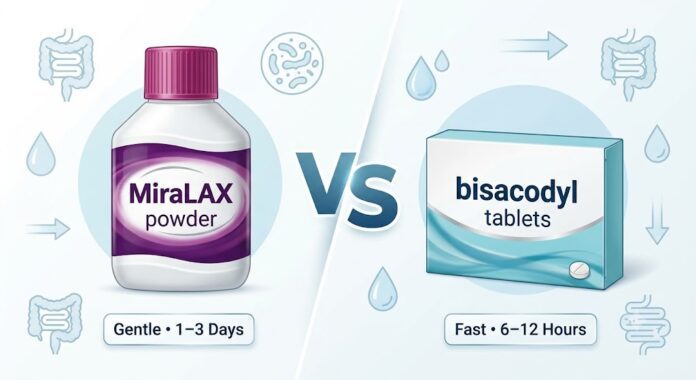
Standing in the laxative aisle with a headache from straining, you want a quick answer, not fine print. MiraLAX and Dulcolax are two of the most widely used OTC constipation treatments in the US, and they work in different ways. MiraLAX (PEG 3350) is an osmotic laxative that gently pulls water into the stool over 1 to 3 days. Dulcolax (bisacodyl) is a stimulant laxative that triggers a bowel movement directly, usually within hours.
Neither is universally “better.” MiraLAX is the evidence-backed choice for ongoing, daily constipation management. Dulcolax is the evidence-backed choice for fast, occasional relief. This guide compares both side by side: mechanism, onset time, dosage, side effects, who should avoid each one, and which one current clinical guidelines support for chronic versus short-term use.
Quick Answer: MiraLAX vs Dulcolax at a Glance
- Faster relief: Dulcolax (bisacodyl), 6-12 hours orally, or 15-60 minutes as a suppository
- Gentler, for daily/chronic use: MiraLAX (PEG 3350), 1-3 days
- Strongest 2023 AGA-ACG recommendation for long-term daily use: MiraLAX
- Strongest 2023 AGA-ACG recommendation for short-term/rescue use: Dulcolax
- Lower cramping risk: MiraLAX
- Best before a colonoscopy or when you need overnight results: Dulcolax
For a broader look at how these two fit alongside other OTC options, see our complete Best OTC Laxatives for Constipation guide, which ranks laxatives using the same clinical evidence referenced here.
Disclosure: This article contains affiliate links. If you purchase through our links, we may earn a small commission at no extra cost to you. Our comparisons are based on clinical evidence and manufacturer labeling, not on affiliate relationships.
At a Glance: Best MiraLAX and Dulcolax Products to Buy
Not sure which form or size to get? Here are the specific products for each use case covered in this guide:
- Best for ongoing/chronic constipation (daily use): MiraLAX Laxative Powder (45-Dose) — PEG 3350 osmotic laxative, tasteless and odorless, mixes into any drink, no cramping or urgency, the only OTC laxative with a strong AGA-ACG recommendation for daily long-term use
- Best for occasional/rescue relief (oral tablet): Dulcolax Stimulant Laxative Tablets 5mg (100-Count) — bisacodyl stimulant laxative, works in 6-12 hours, #1 doctor-recommended stimulant laxative brand, enteric-coated for stomach comfort
- Best for fastest relief (suppository form): Dulcolax Stimulant Laxative Medicated Suppositories 10mg (28-Count) — works in 15-60 minutes, comfort-shaped bisacodyl suppositories, for situations where same-day or same-hour relief is needed, rectal use only
MiraLAX vs Dulcolax: Pros and Cons
| MiraLAX | Dulcolax |
|---|---|
| Gentle | Fast |
| Suited to daily use | Suited to rescue/occasional use |
| Less cramping and urgency | More cramping and urgency |
| Works in 1-3 days | Works in 6-12 hours (15-60 min as suppository) |
| Tasteless powder, mixes into any drink | Tablet, suppository, or enema |
| Strong 2023 AGA-ACG recommendation for chronic use | Strong 2023 AGA-ACG recommendation for short-term/rescue use |
MiraLAX vs Dulcolax: Full Comparison Table
| Feature | MiraLAX (PEG 3350) | Dulcolax (Bisacodyl) |
|---|---|---|
| Laxative type | Osmotic | Stimulant |
| Mechanism | Draws and retains water in the stool | Stimulates colon muscle contractions and fluid secretion |
| Onset time | 24-72 hours (1-3 days) | 6-12 hours (tablet); 15-60 minutes (suppository) |
| Standard adult dose | 17 g powder in 4-8 oz liquid, once daily | 5-15 mg tablet, or 10 mg suppository, once daily |
| Available forms | Powder (dissolves in any beverage) | Enteric-coated tablet, suppository, enema |
| Max recommended OTC duration | Up to 7 consecutive days | Up to 7 consecutive days |
| 2023 AGA-ACG recommendation | Strong, moderate certainty, for chronic/daily use | Strong, moderate certainty, for short-term (under 4 weeks) or rescue use |
| Typical side effects | Bloating, gas, mild nausea | Cramping, urgency, diarrhea at higher doses |
| Best for | Ongoing/chronic constipation | Occasional constipation, rescue relief, bowel prep |
If you only need the essentials, our MiraLAX vs Colace quick comparison guide covers the same core differences in a shorter format.
MiraLAX (PEG 3350): How It Works and What to Expect
What Is MiraLAX?
MiraLAX’s active ingredient is polyethylene glycol 3350 (PEG 3350), an osmotic laxative that the FDA approved for occasional constipation in 1999 and cleared for over-the-counter sale in 2006.2 It is sold as an odorless, flavorless powder meant to be dissolved into any beverage.
Check MiraLAX price on Amazon | View on iHerb
How Does MiraLAX Work?
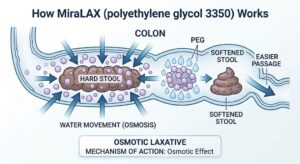
PEG 3350 is a large molecule that is poorly absorbed in the gut, with studies showing only around 0.15% to 0.58% of a dose recovered in urine.2 Because it stays largely in the digestive tract, it draws and holds water in the stool as it passes through, softening it gradually rather than forcing an immediate contraction. This is why MiraLAX does not typically cause the sudden urgency associated with stimulant laxatives.
MiraLAX Dosage
The standard adult dose is 17 g of powder (about one heaping tablespoon, or a capful using the marked measuring cap) dissolved in 4 to 8 ounces of any hot, cold, or room-temperature beverage, taken once daily. Labeling advises against use for more than 7 consecutive days without medical guidance, and against use in children 16 and under without a doctor’s direction.
MiraLAX Side Effects
- Bloating and gas
- Mild nausea
- Loose or watery stools, particularly at higher doses
- Abdominal cramping (less common than with stimulant laxatives)
- Allergic reaction (rare)
For a deeper look at why cramping can still occur with MiraLAX in some people, see our guide: Does MiraLAX Cause Cramping?
MiraLAX Drug Interactions
PEG 3350 is minimally absorbed, so it has few known drug interactions. Still, drug references flag a few worth knowing about: blood pressure medications called ACE inhibitors and ARBs, NSAID painkillers like ibuprofen or naproxen, and diuretics (“water pills”). If you take any of these regularly, check with a pharmacist before adding a daily laxative. The same general caution applies to any laxative used long-term.
Which Type of Constipation Is MiraLAX Best For?
MiraLAX is labeled by the FDA for occasional constipation, but in practice most people reach for MiraLAX for constipation that keeps coming back rather than a single isolated episode. Three situations it’s specifically suited for:
- Chronic idiopathic constipation (ongoing constipation with no identified cause, lasting 3 months or more): this is where MiraLAX has the strongest backing, with a strong 2023 AGA-ACG recommendation for daily use and the largest body of long-term trial data of any OTC laxative.
- Occasional constipation: this is MiraLAX’s original FDA-labeled use, and it works well here too, just more slowly than a stimulant laxative.
- Opioid-induced constipation (OIC): consensus guidelines on OIC recommend OTC laxatives as first-line treatment, and PEG 3350 is one of the most commonly used options for this, including in older adults on multiple medications, where it’s generally considered the safer first-line choice.
What Does the Research Say About MiraLAX?
PEG 3350 is the most extensively studied OTC laxative available. It received a Grade A rating in the 2021 Rao and Brenner systematic review, a distinction it shares only with senna among OTC laxatives.3 Where PEG stands apart is the 2023 AGA-ACG Clinical Practice Guideline: it is the only OTC agent to receive a strong recommendation specifically for long-term, daily use in chronic idiopathic constipation.3 In a randomized, placebo-controlled trial, patients on PEG 3350 were far less likely to need bisacodyl as rescue medication than those on placebo. Researchers pointed to this as evidence of PEG’s effectiveness at managing constipation symptoms without needing a stimulant laxative.2
Dulcolax (Bisacodyl): How It Works and What to Expect
What Is Dulcolax?
Dulcolax’s active ingredient is bisacodyl, a diphenylmethane stimulant laxative that has been used clinically since the 1950s and appears on the World Health Organization’s List of Essential Medicines.4 It is available as enteric-coated tablets, rectal suppositories, and enemas.
Check Dulcolax price on Amazon | View on iHerb
How Does Dulcolax Work?
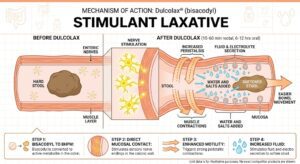
Bisacodyl is a prodrug, meaning it’s inactive until the body converts it. Enzymes in the intestinal mucosa turn it into its active metabolite, which stimulates sensory nerves in the colon wall.5 That triggers stronger, more coordinated muscle contractions (peristalsis) and encourages the colon to secrete extra fluid into the stool. This dual action, more movement plus more fluid, is part of why bisacodyl tends to act more quickly and forcefully than an osmotic laxative like MiraLAX. Because it acts locally on the colonic mucosa rather than through systemic absorption, its effects are largely confined to the gut.
Dulcolax Dosage
The standard adult oral dose is 5 to 15 mg (one to three 5 mg tablets) taken once daily, often at bedtime for a morning result. Tablets are enteric-coated and should be swallowed whole with a full glass of water, not chewed or crushed, and not taken within an hour of dairy products or antacids, which can break down the coating too early and cause stomach irritation. The suppository form is dosed at 10 mg and tends to act within 15 to 60 minutes.6
Dulcolax Side Effects
- Abdominal cramping (the most commonly reported side effect)
- Nausea, particularly on an empty stomach
- Diarrhea with higher or repeated doses
- Low potassium (hypokalemia) with prolonged overuse
- Rectal irritation with suppository use
Which Type of Constipation Is Dulcolax Best For?
Using Dulcolax for constipation makes the most sense when the goal is a fast, predictable result rather than ongoing daily management. It’s best suited to:
- Occasional or acute constipation: a single episode, or a short stretch of a few days without a bowel movement, is exactly what bisacodyl is labeled and studied for.
- Rescue relief: when another laxative (including MiraLAX) hasn’t worked after a few days, a short course of Dulcolax can act as a backup.
- Bowel preparation before a procedure, such as a colonoscopy, when used exactly as your provider directs.
It is not well suited to indefinite daily use. The 2023 AGA-ACG guideline’s strong recommendation for bisacodyl applies to short-term use under 4 weeks or as-needed rescue therapy, not open-ended chronic management, and consensus guidelines on opioid-induced constipation similarly reserve stimulant laxatives for short-term or rescue use rather than long-term monotherapy.
What Does the Research Say About Dulcolax?
Bisacodyl’s evidence grade was upgraded from Grade C in a 2005 review to Grade B in the 2021 Rao and Brenner systematic review.3 The 2023 AGA-ACG Guideline gave bisacodyl a strong recommendation with moderate certainty of evidence, but specifically for short-term use (generally under 4 weeks) or as rescue therapy, not for open-ended daily use.3 Long-term daily effectiveness beyond 4 weeks has not been well studied in adults.
MiraLAX vs Dulcolax Side Effects: Which Is Gentler?
The side effect profiles reflect how each drug works. MiraLAX softens stool gradually without directly forcing muscle contractions, so cramping and urgency are relatively uncommon at normal doses. Dulcolax directly stimulates colon contractions, so cramping, urgency, and diarrhea are more frequently reported, especially with the suppository form or at higher oral doses.
| Side Effect | MiraLAX | Dulcolax |
|---|---|---|
| Cramping | Uncommon at normal dose | Common |
| Urgency | Low | Moderate to high |
| Diarrhea | With excessive dosing | With excessive dosing |
| Nausea | Mild, occasional | More commonly reported |
| Electrolyte imbalance risk | Very unlikely at recommended dose | Possible with prolonged overuse (low potassium) |
Neither laxative should be used for a prolonged period without medical guidance, and both carry warnings against use in people with a known or suspected bowel obstruction, severe abdominal pain, or active inflammatory bowel disease. Anyone noticing rectal bleeding, unexplained weight loss, or symptoms lasting more than a week despite treatment should see a doctor rather than continuing to self-treat.
Who Should Avoid MiraLAX?
According to MiraLAX’s drug facts label and current prescribing information, you should not use it if:
- You are allergic to polyethylene glycol
- You have a known or suspected bowel obstruction or intestinal blockage
- You have kidney disease, unless a doctor is supervising your use — PEG is minimally absorbed, but impaired kidneys are less able to handle any resulting fluid or electrolyte shifts
- You have nausea, vomiting, or abdominal pain that hasn’t been diagnosed
- You’ve had a sudden change in bowel habits lasting more than 2 weeks (this needs medical evaluation first)
Ask a doctor before use if you have an eating disorder such as anorexia or bulimia, inflammatory bowel disease, or irritable bowel syndrome, or if you are pregnant or breastfeeding. MiraLAX also shouldn’t be mixed into starch-based liquid thickeners (used by people with swallowing difficulties), since it can interfere with how the thickener works.
Who Should Avoid Dulcolax?
According to bisacodyl’s drug facts label and current prescribing information, you should not use Dulcolax if:
- You are allergic to bisacodyl or any ingredient in the product
- You have a bowel obstruction, intestinal blockage, or ileus
- You have symptoms of appendicitis or another condition needing urgent surgical evaluation
- You have severe abdominal pain along with nausea or vomiting that hasn’t been diagnosed
- You have rectal bleeding or blood in your stool that hasn’t been evaluated
- You are severely dehydrated
- (Suppository/enema forms) you have anal fissures or proctitis
Children under 6 shouldn’t take the oral tablet, mainly because they can’t reliably swallow it whole; it must not be chewed or crushed. Dulcolax shouldn’t be taken within an hour of antacids or dairy, and chronic, repeated use raises the risk of laxative dependence, which is a core reason the 2023 AGA-ACG guideline limits its strong recommendation to short-term or rescue use. Use in pregnancy should only happen under a doctor’s direction.
Which Works Faster, MiraLAX or Dulcolax?
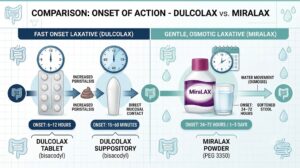
Dulcolax works meaningfully faster. Oral bisacodyl tablets generally produce a bowel movement within 6 to 12 hours, and the suppository form can act in as little as 15 to 60 minutes, which is why it is often used the morning of a procedure or when same-day relief is needed.5 MiraLAX, by contrast, typically takes 1 to 3 days to produce results, since it works by gradually accumulating water in the stool rather than triggering an immediate contraction.7
If you need relief within minutes to a few hours, neither of these is actually the fastest OTC option; magnesium citrate liquid, at 30 minutes to 6 hours, is quicker than both. You can compare timing across more options in our Best OTC Laxatives for Constipation guide.
MiraLAX vs Dulcolax for Chronic Constipation
For ongoing or chronic constipation, defined as symptoms lasting 3 months or longer, MiraLAX is the better-supported option. It is the only OTC laxative with a strong 2023 AGA-ACG recommendation for chronic daily use, and it has the largest body of long-term randomized controlled trial data behind it, including a 6-month placebo-controlled trial in adults with chronic idiopathic constipation.8
Dulcolax’s strong recommendation is specifically for short-term use of under 4 weeks or as an as-needed rescue medication, not for indefinite daily use.3 Long-term daily reliance on a stimulant laxative can also make it harder to tell whether the colon is regaining its own natural motility. A common, evidence-aligned approach is to use MiraLAX as the daily baseline for chronic constipation, and to keep Dulcolax on hand only for occasional flare-ups when a faster result is genuinely needed.
If chronic constipation is a recurring issue for you, it is also worth ruling out contributing factors before relying on any laxative long-term. Our guides on how gut health affects constipation and best supplements for regular bowel movements cover complementary, non-laxative strategies.
How to Choose Between MiraLAX and Dulcolax
In short: using MiraLAX for constipation makes sense when you’re managing an ongoing pattern and can wait a day or two for a gentler result, while using Dulcolax for constipation makes more sense when you need a faster, more predictable result for a single episode. The breakdown below covers the specifics.
Choose MiraLAX If:
- You have ongoing or recurring constipation that needs daily management
- You want to avoid cramping and urgency
- You prefer a tasteless powder you can mix into a daily drink
- You are managing constipation in an elderly relative; see our guide on immediate constipation relief for elderly adults
Choose Dulcolax If:
- You need results overnight or within a few hours
- You have not had a bowel movement in 2-3 days and need rescue relief
- You are preparing for a colonoscopy or medical procedure (only under your provider’s specific instructions)
- Your constipation is occasional rather than ongoing
Special Situations
- Pregnancy: Psyllium and PEG (MiraLAX) are generally considered among the safer OTC options during pregnancy, but any laxative should be cleared with your obstetrician first. Stimulant laxatives like Dulcolax are typically avoided unless specifically prescribed. See our guide on high-fiber foods for pregnancy constipation for additional non-drug approaches.
- Elderly adults: MiraLAX is often preferred because it carries a lower risk of sudden urgency and electrolyte disruption.
- Kidney disease: Both should be used with medical guidance; discuss your specific situation with a doctor before starting either one.
- Children: Do not give either product to a child without a pediatrician’s direction; dosing and safety differ substantially from adult use.
Regardless of which one you reach for, adequate hydration matters for both to work as intended. See: Does Dehydration Cause Constipation?
Can You Take MiraLAX and Dulcolax Together?
Combining an osmotic laxative like MiraLAX with a stimulant laxative like Dulcolax is generally not recommended without medical guidance. Layering two laxatives with different mechanisms can increase the risk of diarrhea and dehydration. It can also disturb electrolyte levels, sodium, potassium, and magnesium, which in more serious cases can affect muscle function and heart rhythm. If MiraLAX alone is not producing results after several days, that is a signal to check in with a doctor rather than to add a second laxative on your own.
Frequently Asked Questions
Which is better for constipation, MiraLAX or Dulcolax?
It depends on your situation. MiraLAX is the only OTC laxative with a strong 2023 AGA-ACG recommendation for daily, long-term use, making it generally the better choice for ongoing constipation. Dulcolax also received a strong recommendation, but specifically for short-term or rescue use, and it tends to act faster.
MiraLAX or Dulcolax: which one should I use for occasional constipation?
For a single, occasional episode where you want relief within hours rather than days, using Dulcolax for constipation is typically the more practical choice. If you have time to wait a day or two and want a gentler option, MiraLAX works well too.
Which works faster, MiraLAX or Dulcolax?
Dulcolax works faster. Oral tablets typically act within 6 to 12 hours, and suppositories can act in 15 to 60 minutes. MiraLAX usually takes 1 to 3 days.
What are the main MiraLAX vs Dulcolax side effect differences?
MiraLAX tends to cause milder side effects such as bloating, gas, and mild nausea, with cramping being relatively uncommon at normal doses. Dulcolax more commonly causes cramping and urgency because it directly stimulates colon muscle contractions.
Is MiraLAX or Dulcolax safer for chronic constipation?
MiraLAX is generally considered the safer option for chronic, ongoing constipation, since it is the only OTC laxative supported by long-term clinical trial data and a strong recommendation for daily use. Dulcolax’s strong recommendation applies to short-term use under 4 weeks or as rescue therapy, not indefinite daily use.
Can I take MiraLAX and Dulcolax on the same day?
Do not combine laxatives without checking with a doctor or pharmacist first. Using both together can raise the risk of diarrhea, dehydration, and electrolyte imbalance.
Quick Verdict: MiraLAX vs Dulcolax
Choose MiraLAX if: your constipation is ongoing rather than a one-off, you want a gentle option you can take daily, and you can wait 1-3 days for results.
Choose Dulcolax if: you need a bowel movement within hours, you’re dealing with an occasional or single episode, or you’re preparing for a procedure under a doctor’s instructions.
Final Thoughts: MiraLAX vs Dulcolax
MiraLAX and Dulcolax are not really competitors so much as tools for different jobs. MiraLAX (PEG 3350) is the evidence-backed choice for ongoing, chronic constipation that needs daily management, with a gentler side effect profile and slower, steadier onset. Dulcolax (bisacodyl) is the evidence-backed choice for short-term or rescue relief when you need a result within hours rather than days, at the cost of a higher chance of cramping and urgency.
For most people dealing with recurring constipation, a reasonable, guideline-aligned approach is to use MiraLAX as the daily baseline and keep Dulcolax on hand for occasional, short-term flare-ups. If constipation persists beyond a week despite consistent laxative use, or if you notice blood in your stool, severe pain, or unexplained weight loss, it is time to see a doctor rather than switching laxatives on your own.
Medical Disclaimer: This article is for informational purposes only and does not constitute medical advice. Always consult a qualified healthcare provider before starting any laxative regimen, especially if you are pregnant, elderly, have kidney disease, or are taking other medications.
References & Sources
- Chang L, Chey WD, Imdad A, et al. American Gastroenterological Association-American College of Gastroenterology Clinical Practice Guideline: Pharmacological Management of Chronic Idiopathic Constipation. Gastroenterology. 2023. PMC10542656
- McGraw T. Safety of polyethylene glycol 3350 solution in chronic constipation: randomized, placebo-controlled trial. Clin Exp Gastroenterol. 2016;9:173-180. PMC4956069
- Rao SSC, Brenner DM. Efficacy and Safety of Over-the-Counter Therapies for Chronic Constipation: An Updated Systematic Review. Am J Gastroenterol. 2021;116(6):1156-1181. Referenced via AGA-ACG guideline, PMC10542656.
- Lawrensia S, Patel P, Raja A. Bisacodyl. StatPearls [Internet]. Updated February 28, 2024. NCBI Bookshelf NBK547733
- Bisacodyl: A review of pharmacology and clinical evidence to guide use in clinical practice in patients with constipation. PMC8596401
- Drugs.com. Bisacodyl Monograph for Professionals. drugs.com/monograph/bisacodyl.html
- GoodRx. How Long Does Miralax Take to Start Working? goodrx.com
- Menees S, et al. Polyethylene Glycol 3350 in the Treatment of Chronic Idiopathic Constipation: Post hoc Analysis Using FDA Endpoints. Can J Gastroenterol Hepatol. 2022. onlinelibrary.wiley.com
- Mayo Clinic. Laxatives: OTC products for constipation. mayoclinic.org





[…] MiraLAX generally produces a bowel movement within 1 to 3 days of starting daily use, though some sources note it can take up to 4 days in certain people.[1][2] This is markedly slower than a stimulant laxative like Dulcolax (bisacodyl), which works in about 6 to 12 hours orally, or a saline laxative like magnesium citrate, which can work in 30 minutes to 6 hours.[5] For a full side-by-side breakdown of onset times, see our guide on MiraLAX vs Dulcolax. […]
[…] Comparing a gentle osmotic option against a faster stimulant laxative: MiraLAX vs Dulcolax […]