

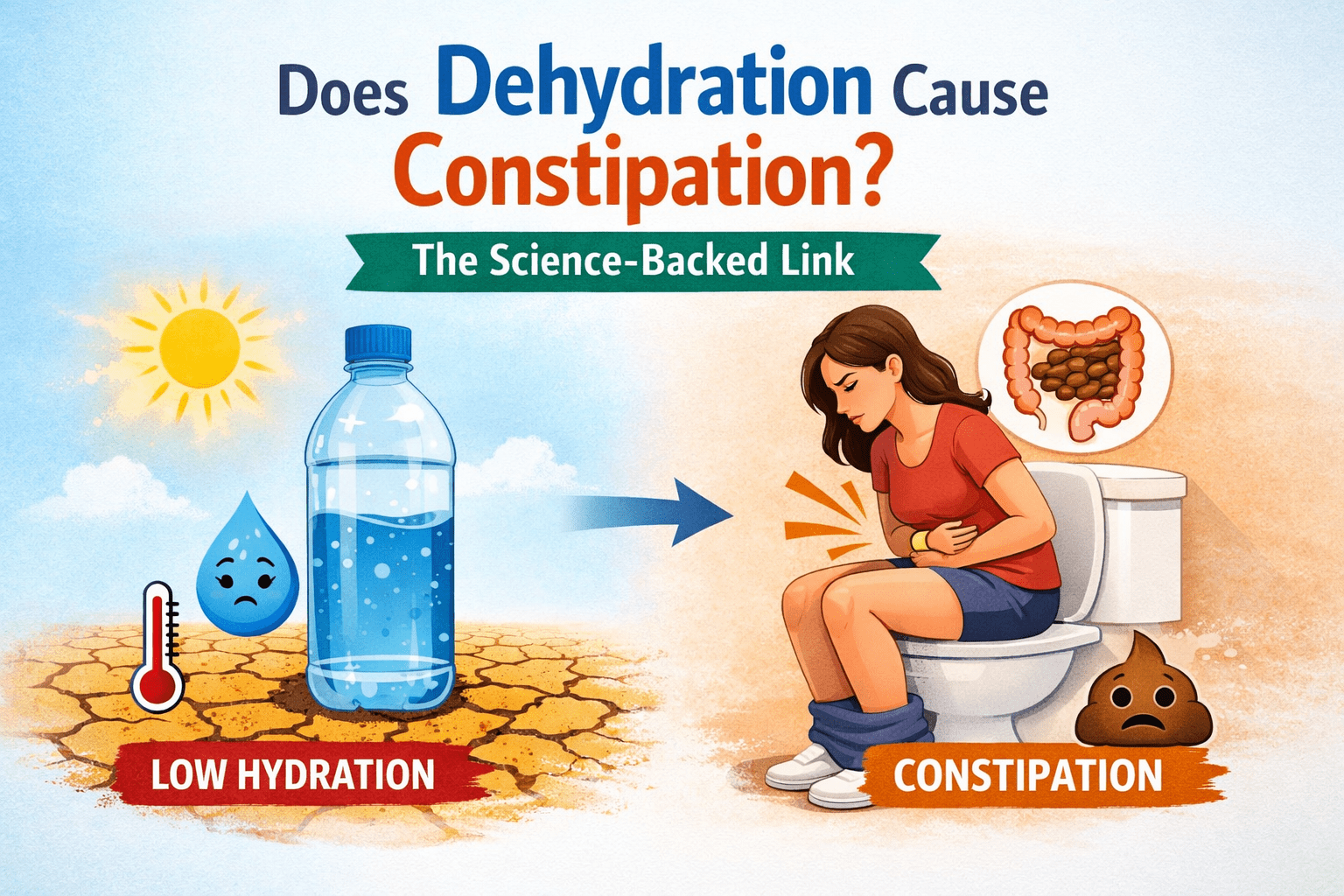
Does dehydration cause constipation? The short answer is yes — and the mechanism is more direct than most people realize. When your body is low on fluids, your colon compensates by pulling extra water out of the waste passing through it. The result: stool that becomes progressively harder, drier, and far more difficult to pass. It is one of the most common yet most overlooked triggers of constipation worldwide.
Most people know they should “drink more water.” Far fewer understand exactly why that advice applies so directly to bowel movements — or how little fluid restriction it actually takes to disrupt gut function. A landmark 2024 study from Keio University found that cutting water intake by just 50% was enough to double gastrointestinal transit time, even without any clinical signs of dehydration in the blood.
In this article, we break down the science behind how fluid intake governs gut transit, what the latest clinical guidelines from AGA, ACG, and ASCRS recommend, and practical steps you can take today to stay regular — backed by real research, not guesswork.
| 📊 Statistic | Figure | Source |
|---|---|---|
| Prevalence of chronic idiopathic constipation in U.S. adults | 8–12% | AGA/ACG Guidelines, 2023[4] |
| Increase in gut transit time when water intake cut by 50% | 2× longer | Keio University, iScience 2024[1] |
| Daily adequate total water intake — adult men | 3.7 litres (125 oz) | Institute of Medicine, 2004[5] |
| Daily adequate total water intake — adult women | 2.7 litres (91 oz) | Institute of Medicine, 2004[5] |
| Global prevalence of constipation during pregnancy | 32.4% | Meta-analysis, 1966–2024[8] |
| Proportion of daily water needs met by food moisture | 20–30% | Institute of Medicine, 2004[5] |
1. What Happens in Your Colon When You’re Dehydrated?
The large intestine has one primary job that most people overlook: water absorption. As partially digested material moves through your colon, it gradually loses water until it forms a solid stool. The problem begins when your body senses it doesn’t have enough water to spare.
When you are under-hydrated, your colon compensates by extracting more water than usual from the stool passing through it. The result is stool that becomes progressively drier, harder, and more compact — making it far harder to push out. This is the core biological mechanism linking low fluid intake to constipation.
Constipation is not only about how often you go — it’s about stool water content. When stool water content drops, consistency shifts from the ideal soft-formed Bristol Stool Scale type 3–4 toward the hard, lumpy types 1–2 that are painful and difficult to pass.
Beyond stool hardness, dehydration also slows colonic motility — the muscular contractions (called peristalsis) that move waste along the large intestine. Slower transit time means the colon has even more time to pull water from the stool, compounding the problem.
→ Related: Best Fiber Foods and Fiber Therapy for Gut Health
2. What the Research Actually Says
The Foundational Study (Arnaud, 2003)
A widely cited review published in the European Journal of Clinical Nutrition established that mild dehydration is a genuine risk factor for constipation across all age groups. In elderly populations specifically, research found a significant relationship between restricting liquid intake from 2,500 ml down to just 500 ml per day and the development of constipation.[2] This study also noted that increasing water intake in children only helped constipation when their baseline intake was already below recommended levels — an important nuance.
2025 NHANES Population Study: Moisture Intake Matters
A large-scale analysis published in BMC Public Health (January 2025) analyzed data from the NHANES database (2005–2010), covering thousands of U.S. adults aged 20 and older. Unlike previous studies focused solely on drinking water, this research investigated total dietary moisture — including moisture from all food and beverages — and its relationship to constipation risk. The findings add important population-level evidence that dietary moisture intake is a significant and modifiable factor in gut health.[3]
Keio University, iScience (May 2024): Researchers found that a 50% restriction in water intake doubled the gastrointestinal transit time and significantly reduced stool water content — and these effects occurred without clinical dehydration in blood markers. This is a critical finding: you don’t need to feel thirsty or show lab signs of dehydration for your gut to suffer. The study also revealed that water restriction disrupts gut microbiome balance and reduces immune cell (Th17) counts in the colon.[1]
The AGA/ACG 2023 Guidelines
The American Gastroenterological Association (AGA) and American College of Gastroenterology (ACG) jointly published updated clinical practice guidelines in 2023 that include increased fluid intake among the first-line non-pharmacological recommendations for chronic idiopathic constipation — alongside dietary fiber and exercise.[4]
ASCRS 2024 Guidelines
The American Society of Colon and Rectal Surgeons’ updated 2024 guidelines explicitly identify dehydration as a modifiable behavioral factor contributing to constipation — clinicians are advised to assess and address it during patient evaluations.[6]
3. The Biological Mechanisms: A Clear Breakdown
| Mechanism | What Happens | Result |
|---|---|---|
| Colonic water absorption | Colon extracts extra water from stool when body fluid is low | Hard, dry, difficult-to-pass stool |
| Reduced peristalsis | Dehydration slows muscular contractions that move stool forward | Longer transit time → more water extracted |
| Mucus layer thinning | Less water reduces the protective mucus lining the intestinal wall | Stool moves with more friction; harder to propel |
| Gut microbiome disruption | Water restriction alters bacterial composition in the colon (2024 Keio data) | Dysbiosis may further impair motility and immune function |
| Salivary & digestive secretion reduction | Less fluid means less digestive enzyme output | Slower digestion from the very start |
4. The Gut Microbiome Connection: A New Frontier
Perhaps the most surprising finding from recent research is how profoundly water intake shapes the gut microbiome. The 2024 Keio University study published in iScience demonstrated that water restriction in mice caused a bloom of total gut bacteria alongside a drop in immune T-helper (Th17) cells in the colon — changes associated with impaired gut barrier function and reduced ability to fight pathogens.[1]
Specifically, water restriction increased the relative abundance of Verrucomicrobiaceae (including Akkermansia — a mucin-degrading bacterium). A thinner mucus layer caused by excess Akkermansia activity further slows stool transit, creating a compounding loop: less water → thinner mucus → slower motility → more water extracted → harder stool.[1]
Earlier research using the American Gut Project database (published in The Journal of Nutrition, 2022) confirmed that drinking water source and intake are significantly associated with distinct gut microbiota signatures in US and UK populations — reinforcing that what and how much you drink shapes the microbial ecosystem of your digestive tract.[7]
→ Related: 9 Best Probiotic Supplements 2026 — Expert Guide for Gut Health
5. Who Is Most at Risk?
While low fluid intake can affect anyone, certain groups are at significantly higher risk of dehydration-driven constipation:
- Older adults: The thirst sensation diminishes with age, meaning elderly individuals often don’t feel thirsty even when clinically under-hydrated. Low fluid intake is a well-documented cause of constipation in this population.[2]
- Pregnant women: A 2024 meta-analysis covering studies from 1966–2024 found that the global prevalence of constipation during pregnancy is 32.4%, with multiple contributing factors including fluid and hormonal changes.[8]
- People using opioid medications: Opioids reduce fluid intake and promote ADH release, compounding constipation risk.[8]
- Children with below-average fluid intake: Research shows that increasing water intake helps constipated children only when their baseline intake was already below normal — suggesting dehydration was the primary driver.[2]
- Athletes and outdoor workers: High sweat losses without adequate fluid replacement deplete total body water rapidly.
- People on high-fiber diets without adequate water: Fiber absorbs water in the gut — without enough fluid intake, high fiber can actually worsen constipation.
If you’re taking fiber supplements (psyllium, methylcellulose, etc.) without drinking sufficient water, the fiber can swell and compact — potentially worsening constipation or even causing blockages. Always pair fiber supplements with an additional full glass of water.
6. How Much Water Do You Actually Need?
There’s no single “magic number” for everyone — hydration needs vary by body weight, activity level, climate, and diet. However, the most widely cited evidence-based guidelines provide a practical starting point:
- Adult men: ~3.7 litres (about 125 oz / 15.5 cups) of total water daily — from all beverages and food[5]
- Adult women: ~2.7 litres (about 91 oz / 11.5 cups) of total water daily[5]
- Roughly 20–30% of this comes from food moisture; the rest from beverages
- In hot climates or with vigorous exercise, needs increase substantially
A simple real-world check: Your urine should be pale straw-coloured to nearly clear. Dark yellow or amber urine is a reliable sign that you need more fluids immediately.
A 2025 BMC Public Health NHANES study found that the relationship between moisture intake and constipation is non-linear — meaning there may be a threshold effect where constipation risk drops significantly once intake crosses a certain level. Focus on consistency rather than perfection: drink water regularly throughout the day, not all at once.[3]
7. Beverages That Help — and Ones That Hurt
Helpful for Hydration & Bowel Regularity
- Plain water — the gold standard; calorie-free and maximally effective
- Herbal teas (senna, ginger, peppermint) — provide fluids with added motility benefits
- Water-rich foods — cucumbers (96% water), watermelon (92%), celery, oranges, soups
- Prune juice — contains sorbitol (a natural osmotic agent) that draws water into the colon; clinically supported for constipation relief
- Warm water in the morning — stimulates the gastrocolic reflex, which triggers bowel movements
Beverages That Can Worsen Dehydration
- Alcohol — a diuretic; increases urine output and reduces body water
- Excess caffeine (>400 mg/day) — can have mild diuretic effects at high doses
- Sugary sodas — high sugar content can impair fluid balance
- Energy drinks — often high in caffeine and sugar with minimal hydration benefit
→ Related: Coconut Water for Constipation — Does It Really Help?
8. Water + Fiber: The Power Combination
Hydration and dietary fiber don’t work independently — they are a team. A landmark clinical study (Anti et al., 1998) found that water supplementation significantly enhanced the laxative effect of a high-fiber diet in adults with functional constipation, reducing stool transit time and laxative dependence more than fiber alone.[9]
Soluble fiber (found in oats, apples, flaxseed, psyllium) forms a gel when combined with water — this gel softens stool and slows its transit for better water absorption in the gut. Without adequate water, soluble fiber cannot form this gel effectively. Insoluble fiber (in whole grains, bran) adds bulk — but again, needs water to work properly and avoid compaction.
The practical takeaway: If you’re eating a high-fiber diet or taking fiber supplements and still experiencing constipation, insufficient water intake is the most likely missing variable.
9. When Constipation Is NOT Caused by Dehydration
Dehydration is a common and correctable cause of constipation — but it’s not the only one. If you’ve significantly increased your fluid intake and constipation persists for more than 2–3 weeks, other causes should be investigated, including:
- Insufficient dietary fiber (less than 25–38g/day)
- Sedentary lifestyle (physical activity directly stimulates gut motility)
- Medications: opioids, iron supplements, certain antidepressants, antacids with calcium or aluminium
- Hypothyroidism, diabetes, irritable bowel syndrome (IBS)
- Pelvic floor dysfunction or outlet obstruction (dyssynergia)
- Colorectal structural issues (in rare cases)
Rectal bleeding, unintentional weight loss, family history of colorectal cancer, new-onset constipation after age 50, or constipation accompanied by severe abdominal pain. These warrant prompt medical evaluation per ASCRS 2024 guidelines.[6]
→ Related: 10 Best Natural Ways to Relieve Hemorrhoids and Constipation
10. Frequently Asked Questions
Can drinking more water cure my constipation?
Does coffee cause constipation by dehydrating me?
How quickly does dehydration cause constipation?
Is sparkling water as effective as still water for constipation?
My urine looks pale — why am I still constipated?
Conclusion: Water Is Not a Cure-All — But It’s Often the Missing Piece
The relationship between dehydration and constipation is not a myth — it is one of the most well-supported and physiologically straightforward connections in gastroenterology. When your body lacks adequate fluid, your colon compensates by reclaiming water from your stool, leaving it hard, compact, and difficult to pass. Peristalsis slows. The mucus layer thins. And as the landmark 2024 Keio University study demonstrated, your gut microbiome and colonic immune function begin to suffer — all without a single abnormal reading on a blood test.
What makes this so important is also what makes it so actionable: hydration is one of the few causes of constipation you can correct today, for free, without a prescription. A consistent intake of water — spread throughout the day, not gulped all at once — paired with adequate dietary fiber, is the foundation of healthy bowel function that no supplement can replace.
That said, water is not a magic cure. If you’re already drinking plenty of fluids and still struggling, the problem likely lies elsewhere — in fiber deficiency, physical inactivity, medication side effects, or an underlying condition that deserves proper medical evaluation. The goal of this article is not to oversimplify, but to ensure that the most overlooked variable is the first one you investigate.
Start with these evidence-based steps and track your results over one week:
- Day 1–2: Calculate your target — body weight (kg) × 30–35 ml = daily water goal
- Day 3: Start every morning with a full glass of warm water before coffee
- Day 4: Add one water-rich food to each meal (cucumber, watermelon, celery, soup)
- Day 5: Check urine colour at midday — aim for pale straw, not deep yellow
- Day 6: Pair your fiber intake (25–38g/day) with an extra glass of water at each meal
- Day 7: Assess: Has stool consistency improved? Transit easier? If not, evaluate fiber, activity, and consult a provider
Constipation is one of the most common yet most undertreated digestive complaints in the world. But unlike many chronic conditions, its most frequent cause sits on your kitchen counter. The science is clear, the fix is simple, and the first step costs nothing: drink more water, consistently, every single day.
Key Takeaways at a Glance
- Dehydration causes constipation by prompting the colon to extract excess water from stool, making it hard and dry
- A 2024 Keio University study found that even 50% water restriction doubles gastrointestinal transit time — without clinical signs of dehydration in the blood
- Water restriction also disrupts the gut microbiome and reduces immune cell populations in the colon, compounding motility problems
- AGA/ACG 2023 and ASCRS 2024 guidelines both list increased fluid intake as a first-line non-pharmacological treatment for chronic constipation
- Target ~3.7 L/day (men) or ~2.7 L/day (women) of total moisture from all food and beverages combined
- Pair hydration with adequate dietary fiber (25–38g/day) — they work synergistically, not independently
- Special risk groups include the elderly, pregnant women, opioid users, and high-fiber dieters who don’t drink enough water
- Pale urine is your simplest real-time hydration gauge — check it daily
- If constipation persists despite 2–3 weeks of adequate hydration, investigate other causes with a qualified healthcare provider
References
- Sato K, Hara-Chikuma M, Yasui M, Inoue J, Kim YG. Sufficient water intake maintains the gut microbiota and immune homeostasis and promotes pathogen elimination. iScience. 2024 May 3;27(6):109903. doi: 10.1016/j.isci.2024.109903. PubMed PMID: 38799550.
- Arnaud MJ. Mild dehydration: a risk factor of constipation? Eur J Clin Nutr. 2003;57(Suppl 2):S88–S95. doi: 10.1038/sj.ejcn.1601907. PubMed PMID: 14681719.
- [NHANES 2025] Association of moisture intake and constipation among US adults. BMC Public Health. January 31, 2025. https://link.springer.com/article/10.1186/s12889-025-21346-x
- Lacy BE, Pimentel M, Brenner DM, et al. ACG Clinical Guideline: Management of Irritable Bowel Syndrome. Am J Gastroenterol. 2021. AGA/ACG 2023 Chronic Idiopathic Constipation Guidelines. AGA Guidelines PDF
- Institute of Medicine. Dietary Reference Intakes for Water, Potassium, Sodium, Chloride, and Sulfate. Washington, DC: The National Academies Press; 2004. https://www.ncbi.nlm.nih.gov/books/NBK555956/
- Paquette IM, et al. Evaluation and Management of Chronic Constipation. Diseases of the Colon & Rectum. October 2024;67:1244–1257. ASCRS 2024 Guidelines. ASCRS Toolkit
- Vanhaecke T, Bretin O, Poirel M, et al. Drinking water source and intake are associated with distinct gut microbiota signatures in US and UK populations. J Nutr. 2022;152(1):171–182. doi: 10.1093/jn/nxab312. PubMed PMID: 34642755.
- Vazquez JC. Constipation, haemorrhoids, and heartburn in pregnancy. BMJ Clin Evid. Global prevalence meta-analysis (1966–2024). Referenced in Arnaud 2003 and pregnancy constipation meta-analyses via PubMed/Scopus search, August 2024 update.
- Anti M, Pignataro G, Armuzzi A, et al. Water supplementation enhances the effect of high-fiber diet on stool frequency and laxative consumption in adult patients with functional constipation. Hepatogastroenterology. 1998;45(21):727–732. PMID: 9684123.
- Diaz S, et al. Constipation. In: StatPearls [Internet]. Treasure Island (FL): StatPearls Publishing; 2023. https://www.ncbi.nlm.nih.gov/books/NBK513291/
Medical Disclaimer: This article is for informational purposes only and does not constitute medical advice. Always consult a qualified healthcare provider for diagnosis and treatment of any medical condition, including constipation.






[…] → Related: Does Dehydration Cause Constipation? The Hidden Link Explained […]
[…] Before reaching for a laxative, Mayo Clinic recommends trying these lifestyle changes first: eat 25–31 grams of fiber daily, drink 8–10 glasses of water per day, and exercise regularly.3 For more on how dehydration causes constipation, see our guide: Does Dehydration Cause Constipation? […]
[…] You can learn more about how dehydration worsens constipation in seniors in our dedicated article: Does Dehydration Cause Constipation? The Science-Backed Link. […]
[…] Dehydration — concentrates stool and slows movement through the colon. Learn more: Does Dehydration Cause Constipation? […]
[…] Dehydration and Constipation: The Hidden Link […]
[…] Does Dehydration Cause Constipation? The Science-Backed Link […]
[…] ⚠️ Note on Hydration: When stool moves slowly through the colon, the colon absorbs excess water from it — resulting in hard, dry stools. This is why hydration is the foundation of almost every remedy on this list. Learn more in our article on how dehydration causes constipation. […]
[…] More and more people are turning to probiotics as a longer-term approach to help support bowel function, rather than relying on laxatives that may provide quick relief but sometimes lead to cramping or discomfort afterward. If you are also considering other approaches, see our related guide: Why Fiber Isn’t Working for Your Constipation and Dehydration and Constipation: What the Research Shows. […]
[…] for 6–8 cups of water a day supports the laxative mechanisms of both foods. Our article on does dehydration cause constipation explains exactly why hydration matters so much for bowel […]
[…] 📖 Related: Does Dehydration Cause Constipation? […]
[…] dehydration appears to reduce stool water content and slow gut transit. Our guide on how dehydration affects bowel function covers the research behind this in […]
[…] gradually, while maintaining good water intake, helps minimize discomfort. See our guide on dehydration and constipation for more on why fluid intake […]
[…] you’re dehydrated, your colon pulls extra water out of your stool to compensate, leaving behind dry, hard stool […]
[…] is low dietary fiber. For strategies to combine fiber correctly with hydration, see our guide to dehydration and constipation. If you’re deciding between the two most evidence-backed options in this guide, see our […]