

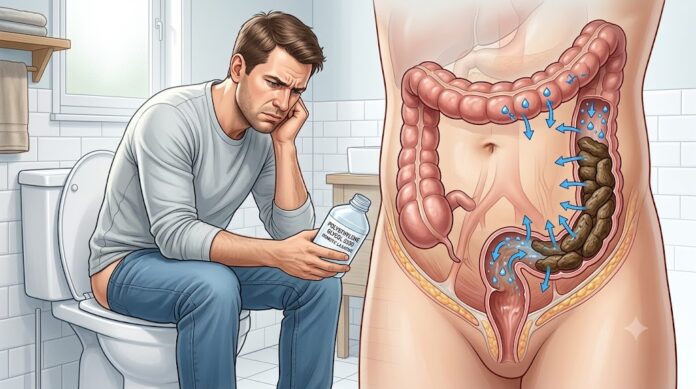
MiraLAX usually does work, but it often takes longer than people expect. If you’re wondering, “Why isn’t MiraLAX working?” the answer is often simple: it may not have had enough time to work. Polyethylene glycol 3350 (PEG 3350) typically takes 1 to 3 days, and sometimes up to 4 days, to produce a bowel movement.[1][2] If MiraLAX isn’t working yet, stopping after just a day or two is the most common reason it seems to have failed—not a problem with the medication itself.
Beyond timing, several other factors can reduce MiraLAX’s effectiveness. Common causes include not drinking enough water, taking too little of the medication, or having severe stool buildup (fecal impaction), which often requires a different treatment approach. Some people also have underlying conditions, such as chronic slow-transit constipation, opioid-induced constipation, IBS-C, or pelvic floor dysfunction. These conditions may not respond fully to an osmotic laxative alone.
If MiraLAX has not worked after 7 days of consistent daily use, it’s time to stop asking, “Why isn’t MiraLAX working?” and talk to a doctor instead of increasing the dose on your own. Seven days is also the FDA-labeled limit for over-the-counter (OTC) use.[3]
Signs MiraLAX Is Working
Because MiraLAX works gradually rather than causing an immediate urge, it can be hard to tell whether it is doing anything at all in the first day or two. Look for these early signs that it is taking effect, even before a full bowel movement happens:
- Stool that is noticeably softer or looser than before you started, even if you haven’t gone yet
- Mild bloating or increased gas, which reflects fluid and volume shifting into the colon
- A gradual return of the normal urge to defecate after days of feeling nothing
- Smaller, more frequent soft movements as an impaction or backlog begins to clear, rather than one large movement
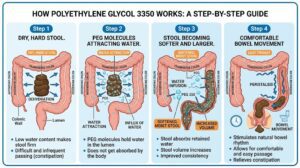
PEG 3350 is not meaningfully absorbed by the body, so it has to physically accumulate water in the colon before it produces a result.[4] That is a normal part of how it works, not a sign that something has gone wrong.
At a Glance: Best Options When MiraLAX Isn’t Working
If MiraLAX isn’t producing results after the correct dose and adequate hydration, here are the next steps covered in this guide:
- Best rescue option (faster stimulant relief): Dulcolax Stimulant Laxative Tablets 5mg (100-Count) — bisacodyl stimulant laxative, works in 6-12 hours, clinical guidelines support short-term rescue use when osmotic laxatives alone are insufficient
- Best faster-acting osmotic alternative (use on a separate day only): Natural Vitality CALM Magnesium Citrate Powder — works in 30 minutes to 6 hours, do not combine with MiraLAX on the same day without medical guidance
- Best for fastest suppository relief: Dulcolax Stimulant Laxative Medicated Suppositories 10mg (28-Count) — works in 15-60 minutes, for situations where same-hour relief is needed, rectal use only
How Long Does MiraLAX Take to Work?
MiraLAX generally produces a bowel movement within 1 to 3 days of starting daily use, though some sources note it can take up to 4 days in certain people.[1][2] This is markedly slower than a stimulant laxative like Dulcolax (bisacodyl), which works in about 6 to 12 hours orally, or a saline laxative like magnesium citrate, which can work in 30 minutes to 6 hours.[5] For a full side-by-side breakdown of onset times, see our guide on MiraLAX vs Dulcolax.
The greatest efficacy from PEG 3350 has been observed during the second week of consistent daily therapy in clinical trials.[6] A single dose, or a single day of “as needed” use, rarely tells you much about whether MiraLAX will work for your particular case, since the effect builds with consistency.
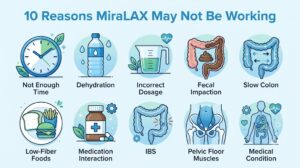
10 Reasons MiraLAX Isn’t Working
1. It Hasn’t Been Long Enough
This is by far the most common reason MiraLAX seems like it isn’t working. PEG 3350 needs to accumulate water in the stool over roughly 24 to 96 hours before a bowel movement happens.[1][2] If you started yesterday and nothing has happened yet, that is within the expected window, not a sign of failure. Give it the full 3 to 4 days before concluding it isn’t working, unless you develop one of the warning signs covered later in this article.
2. You’re Not Drinking Enough Water
MiraLAX works by drawing water into the colon from the rest of your body. If you are not drinking enough fluid to begin with, there is simply less water available for the medication to pull in, which blunts its effect and can leave you more dehydrated rather than less constipated. Clinical guidance recommends drinking plenty of fluids alongside any osmotic laxative, both to improve its effectiveness and to reduce the risk of dehydration.[7] For a deeper look at how fluid intake and constipation interact, see: Does Dehydration Cause Constipation?
3. Incorrect Dosage
The standard dose for adults and adolescents (17 years and older) is 17 grams of powder (about one capful filled to the marked line), dissolved completely in 4 to 8 ounces of any beverage and taken once daily.[8] Using a heaping or unmeasured scoop, taking less than the full 17-gram dose, or not fully dissolving the powder can reduce its effectiveness.
Taking more than the recommended dose will not make MiraLAX work faster. Instead, it increases the risk of side effects. If a correctly measured daily dose has not worked after several days, taking more is not the solution.
The OTC label recommends using MiraLAX for occasional constipation for no longer than 7 days unless a doctor advises otherwise.[3] Although longer or repeated use is common in clinical practice, it should only be done under medical supervision.
Pediatric note: OTC MiraLAX is intended for people age 17 and older. For children 16 and under, use only under a doctor’s direction.[9]
4. Severe Stool Buildup (Fecal Impaction)
If stool has been building up for a long time, it can harden into a large, immobile mass in the rectum. This is called fecal impaction. A standard daily dose of an osmotic laxative may not be enough to clear it on its own.[10][11]
Fecal impaction is especially common in older adults and people with limited mobility or neurological conditions. It usually does not resolve without direct treatment.[10] Warning signs include a feeling of blockage, small amounts of watery stool leaking around a hard mass (which can look like diarrhea despite underlying constipation), or several days without a bowel movement despite using a laxative.
This condition often requires a clinician-guided treatment plan. Depending on the severity, treatment may include a bowel-cleansing regimen, an enema, or manual removal instead of continuing a standard daily dose of MiraLAX at home.[11] Older adults and caregivers may also find our guide to Immediate Constipation Relief for Elderly at Home helpful for safe next steps.
5. Chronic Constipation or Slow-Transit Constipation
Some people have a form of constipation where the colon itself moves stool very slowly, called slow-transit constipation, which is a distinct condition from ordinary occasional constipation.[12] It affects an estimated 2 to 4 percent of the general population and is more likely to cause symptoms that don’t respond fully to standard laxatives, including PEG.[12]
If MiraLAX has helped only partially, or has stopped helping as much over time, a doctor may discuss prescription options that target colonic motility directly, such as prucalopride, which clinical guidelines recognize as an option for chronic idiopathic constipation not adequately controlled by standard laxatives.[13]
6. Low-Fiber Diet
MiraLAX softens and hydrates stool, but it does not add bulk the way dietary fiber does. If your overall fiber intake is very low, there may simply not be enough stool volume for the softened, water-retaining effect of PEG to translate into an urge to go.
Most adults fall well short of the roughly 25 to 38 grams of fiber recommended daily, depending on age and sex. For food-based and supplement strategies that work alongside an osmotic laxative rather than in place of it, see: Constipation Relief: Best Fiber Foods and Fiber Therapy for Gut Health.
If you’re deciding between relying on MiraLAX alone or adding a daily fiber supplement like psyllium, our guide to MiraLAX vs Metamucil breaks down when each one (or both together) makes sense.
7. Constipating Medications (Opioids, Iron, and Others)
Opioid pain medications are one of the most common causes of medication-related constipation. An estimated 40% to 95% of people taking opioids regularly experience constipation.[14][15] This type of constipation is often more difficult to treat with standard laxatives.
Opioids slow the movement of the intestines and reduce fluid secretion by acting on receptors in the gut wall.[14] Because osmotic laxatives like PEG do not directly reverse these effects, they may not provide enough relief on their own. In fact, about half of people with opioid-induced constipation do not get adequate relief from laxatives alone.[15]
Clinical guidelines recommend a stepwise treatment approach for opioid-induced constipation.[16] If standard laxatives are not effective, a doctor may recommend adding a second laxative with a different mechanism or prescribing a medication designed specifically for opioid-induced constipation.
Other medications can also cause constipation. Common examples include iron supplements, calcium- or aluminum-containing antacids, calcium channel blockers, and certain antidepressants. If your constipation started soon after beginning a new medication, tell your doctor or pharmacist, as the medication itself may be contributing to the problem.
8. IBS-C or Another Digestive Disorder
Irritable bowel syndrome with constipation (IBS-C) involves abdominal pain alongside altered bowel habits, and it does not always respond the same way ordinary functional constipation does to an osmotic laxative alone.[17] PEG is considered one of the safer osmotic laxative options for people with IBS-C, but because IBS-C also involves visceral sensitivity and gut-brain signaling, some people need an IBS-C-specific medication in addition to, or instead of, a general laxative.[17]
If constipation is consistently paired with cramping or pain that eases somewhat after a bowel movement, that pattern is worth describing to a doctor rather than assuming any laxative alone will resolve it.
9. Pelvic Floor Dysfunction
Dyssynergic defecation, also called pelvic floor dyssynergia, occurs when the muscles that should relax during a bowel movement instead tighten or fail to coordinate properly.[18][19] As a result, stool cannot pass easily, even when it is soft. This is a well-recognized cause of chronic constipation and can reduce the effectiveness of laxatives, including PEG.[18]
Common signs include a feeling of blockage during a bowel movement, needing to use a finger to help pass stool, spending a long time on the toilet, or feeling like you have not completely emptied your bowels even after going.[20]
Because the symptoms can be similar to slow-transit constipation, doctors usually need specialized anorectal tests to confirm the diagnosis.[19][21] The most effective treatment is biofeedback therapy, which helps retrain the pelvic floor muscles, rather than simply using a stronger laxative.[19][21]
10. An Underlying Medical Condition
Constipation can be a symptom of conditions such as hypothyroidism, diabetes, or other metabolic or neurological disorders that slow gut motility through mechanisms a laxative cannot fix at the source. Less commonly, it can signal a structural problem such as a colonic stricture or obstruction. This is why persistent, unexplained MiraLAX resistance, especially when paired with any of the red flag symptoms further down this page, deserves a medical evaluation rather than an escalating laxative regimen at home.
When Not to Use MiraLAX Without Medical Advice
MiraLAX is generally well tolerated, but its OTC label includes specific situations where you should check with a doctor before using it or continuing it:[3][9]
- Nausea, vomiting, or abdominal pain that started before you began MiraLAX, since these can be symptoms of a bowel obstruction, a situation where a laxative is not the appropriate first step
- Known allergy to polyethylene glycol
- Kidney disease, except under a doctor’s advice and supervision
- Pregnancy or breastfeeding, where a health professional should be consulted before use
- Children age 16 or younger, where a doctor’s direction is needed for OTC use
If you are already taking MiraLAX and develop new nausea, vomiting, severe abdominal pain, or an inability to pass stool or gas at all, stop and seek medical attention rather than continuing the regimen or adding another laxative.
What You Should Do If MiraLAX Isn’t Working
- Confirm you’re using it correctly. 17 grams (one properly measured capful) fully dissolved in 4 to 8 ounces of liquid, taken once daily, at the same time each day.[8]
- Increase your total fluid intake for the day, not just the liquid you mix the powder into.[7]
- Give it the full window. Continue for up to 3 to 4 days before deciding it isn’t working, as long as you have none of the safety concerns above.[1][2]
- Add gentle movement. A 20 to 30 minute walk stimulates colonic activity and can meaningfully shorten transit time.
- Review your medication list with a pharmacist for constipating drugs, particularly if you are on opioids, iron, or certain antacids.
- Consider a fecal impaction workup if you have gone many days with no result despite consistent use, especially if you are older or have limited mobility.[10][11]
- See a doctor after 7 days of correctly dosed, consistent use with no improvement, per standard OTC labeling.[3]
If inadequate hydration genuinely seems to be the gap, a faster-acting osmotic option such as magnesium citrate can sometimes help in the meantime, though it should not be combined with MiraLAX on the same day without medical guidance (see the next section). Our guide to the 5 Best Magnesium Supplements for Constipation compares options, including magnesium citrate , which is commonly used as a separate-day alternative.
Can You Take MiraLAX Twice a Day?
The standard over-the-counter (OTC) dose of MiraLAX is once daily. Do not take more than one dose in a 24-hour period unless your doctor tells you to do so.[8]
Taking a second dose on your own will not make MiraLAX work faster. It works by gradually drawing water into the colon, so taking more does not speed up the process. Instead, higher doses increase the risk of side effects such as diarrhea, bloating, and electrolyte disturbances.
Doctors sometimes prescribe higher or more frequent PEG regimens for specific situations, such as supervised treatment for fecal impaction.[11] These regimens are used only under medical supervision and are usually limited to a short period. Do not increase your dose or take MiraLAX more often than the label recommends without first talking to your doctor or pharmacist.
Can You Combine MiraLAX With Another Laxative?
Combining an osmotic laxative like MiraLAX with a stimulant laxative such as Dulcolax (bisacodyl) or senna is sometimes done under medical guidance, particularly for opioid-induced constipation, where combination therapy is a recognized step when a single laxative isn’t enough.[15][16]
However, layering laxatives on your own increases the risk of diarrhea, dehydration, and electrolyte shifts affecting sodium, potassium, and magnesium, which in more serious cases can affect muscle function and heart rhythm.
If MiraLAX alone has not worked after several days, treat that as a signal to check in with a doctor rather than adding a second laxative on your own. For a full breakdown of how MiraLAX and Dulcolax compare and when each is appropriate, see: MiraLAX vs Dulcolax and our complete Best OTC Laxatives for Constipation guide.
When to See a Doctor
Reach out to a healthcare provider if any of the following apply:
- No improvement after 7 days of correctly dosed, consistent daily use[3]
- Constipation that has lasted more than 2 to 3 weeks, on and off, regardless of laxative use
- Severe or worsening abdominal pain, or any nausea and vomiting
- Suspected fecal impaction, including overflow leakage of watery stool around a hard mass[10]
- New constipation after starting a medication known to cause it, such as an opioid or iron supplement[14]
- Constipation paired consistently with abdominal pain that improves after a bowel movement, which can suggest IBS-C[17]
- A sense of straining or blockage during bowel movements even when stool is soft, which can suggest pelvic floor dysfunction[18]
Red Flag Symptoms
The following symptoms warrant prompt medical evaluation rather than continued self-treatment with any laxative, since they can indicate a condition beyond ordinary functional constipation:[22][23]
- Blood in the stool or rectal bleeding
- Severe or persistent abdominal pain, particularly with distension
- Vomiting, especially alongside an inability to pass stool or gas, which can suggest bowel obstruction
- Unexplained weight loss
- Iron deficiency anemia
- New onset of constipation after age 50 without prior colorectal cancer screening
- Family history of colorectal cancer combined with a new or changing bowel pattern
These features do not necessarily mean something serious is happening, but they mean a doctor, rather than a stronger laxative, should be the next step.[22][23]
Frequently Asked Questions
Why isn’t MiraLAX working after 3 days?
For most people, 3 days is close to the upper edge of the expected onset window, so it may simply need a little more time.[1][2] If you are also not drinking enough fluid, are underdosing the powder, or have a significant stool backlog, any of these can extend the timeline further. If there is still no result by day 4, and you have none of the safety concerns described above, it is reasonable to contact a doctor.
Why isn’t MiraLAX working after a week?
A full week of correctly dosed, consistent daily use with no result is beyond the expected window and is the point at which standard labeling recommends contacting a healthcare provider rather than continuing on your own.[3] At this stage, causes such as fecal impaction, an underlying motility disorder, pelvic floor dysfunction, or a constipating medication become more likely explanations than simple timing.
Can I take Dulcolax if MiraLAX doesn’t work?
A short course of Dulcolax (bisacodyl) is a reasonable rescue option many people use when MiraLAX alone has not produced results, and clinical guidelines support bisacodyl for short-term or rescue use.[13][5] That said, if you’re already several days into MiraLAX use, check with a pharmacist or doctor before adding a stimulant laxative, particularly if you have any red flag symptoms, since combining laxatives can increase the risk of dehydration and electrolyte disturbances.
Can dehydration make MiraLAX less effective?
Yes. MiraLAX works by pulling water into the colon, and if your overall fluid intake is low, there is less water available for it to draw on, which can blunt its effect.[7] Adequate hydration alongside any osmotic laxative both improves effectiveness and reduces the risk of dehydration from the laxative itself. See our full guide: Does Dehydration Cause Constipation?
Quick Verdict
Most of the time, MiraLAX isn’t failing, it just needs more time, more water, or a correctly measured dose. Give it a full 3 to 4 days of consistent, correctly dosed daily use with adequate fluids before concluding it isn’t working.
If there’s still no result after 7 days, or if you notice fecal impaction symptoms, are on a constipating medication, or have red flag symptoms such as rectal bleeding or unexplained weight loss, stop self-treating and see a doctor.
For everyone else, a correctly dosed regimen combined with adequate hydration, movement, and dietary fiber remains the best-supported first step.
Outside the United States, PEG 3350 is sold under other brand names, such as Movicol, Laxido, or Pegmove, and general onset timing and dosing principles are broadly similar, though local product concentrations, permitted ages, and duration-of-use limits can differ. Always check the labeling on your specific local product rather than assuming U.S. MiraLAX instructions apply exactly.
Affiliate Disclosure:This article contains affiliate links. If you purchase through our links, we may earn a small commission at no extra cost to you. Our comparisons are based on clinical evidence and manufacturer labeling, not on affiliate relationships.
References
- GoodRx. How Long Does Miralax Take to Start Working? goodrx.com
- MedlinePlus. Polyethylene Glycol 3350: Drug Information. medlineplus.gov
- Drugs.com. MiraLAX Uses, Dosage & Side Effects. drugs.com
- McGraw T. Safety of polyethylene glycol 3350 solution in chronic constipation: a randomized, placebo-controlled trial. Clin Exp Gastroenterol. 2016;9:173-180. PMC4956069
- GoodRx. The Best Laxatives and Stool Softeners for Constipation. goodrx.com
- Ramkumar D, Rao SSC. Medical Treatment of Constipation. Clin Colon Rectal Surg. PMC2780140
- Cleveland Clinic. Laxatives: What They Do, Types & How To Use Them. my.clevelandclinic.org
- Drugs.com / MiraLAX product labeling, dosage section. drugs.com
- Healthline. MiraLAX: Side Effects and How to Manage Them. healthline.com
- Serrano Falcón B, Barceló López M, Mateos Muñoz B, et al. Fecal impaction: a systematic review of its medical complications. BMC Geriatr. PMC4709889
- Hussain ZH, Whitehead DA, Lacy BE. Fecal Impaction. StatPearls [Internet]. NCBI Bookshelf NBK448094
- Bhatt A, Marks D, et al. Idiopathic Slow Transit Constipation: Pathophysiology, Diagnosis, and Management. PMC10819559
- Lacy BE, Chang L, et al. AGA-ACG Clinical Practice Guideline: Pharmacological Management of Chronic Idiopathic Constipation. Gastroenterology. 2023. PMC10542656
- Farmer AD, et al. Opioid-Induced Constipation: Pathophysiology, Clinical Consequences, and Management. PMC4027019
- Farmer AD, Holt CB, Downes TJ, et al. Pathophysiology and management of opioid-induced constipation: European expert consensus statement. United European Gastroenterol J. 2019. PubMed 30788113
- Bassotti G, et al. Management of Opioid-Induced Constipation and Bowel Dysfunction: Expert Opinion of an Italian Multidisciplinary Panel. PMC8279968
- Nayak A, et al. Pharmacotherapy for Chronic Idiopathic Constipation and Constipation-Predominant Irritable Bowel Syndrome Beyond Conventional Laxatives: A Narrative Review. PMC12722192
- Rao SSC, Patcharatrakul T. Diagnosis and Treatment of Dyssynergic Defecation. J Neurogastroenterol Motil. PMC4930297
- Rao SSC, et al. Biofeedback for pelvic floor dysfunction in constipation. BMJ. PMC341393
- IFFGD. Dyssynergic Defecation: About A Common Cause Of Chronic Constipation. iffgd.org
- Patcharatrakul T, Gonlachanvit S. Dyssynergic Defecation: A Comprehensive Review on Diagnosis and Management. PMC10152153
- American Gastroenterological Association Medical Position Statement on Constipation. Gastroenterology. gastrojournal.org
- Bharucha AE, Lacy BE. Chronic Constipation. Mayo Clin Proc. 2019 (Mayo Foundation for Medical Education and Research). mayoclinicproceedings.org