

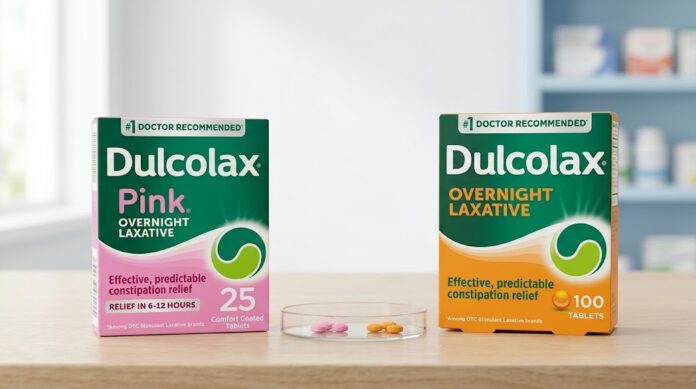
Dulcolax Pink vs Dulcolax laxative tablets: which box belongs in your basket? One holds pink tablets, the other holds the classic ones, and both promise gentle overnight relief.
The short, label-based answer: Dulcolax Pink and standard Dulcolax laxative tablets share the same active ingredient at the same strength, 5 mg of bisacodyl, a stimulant laxative. Both labels say a bowel movement generally comes in 6 to 12 hours.[1][2] The inactive ingredients, coating, tablet color and dosing wording are not identical, though. This guide covers what differs, what research says about bisacodyl, and how to use either box more safely.
Quick answer
Same active ingredient and strength (bisacodyl 5 mg per tablet) and the same labeled timing (generally 6 to 12 hours).
Different on the current labels: dosing wording, tablet color, dyes, coating ingredients, sucrose, and pack sizes.
We found no head-to-head study showing that one works better or feels gentler than the other.
Do not take both together, because the doses add up.
This article contains affiliate links. As an Amazon Associate, ConstipationRelief.net earns from qualifying purchases, at no extra cost to you. Our comparisons are based on drug labels and published research, not on affiliate relationships.
Are Dulcolax Pink and Dulcolax Laxative Tablets the Same Thing?


For the active ingredient, yes.Both Drug Facts panels list bisacodyl(USP) 5 mg with a stimulant laxative purpose.[1][2] Beyond that, the two current DailyMed labels differ in several small ways, shown below.
| Feature | Dulcolax Pink | Dulcolax laxative tablets (standard) |
|---|---|---|
| Active ingredient | Bisacodyl 5 mg per tablet | Bisacodyl 5 mg per tablet |
| Drug type | Stimulant laxative | Stimulant laxative |
| Label timing | Generally 6 to 12 hours | Generally 6 to 12 hours |
| Adults and children 12 and over | 1 to 3 tablets in a single daily dose | Start with 1 tablet a day. If needed, increase to 2 or 3 tablets a day in a single daily dose |
| Children 6 to under 12 | 1 tablet in a single daily dose | 1 tablet per day |
| Children under 6 | Ask a doctor | Ask a doctor |
| Tablet as described on the label | Pink, round, 6 mm | Orange, round, 5 mm |
| Coating ingredients listed | Includes polyvinyl acetate phthalate and shellac | Includes methacrylic acid and ethyl acrylate copolymer |
| Colorants listed | D&C Red No. 27, FD&C Blue No. 2, FD&C Yellow No. 6, iron oxides | Iron oxides (no other colorants listed) |
| Lactose and sucrose | Lactose and sucrose both listed | Lactose listed, sucrose not listed |
| Milk and antacid rule | Not within 1 hour | Not within 1 hour |
| Pack sizes in the labels reviewed | 25 count | Several, from 6 up to 200 count in the label’s package list |
One caution about that table. It follows the current DailyMed labels (Pink updated February 2025, standard updated April 2025), which we rechecked on October 22, 2026.
Retailer listings for the standard tablet sometimes show an older formulation, with sucrose, different colorants and a different coating blend, and some of those older listings use the “1 to 3 tablets” dosing wording. Pack availability also varies by store. The package in your hand is always the final word.
Pink states directly that it contains FD&C Yellow No. 6.[1] If you avoid a particular dye, sugar or lactose, read the ingredient list on your exact package instead of assuming either box is “cleaner” or “plainer.”
How Bisacodyl Works in Both Tablets
Bisacodyl has been used to treat constipation since the 1950s, and it acts locally in the large bowel.[3] It is a prodrug, which means it is inactive until intestinal enzymes convert it into an active metabolite called BHPM. That metabolite prompts stronger muscle contractions in the colon and encourages the colon wall to release more fluid into the stool.[3][4]
In practice, bisacodyl stimulates bowel activity and increases fluid secretion in the colon. It can cause abdominal cramps, so the dose and your individual response matter when choosing a laxative. For the broader picture of how stimulant, osmotic and bulk-forming products differ, our guide to the best OTC laxatives for constipation lays them out side by side.
Both products are coated tablets, but their inactive ingredients and coating formulations are not identical in the labels reviewed. The Pink label lists polyvinyl acetate phthalate and shellac, while the current standard label lists a methacrylic acid and ethyl acrylate copolymer.[1][2]
The labels give the rules (swallow whole, do not chew or crush, wait an hour after milk or an antacid) without explaining them. The most likely reason is protecting the coating so the tablet reaches the intestine before it dissolves, but that is our reading, not a statement from the label.
What the Research Says About Bisacodyl
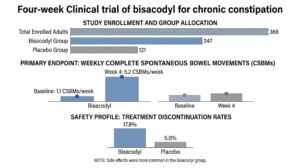
Nearly everything we know comes from studies of bisacodyl itself, not from a Pink versus standard comparison. The best-known trial, by Kamm and colleagues, enrolled 368 adults in the UK who met Rome III criteria for chronic constipation. They were randomized 2 to 1 to 10 mg of bisacodyl (247 people) or placebo (121 people) once daily for 4 weeks. The 10 mg dose equals the strength of two 5 mg tablets.[5]
Complete spontaneous bowel movements per week rose from 1.1 at baseline to 5.2 on bisacodyl, compared with 1.9 on placebo.[5] The trade-off was more side effects. Adverse events were nearly twice as common on bisacodyl, mostly diarrhea and abdominal pain and mostly in the first week of treatment, and more people stopped treatment on bisacodyl (17.8% versus 5.0% on placebo).[5][4]
Two caveats matter. The trial was sponsored by the manufacturer, which is common for drug trials but worth knowing, and it ran for only 4 weeks. The commentary on the trial noted that it remains unclear whether tolerance develops with longer use.[4]
The 2023 joint guideline from the American Gastroenterological Association and the American College of Gastroenterology recommends bisacodyl or sodium picosulfate for short-term use or as rescue therapy in adults with chronic idiopathic constipation. It is a strong recommendation based on moderate certainty of evidence.[6][7] The ACG’s summary of the guideline describes short-term as under 4 weeks.[8]
That guideline advice is written for people with a diagnosed condition under clinical care, and it is not the same instruction as the package label. The label tells you to stop and ask a doctor if you need a laxative for more than 1 week.[1][2] For self-treatment, treat the label as your limit. Our MiraLAX vs Dulcolax comparison covers how the guideline compares with daily polyethylene glycol.
On long-term safety, a 2024 critical review of 43 publications found no convincing evidence that stimulant laxatives damage the gut or cause colon cancer, and the authors concluded that such harms have probably been overstated.[9] That is reassuring, but long-term data in adults remain limited, so it does not settle the question of daily use and it does not turn the label limits into suggestions.
Why Some People Say Pink Feels Gentler
Both products are marketed with similar language. The Dulcolax Pink listing describes easy-to-swallow, comfort-coated tablets that are gentle enough for sensitive stomachs yet strong enough for overnight relief.[10] A listing for standard 25 count tablets uses nearly the same sentence.[11] That is marketing language, not clinical evidence that either tablet causes less cramping.
We did not find any trial that compares the two versions. When someone feels one box is rougher than the other, there are ordinary explanations to consider. These are possibilities, not proven causes:
- A different number of tablets was taken.
- The tablet was taken close to a meal, milk or an antacid.
- The stool was harder to begin with, or fluid intake was low (see does dehydration cause constipation).
- A reaction to a particular dye or inactive ingredient, since the two products do not share identical lists.
- Expectation, since a pink tablet marketed as gentle may simply feel gentler.
If cramping is strong with either one, stop and ask a pharmacist or doctor instead of switching colors.
How to Take Dulcolax Pink or Dulcolax Tablets
Follow the directions on the specific package you have, because the two current labels word the dose differently.[1][2]
- Take the tablet with a glass of water, swallow it whole, and do not chew or crush it.
- Do not use it within 1 hour after taking an antacid or milk.
- Dulcolax Pink, adults and children 12 and over: 1 to 3 tablets in a single daily dose.
- Standard Dulcolax on the current US label, adults and children 12 and over: start with 1 tablet a day, and increase to 2 or 3 tablets in a single daily dose only if needed.
- Children 6 to under 12: 1 tablet daily on both labels. Children under 6: ask a doctor. This article is a product comparison, not pediatric guidance, so for any child follow the package label and the child’s doctor.
- Do not exceed the directions on your package.
Older standard packs may still carry the older “1 to 3 tablets” wording, which is one more reason to read your own carton. Because the label timing is 6 to 12 hours, many people take a tablet at bedtime and expect a bowel movement the next morning. That is the idea behind the “overnight” wording on the Pink carton. A pharmacist can help if you take other medicines.
If your stool tends to be hard and lumpy rather than just infrequent, it helps to describe it accurately to a clinician. Our Bristol Stool Chart explained guide shows the seven types in plain language.
Side Effects and Safety Points Worth Knowing
The Drug Facts panels say bisacodyl may cause stomach discomfort, faintness and cramps.[1][2] They also list situations where you should speak to a doctor first or stop use:
- Ask a doctor before use if you have stomach pain, nausea or vomiting.
- Ask a doctor before use if you have noticed a sudden change in bowel habits that lasts more than 2 weeks.
- Do not use the product if you cannot swallow without chewing.
- Stop use and ask a doctor if you have rectal bleeding or fail to have a bowel movement after using it.
- Stop use and ask a doctor if you need a laxative for more than 1 week.
- If you are pregnant or breastfeeding, ask a health professional before use. Our guide to safe laxatives during pregnancy explains the usual options.
Get prompt medical care for severe or worsening abdominal pain, especially with vomiting, or for any rectal bleeding. Rectal bleeding should never be treated as ordinary constipation.
Book a routine appointment if constipation keeps returning, lasts beyond a week of laxative use, or comes with a sudden change in bowel habits. Persistent symptoms can have causes that a laxative will not fix, and our article on IBS-C vs chronic constipation explains how clinicians tell some of them apart.
Laxatives are also not a safe way to control weight. If that is a concern for you or someone close to you, a doctor can help.
Other Dulcolax Products People Mix Up With These Tablets
The Dulcolax name covers several different medicines, which is a common source of confusion when people search for “Dulcolax laxative tablets.”[12]
| Dulcolax product | Active ingredient | Type |
|---|---|---|
| Pink Tablets, Tablets, Liquid Gels, Suppository | Bisacodyl | Stimulant laxative |
| Liquid, Soft Chews, Kids Soft Chews, Chewy Fruit Bites | Magnesium hydroxide | Saline laxative |
| Stool Softener | Docusate | Stool softener |
So the name on the front of the box does not tell you what is inside. Always read the Drug Facts panel. If a stool softener is what you were actually after, our guide to the best stool softeners for constipation compares the main choices.
Which One Should You Choose?
Because the active ingredient and strength are the same, the choice is mostly practical:
- Dosing wording. If you want a label that tells you to begin with a single tablet, check that your standard package says so. Pink’s label gives a 1 to 3 tablet range.
- Dyes and inactive ingredients. Compare the two lists if you avoid a specific dye, sucrose or lactose.
- Availability. Pack sizes vary by retailer and change over time, so check what is actually in stock.
- Personal preference. Some people simply like one tablet’s look or feel, and that is a fine reason as long as the dose stays within the label.
If neither version suits your situation, for example because you need relief more than occasionally or want a gentler daily option, that is a conversation for a clinician. You can also read our guide to relieving constipation without laxatives for the non-drug steps that are usually tried first.
Products Mentioned
If you decide to try one, here are the two versions discussed above. Both contain bisacodyl 5 mg. Check the current package details and the label on whatever you receive, because formulations and pack contents change.
- Dulcolax Pink Stimulant Laxative Tablets, 25 count: Check Dulcolax Pink on Amazon
- Dulcolax Stimulant Laxative Tablets, 100 count: A larger pack does not mean the product should be used more often or for longer than directed. Check Dulcolax tablets on Amazon
Frequently Asked Questions
Is Dulcolax Pink stronger than regular Dulcolax tablets?
No. Both list bisacodyl 5 mg per tablet. The dosing wording differs slightly between the current labels, with Pink saying 1 to 3 tablets in a single daily dose and the standard label saying to start with 1 tablet and increase to 2 or 3 only if needed, so follow the directions on your package.
Is Dulcolax Pink gentler on the stomach?
Pink is marketed as gentle for sensitive stomachs, but the standard tablets use very similar wording, and we found no head-to-head study comparing them. Cramping is a listed effect of both, so how you feel may depend more on dose and individual response than on tablet color, though no study has tested that directly.
Can I take Dulcolax Pink and regular Dulcolax together?
It is not a good idea. Both contain the same active ingredient, so the doses add up. Count every bisacodyl tablet you take, whatever the color, and do not exceed the directions on your package.
How long does Dulcolax take to work?
The Drug Facts panel says the tablets generally produce a bowel movement in 6 to 12 hours, which is why they are often taken at bedtime.
Can I use Dulcolax tablets every day?
The label says to stop use and ask a doctor if you need a laxative for more than 1 week. Guidelines support bisacodyl for short-term use or as rescue therapy, so ongoing daily use should be planned with a clinician.
Why can’t I take Dulcolax tablets with milk or an antacid?
The label says not to use the tablets within 1 hour after an antacid or milk and not to chew or crush them. Follow those directions exactly, and ask a pharmacist if you are unsure.
Final Thoughts
Dulcolax Pink and Dulcolax laxative tablets contain the same 5 mg of bisacodyl, but they are not identical products: color, dyes, coating, sucrose and dosing wording differ on the current labels. In practice, read the label on your own package, keep use short, and see a doctor if constipation lasts, keeps returning, or comes with warning signs such as rectal bleeding or severe pain.
This article is for informational purposes only and does not constitute medical advice. Always consult a qualified healthcare provider before starting any laxative, especially if you are pregnant, breastfeeding, elderly, have kidney or bowel conditions, or take other medicines.
References
- Chattem, Inc. Dulcolax Pink Stimulant Laxative (bisacodyl) tablet, coated: drug label [Internet]. Bethesda (MD): DailyMed, National Library of Medicine; [updated 2025 Feb 5; cited 2026 Oct 22]. Available from: https://dailymed.nlm.nih.gov/dailymed/drugInfo.cfm?setid=fb5ad666-57b3-4b95-b5de-9db5d265925e
- Chattem, Inc. Dulcolax Stimulant Laxative Tablets (bisacodyl) tablet, film coated: drug label [Internet]. Bethesda (MD): DailyMed, National Library of Medicine; [updated 2025 Apr 1; cited 2026 Oct 22]. Available from: https://dailymed.nlm.nih.gov/dailymed/drugInfo.cfm?setid=d285651b-7ccc-4ae5-a862-7a38dffefa28
- Corsetti M, Landes S, Lange R. Bisacodyl: a review of pharmacology and clinical evidence to guide use in clinical practice in patients with constipation. Neurogastroenterol Motil. 2021;33(10):e14123. doi:10.1111/nmo.14123. PMID: 33751780. Available from: https://pmc.ncbi.nlm.nih.gov/articles/PMC8596401/
- Rex DK. Daily bisacodyl effective for chronic constipation [Journal Watch commentary]. NEJM Clinician. 2011 Aug 5. doi:10.1056/JG201108050000001. Available from: https://clinician.nejm.org/daily-bisacodyl-effective-chronic-constipation-JG201108050000001
- Kamm MA, Mueller-Lissner S, Wald A, Richter E, Swallow R, Gessner U. Oral bisacodyl is effective and well-tolerated in patients with chronic constipation. Clin Gastroenterol Hepatol. 2011;9(7):577-83. doi:10.1016/j.cgh.2011.03.026. PMID: 21440672. Available from: https://www.cghjournal.org/article/S1542-3565(11)00323-5/fulltext
- Chang L, Chey WD, Imdad A, et al. American Gastroenterological Association-American College of Gastroenterology clinical practice guideline: pharmacological management of chronic idiopathic constipation. Am J Gastroenterol. 2023;118(6):936-54. Also published in: Gastroenterology. 2023;164(7):1086-106. doi:10.1053/j.gastro.2023.03.214. Available from: https://doi.org/10.1053/j.gastro.2023.03.214
- American Gastroenterological Association. New guidelines for the pharmacological treatment of chronic idiopathic constipation in adults [press release] [Internet]. 2023 [cited 2026 Oct 22]. Available from: https://gastro.org/?p=79354
- Schoenfeld P. Joint AGA-ACG clinical practice guideline on chronic idiopathic constipation treatments: parsing benefits and risks [Internet]. American College of Gastroenterology; 2023 Jun [cited 2026 Oct 22]. Available from: https://gi.org/?p=54514
- Whorwell P, Lange R, Scarpignato C. Review article: do stimulant laxatives damage the gut? A critical analysis of current knowledge. Therap Adv Gastroenterol. 2024;17:17562848241249664. doi:10.1177/17562848241249664. Available from: https://pmc.ncbi.nlm.nih.gov/articles/PMC11181897/
- Food Lion. Dulcolax Pink Overnight Laxative 5 mg Comfort Coated Tablets, 25 ct [product listing] [Internet]. [cited 2026 Oct 22]. Available from: https://foodlion.com/groceries/health-beauty/digestive-health-nausea/laxatives/dulcolax-pink-overnight-laxative-5-mg-comfort-coated-tablets-25-ct-pkg.html
- Stop & Shop. Dulcolax Laxative Overnight 5 mg Relief Comfort Coated Tablets, 25 ct [product listing] [Internet]. [cited 2026 Oct 22]. Available from: https://stopandshop.com/groceries/health-beauty/digestive-health-nausea/laxatives/dulcolax-laxative-overnight-5-mg-relief-comfort-coated-tablets-25-ct-pkg.html
- WebMD. Dulcolax (bisacodyl) oral: product types and uses [Internet]. [cited 2026 Oct 22]. Available from: https://www.webmd.com/drugs/2/drug-3721/dulcolax-bisacodyl-oral/details/list-interaction-medication