

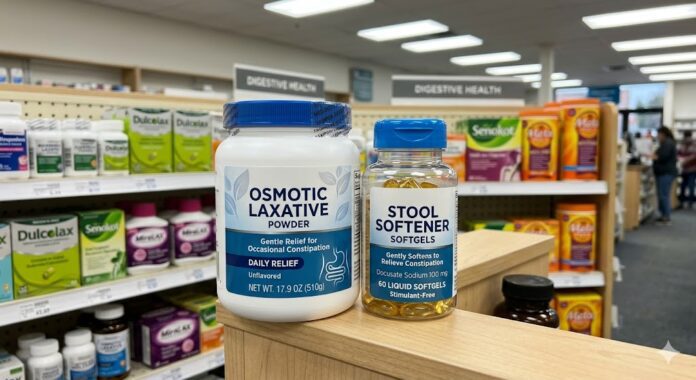
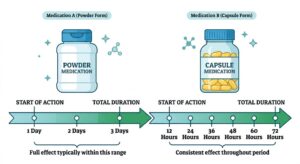
Quick answer: MiraLAX is usually the better choice for actually treating constipation — it has stronger research behind it and works by drawing water into the colon (typically 1–3 days). Colace mainly softens stool to prevent straining and isn’t well-supported for relieving constipation that has already set in (typically 12–72 hours). Colace’s window starts a bit earlier on paper, but that doesn’t make it the better pick — see “Which Works Faster?” below for why. Either way, neither works in minutes; both take hours to a few days.
Walk down any pharmacy aisle and you’ll likely see MiraLAX and Colace sitting near each other — both marketed as gentle, non-stimulant options for constipation, and both available without a prescription. But they’re not interchangeable. MiraLAX is an osmotic laxative built to soften and move stool that’s already a problem, while Colace is a stool softener originally designed to help people avoid straining in the first place.
That difference matters more than most people realize, especially when you’re trying to figure out which one will actually get you relief, and how soon. In this guide, we’ll break down exactly how each one works, what the research says about how fast and how well they perform, which one makes more sense for hard stool versus chronic constipation, and what to do if neither is working for you.
Affiliate Disclosure: This post contains affiliate links. As an Amazon Associate, ConstipationRelief.net earns from qualifying purchases, at no extra cost to you. Medically reviewed by Dr. ABM Sadikullah (FCPS, Medicine).
1. MiraLAX vs Colace: The Short Version
MiraLAX (polyethylene glycol 3350) and Colace (docusate sodium) are both gentle, non-stimulant options for occasional constipation — but they work differently and on different timelines.
MiraLAX is an osmotic laxative that pulls water into the colon and generally produces a bowel movement within 1 to 3 days.
Colace is a stool softener that helps water and fat penetrate hard stool, and it typically takes 12 to 72 hours to work.
Neither product is designed for “fast” relief in the sense of working within minutes or a few hours. If you need something that acts that quickly, a saline laxative such as magnesium citrate (30 minutes to 6 hours) is a better fit. You can compare those options in our guide to the best OTC laxatives for constipation.
For most people, MiraLAX has stronger evidence behind it and tends to be more reliably effective for actual constipation. Colace is more often used preventively — to keep stool soft so people don’t have to strain, for example after surgery, childbirth, or with hemorrhoids.
If your constipation has lasted for weeks rather than days, neither product is a substitute for a proper medical evaluation.
2. How MiraLAX Works
MiraLAX’s active ingredient is polyethylene glycol 3350 (PEG 3350), an osmotic laxative.
In simple terms, it’s a powder that pulls water into your gut and holds onto it. It is not a stimulant and does not directly trigger muscle contractions in the bowel.
Instead, it’s a long-chain polymer that binds and retains water in the intestinal lumen. This softens the stool, increases its volume, and makes it easier for the colon to move it along.
The standard adult dose is 17 grams of powder once daily, mixed into 4 to 8 ounces of water or another beverage. It generally produces a bowel movement within 1 to 3 days, and it shouldn’t be used for more than 7 days without medical advice.
The most common side effects are bloating, gas, abdominal cramping, and nausea — which are usually dose-related.

3. How Colace Works
Colace’s active ingredient is docusate sodium, classified as a stool softener (or surfactant laxative) rather than a true laxative in the sense of stimulating the bowel or strongly drawing in water.
In simple terms, think of it like a wetting agent — it helps water and fat soak into stool that’s already there, so it’s softer and slides out more easily.
Taken orally, docusate typically produces a bowel movement within 12 to 72 hours. The usual adult dosage ranges from 50 to 300 mg per day, in one or more doses.
It’s frequently recommended for people who need to avoid straining — for example, after surgery, after childbirth, or with hemorrhoids and anal fissures — rather than for people who already have hard, established constipation.
It’s worth noting: in the 2021 American College of Gastroenterology systematic review of OTC laxatives, docusate received a Grade I rating, meaning the evidence was considered insufficient to make a recommendation either way.
The reviewers found no qualifying randomized trials of docusate published after 2004. The 2023 AGA-ACG guideline on chronic idiopathic constipation ultimately did not issue a formal recommendation for it, consistent with the 2021 findings.
This doesn’t mean Colace doesn’t work for everyone — but the research backing it is much weaker than the research behind MiraLAX, especially for ongoing constipation.

4. MiraLAX vs Colace: Comparison Table
| Feature | MiraLAX (PEG 3350) | Colace (Docusate Sodium) |
|---|---|---|
| Drug class | Osmotic laxative | Stool softener (surfactant laxative) |
| How it works | Draws and retains water in the colon to soften and bulk the stool | Lowers stool surface tension so water and fat can penetrate hard stool |
| Typical onset | 1 to 3 days | 12 to 72 hours |
| Best suited for | Occasional constipation; supported for chronic idiopathic constipation | Preventing straining (post-surgery, postpartum, hemorrhoids, anal fissures) |
| Evidence grade (2021 ACG review) | Grade A (good evidence) | Grade I (insufficient evidence) |
| 2023 AGA-ACG guideline status | Strong recommendation, moderate-certainty evidence | Not given a formal recommendation |
| Form | Powder, mixed with 4–8 oz liquid | Capsules/softgels (50 mg, 100 mg, 250 mg) |
| Common side effects | Bloating, gas, nausea, loose stools | Mild cramping, bloating, bitter taste, diarrhea |
| Max use without a doctor | Up to 7 days | Up to 1 week |

5. Which Works Faster — MiraLAX or Colace?
This is the question most people actually want answered, so let’s be direct about it.
On paper, Colace’s window (12–72 hours) can start a little earlier than MiraLAX’s (roughly 24–72 hours, i.e., 1–3 days). But “faster on paper” doesn’t always translate to “more reliable in practice.” Docusate’s effect is gradual and depends on it mixing into stool that’s already forming, so people with already-hard, dry stool may not notice much change in the first day. MiraLAX works continuously from the moment it’s taken, pulling fluid into the colon throughout transit, so most people see a result within the 1–3 day window fairly consistently — and it has Grade A evidence behind that effect, compared with Grade I for docusate.
The practical takeaway: neither product is a same-day rescue option. If you need relief within hours rather than a day or more, that’s a different category of product — magnesium citrate, magnesium hydroxide (milk of magnesia), or a stimulant laxative like bisacodyl or senna act faster, though usually with a higher chance of cramping. Our guide to fast constipation relief at home covers natural options you can try while you wait for either product to kick in. See the alternatives section below for how these compare.
6. Which Is Better for Hard, Lumpy Stool?
For genuinely hard or lumpy stool, MiraLAX is generally the stronger option. Because PEG 3350 keeps pulling water into the colon throughout transit, it tends to soften stool more thoroughly and increase stool water content more than docusate does. Colace can help at the margins — keeping a forming stool a bit softer — but it’s less effective at rehydrating stool that has already become hard and compacted.
This lines up with how clinicians typically use the two: docusate is often described as useful for preventing hard stool in people at higher risk (for example, those on opioid pain medication after surgery), rather than for treating stool that’s already hard.
7. Which Is Better for Chronic Constipation?
For chronic idiopathic constipation (CIC) — generally defined as fewer than three bowel movements per week, with hard stools or straining, lasting for months — MiraLAX has a meaningfully stronger evidence base. The 2023 joint AGA-ACG guideline gives PEG a strong recommendation based on moderate-certainty evidence, noting that it can increase the number of complete spontaneous bowel movements compared with placebo, with effects that appear durable over several months of continued use.
Docusate, by contrast, received a Grade I (insufficient evidence) rating in the 2021 ACG systematic review and was not given a formal recommendation in the 2023 guideline. The available trials are small and dated, and the few that exist suggested docusate was not clearly better than placebo and was less effective than psyllium. In practice, this means Colace is reasonable for short-term, occasional use, but it isn’t the product most guidelines point to for managing ongoing constipation. For a broader comparison of evidence-graded options, see our complete guide to the best OTC laxatives for constipation. If your constipation has lasted more than a few weeks, it’s worth discussing with a doctor rather than relying on either product long-term.
8. Side Effects
Both MiraLAX and Colace are generally considered gentle compared with stimulant laxatives (such as senna or bisacodyl), but neither is completely free of side effects.
MiraLAX side effects most commonly include bloating, gas, abdominal cramping, and nausea. At higher-than-recommended doses, it can cause loose or watery stools. It should be avoided by people with a known allergy to polyethylene glycol or with a bowel obstruction. If cramping is a concern for you specifically, our guide to why MiraLAX can cause cramping goes into the most common causes and fixes.
Colace side effects can include mild stomach cramps, bloating, gas, a bitter taste, and sometimes diarrhea. Docusate isn’t generally recommended for long-term daily use without medical supervision, and people on a sodium-restricted diet should check the sodium content of docusate sodium products.
For either product, contact a healthcare provider if you notice rectal bleeding, severe abdominal pain, or no bowel movement at all after using the product as directed for several days — these can be signs of a more serious underlying issue.
9. Can You Take MiraLAX and Colace Together?
Combining an osmotic laxative (MiraLAX) with a stool softener (Colace) is something some people do, and since the two work through different mechanisms, there’s no direct pharmacological conflict between them. In practice, however, many clinicians find that adding docusate on top of PEG provides little extra benefit, since MiraLAX is already drawing substantial water into the stool on its own.
If you’re in a situation where straining must be avoided — for example, recovering from hemorrhoid surgery or childbirth — and your doctor has recommended both, that’s a reasonable combination to follow under their guidance. But if you’re simply trying to get more reliable relief from occasional constipation, it’s usually better to use one product consistently at the recommended dose and give it the full 1–3 day window, rather than stacking two products and guessing at the cause if something feels off. Always check with a pharmacist or doctor before combining laxatives, especially if you’re taking other medications.
10. Product Comparison: MiraLAX Powder vs Colace Capsules
Beyond how they work medically, MiraLAX and Colace are also just different products to use day-to-day — and that affects which one people actually stick with. Here’s what to expect from each, side by side.
MiraLAX: Form, Taste, Ease of Use, and Price
Form and dosing: MiraLAX is an unflavored powder. You measure one capful (17 g) and stir it into 4–8 oz of water, juice, coffee, or tea, once a day.
Taste: It’s marketed as tasteless and grit-free once fully dissolved, and most users say it blends into drinks without changing the flavor noticeably.
Ease of use: It takes a few extra seconds to measure and stir compared with swallowing a pill. Many people simply mix it into their morning coffee or tea, so it becomes part of an existing routine rather than an extra step.
Price: A roughly month-long supply of generic PEG 3350 powder is typically inexpensive — often comparable to or less than the brand-name product, since both contain the same active ingredient at the same dose (17 g PEG 3350 per serving).
👉 Check current MiraLAX price on Amazon
Colace: Form, Taste, Ease of Use, and Price
Form and dosing: Colace is a swallowable capsule or softgel (commonly 50 mg or 100 mg). Some people find this more convenient if they’re already taking other pills, especially while traveling or at work.
Taste: Capsules are swallowed whole with water, so there’s generally no taste at all. A mild bitter aftertaste is occasionally reported if a capsule is chewed or opens slowly in the mouth.
Ease of use: No mixing or measuring — just swallow with a glass of water, which can feel simpler for people who don’t want to prepare a drink.
Price: A bottle of around 100 generic docusate sodium capsules is also typically inexpensive, in a similar range to generic PEG powder. Brand-name Colace usually costs more than the generic equivalent at the same strength.
👉 Check current Colace price on Amazon
Bottom line: if you’re already used to taking a daily pill, Colace’s capsule format may feel easier to stick with. If you don’t mind mixing a powder into a drink you’re having anyway, MiraLAX fits just as easily into a routine — and, as covered above, it’s the one with stronger evidence for actually relieving constipation. Either way, always check the “Drug Facts” panel to confirm the active ingredient and strength before comparing prices, since generic and brand-name versions contain the same medication.
11. Alternatives to MiraLAX and Colace
If MiraLAX or Colace haven’t worked well for you, or you’re looking for a different approach — including options that may act faster or address the underlying cause — there are several well-studied alternatives:
- Psyllium husk and other fiber supplements — bulk-forming fibers that are a good first step for mild, occasional constipation, though they need to be introduced gradually with plenty of water. See our picks for the best psyllium husk products and our roundup of 7 natural fiber supplements for chronic constipation. If you’ve started fiber and noticed things got worse before they got better, our article on why fiber supplements can make you more constipated explains why.
- Magnesium citrate or magnesium oxide — osmotic agents that, depending on the form, can act considerably faster than MiraLAX (sometimes within 30 minutes to 6 hours for magnesium citrate). Our guide to the best magnesium supplements for constipation covers how the different forms compare, and our Mag O7 review looks at one popular oxygen-based magnesium product specifically.
- Lactulose — another osmotic option, sometimes used when OTC choices like PEG alone aren’t effective enough.
- Stimulant laxatives (senna, bisacodyl) — these act faster (typically 6–12 hours) but are generally recommended for short-term or “rescue” use rather than daily long-term management. See our best senna tea picks and our head-to-head on Bisacodyl vs Milk of Magnesia vs MiraLAX.
For all of these options and more, visit our Digestive Wellness Hub — a curated collection of high-quality gut-health supplements and digestive essentials recommended by our team.

Frequently Asked Questions
Is MiraLAX or Colace better for constipation?
For most people with actual constipation — meaning fewer bowel movements than usual, or hard, difficult-to-pass stool — MiraLAX is generally the better choice. It has Grade A evidence and a strong guideline recommendation, while Colace has insufficient evidence (Grade I) for treating constipation that has already developed.
How long does it take for MiraLAX to work?
MiraLAX generally produces a bowel movement within 1 to 3 days of starting daily use. It doesn’t usually cause an urgent bowel movement shortly after taking it.
How long does it take for Colace to work?
Colace (docusate sodium) typically takes 12 to 72 hours to produce a bowel movement. Because the effect is gradual, it’s often taken at night so it aligns with a bowel movement the next morning or the morning after.
Can I take MiraLAX and Colace on the same day?
There’s no known dangerous interaction between the two, and some people do use them together under a doctor’s guidance — for example, after surgery. For everyday occasional constipation, though, most people don’t need both; MiraLAX alone is usually sufficient.
Which is gentler, MiraLAX or Colace?
Both are considered gentle compared with stimulant laxatives. Colace is sometimes perceived as “gentler” because it doesn’t usually cause urgency, but MiraLAX is also non-stimulant and is well tolerated by most people at the recommended dose. The main side effects for both are bloating, gas, and mild cramping.
Is Colace safe to take every day?
Colace’s label advises against use for more than one week without talking to a doctor. For longer-term needs, options with stronger evidence — such as PEG (MiraLAX) or psyllium — are generally preferred, and any daily laxative use beyond a week or two should be discussed with a healthcare provider.
What works faster than MiraLAX or Colace?
If you need relief sooner than 12–24 hours, magnesium citrate (30 minutes–6 hours), magnesium hydroxide/milk of magnesia (30 minutes–6 hours), or stimulant laxatives like bisacodyl or senna (6–12 hours) act faster. These tend to come with a higher chance of cramping or urgency. See our OTC laxatives comparison guide for details.
References
- Chang L, Chey WD, Imdad A, et al. American Gastroenterological Association-American College of Gastroenterology Clinical Practice Guideline: Pharmacological Management of Chronic Idiopathic Constipation. Am J Gastroenterol. 2023;118(6):936-954.
- Rao SSC, Brenner DM. Efficacy and Safety of Over-the-Counter Therapies for Chronic Constipation: An Updated Systematic Review. Am J Gastroenterol. 2021;116(6):1156-1181. PMID: 33767108.
- Polyethylene Glycol 3350 — MedlinePlus Drug Information. National Library of Medicine.
- Docusate Sodium (Oral Route) — Side Effects & Dosage. Mayo Clinic.
- Docusate. StatPearls, NCBI Bookshelf.
- MiraLAX Drug Facts Label. U.S. FDA / DailyMed.
This article is for informational purposes only and is not a substitute for professional medical advice. Always read product labels and consult a healthcare provider before starting any new laxative, especially if you have kidney disease, are pregnant, or are on a sodium-restricted diet.





[…] you only need the essentials, our MiraLAX vs Colace quick comparison guide covers the same core differences in a shorter […]
[…] For a shorter, brand-name-focused version of this comparison (MiraLAX vs Colace, including product sizes and where to buy), see our MiraLAX vs Colace quick comparison guide. […]
[…] pills. If you are looking for an option with stronger trial evidence for ongoing constipation, our MiraLAX vs Colace comparison and our full best OTC laxatives guide walk through the […]