

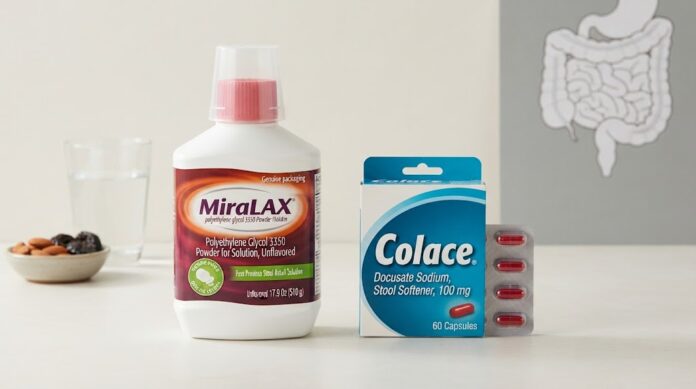
Constipation sometimes does not improve enough with one over-the-counter product, which can lead people to wonder whether MiraLAX and Colace can be taken together. The two medicines work differently, but that does not mean everyone should automatically use both. This article covers how each one works, what is and is not known about combining them, and when to check with a doctor first.
The short answer
Can you take MiraLAX and Colace together? In some situations they may be used together, but it is not right for everyone. MiraLAX (polyethylene glycol 3350) and Colace (docusate sodium) work through different mechanisms.[1,5,6]
The current product labeling does not identify a specific interaction between polyethylene glycol 3350 and docusate, but direct evidence evaluating the combination itself is limited.[1,2] That is not the same as saying it is proven or right for everyone. Using two laxative products can make cramping, urgency, or loose stools more noticeable in some people.
The MiraLAX label limits use to seven days unless a doctor directs otherwise, and the Colace label directs consumers to stop use and ask a doctor if a stool softener is needed for more than one week. Certain health conditions, medications, and warning symptoms change the calculation. The rest of this article walks through the details.
Affiliate disclosure: This post contains affiliate links. As an Amazon Associate, ConstipationRelief.net earns from qualifying purchases, at no extra cost to you.
How MiraLAX works
MiraLAX‘s active ingredient is polyethylene glycol 3350, an osmotic laxative. It is not absorbed into the bloodstream in any meaningful way. Instead, it holds water in the stool, making it softer and easier to pass.[1,3] The FDA labeling describes it as generally producing a bowel movement within one to three days, and it is meant to be used for no more than seven days unless a doctor says otherwise.[1]

How Colace works
Colace‘s active ingredient is docusate sodium, classified as a stool softener rather than a true stimulant or osmotic laxative. It acts as a surfactant, helping water mix more readily with stool so that the stool becomes softer and easier to pass.[5,6] Onset is typically described as one to three days, though estimates vary somewhat by source.[5,6] It is worth knowing that the evidence behind docusate is weaker than many people assume.
Systematic reviews and randomized trials have generally not shown a clear benefit over placebo for constipation, and the evidence base has been described as inadequate to support routine use.[7,8,9] Our guide to the best stool softeners for constipation looks at how that evidence gap plays out across products.

What We Know About Using MiraLAX and Colace Together
Because the two products work differently, they can theoretically be used together, but evidence specifically evaluating this combination is limited. Docusate helps water mix into stool, while polyethylene glycol retains water in the bowel and increases stool water content.
The 2023 AGA-ACG guideline strongly recommends polyethylene glycol for chronic idiopathic constipation. Docusate appears in the guideline’s evidence review, but the guideline does not provide a recommendation for docusate.[4] The appropriate approach depends on the cause and severity of constipation, which is a question for a clinician rather than a rule of thumb.
What actually changes when you combine them
A few things shift once you move from one laxative to two, and they are worth going in with your eyes open about.
- Cramping, urgency, and looser stools may occur. Because the two products affect stool consistency through different mechanisms, using both may make stools looser or bowel movements more urgent in some people. If stools become watery or diarrhea develops, stop the product and follow the label or seek medical advice as appropriate. If cramping is a recurring problem with MiraLAX on its own, our article on why MiraLAX can cause cramping covers the common reasons.
- Significant diarrhea can cause fluid loss and, in some circumstances, electrolyte disturbances, particularly when laxatives are overused.[5] People with kidney disease, older adults, and anyone who has been told to restrict or carefully manage fluid intake should discuss laxative use with a healthcare professional.
- It is easy to overuse both. Neither over-the-counter label supports daily, long-term use without medical guidance (doctor-supervised treatment of chronic constipation is a separate matter), and combining them does not change that.[1,2]
Who should check with a doctor before combining them
A quick conversation with a doctor or pharmacist before combining MiraLAX and Colace is worth having if any of the following apply:
- Kidney disease, since polyethylene glycol labeling specifically flags kidney disease as a reason to get medical supervision first[1]
- A known allergy to polyethylene glycol, since MiraLAX’s label lists this as a direct “do not use” allergy alert, not just a caution[1]
- Irritable bowel syndrome (IBS), which MiraLAX’s own labeling flags as a reason to ask a doctor before use[1]
- Pregnancy or breastfeeding
- A known or suspected intestinal blockage, or symptoms such as severe abdominal pain, nausea, or vomiting, because laxatives should not be used to treat a possible obstruction without medical evaluation[2,5,10]
- Taking other prescription medications. MiraLAX’s own labeling advises checking with a doctor or pharmacist first if you are on a prescription drug.[1] Docusate specifically should not be used with mineral oil, since it can increase how much mineral oil the body absorbs.[2,5]
- Constipation that has already lasted more than two weeks, or a sudden, unexplained change in bowel habits[2]
- Needing a laxative combination on most days rather than occasionally
- Children. MiraLAX labeling directs children 16 years and under to ask a doctor, while Colace dosing varies by product and age. Children should not be given an adult dose without medical guidance[1,2]
None of these automatically rule out using both products, but they are exactly the situations where “probably fine for most people” stops being a good enough answer for your specific case.
General precautions if you and a clinician decide to use both
This article does not offer a dosing protocol for combining these products, since direct evidence for the combination is limited. If you and a doctor or pharmacist decide to use both, the points below reflect the product labels and general laxative safety. Children and teenagers 16 and under should ask a doctor before using MiraLAX.[1]
- Dissolve the MiraLAX dose fully in four to eight ounces of water, juice, or another beverage, following the product directions[1]
- Take Colace according to its own product directions or a clinician’s instructions. The labeling does not list a specific separation interval for these two ingredients, so any spacing is a practical choice (for example, to make side effects easier to track) rather than a labeled requirement[1,2]
- Drink adequate fluids unless you have been told to restrict fluids, because dehydration can worsen constipation
- If stools become watery or diarrhea develops, stop the product and follow the label or seek medical advice as appropriate, and do the same if cramping is more than mild
- Treat this as a short-term measure. The MiraLAX label limits use to seven days unless a doctor directs otherwise, and the Colace label directs consumers to ask a doctor if a stool softener is needed for more than one week, so check in with a doctor if constipation has not improved by then. Longer-term treatment of chronic constipation should be directed by a clinician[1,2]
This is general information rather than a personal medical recommendation, and dosing should follow the product label or a healthcare provider’s specific instructions, especially for children, older adults, or anyone managing a chronic condition. Our guide to constipation relief for older adults covers gentler approaches to start with.
When constipation needs more than a laxative combination
Reaching for two laxatives at once can also be a signal worth paying attention to on its own. If MiraLAX and Colace together are not solving the problem, or if you find yourself needing this combination regularly, it may be less about which laxative to add and more about what is driving the constipation in the first place, whether that is low fiber intake, dehydration, a medication side effect, thyroid function, or a motility issue that deserves its own evaluation.
Seek prompt medical care for severe abdominal pain, vomiting, blood in the stool, fever, or no bowel movement at all despite treatment. If MiraLAX alone has not worked, our guide to why MiraLAX may not be working covers common reasons to look at before adding a second product.
Other approaches worth knowing about
Laxatives are not the only lever available, and plenty of people look for a gentler, longer term option to use alongside or instead of them. Dietary fiber, adequate fluid intake when appropriate, and identifying the cause of constipation are important parts of constipation management (our guide to natural fiber supplements for chronic constipation is a good starting point), and some people also turn to probiotics as a complementary approach.
If that is a direction you are exploring, our look at whether a Garden of Life probiotic for constipation actually helps walks through the evidence for that specific product line.
For a wider view of what is on the shelf, our guide to the best OTC laxatives for constipation compares options beyond just MiraLAX and Colace, and if Colace itself is what you are trying to pin down, this comparison of Amazon Basics stool softener vs Colace breaks down whether the store brand is really the same thing. If you would rather see the two products compared head to head, our MiraLAX vs Colace comparison covers that.
Frequently asked questions
Can you take MiraLAX and Colace together on the same day?
MiraLAX and Colace may be used on the same day in some situations, since they work through different mechanisms, but direct evidence for the specific combination is limited. That is not the same as saying it is risk free for everyone, and anyone with kidney disease, IBS, on other medications, or with ongoing symptoms should check with a doctor or pharmacist first.
Is it safe to use MiraLAX and Colace together every day?
The MiraLAX label limits use to seven days unless a doctor directs otherwise, and the Colace label directs consumers to stop use and ask a doctor if a stool softener is needed for more than one week. Doctor-supervised treatment of chronic constipation is a separate matter, but it is a decision to make with a clinician, not a reason to use both products daily on your own. Long-term daily use without medical guidance can mask an underlying issue that needs its own evaluation.
How long should you wait between MiraLAX and Colace?
There is no specific separation interval listed in the MiraLAX or Colace labeling for these two ingredients. If both are being used, follow the product directions or a clinician’s instructions. Some people space the doses apart mainly to make it easier to notice which product might be behind a side effect, but that is a practical choice rather than a labeled requirement.
What side effects can happen when combining MiraLAX and Colace?
Cramping, bloating, gas, loose or watery stools, and fecal urgency can occur with laxatives and may be more noticeable in some people when two products are used. Significant diarrhea can cause fluid loss and, in some circumstances, electrolyte disturbances, particularly when laxatives are overused, which is part of why both are meant for short-term, occasional use.
When should you call a doctor instead of combining laxatives?
Seek medical advice before combining or continuing either product if there is severe abdominal pain, vomiting, blood in the stool, no bowel movement despite treatment, or constipation lasting longer than two weeks. These can point to a cause that a laxative combination will not fix and that needs its own workup.
References
- U.S. Food and Drug Administration. MiraLAX (polyethylene glycol 3350) drug facts label. Available from: https://www.accessdata.fda.gov/drugsatfda_docs/label/2023/022015Orig1s048Correctedlbl.pdf
- DailyMed. Colace (docusate sodium) capsule drug facts label. National Library of Medicine. Available from: https://dailymed.nlm.nih.gov/dailymed/drugInfo.cfm?setid=7793fced-e8ee-44e2-b212-dd2a59a5f462
- MedlinePlus. Polyethylene Glycol 3350. National Library of Medicine. Available from: https://medlineplus.gov/druginfo/meds/a603032.html
- Chang L, Chey WD, Imdad A, et al. American Gastroenterological Association-American College of Gastroenterology Clinical Practice Guideline: Pharmacological Management of Chronic Idiopathic Constipation. Gastroenterology. 2023;164(7):1086 to 1106. doi:10.1053/j.gastro.2023.03.214
- Docusate salts (monograph). In: AHFS Drug Information. American Society of Health-System Pharmacists. Accessed via Drugs.com professional monographs. Available from: https://www.drugs.com/monograph/docusate-salts.html
- StatPearls. Docusate. Treasure Island, FL: StatPearls Publishing; updated 2023 Aug 17. Available from: https://www.ncbi.nlm.nih.gov/books/NBK555942/
- Rao SSC, Brenner DM. Efficacy and safety of over the counter therapies for chronic constipation: an updated systematic review. Am J Gastroenterol. 2021;116(6):1156 to 1181. Available from: https://doi.org/10.14309/ajg.0000000000001222
- Hurdon V, Viola R, Schroder C. How useful is docusate in patients at risk for constipation? A systematic review of the evidence in the chronically ill. J Pain Symptom Manage. 2000;19(2):130 to 136. Available from: https://pubmed.ncbi.nlm.nih.gov/10699540/
- Tarumi Y, Wilson MP, Szafran O, Spooner GR. Randomized, double-blind, placebo-controlled trial of oral docusate in the management of constipation in hospice patients. J Pain Symptom Manage. 2013;45(1):2 to 13. Available from: https://www.sciencedirect.com/science/article/pii/S0885392412002497
- Drugs.com. Colace drug label, dosage, and drug interactions. Available from: https://www.drugs.com/colace.html
- GoodRx Health. Miralax vs. Colace for constipation: 5 key differences to consider. Reviewed by Austin Ulrich, PharmD, BCACP. Supplementary consumer comparison. Available from: https://www.goodrx.com/conditions/constipation/miralax-vs-colace
This article is for general educational purposes and is not a substitute for medical advice. Talk to a doctor or pharmacist about your specific situation, especially before combining medications.