
The best stool softeners for constipation aren’t always the products backed by the strongest clinical evidence. Docusate sodium (Colace) has been the default answer to “what softens stool” for decades. But when researchers tested it against placebo in controlled trials, the results were far less convincing than most people assume.
This guide compares docusate, docusate calcium, glycerin suppositories, and their more evidence-backed alternatives: what each one actually does, exact dosing, timing, side effects, and who should avoid it. It’s based on the 2021 Rao & Brenner systematic review, the 2023 AGA-ACG clinical practice guideline, and FDA-approved labeling where available, along with other authoritative drug references.[1,2,3]
If your constipation is tied to a specific medication, see our guide to iron-related constipation. For a broader comparison across all laxative categories, see our guide to OTC laxatives in the US.
A note on terminology: Although only docusate products are true “stool softeners” (emollient laxatives), people often use the term more broadly to include other products that soften stool, such as PEG and psyllium. This guide compares both true stool softeners and stool-softening laxatives, and is clear about which is which throughout.
The best stool softener depends on your goal. If you need to avoid straining after surgery or hemorrhoids, docusate may be appropriate. If you want to actually treat constipation, polyethylene glycol (PEG) has the strongest clinical evidence, while psyllium is the best long-term fiber-based option.
Quick Answer
- Polyethylene Glycol / PEG (MiraLAX): Strong recommendation, moderate-certainty evidence — the most robust option if you need an actual laxative effect rather than straining prevention.
- Psyllium Husk (Metamucil): Conditional recommendation, and the best-supported daily fiber-based option for softening stool long term.
- Glycerin Suppositories: Fast, localized, low-risk option for occasional or pediatric use.
- Docusate Sodium (Colace): Insufficient evidence (2021 review); no recommendation due to insufficient evidence (2023 AGA-ACG). Still reasonable for reducing straining after surgery, childbirth, or with hemorrhoids.
- Docusate Calcium (Surfak): Same active mechanism as docusate sodium, in a once-daily format.
- Mineral Oil: Effective lubricant but carries aspiration risk in elderly or bedridden patients; least recommended of the group.
Which One Should You Use? A Goal-Based Quick Reference
| Your Main Goal | Recommended Option |
|---|---|
| Reduce straining (post-surgery, hemorrhoids, cardiac history) | Docusate sodium or docusate calcium |
| Treat ongoing / chronic constipation | Polyethylene glycol (PEG) |
| Fast, occasional relief | Glycerin suppository |
| Daily fiber-based support (plus cholesterol benefit) | Psyllium husk |
Disclosure: This article contains affiliate links. If you purchase through our links, we may earn a small commission at no extra cost to you. Our rankings are based on clinical evidence, not on affiliate relationships.
At a Glance: Best Stool Softeners for Constipation — Ranked by Evidence
The right product depends on your goal. See the goal-based table above first, then choose from the options below:
- Best for straining prevention (post-surgery, hemorrhoids, cardiac patients): Colace Docusate Sodium 100mg (100 Capsules) — #1 doctor-recommended stool softener brand, stimulant-free, works in 12-72 hours — ⚠️ note: 7 placebo-controlled trials found no significant benefit over placebo for treating constipation itself; best suited to straining prevention only
- Best once-daily straining prevention (docusate calcium): Docusate Calcium 240mg Softgels (Generic for Surfak) — same surfactant mechanism as docusate sodium, single daily capsule format, identical evidence limitations apply
- Best for fast localized relief (15-60 minutes): Fleet Laxative Glycerin Suppositories Adult 12 Count — hyperosmotic action draws water directly into the rectum, stimulant-free, #1 doctor-recommended suppository brand, works without passing through the entire digestive system
- Best for actual constipation treatment (strongest evidence): MiraLAX Laxative Powder (45-Dose) — PEG 3350 osmotic laxative, strong recommendation from 2023 AGA-ACG guideline, the only agent here with moderate-certainty evidence for increasing bowel movement frequency — ⚠️ do not use with known bowel obstruction
- Best daily fiber-based option (long-term regularity): Konsyl Daily Psyllium Fiber Powder (19oz, 90 Servings) — 100% pure psyllium husk, conditional recommendation from 2023 AGA-ACG guideline, also has FDA-authorized cholesterol-lowering claim — always take with at least 8oz water, never dry
What Counts as a “Stool Softener,” Exactly?
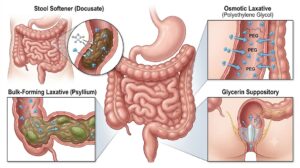
Strictly speaking, a stool softener (also called an emollient laxative) refers to docusate sodium or docusate calcium. Docusate is a surfactant — a detergent-like molecule that reduces the surface tension at the oil-water interface inside the stool, letting water and fat penetrate and soften it from within.[4] It does not stimulate the bowel wall the way senna or bisacodyl does.
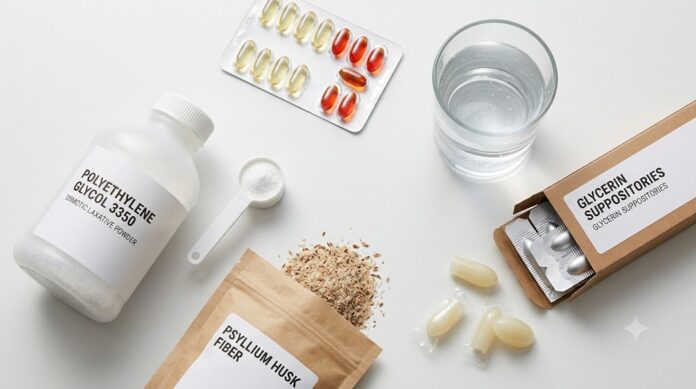
In everyday language, though, people use “stool softener” more loosely to mean anything that makes stool easier to pass without straining. That’s why osmotic laxatives like MiraLAX and bulk-forming fibers like psyllium often get included in the same conversation — technically they’re stool-softening laxatives rather than classic emollient stool softeners. We cover both categories below so you can see how they actually compare on paper, and exactly how to use each one safely.
What the Clinical Evidence Really Says About Docusate: Why the Most Popular Stool Softener Has a Surprisingly Thin Research Base
This is the part most articles skip. A 2021 comprehensive review published in the American Journal of Gastroenterology identified 7 randomized, placebo-controlled trials of docusate conducted between 1956 and 2021. None of the 7 found a statistically significant stool-softening benefit over placebo.[4] An 8th trial directly tested the proposed mechanism, comparing docusate sodium (200 mg/day) against psyllium in patients with chronic idiopathic constipation over 4 weeks, and found docusate did not meaningfully increase stool water content — the very effect it is marketed to produce.[4]
The 2023 AGA-ACG joint clinical practice guideline, the current standard reference for US gastroenterologists, went a step further: it listed docusate as an agent that would be evaluated, but ultimately presented no literature review and issued no recommendation due to insufficient evidence to support one either way.[2] That’s a notably different outcome from polyethylene glycol, which received a strong recommendation, or psyllium and senna, which received conditional recommendations.[2]
Mayo Clinic notes that stool softeners “add moisture to stool to soften it, allowing strain-free bowel movements,” but that in controlled clinical trials, there is no evidence that they improve symptoms.[3]
This shows up in specific patient populations too. A randomized, placebo-controlled trial in hospice patients found no significant difference in stool frequency, volume, or consistency when docusate was added to senna, compared with senna alone.[5] It’s also worth knowing that docusate’s FDA OTC monograph status is listed as not yet final, meaning the agency has never formally completed its determination of docusate’s safety and effectiveness for treating constipation.[6]
None of this means docusate is dangerous or useless. It has an excellent safety record, and it’s still commonly used by physicians for a narrower purpose than treating constipation itself: reducing the strain of defecation in people who specifically need to avoid it, such as those recovering from surgery, childbirth, or a heart event, or those managing hemorrhoids or anal fissures.[6] If your goal is to increase bowel movement frequency and improve stool consistency, the evidence more strongly favors PEG or psyllium instead.
How We Evaluated and Ranked These Products
Each option in this guide was assessed against the same set of criteria, rather than ranked by popularity or brand recognition:
- Clinical practice guidelines — primarily the 2023 AGA-ACG guideline, the current reference for US gastroenterologists
- Randomized controlled trial evidence — placebo-controlled data where available, not just observational or marketing claims
- Safety profile — documented side effects, contraindications, and drug interactions from FDA labeling and national drug reference databases
- OTC availability — whether it can be purchased without a prescription in the US
- Ease of use — dosing complexity, onset time, and practicality for daily or occasional use
Stool Softeners and Stool-Softening Laxatives at a Glance: Full Comparison Table
| Product | Type | 2023 AGA-ACG Status | Evidence Quality | Onset | Best For |
|---|---|---|---|---|---|
| Docusate Sodium (Colace) | Emollient / stool softener | No recommendation (insufficient evidence) | Insufficient | 12–72 hrs | Straining prevention (post-surgery, hemorrhoids, cardiac patients) |
| Docusate Calcium (Surfak) | Emollient / stool softener | No recommendation (insufficient evidence) | Insufficient | 12–72 hrs | Once-daily straining prevention |
| Glycerin Suppository | Hyperosmotic / lubricant | Not separately graded | Not graded | 15–60 min | Occasional or pediatric use, fast localized relief |
| Polyethylene Glycol / PEG (MiraLAX) | Osmotic laxative | Strong, moderate certainty | Moderate | 24–72 hrs | Actual constipation treatment, daily long-term use |
| Psyllium Husk (Metamucil) | Bulk-forming fiber | Conditional, low certainty | Low | 12–72 hrs | Daily fiber-based softening plus cholesterol support |
| Mineral Oil | Lubricant laxative | Not evaluated | Not evaluated | 6–8 hrs | Occasional use only; avoid in elderly or bedridden patients |
1. Docusate Sodium (Colace): Well-Suited for Reducing Straining, Not for Treating Constipation
Evidence Rating: Insufficient Evidence (2021 review) | No Recommendation Issued (2023 AGA-ACG)
Docusate sodium is available as capsules, softgels, tablets, and liquid. It works locally in the gut and is minimally absorbed into the bloodstream.
How to Take It
- Swallow capsules, softgels, or tablets whole with a full glass of water. Do not chew.
- Liquid docusate has a bitter taste and can irritate the throat, so mix it into 6 to 8 ounces of milk or juice right before drinking.[7]
- Can be taken with or without food, at any consistent time of day. Doses can be split through the day or taken all at once.
- Drink plenty of water throughout the day while using it, since docusate depends on adequate fluid to work.
Dosage
- Adults and children 12 and older: 50 to 400 mg per day, in 1 to 4 divided doses. A common starting dose is 100 mg once or twice daily.[7]
- Children 6 to 12 years: 40 to 150 mg per day, divided, only under a doctor’s guidance.
- Children 3 to 6 years: 20 to 60 mg per day, divided, only under a doctor’s guidance.
- Do not use for longer than 1 week unless a doctor has told you to continue.
Side Effects
- Mild stomach or abdominal cramping
- Throat irritation, mainly with the liquid form taken undiluted
- Diarrhea if the dose is too high
- Rare allergic reaction: rash, hives, swelling, or difficulty breathing (seek emergency care if this occurs)
Who Should Not Take This
- Anyone with a known allergy to docusate or its ingredients
- People with stomach pain, nausea, or vomiting of unknown cause, since these can be signs of appendicitis or a bowel obstruction that a stool softener could mask[7]
- Anyone also using mineral oil, since docusate increases mineral oil absorption and raises the risk of lipid pneumonia[7]
- Children under 12 without a doctor’s guidance
- Pregnant or breastfeeding women, without first checking with a doctor (see the pregnancy note below)
Who it genuinely helps: post-surgical patients, new mothers recovering from childbirth, people with hemorrhoids or anal fissures, cardiac patients advised to avoid straining (the Valsalva maneuver), and people on iron supplements who need a gentle daily option. See our guide to iron-related constipation for this specific use case.
Pregnancy and breastfeeding: Docusate has minimal systemic absorption and is commonly used as a second-line option during pregnancy when fiber and fluids aren’t enough. There is a published case report linking chronic docusate use in pregnancy to symptomatic low magnesium levels in the newborn, which is a reason to use it only occasionally and under medical guidance rather than as a long-term daily routine during pregnancy.[8] For pregnancy-specific fiber strategies, see 7 Natural High-Fiber Foods for Pregnancy Constipation Relief.
A note on docusate and iron supplements: Docusate is sometimes recommended to reduce straining in people taking iron supplements, although evidence supporting its effectiveness for constipation itself remains limited, consistent with the broader evidence picture above.
👉 Compare top-rated docusate sodium stool softeners on Amazon
2. Docusate Calcium (Surfak): Same Mechanism, Once-Daily Dosing
Evidence Rating: Insufficient Evidence (shares docusate’s evidence base)
Docusate calcium works through the identical surfactant mechanism as docusate sodium. Some people prefer it simply because a single daily capsule is more convenient than the divided dosing often used with docusate sodium.
How to Take It
- Swallow the capsule whole with a full glass of water, once daily.
- Can be taken with or without food, but taking it at the same time each day helps maintain a steady effect.
Dosage
- Adults: 240 mg once daily.[6]
- Do not use for longer than 1 week unless a doctor has told you to continue.
Side Effects
- Mild stomach cramping (uncommon)
- Rare allergic reaction
Who Should Not Take This
- Anyone with a known allergy to docusate
- People with unexplained abdominal pain, nausea, or vomiting
- Anyone also using mineral oil
- Pregnant or breastfeeding women without medical guidance
It carries the same caveat as docusate sodium: no controlled-trial evidence that it outperforms placebo for treating constipation itself, even though it’s commonly used to prevent straining. Check Price on Amazon.
3. Glycerin Suppositories: Fastest-Acting Option for Occasional Use
Glycerin suppositories work through a hyperosmotic effect, drawing water into the stool locally in the rectum while also lubricating and mildly stimulating the rectal mucosa. Because they act directly at the site where stool needs to pass, onset is typically 15 to 60 minutes, making them one of the fastest options in this category.[9]
How to Take It
- Unwrap the suppository. If it feels too soft to insert, chill it briefly or run it under cold water.
- Moisten the tapered end with water if needed, then insert it well up into the rectum.
- Try to hold it in for a few minutes before the urge to pass stool arrives; it doesn’t need to melt completely to work.[9]
- Wash your hands before and after use.
Dosage
- Adults and children 6 and older: 1 suppository once daily as needed.[9]
- Children 2 to under 6 years: use a pediatric-strength suppository, and only under a caregiver’s supervision.
- Do not use for longer than 1 week unless a doctor has told you to continue.
Side Effects
- Rectal burning or discomfort
- Mild cramping
- Tenesmus (the urge to pass stool even after the bowel is empty)
Who Should Not Take This
- Anyone with rectal bleeding of unknown origin
- People with abdominal pain, nausea, or vomiting that hasn’t been evaluated by a doctor
- Children under 2 without a doctor’s guidance
- Anyone who has already used a laxative for more than a week without improvement, since this warrants a medical check rather than continued self-treatment
They’re widely used in infants, young children, and elderly or post-surgical patients who need occasional, low-risk relief rather than a daily regimen.[13] For elderly-specific strategies, see how to relieve constipation in older adults. Check the Latest Price on Amazon.
4. Polyethylene Glycol / PEG (MiraLAX): The Most Robust Evidence If You Actually Need Relief
Evidence Rating: Strong Recommendation, Moderate Certainty (2023 AGA-ACG) — of all the best stool softeners for constipation covered here, PEG has the most consistent trial support.
PEG is technically an osmotic laxative rather than a classic stool softener, but it’s worth including here because it’s the only agent in this comparison with strong, consistent trial evidence for actually softening stool and increasing bowel movement frequency, both short-term and long-term.[1,2] It draws water into the colon rather than acting on the stool’s surface tension, and it’s not absorbed systemically.[14]
How to Take It
- Dissolve one capful (17 g, measured to the line marked in the cap) fully in 4 to 8 ounces of any beverage: cold, warm, or hot.
- Stir until completely dissolved, then drink right away.
- Do not mix it with starch-based thickeners sometimes used for swallowing difficulty.[10]
- Take once daily, any time of day, with or without food.
Dosage
- Adults: 17 g once daily, dissolved in 4 to 8 ounces of liquid.[10]
- Do not use more than once per day.
- If constipation is not resolved after 7 days of daily use, stop and see a doctor rather than increasing the dose.[10]
Side Effects
- Bloating and gas
- Nausea, especially on an empty stomach
- Loose or watery stools if the dose is too high
- Abdominal cramping (uncommon at the normal dose)
- Rare allergic reaction: hives or difficulty breathing
Who Should Not Take This
- Anyone with a known allergy to polyethylene glycol
- People with a known or suspected bowel obstruction, since the osmotic effect could worsen a blockage or contribute to perforation[10]
- People with toxic colitis or toxic megacolon
- Anyone with kidney disease should only use it with a doctor’s guidance
- People with eating disorders such as anorexia or bulimia, unless a doctor has advised it[10]
If your goal is to increase bowel movement frequency and improve stool consistency, rather than just easing the passage of stool that’s already coming regularly, this is the option with the most consistent evidence behind it. For a head-to-head look at PEG against other common OTC options, see Bisacodyl vs Milk of Magnesia vs MiraLax. Compare top-rated MiraLAX (polyethylene glycol) options on Amazon.
5. Psyllium Husk (Metamucil): Evidence-Backed Daily Fiber Option
Evidence Rating: Conditional Recommendation, Low Certainty (2023 AGA-ACG)
Psyllium forms a viscous gel in the intestine that both softens and bulks the stool, and it has the added benefit of an FDA-recognized cholesterol-lowering claim.[3]
How to Take It
- Mix the powder into at least 8 ounces (a full glass) of cold water or another liquid.
- Stir briskly and drink it right away, before it thickens into a gel in the glass.[11]
- Follow with a second glass of water.
- Take other oral medications at least 2 hours before or after psyllium, since it can reduce their absorption.[15]
- Start with a smaller dose for the first week and increase gradually to reduce gas and bloating.
Dosage
- Typically 1 rounded teaspoon (roughly 3 to 5 g) in liquid, taken 1 to 3 times daily depending on the product’s labeled strength.
- For a therapeutic effect on constipation, more than 10 g of fiber per day for at least 4 weeks tends to show the most consistent results, reached gradually rather than all at once.
Side Effects
- Gas and bloating, especially in the first 1 to 2 weeks
- Mild cramping
- Rare allergic reaction in people sensitive to inhaled or ingested psyllium
Who Should Not Take This
- Anyone with difficulty swallowing or a known narrowing (stricture) of the esophagus: psyllium can swell in the throat and cause choking, and cases of fatal choking have been reported when it was taken without enough liquid[11]
- People with a known bowel obstruction or fecal impaction
- Anyone with sudden chest pain, vomiting, or difficulty swallowing or breathing after taking it should seek emergency care
- People managing phenylketonuria (PKU) should check the label, since some psyllium products contain phenylalanine
It requires consistent water intake to work properly and to avoid worsening constipation. It’s a reasonable long-term daily choice for people whose main issue is low dietary fiber. For strategies to combine fiber correctly with hydration, see our guide to dehydration and constipation. If you’re deciding between the two most evidence-backed options in this guide, see our comparison of MiraLAX vs Metamucil, and if you’re weighing psyllium against newer options, see fiber gummies vs psyllium husk. See Latest Price on Amazon.
6. Mineral Oil: Effective but the Least Recommended Option Here
Mineral oil is a lubricant laxative that coats the stool and intestinal lining to ease passage. It works, but it carries a meaningful aspiration risk in elderly, bedridden, or dysphagic patients, since inhaled mineral oil can cause lipid pneumonia.
How to Take It
- Take it orally at bedtime, on an empty stomach, away from meals, since it can reduce absorption of fat-soluble vitamins (A, D, E, K).[12]
- Sit or stand upright while taking it, and avoid lying down immediately afterward, to reduce the risk of it entering the airway.
- Measure the dose with the device provided rather than a household spoon.
Dosage
- Adults: 15 to 45 mL orally, once daily.[12]
- Do not use for longer than 1 week without medical guidance.[12]
Side Effects
- Rectal or anal leakage, especially at higher doses
- Mild abdominal cramping
- Nausea
- Reduced absorption of fat-soluble vitamins with prolonged use
Who Should Not Take This
- Children younger than 6 years[12]
- Elderly, bedridden, or debilitated patients, due to aspiration risk[12]
- Anyone with dysphagia (swallowing difficulty), hiatal hernia, or a condition affecting the throat muscles
- Pregnant patients: chronic use has been linked to low vitamin K levels and bleeding risk in newborns[12]
- Anyone with appendicitis or undiagnosed rectal bleeding
- Anyone also taking docusate or other stool softeners at the same time[7]
Chronic use can also interfere with absorption of fat-soluble vitamins over time. It should never be combined with docusate, since docusate increases mineral oil absorption and compounds the aspiration and toxicity risk.[7] For most people, PEG or psyllium is a safer choice for the same goal. Check the Latest Price on Amazon.
Safety, Side Effects, and Who Should Be Extra Careful
Even among the best stool softeners for constipation, safety considerations shift depending on who’s using them:
- Post-surgical and cardiac patients: Docusate is commonly used specifically to prevent straining; discuss timing with your surgical or cardiology team.
- Pregnant and postpartum women: Docusate and PEG are generally considered acceptable options, but stimulant laxatives and mineral oil should be avoided unless specifically prescribed. See high-fiber foods for pregnancy constipation for first-line strategies.
- Elderly adults: More prone to side effects, drug interactions, and aspiration risk with mineral oil. See how to relieve constipation in older adults.
- People taking iron supplements: Docusate is sometimes recommended alongside iron therapy to ease straining. See our guide to iron-related constipation.
- People with chronic idiopathic constipation (Rome IV criteria): If constipation is a persistent, ongoing pattern rather than a temporary straining concern, PEG and psyllium have far stronger supporting evidence than docusate. If either doesn’t resolve symptoms after consistent use, see Prucalopride for Chronic Constipation for prescription-level options.
When to See a Doctor
Contact a healthcare provider promptly if you experience severe abdominal pain, blood in the stool, unexplained weight loss, or constipation that persists longer than one to two weeks despite trying a stool softener or laxative. These can signal an underlying condition that needs proper diagnosis rather than a stronger over-the-counter product.
Conclusion: Which Stool Softener Is Right for You?
The best stool softener for constipation depends on why you’re constipated. If your goal is simply to reduce straining after surgery, childbirth, or hemorrhoids, docusate may still be reasonable despite limited clinical evidence. But if you’re looking for a treatment that reliably increases bowel movements and softens stool, polyethylene glycol (PEG) has the strongest research support, while psyllium is the best long-term fiber-based option.
Choose the product that matches your situation, follow the labeled dosage, and talk with your healthcare provider if constipation persists or is accompanied by warning signs.
Not sure which option is right for you? Read our complete guide to OTC laxatives to compare stool softeners, osmotic laxatives, stimulant laxatives, and fiber supplements side by side.
Frequently Asked Questions
What is the most effective stool softener for constipation?
Docusate sodium (Colace) is one of the most commonly used stool softeners in clinical practice, and it’s commonly recommended in specific situations such as after surgery, childbirth, or with hemorrhoids. Clinical trial evidence, however, does not show that docusate treats constipation itself any better than placebo. For an actual laxative effect, polyethylene glycol (MiraLAX) has the strongest supporting evidence.[1,2,4]
Does docusate sodium (Colace) actually work for constipation?
A 2021 review of 7 randomized, placebo-controlled trials found no significant difference between docusate and placebo for softening stool, and the 2023 AGA-ACG clinical guideline issued no recommendation, citing insufficient evidence to support one either way.[2,4] Docusate is still commonly used to reduce straining in specific situations, but it’s not strongly supported as a treatment for constipation.
What is the difference between a stool softener and a laxative?
A stool softener, or emollient laxative such as docusate, lets water and fat mix into the stool so it passes with less straining. The broader term laxative also includes osmotic agents like polyethylene glycol, which draw water into the colon, and stimulant agents like senna or bisacodyl, which trigger muscle contractions. In practice, osmotic laxatives often soften stool more effectively than dedicated stool softeners.
Which is better: a stool softener or MiraLAX?
For actually treating constipation, MiraLAX (polyethylene glycol) is generally the better-supported choice. It’s an osmotic laxative with a strong recommendation and moderate-certainty evidence from the 2023 AGA-ACG guideline, and it reliably increases bowel movement frequency and softens stool.[1,2] A stool softener like docusate is better suited to a narrower goal: reducing the strain of a bowel movement in someone who specifically needs to avoid straining, such as after surgery or childbirth, even though it hasn’t been shown to outperform placebo for treating constipation itself.[4] If ongoing constipation is the main problem, MiraLAX is the more evidence-backed option; if straining avoidance is the goal, docusate remains reasonable.
Is it safe to use a stool softener every day?
Docusate sodium has a good short-term safety profile and is sometimes used daily under a doctor’s guidance, particularly after surgery, during pregnancy, or with iron supplementation. It should not be combined with mineral oil, since this can increase mineral oil absorption and raise the risk of lipid pneumonia.[7] Most product labels advise against continuous use for longer than one week without medical guidance.
What is the fastest-acting stool softener?
Glycerin suppositories tend to act fastest, often producing a bowel movement within 15 to 60 minutes, since they work directly in the rectum. Oral docusate sodium typically takes 12 to 72 hours to have an effect.
Can children use stool softeners?
Some options, such as glycerin suppositories, have pediatric dosing starting around age 2, and docusate sodium has weight-based dosing used under medical supervision in children.[13] Mineral oil should not be given to children under 6 because of aspiration risk.[12] Any laxative or stool softener use in a child should be guided by a pediatrician rather than self-directed.
Medical Disclaimer: This article is for informational purposes only and does not constitute medical advice. Always consult a qualified healthcare provider before starting any laxative or stool softener regimen, especially if you are pregnant, elderly, recovering from surgery, or taking other medications. Seek medical attention promptly if you experience blood in your stool, severe abdominal pain, or constipation lasting more than one to two weeks despite treatment.
References
- Rao SSC, Brenner DM. Efficacy and Safety of Over-the-Counter Therapies for Chronic Constipation: An Updated Systematic Review. Am J Gastroenterol. 2021;116(6):1156–1181. https://doi.org/10.14309/ajg.0000000000001222
- Chang L, Chey WD, Imdad A, et al. American Gastroenterological Association-American College of Gastroenterology Clinical Practice Guideline: Pharmacological Management of Chronic Idiopathic Constipation. Am J Gastroenterol. 2023;118(6):936–954. https://doi.org/10.14309/ajg.0000000000002227
- Mayo Clinic. Laxatives: OTC products for constipation. https://www.mayoclinic.org/diseases-conditions/constipation/in-depth/laxatives/art-20045906
- McRorie JW, et al. Docusate Is Not Different From Placebo for Stool Softening: A Comprehensive Review. Am J Gastroenterol. 2021;116(Suppl):S190. https://journals.lww.com/ajg/fulltext/2021/10001/s190_docusate_is_not_different_from_placebo_for.190.aspx
- Tarumi Y, Wilson MP, Szafran O, Spooner GR. Randomized, Double-Blind, Placebo-Controlled Trial of Oral Docusate in the Management of Constipation in Hospice Patients. J Pain Symptom Manage. 2013;45(1):2–13. https://www.sciencedirect.com/science/article/pii/S0885392412002497
- Docusate. In: StatPearls [Internet]. Treasure Island, FL: StatPearls Publishing; 2023. https://www.ncbi.nlm.nih.gov/books/NBK555942/
- DailyMed. Colace (docusate sodium) capsule — FDA-approved drug label. National Library of Medicine. https://dailymed.nlm.nih.gov/dailymed/drugInfo.cfm?setid=7793fced-e8ee-44e2-b212-dd2a59a5f462
- Trottier M, Erebara A, Bozzo P. Treating constipation during pregnancy. Can Fam Physician. 2012;58(8):836–838. https://pmc.ncbi.nlm.nih.gov/articles/PMC3418980/
- DailyMed. Fleet (glycerin) suppository — FDA-approved drug label. National Library of Medicine. https://dailymed.nlm.nih.gov/dailymed/drugInfo.cfm?setid=31778652-e60e-4098-8e90-3e4f56b5800c
- DailyMed. Polyethylene Glycol 3350 NF powder, for solution — FDA-approved drug label. National Library of Medicine. https://dailymed.nlm.nih.gov/dailymed/drugInfo.cfm?setid=ce5197a1-2677-4ffb-aef2-9221b28ebd23
- Institute for Safe Medication Practices Canada. Fatal Choking Incident Associated with Inappropriate Use of Psyllium. ISMP Canada Safety Bulletin. https://ismpcanada.ca/bulletin/inappropriate-use-of-psyllium/
- DailyMed. Mineral oil (heavy) liquid — FDA-approved drug label. National Library of Medicine. https://dailymed.nlm.nih.gov/dailymed/drugInfo.cfm?setid=9d7402e1-524b-1084-e053-2a95a90ae3af
- MedlinePlus Medical Encyclopedia. Constipation in infants and children. National Library of Medicine. https://medlineplus.gov/ency/article/003125.htm
- MedlinePlus Drug Information. Polyethylene Glycol 3350. National Library of Medicine. https://medlineplus.gov/druginfo/meds/a603032.html
- MedlinePlus Drug Information. Psyllium. National Library of Medicine. https://medlineplus.gov/druginfo/meds/a601104.html