
Affiliate Disclosure: This post contains affiliate links. As an Amazon Associate, ConstipationRelief.net earns from qualifying purchases, at no extra cost to you.
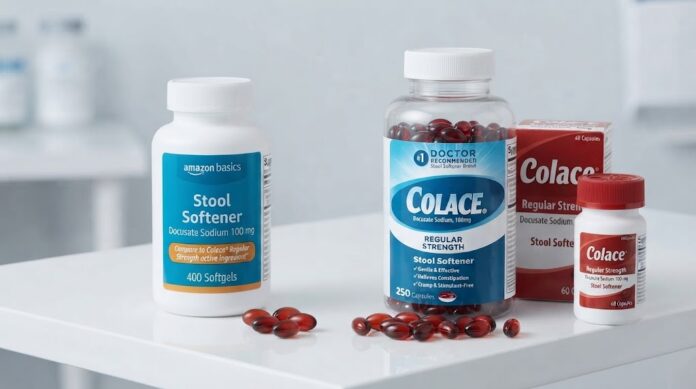
When people search “Amazon Basics Stool Softener vs Colace,” it’s usually because the two sit on the same shelf, and turn up in the same search results, for a simple reason: they both use docusate sodium 100 mg as their only active ingredient, at the same strength. They are not, however, literally the same product. Here is what is actually shared between them, what is genuinely different, and which one makes more sense for your situation.
Amazon Basics vs Colace: Quick Answer
Amazon Basics Stool Softener and Colace both use docusate sodium 100 mg as their only active ingredient, so they are similar in active drug and labeled use for occasional constipation.[1,2] Amazon markets its version as a softgel, and both products are identified in their DailyMed labeling as liquid-filled capsules. So this is mostly a difference in wording. Their inactive ingredient lists overlap substantially (both use gelatin, glycerin, a polyethylene glycol base, propylene glycol, and sorbitol), but the two formulas are not identical.
The most noticeable practical difference is price: Amazon Basics is typically the cheaper option per capsule at most online retailers, while Colace carries the recognition of being marketed as the “#1 doctor recommended” stool softener brand. One caveat before you buy either one: clinical evidence supporting docusate sodium for constipation is limited, so neither product should be treated as a strong, reliably effective standalone treatment. We cover that evidence gap in more detail in our guide to the best stool softeners for constipation.
Bottom line: Amazon Basics and Colace are not literally the same product. They share the same active ingredient at the same strength, docusate sodium 100 mg, but they come from different brands and have somewhat different inactive-ingredient profiles.
Are Amazon Basics Stool Softener and Colace the Same?
In terms of the active drug and its labeled use, yes, essentially. Both products are marketed as OTC docusate sodium products under the FDA’s OTC laxative framework, and both list docusate sodium 100 mg as the sole active ingredient per capsule.[1,2]
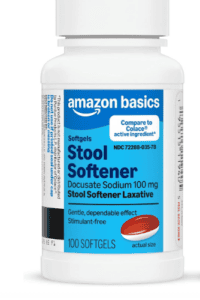
Amazon’s own product listing for Amazon Basics Stool Softener explicitly states that it can be compared to the active ingredient in Colace, which is a common way store-brand and generic manufacturers signal that a product is formulated to match a name brand’s active ingredient and strength.
What is genuinely different is the brand and manufacturer, not the dosage form. Amazon Basics softgels are an Amazon-branded private-label product (the DailyMed label itself is filed under the name “Basic Care Stool Softener,” and current product listings note it was previously sold as “Basic Care”), while Colace is distributed and marketed by Atlantis Consumer Healthcare, the current holder of the Colace brand. Colace currently markets itself as the “#1 doctor recommended” stool softener brand.[1]
That is a brand marketing claim rather than a clinical endorsement, and we were not able to independently verify the survey methodology behind it. Amazon Basics does not make that specific brand claim.
Its own listing instead cites survey data describing docusate sodium generally, rather than the Amazon Basics product specifically, as a physician-recommended active ingredient. That distinction is worth keeping in mind, since “the ingredient is recommended” is not the same claim as “this brand is recommended.”
Active Ingredient: Docusate Sodium
Docusate sodium is classified as a stool softener, sometimes called an emollient laxative or surfactant laxative. It’s a surfactant that helps water and fatty substances mix into the stool, which can make the stool softer and, in theory, easier to pass without straining.
It is worth being honest about the evidence here, since we hold every product on this site to the same standard. A 2021 systematic review of over-the-counter therapies for chronic constipation, led by Rao and Brenner and published in the American Journal of Gastroenterology, found insufficient evidence to support docusate sodium as an effective treatment for chronic constipation.[3]
That finding applies equally to Amazon Basics and Colace, since they share the same active ingredient. Docusate is still used in situations where keeping stools softer and reducing straining is considered useful, for example after surgery, during postpartum recovery, or alongside iron supplementation. The appropriate choice still depends on the clinical situation, so talk to a doctor or pharmacist about whether it fits yours.
For more on iron-related constipation specifically, see our guide to the best laxative for constipation from iron pills. If you are looking for an option with stronger trial evidence for ongoing constipation, our MiraLAX vs Colace comparison and our full best OTC laxatives guide walk through the alternatives.
Amazon Basics Stool Softener vs Colace: Key Differences
| Feature | Amazon Basics Stool Softener | Colace Regular Strength |
|---|---|---|
| Active ingredient | Docusate sodium 100 mg | Docusate sodium 100 mg |
| Dosage form | Softgel (capsule, liquid filled) | Capsule, liquid filled |
| Labeled onset | 12 to 72 hours | 12 to 72 hours |
| Sodium | 6 mg per softgel (very low sodium) | 5 mg per capsule (very low sodium) |
| Labeler/packager | Amazon.com Services LLC (Amazon private label) | Atlantis Consumer Healthcare Inc. |
| Brand positioning | Marketed as comparable to Colace’s active ingredient | Marketed as the “#1 doctor recommended” stool softener brand |
| Gluten free | Marketed as gluten free on the Amazon product listing | Not specifically marketed as gluten free on the standard label |
| Where to buy | Amazon (private label, not typically sold elsewhere) | Amazon, plus most pharmacies, grocery stores, and big box retailers |
| Typical price per capsule | Often the lower-cost option at most online retailers | Often higher cost per capsule than store-brand equivalents |
Prices for both products change frequently and vary by retailer, pack size, and subscription discounts, so treat the pricing row above as a general pattern rather than a fixed figure, and always check the current listing before buying.
If you would rather grab a bottle in person, Colace’s wider retail presence is the more practical option. Amazon Basics, as a private-label brand, is primarily sold through Amazon, so it mainly makes sense if you are already ordering online.
Dosage and Directions
Both products use the standard OTC labeling format for docusate sodium 100 mg, and their current directions line up closely.[1,2]
| Age group | Amazon Basics Stool Softener | Colace Regular Strength |
|---|---|---|
| Adults and children 12 years and older | 1 to 3 softgels daily | 1 to 3 capsules daily |
| Children 2 to under 12 years | 1 softgel daily | 1 capsule daily |
| Children under 2 years | Ask a doctor | Ask a doctor |
Both labels allow the daily dose to be taken all at once or split into smaller doses throughout the day. Neither product should be used for more than one week without talking to a doctor, and if you are pregnant or breastfeeding, ask a health professional before starting either one. For pregnancy-specific guidance, see our guide to high fiber foods for pregnancy constipation, which also covers when a stool softener may be appropriate.
Inactive Ingredients
This is where the two labels differ somewhat, although both products contain several of the same inactive ingredients. Per the current DailyMed labels:[1,2]
Amazon Basics Stool Softener: D&C red no. 33, edible ink, FD&C blue no. 1, FD&C red no. 40, FD&C yellow no. 6, gelatin, glycerin, polyethylene glycol, propylene glycol, purified water, sorbitol sorbitan solution, and titanium dioxide.
Colace Regular Strength: D&C red no. 33, FD&C blue no. 1, FD&C red no. 40, FD&C yellow no. 6, gelatin, glycerin, PEG 400, propylene glycol, sorbitol, and titanium dioxide.
The two formulas overlap substantially. Both use gelatin capsules with the same dye system (D&C Red No. 33, FD&C Blue No. 1, FD&C Red No. 40, FD&C Yellow No. 6), plus glycerin, a polyethylene glycol base, propylene glycol, sorbitol, and titanium dioxide.
They are not identical, though: Amazon Basics additionally lists edible ink, purified water, and sorbitan solution that do not appear on the current Colace 100 mg label. If you have a known sensitivity to a specific dye or excipient, check the ingredient panel on the bottle in your hand rather than relying only on this comparison.
Both products contain very low amounts of sodium per capsule or softgel: 6 mg for Amazon Basics and 5 mg for Colace.
Neither product is dye-free at the 100 mg strength. Colace does sell a separate 50 mg dye-free version marketed as Colace Clear, but that is a different strength and product line, not the 100 mg regular-strength capsule compared here.
How Long Do They Take to Work?
Both products carry the same labeled onset window: generally 12 to 72 hours to produce a bowel movement.[1,2] This is expected, since the onset of action for a stool softener depends on the active ingredient working its way through the digestive tract, not on the brand around it.
If you need something faster than that, docusate sodium, whether store brand or Colace, is generally not a fast-acting option. Our best OTC laxatives for constipation guide breaks down speed of action across categories if timing matters for you.
Side Effects
Because the active ingredient is the same, the major labeled warnings on both boxes are very similar.[1,2] The main safety information on both labels focuses on when not to use the product, when to ask a doctor before use, and when to stop using it and ask a doctor:
- Do not use if you are currently taking mineral oil, unless a doctor tells you to.
- Ask a doctor before use if you have stomach pain, nausea, or vomiting, or if you have noticed a sudden change in bowel habits that has lasted over two weeks.
- Stop use and ask a doctor if you have rectal bleeding, if you fail to have a bowel movement after using a laxative, or if you need to use a stool softener for more than one week. These can be signs of a more serious condition.
- If you are pregnant or breastfeeding, ask a health professional before use.
Neither product is a substitute for medical advice if your constipation is severe or persistent, or if it comes with other symptoms such as significant abdominal pain, vomiting, or rectal bleeding.
Price and Value
This is usually the deciding factor once people confirm the active ingredients match. Across the current retailer listings we compared, the general pattern held up consistently: generic docusate sodium products, including Amazon Basics, tend to sell for less per capsule when bought in larger counts, while Colace tends to run higher per capsule. We are not citing a fixed price range here on purpose.
Online prices shift with promotions, subscribe-and-save discounts, and pack size, sometimes within the same day. Treat this as a general pattern rather than a number to plan around, and check the live price on the listing before you buy.
If the active ingredient and strength are your main considerations, comparing the current price per softgel or capsule can help you decide whether the Amazon Basics product offers enough savings for you. If brand recognition, a long track record, or easy access at your local pharmacy matters more to you than saving a few dollars, Colace’s premium may feel worth it.
Which One Should You Choose?
For someone considering a docusate sodium stool softener, the two products are similar in active ingredient and labeled strength, but they differ in brand, inactive ingredients, and price.[1,2] A few practical pointers:
- Consider Amazon Basics Stool Softener if its current price per softgel is lower than Colace’s and the inactive ingredients work for you.
- Choose Colace if your doctor specifically recommended the brand by name, or if you want the dye-free Colace Clear option at the 50 mg strength.
- Either way, remember that docusate sodium has limited clinical trial support for treating constipation itself, so if it is not working for you after a few days, it is worth looking at better evidence-backed options in our best stool softeners for constipation and best OTC laxatives for constipation guides, or talking to a doctor if your constipation has lasted more than a couple of weeks.
- If you’re switching from one to the other because of a medical recommendation, or if you have a known sensitivity to one of the inactive ingredients that differ between the two, check with a pharmacist or doctor first.
Prices on both change often, so it’s worth checking the current listing before you buy.
Frequently Asked Questions
Is Amazon Basics Stool Softener the same as Colace?
Amazon Basics Stool Softener and Colace Regular Strength both contain docusate sodium 100 mg as their only active ingredient. Both are oral softgel/liquid-filled-capsule products with the same labeled 12 to 72 hour onset, but their inactive ingredients, manufacturer, and some labeling details are not identical.
Can I substitute Amazon Basics Stool Softener for Colace?
Because both contain docusate sodium 100 mg as the only active ingredient, they are similar in active drug and labeled use. If you were specifically told to use the Colace brand by a doctor, or if you have a known sensitivity to one of the inactive ingredients that differ between the two, check with your doctor or pharmacist before switching.
Which is cheaper, Amazon Basics or Colace?
Amazon Basics is typically the lower-cost option per capsule at most online retailers, though exact prices change often with promotions and pack size, so it is worth comparing current listings before you buy.
Do Amazon Basics and Colace work the same way?
Yes. Both contain docusate sodium, a surfactant that helps water and fatty substances mix with the stool, which can make it softer and easier to pass. Their labels state the same 12 to 72 hour expected onset window.
References
- Atlantis Consumer Healthcare, Inc. COLACE, docusate sodium capsule [package insert]. DailyMed, U.S. National Library of Medicine. NDC 67618-101, current label updated June 29, 2026. Available from: https://dailymed.nlm.nih.gov/dailymed/drugInfo.cfm?setid=7793fced-e8ee-44e2-b212-dd2a59a5f462
- Amazon.com Services LLC. BASIC CARE STOOL SOFTENER (Amazon Basics Stool Softener), docusate sodium capsule, liquid filled [package insert]. DailyMed, U.S. National Library of Medicine. NDC 72288-486-78. Available from: https://dailymed.nlm.nih.gov/dailymed/drugInfo.cfm?setid=356a889f-ec23-4eb2-a25c-bbe609475155
- Rao SSC, Brenner DM. Efficacy and Safety of Over-the-Counter Therapies for Chronic Constipation: An Updated Systematic Review. Am J Gastroenterol. 2021;116(6):1156-1181. doi:10.14309/ajg.0000000000001222. PMID: 33767108.
This article is for informational purposes only and is not a substitute for professional medical advice. Talk to your doctor or pharmacist before starting any new stool softener, especially if you are pregnant, breastfeeding, or taking other medications.