


Choosing the best probiotics for IBS-C and constipation is harder than it looks. IBS-C means hard, infrequent stools together with belly pain, bloating, and cramping. Fiber, laxatives, and diet changes do not fully fix it for everyone, which is one reason researchers have looked at the gut microbiome and at probiotics. Probiotics are live microorganisms that can give a health benefit when taken in adequate amounts.[1]
The evidence is real but uneven. Results depend on the strain, so the strain name on the label matters more than the CFU number on the front of the bottle. Also, much of the best data comes from people with functional constipation or IBS in general, not IBS-C alone. This guide explains what the research does and does not show, then reviews seven probiotic supplements sold in the US in 2026. For a wider look at constipation with bloating, see our guides on the best probiotics for constipation and bloating and on probiotic strains for constipation and bloating.
Quick Picks: Best Probiotics for IBS-C and Constipation at a Glance
| # | Product | Best for | Price per month (approx.) |
|---|---|---|---|
| 1 | Align Probiotic | IBS-C with pain and bloating | $30 to $38 |
| 2 | Renew Life Ultimate Flora | Bifidobacterium focus, stool frequency | $23 to $30 |
| 3 | Seed DS-01 | Synbiotic with a gentle, nonfermentable prebiotic | About $50 |
| 4 | Garden of Life Women’s | Women wanting a broad multistrain blend | $35 to $45 |
| 5 | Culturelle Digestive Daily | Budget starting point | $22 to $26 |
| 6 | MegaSporeBiotic | Spore based, shelf stable | $63 to $70 |
| 7 | Visbiome | High potency multistrain | Varies widely by format |
Product details were last reviewed in October 2026. Prices change often, so check the current listing before you buy.
Key Takeaways
- Bifidobacterium lactis strains such as BB-12 and HN019 have the most trial data for constipation, but results across trials are mixed.
- Bifidobacterium infantis 35624 (Align) has the largest IBS trial, with benefits for pain, bloating, and bowel symptoms. That trial enrolled only women and was not limited to IBS-C.
- Spore based probiotics (Bacillus species) survive stomach acid well but have little direct IBS-C data.
- Probiotics are not fast acting. Give a product 4 to 8 weeks, and use it alongside fiber, fluids, and, when needed, magnesium supplements or OTC laxatives.
What Is IBS-C and Why Does the Gut Microbiome Matter?
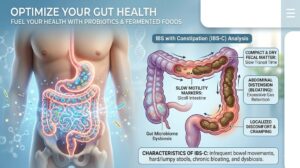
Irritable bowel syndrome with constipation (IBS-C) is a functional gut disorder. It means recurring abdominal pain linked to infrequent or hard stools, without a structural, inflammatory, or biochemical disease that explains the symptoms.[2]
Under the Rome IV criteria, the pain must occur on average at least one day a week over the last three months, with symptoms starting at least six months earlier. It must also be tied to at least two of these: defecation, a change in stool frequency, or a change in stool form. In the constipation subtype, more than 25% of bowel movements are hard or lumpy (Bristol Stool Scale types 1 and 2) and fewer than 25% are loose or watery (types 6 and 7).[2]
IBS-C vs. Chronic Idiopathic Constipation (CIC)
Both involve difficult or infrequent bowel movements. The main difference is abdominal pain: IBS-C requires it, while chronic idiopathic constipation does not. This matters when you read probiotic research. Some trials enrolled people with IBS and measured pain, while others enrolled people with functional constipation and measured stool frequency or transit time. The two groups overlap, but a result in one does not automatically apply to the other.
How Common Is It, and What Causes It?
IBS is common, although prevalence estimates vary widely depending on the diagnostic criteria used. The constipation subtype accounts for roughly a third of cases, and IBS is more common in women.
IBS-C has several overlapping contributors: altered gut motility, visceral hypersensitivity, disrupted gut-brain signaling, low grade inflammation, and possibly changes in the gut microbiome. A small Korean study of 30 people with functional constipation found lower levels of Bifidobacterium and Bacteroides in their stool than in 30 healthy controls.[3] Whether such differences cause constipation or result from slower transit is still unclear.[4] That uncertainty is why probiotics are a reasonable thing to try but not a proven fix.
How Probiotic Supplements May Work for IBS-C and Constipation
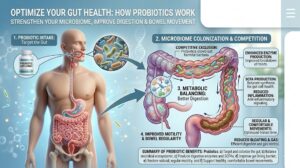
Several mechanisms have been proposed, and the picture is still developing.
Gut motility and transit time
Some probiotic bacteria have been shown to stimulate intestinal motility in animal and human studies, and fermentation products such as short chain fatty acids are one proposed pathway. The exact effects are still being worked out.[4]
Stool consistency and frequency
A systematic review of 14 randomized trials in adults with functional constipation found that probiotics improved stool consistency and may shorten whole gut transit time and raise stool frequency, with the clearest benefit seen for B. lactis strains.[5]
Abdominal pain
Pain is less well understood. Some strains, especially B. infantis 35624, reduced IBS pain in trials, but how they do so is not firmly established. Immune modulation is one proposal.
Microbiome balance
Antibiotics, illness, stress, and a low fiber diet can all disturb the gut microbiome, and probiotics try to add beneficial bacteria back. Whether that actually explains any symptom relief is still an open question. A major review noted that no study has yet shown that clinical improvements are caused by probiotic-induced changes in the microbiota.[6]
Wondering why fiber alone has not fixed your constipation? See: Why Fiber Isn’t Working for Your Constipation (And How MCT Oil & Probiotics Can Help).
Best Probiotic Strains for IBS-C and Constipation: Evidence by Strain
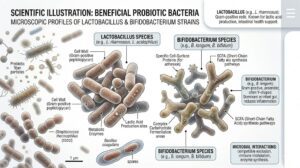
This is where many buying guides fall short. Here is what the research shows for the strains most often used in probiotics for IBS-C and constipation.
Bifidobacterium lactis BB-12
Bifidobacterium animalis subsp. lactis BB-12 is a common ingredient in probiotic products. Recent systematic reviews of probiotics for constipation give Bifidobacterium strains a prominent place,[7] but most of that evidence is grouped at the species level (B. lactis) rather than for BB-12 alone. The data are encouraging but mixed, and most trials enrolled people with functional constipation rather than IBS-C.
Bifidobacterium lactis HN019
In a 14 day trial of 100 adults, HN019 shortened whole gut transit time in a dose dependent way, at 17.2 billion and 1.8 billion CFU per day.[8] A later 28 day, dose ranging trial in 228 adults with functional constipation also reported benefits, especially in people with low stool frequency (three or fewer bowel movements a week).[9] However, an 8 week trial of 229 adults in Shanghai found no advantage over placebo for complete spontaneous bowel movements.
The dose there started at 7.0 billion CFU a day and fell to about 4.7 billion by the end of the study, and both groups improved.[10] HN019 looks promising, but the results are not consistent, and dose and study population seem to matter.
Bifidobacterium infantis 35624
This is the strain in Align (the label now calls it Bifidobacterium longum subsp. longum 35624), and it has the largest IBS trial of any strain in this guide. In 362 women with IBS of any bowel habit, 100 million CFU daily for four weeks beat placebo for abdominal pain, bloating, bowel dysfunction, incomplete evacuation, and straining.
The 1 million CFU dose and the 10 billion CFU dose did not beat placebo, and the highest dose had formulation problems.[11] Two caveats apply: the trial was not limited to IBS-C, and it enrolled only women.
Why is Align ranked first if B. lactis has more constipation research? Abdominal pain is a required feature of IBS-C, and B. infantis 35624 has the largest IBS trial covering pain, bloating, and bowel symptoms together. If your main problem is stool frequency without much pain, a B. lactis based product such as Renew Life (#2) may suit you better.
Lactobacillus reuteri DSM 17938
A small randomized trial of 40 adults with chronic functional constipation reported more bowel movements per week than placebo after four weeks, with no change in stool consistency.[12] The evidence rests on small trials, so treat it as promising rather than established. Our dedicated guide goes deeper: Does L. Reuteri Help Constipation and Bloating?
Lactobacillus acidophilus NCFM + Bifidobacterium lactis Bi-07
A small placebo controlled trial of 60 people with functional bowel disorders reported less bloating with this combination. However, it enrolled people without constipation, so it says little about IBS-C.[13]
Lactobacillus plantarum 299v
In a 4 week trial of 214 people with IBS, this strain reduced abdominal pain and bloating compared with placebo.[14] Its evidence for constipation is weaker, so it is better seen as a supporting strain than a main pick for IBS-C.
Bacillus coagulans GBI-30, 6086
Spore formers survive stomach acid far better than most conventional strains. A small, preliminary trial of 44 people with IBS reported improvement in abdominal pain and bloating from baseline. The groups started at different baseline levels, though, so the comparison with placebo is weak.[15] Direct IBS-C evidence is limited, so this strain makes sense as an add-on rather than a first choice.
Quick reference by symptom
- Transit time and stool frequency: B. lactis BB-12 and HN019, L. reuteri DSM 17938
- Abdominal pain and bloating: B. infantis 35624, B. coagulans GBI-30 (preliminary data), L. plantarum 299v
- Broader coverage: multistrain blends that combine B. lactis with other Lactobacillus or Bifidobacterium strains
- Shelf stable and travel friendly: spore based Bacillus products
Top 7 Probiotic Supplements for IBS-C and Constipation: 2026 Reviews
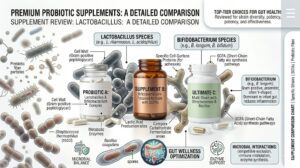
We ranked these products by how closely their strains and doses match human trial data, then looked at CFU count and viability, manufacturing quality, tolerability for people with IBS, and value. All seven are sold in the US. Where a product’s own strains do not match the studies above, we say so.
-
#1 Align Probiotic Supplement (Best for IBS-C Pain and Bloating)
Key strain Bifidobacterium longum 35624 (Bifantis®), earlier called B. infantis 35624 CFU 1 billion when manufactured; the label states 10 million until the best by date Capsules per month 28 Price About $30 to $38 per month Refrigeration Not required Align comes first because abdominal pain is part of what defines IBS-C, and 35624 has the largest IBS trial behind it.[11] Benefit in IBS-C specifically is inferred rather than proven, and the trial enrolled only women.
On potency, the label states 1 billion CFU at manufacture and 10 million CFU until the best by date. The dose that worked in the trial was 100 million CFU, and a 10 billion dose did not beat placebo. Label potency and trial dose are not directly comparable, which is a good example of why CFU alone tells you little about a product.
Pros
- Large IBS trial behind the strain
- Targets pain and bloating as well as bowel symptoms
- No refrigeration needed
- Widely available
Cons
- Single strain, with no B. lactis for transit time support
- The cost adds up over several months
- May take about 4 weeks to notice a change
Who it is for: People with IBS-C whose main complaints are abdominal pain and bloating. You can buy it on Amazon, the manufacturer’s page, or iHerb.
#2 Renew Life Ultimate Flora Extra Care Probiotic 30 Billion (Best for Stool Frequency and Transit Time)
Key strains Bifidobacterium focused blend: about 17.5 billion CFU of Bifidobacterium (mostly B. lactis) and about 12.5 billion CFU of Lactobacillus and related strains CFU 30 billion (other strengths exist) Capsules per month 30 Price About $23 to $30 per month Refrigeration Not required for the 30 billion Extra Care capsule, according to the manufacturer For IBS-C where stool frequency and transit time matter more than pain, this is one of the more Bifidobacterium dense options in this list. It leans on B. lactis, the species with the clearest constipation signal in reviews,[5] and uses a delayed release vegan capsule designed to protect the bacteria from stomach acid.
The limitation is transparency. Different versions of Ultimate Flora have listed different strains (one version names B. lactis HN019 and Bi-07, while newer labels use Renew Life’s own strain codes). Many retailer listings also show CFU only as a blend total, so you cannot match the product to specific trials or confirm per strain doses. There is no IBS-C trial of this exact product either.
Pros
- Bifidobacterium focused blend
- Delayed release capsule
- No refrigeration needed for this version
- Good value for the potency
Cons
- Per strain doses are not disclosed
- Strain list differs between versions, so check your bottle
- No IBS-C trial of the exact product
Who it is for: People who want a high potency, Bifidobacterium rich product aimed at stool frequency and transit time.You can buy it on Amazon or iHerb.
#3 Seed DS-01 Daily Synbiotic (Best Synbiotic)
Key ingredients 24 strains plus a nonfermentable prebiotic from Indian pomegranate Potency 53.6 billion AFU Capsules per month 60 (2 per day) Price About $50 per month (Seed also sells it directly by subscription at $49.99) Refrigeration Not required Seed DS-01 has a feature that is useful for IBS-C. Its prebiotic comes from Indian pomegranate rind (punicalagins), which Seed describes as nonfermentable. Fermentable prebiotics such as inulin and FOS are common in probiotic supplements and often add gas and bloating for people with IBS, so avoiding them is a sensible design choice.
Seed measures potency in AFU (active fluorescent units) rather than CFU. The company says this is a more sensitive way to count live cells, but the method is not yet standardized across the industry. Seed reports four human clinical trials on DS-01, though most are company funded and independent replication is limited.[16]
Pros
- Nonfermentable prebiotic, which suits many people with IBS
- No refrigeration needed
- Acid resistant capsule-in-capsule design
- Transparent about its research
Cons
- Higher cost than most competitors
- Not every strain has IBS-C trial data
- Most published trials are industry funded
- Two capsules per day
Who it is for: People who want a premium synbiotic with a gentler prebiotic, especially if other probiotics have left them bloated. You can buy it on Amazon.
#4 Garden of Life Dr. Formulated Probiotics Once Daily Women’s (Best for Women Wanting a Broad Blend)
Key strains 16 Lactobacillus and Bifidobacterium strains, including L. plantarum Lp-115, L. acidophilus La-14, B. lactis Bl-04, and L. reuteri CFU 50 billion Capsules per month 30 Price About $35 to $45 per month Refrigeration Current listings for this once daily, 30 capsule bottle describe it as shelf stable. Garden of Life also sells refrigerated probiotics under similar names, so check the label of the exact bottle. This is a once daily, multistrain probiotic with 16 strains and an organic prebiotic fiber blend (potato resistant starch and acacia gum), which makes it a synbiotic. It is marketed for digestive, immune, and vaginal health, and it is labeled dairy free and gluten free.
One caution about the IBS-C angle. The label lists L. reuteri at only about 0.3 billion CFU of the 50 billion total. The strain code on the label has also changed over time (UALR-16 on older labels, 1E1 on newer ones). Neither is the DSM 17938 strain used in constipation trials.[12] Evidence is strain specific, so the constipation data for DSM 17938 should not be assumed to apply here. We are not aware of an IBS-C trial of this exact blend, which is why it sits below the three products above.
People who are sensitive to FODMAPs should try the prebiotic fiber carefully, since acacia and resistant starch can cause gas or bloating in some people with IBS. If gas and bloating are your main problem, our guide to probiotic strains for constipation and bloating explains how strain priorities differ from pure transit support.
Pros
- High potency with many strains
- Prebiotic fiber included
- Labeled dairy free and gluten free
- Designed with women’s health in mind
Cons
- The IBS-C evidence for these exact strains is limited
- The prebiotic fiber may cause bloating in sensitive people
- Higher price than basic options
- Other Garden of Life probiotics are refrigerated, so match the bottle to the label
Who it is for: Women who want a high potency, multistrain daily probiotic for general digestive support, understanding that it is not the most evidence backed choice for IBS-C.You can buy it on Amazon, the manufacturer’s page, or iHerb.
#5 Culturelle Digestive Daily Probiotic (Best Budget Pick)
Key strain Lactobacillus rhamnosus GG (LGG) CFU 10 billion Prebiotic Some versions list 200 mg of inulin (chicory root), so check the label Capsules per month 30 Price About $22 to $26 per month Refrigeration Not required Culturelle is built around Lactobacillus rhamnosus GG, one of the most extensively studied probiotic strains, with a long safety record.[17] Direct evidence for IBS-C is more limited than for the Bifidobacterium strains above, so expect a modest effect, if any, on stool frequency.
One thing to watch: some versions of Culturelle Digestive Daily add inulin, the same high FODMAP prebiotic we warn about in the buying guide below. If you are sensitive to FODMAPs, look for a version without it.
For someone new to probiotics or working with a limited budget, it is a dependable, well tolerated starting point that is easy to find in pharmacies.
Pros
- Well documented strain with a strong safety record
- Affordable and widely available
- No refrigeration needed
Cons
- Limited direct evidence for IBS-C
- Single strain, with no Bifidobacterium for motility support
- Some versions contain inulin, which can worsen bloating in IBS
Who it is for: Budget conscious people starting out with probiotics, or those with mild symptoms who want a low risk option alongside diet changes.You can buy it on Amazon, the manufacturer’s page, or iHerb.
#6 MegaSporeBiotic (Best Spore Based Option)
Key strains 5 Bacillus spore strains: B. indicus HU36, B. subtilis HU58, B. coagulans SC-208, B. clausii SC-109, B. licheniformis SL-307 CFU 4 billion per serving (2 capsules) Capsules per month About 60 (2 per day) Price About $63 to $70 per month Refrigeration Not required MegaSporeBiotic takes a different approach from Lactobacillus and Bifidobacterium products. Its Bacillus species form protective endospores, so they survive stomach acid, heat, and storage much better than conventional strains. A small 45 day study in adults who took a spore based probiotic found changes in the expression of genes linked to gut immunity after a high fat meal.[18]
That is not IBS-C data. The strain with an IBS trial above, B. coagulans GBI-30, is also not the B. coagulans strain in this product. Direct IBS-C evidence is thin and the price is high, which is why it sits at #6, even though it can be worth considering if conventional probiotics have not helped. The label suggests building up slowly (one capsule every other day, then daily, then two a day) to limit gas. Our side by side review has more detail: Best Spore-Based Probiotic 2026: MegaSporeBiotic vs Just Thrive.
Histamine note: Some people with histamine intolerance or mast cell activation syndrome report symptoms with Bacillus products. The evidence is limited, but if this applies to you, talk with your gastroenterologist first.
Pros
- Strong acid stability and no refrigeration
- Useful for travel
- A reasonable second option when conventional probiotics have not worked
Cons
- Little direct IBS-C evidence
- High cost for the evidence available
- An adjustment period with gas is possible
- Possible concern for people with histamine sensitivity
Who it is for: People who have not responded to conventional probiotics, who need a shelf stable travel option, or who want to try a different type of product alongside other IBS-C treatment. You can buy it on Amazon.
#7 Visbiome High Potency Probiotic (Best High Potency Formula)
Key strains 8 strains: 4 Lactobacillus, 3 Bifidobacterium, and Streptococcus thermophilus CFU 112.5 billion (capsule) to 450 billion (packet). Extra Strength packets have 900 billion and are prescription only. Price Varies widely by format and dose Refrigeration Required Visbiome vs. VSL#3: The license that let VSL Pharmaceuticals sell Prof. Claudio De Simone’s eight strain formula under the VSL#3 name expired in early 2016. De Simone then worked with ExeGi Pharma, which launched the same formulation as Visbiome in the US and Canada. VSL#3 is now sold by a different company, and its formulation differs from the one used in most studies done before 2016. In practice, older studies of “VSL#3” apply to Visbiome, not to the VSL#3 on shelves today. See our VSL#3 guide for more.
Visbiome has been studied mostly in pouchitis and ulcerative colitis. For constipation, the evidence is smaller. One study of 30 adults with functional constipation gave VSL#3 (one sachet twice daily for two weeks) and reported higher Bristol scores and more complete spontaneous bowel movements per week. However, it was not a placebo controlled trial, and 44% of the patients who improved had a recurrence of constipation after stopping, mostly within a month.[3] The study also used VSL#3 before the 2016 split, so it relates to the formula now sold as Visbiome.
Very high CFU totals reflect eight strains delivered together, and whether doses this high are needed for constipation has not been established. Visbiome is marketed as a medical food for use under medical supervision, and the Extra Strength version requires a prescription, so ask your doctor before choosing it.
Pros
- A long research history in gastroenterology
- Eight strain blend of Bifidobacterium and Lactobacillus
- Some data in functional constipation
Cons
- Expensive and requires refrigeration
- Confusion with VSL#3
- Can cause bloating at the start because of the high dose
- The constipation data are from functional constipation, not IBS-C
Who it is for: People with persistent IBS-C or functional constipation who want a heavily studied multistrain formula and are working with a doctor. You can buy it on Amazon.
More Guides from Constipation Relief
If you want to compare more options, start with our guides to the best probiotics for constipation and bloating and the best probiotic strains. You can also read how MegaSporeBiotic compares with Just Thrive, or see whether L. reuteri helps constipation and bloating.
A probiotic can take weeks to work, so you may want something faster in the meantime. Our guides cover the best OTC laxatives, the best magnesium supplements, and the best psyllium husk. If you are choosing between two common options, see MiraLAX vs Colace, or try some natural constipation relief remedies at home. For a stimulant option, read about the best senna tea.
If fiber has not helped you, read why fiber isn’t working for your constipation and why fiber supplements can make constipation worse.
Probiotic Buying Guide for IBS-C: What to Look For
Strain identity over CFU count
A label that says “50 billion CFU” tells you little by itself. Look for products that name strains down to the strain designation, for example Lactobacillus rhamnosus GG rather than just “Lactobacillus rhamnosus,” and check whether that exact strain has been tested in people with symptoms like yours.
CFU guaranteed through expiry
Live bacteria decline over time. Choose products that guarantee their CFU count through the expiration date, not only at the time of manufacture.
Acid resistant delivery
Conventional probiotics have to survive stomach acid. Delayed release or enteric coated capsules, Seed’s capsule-in-capsule design, and naturally acid resistant spore formers are all attempts to solve this.
Prebiotic content and FODMAPs
Prebiotics can help probiotics, but the type matters in IBS. Inulin, chicory root, and FOS are high FODMAP and often worsen bloating and cramping. Some versions of Culturelle Digestive Daily, for example, add inulin. Better tolerated options include partially hydrolyzed guar gum (PHGG), pomegranate rind extract (as in Seed DS-01), or small amounts of acacia fiber. If you follow a low FODMAP diet, also check fillers such as mannitol or sorbitol, which can trigger symptoms on their own.
Third party testing
Independent certification from NSF International, USP, or ConsumerLab helps confirm that a product contains what the label claims and is free of contaminants.
Refrigeration is a practical factor, not a quality signal
A refrigerated product is not automatically better than a shelf stable one. If you travel or would forget to keep it cold, a shelf stable product you take every day is the better choice.
While a probiotic takes effect over weeks, you may need something faster. See OTC laxatives for short term options.
How to Take Probiotic Supplements for IBS-C
- Be consistent. Take one product daily and change only one thing at a time, so you can tell what is helping.
- Follow the label on timing. Some products are taken with food and others work with or without it. Pick a time you will remember.
- Start gently if you get gas. Temporary gas or bloating is common at the start. With multi capsule products, some people begin with one capsule a day for a week or two.
- Ask about antibiotics. If you are taking antibiotics, ask your doctor or pharmacist how to time your probiotic.
- Pair with fiber you tolerate. Oat bran, cooked vegetables, and psyllium (if it suits you) can support regularity without upsetting IBS. See Best Psyllium Husk for Constipation Relief in 2026.
- Keep a symptom diary. Record bowel movements per week, stool form on the Bristol scale, bloating, and pain for the first 8 weeks. It helps you and your doctor judge the result.
When to See a Doctor About IBS-C Symptoms
Constipation should be evaluated properly before you assume it is functional. Speak with a gastroenterologist or GP promptly if you notice any of the following:
- Blood in the stool or unexplained rectal bleeding
- Unexplained weight loss
- New constipation after age 50, which calls for colorectal cancer screening
- Fever together with bowel symptoms
- Symptoms that wake you from sleep
- Worsening symptoms despite diet, lifestyle, and probiotic changes
- A family history of colorectal cancer or inflammatory bowel disease
These can point to conditions beyond IBS-C, including inflammatory bowel disease, colorectal cancer, or thyroid disorders, and a probiotic cannot treat them.
Frequently Asked Questions About Probiotics for IBS-C
What is the best probiotic strain for IBS-C?
It depends on your main symptom. Bifidobacterium lactis strains such as BB-12 and HN019 have the most trial data for stool frequency and transit time in functional constipation, though results are mixed. Where pain and bloating dominate, Bifidobacterium infantis 35624 (Align) has the largest IBS trial.[11] For a closer comparison, see Best Probiotic Strains for Constipation and Bloating.
How long do probiotics take to work for IBS-C?
Most trials last 2 to 8 weeks, and the largest IBS trial ran for 4 weeks. A practical approach is to take one product daily for 4 to 8 weeks and track your symptoms before judging it. Some people notice changes in stool consistency sooner, but others notice nothing at all, which can simply mean that strain does not suit you.
Can probiotics make constipation worse?
Sometimes, at least at first. Gas and bloating are the most common complaints, and highly fermentable prebiotics such as inulin, FOS, and chicory root can make them worse. If symptoms get clearly worse or last beyond two weeks, stop the product and speak with your healthcare provider.
Are spore-based probiotics better for IBS-C than traditional ones?
Not necessarily. Bacillus spore products survive stomach acid well and do not need refrigeration, but direct IBS-C evidence is thinner than for some Bifidobacterium strains. Many people treat them as a second option after a conventional probiotic has not worked. See our comparison: Best Spore-Based Probiotic 2026: MegaSporeBiotic vs Just Thrive.
Do I need a prescription for probiotics for IBS-C?
Most products in this guide are sold over the counter in the US. Visbiome is a medical food meant to be used under medical supervision, and its Extra Strength packets (900 billion CFU) are prescription only. Check the current listing, and talk to your doctor before starting any supplement, especially if you take medication or have a diagnosed condition.
Can I take probiotics with laxatives or magnesium?
Usually yes. Many clinicians suggest an osmotic option such as magnesium supplements for near term relief while a probiotic has time to work. If you are also on antibiotics, ask your doctor or pharmacist how to space the doses. Check with them as well about any interaction with prescription medicines.
Are probiotics safe for long term use?
Probiotics are generally well tolerated in healthy adults. Rare cases of bloodstream infection have been reported in high risk groups, so people with weakened immune systems, central venous catheters, or serious illness should speak with a gastroenterologist first.[17]
Does Align work for men with IBS-C?
The main Align trial enrolled only women, so the evidence in men is thinner.[11] Gastroenterologists still suggest it to men with IBS, but that is an extrapolation.
What is the difference between Visbiome and VSL#3?
Visbiome (ExeGi Pharma) carries the original De Simone formulation that was sold as VSL#3 before 2016. Today’s VSL#3 is made by a different company and differs from that formula. The Visbiome review above and our VSL#3 guide have the details.
The Bottom Line: Choosing the Right Probiotic for IBS-C
The research on probiotics for IBS-C is promising, but expectations should stay realistic. Any benefit tends to build over weeks, and it depends on the strain.
For most people, these are the clearest starting points:
- Abdominal pain and bloating dominate: Align (B. infantis 35624).[11]
- Stool frequency and transit time are the priority: Renew Life Ultimate Flora (#2), a B. lactis focused product.
- You want a gentler prebiotic: Seed DS-01 (#3).
- Conventional probiotics have not worked: MegaSporeBiotic (#6) as a spore based option, or Visbiome (#7) for a high potency multistrain formula, keeping in mind the difference from the current VSL#3.
Probiotics work best as one part of a broader plan. Our guides on magnesium supplements, psyllium husk supplements, and OTC laxatives can help you build the rest of that plan, and our guide to probiotic strains for constipation and bloating covers the different priorities when bloating is a major symptom.
Affiliate disclosure: This article contains affiliate links. If you buy through them, we may earn a small commission at no extra cost to you. Our recommendations are based on research and editorial judgment.
Medical disclaimer: The information on this page is for general educational purposes only and is not a substitute for professional medical advice, diagnosis, or treatment. Individual responses to supplements vary. Always consult a qualified healthcare provider before starting, stopping, or changing any supplement or treatment, especially if you have an underlying medical condition.
References
- Hill C, et al. Expert consensus document: The International Scientific Association for Probiotics and Prebiotics consensus statement on the scope and appropriate use of the term probiotic. Nature Reviews Gastroenterology & Hepatology. 2014;11(8):506-514. PMID: 24912386
- Lacy BE, et al. Bowel Disorders. Gastroenterology. 2016;150(6):1393-1407.e5. [Rome IV diagnostic criteria for IBS] PMID: 27144627
- Kim SE, Choi SC, Park KS, et al. Change of fecal flora and effectiveness of the short-term VSL#3 probiotic treatment in patients with functional constipation. Journal of Neurogastroenterology and Motility. 2015;21(1):111-120. PMID: 25537674
- Alteration of gut microbiota and efficacy of probiotics in functional constipation [editorial]. Journal of Neurogastroenterology and Motility. 2015;21(1):4-7. PMC4288092
- Dimidi E, Christodoulides S, Fragkos KC, Scott SM, Whelan K. The effect of probiotics on functional constipation in adults: a systematic review and meta-analysis of randomized controlled trials. American Journal of Clinical Nutrition. 2014;100(4):1075-1084. PMID: 25099542
- Sanders ME, Guarner F, Guerrant R, et al. An update on the use and investigation of probiotics in health and disease. Gut. 2013;62(5):787-796. PMID: 23474420
- Garzon Mora N, Jaramillo AP. Effectiveness of probiotics in patients with constipation: a systematic review and meta-analysis. Cureus. 2024;16(1):e52013. PMID: 38344565
- Waller PA, et al. Dose-response effect of Bifidobacterium lactis HN019 on whole gut transit time and functional gastrointestinal symptoms in adults. Scandinavian Journal of Gastroenterology. 2011;46(9):1057-1064. PMID: 21663486
- Ibarra A, et al. Effects of 28-day Bifidobacterium animalis subsp. lactis HN019 supplementation on colonic transit time and gastrointestinal symptoms in adults with functional constipation: a double-blind, randomized, placebo-controlled, and dose-ranging trial. Gut Microbes. 2018;9(3):236-251. PMC6219592
- Cheng J, et al. Eight-week supplementation with Bifidobacterium lactis HN019 and functional constipation: a randomized clinical trial. JAMA Network Open. 2024;7(10):e2436888. PMID: 39356506
- Whorwell PJ, et al. Efficacy of an encapsulated probiotic Bifidobacterium infantis 35624 in women with irritable bowel syndrome. American Journal of Gastroenterology. 2006;101(7):1581-1590. PMID: 16863564
- Ojetti V, et al. The effect of Lactobacillus reuteri supplementation in adults with chronic functional constipation: a randomized, double-blind, placebo-controlled trial. Journal of Gastrointestinal and Liver Diseases. 2014;23(4):387-391. PMID: 25531996
- Ringel Y, Ringel-Kulka T, Maier D, et al. Probiotic bacteria Lactobacillus acidophilus NCFM and Bifidobacterium lactis Bi-07 versus placebo for the symptoms of bloating in patients with functional bowel disorders: a double-blind study. Journal of Clinical Gastroenterology. 2011;45(6):518-525. PMID: 21436726
- Ducrotté P, Sawant P, Jayanthi V. Clinical trial: Lactobacillus plantarum 299v (DSM 9843) improves symptoms of irritable bowel syndrome. World Journal of Gastroenterology. 2012;18(30):4012-4018. PMID: 22912552
- Hun L. Bacillus coagulans significantly improved abdominal pain and bloating in patients with IBS. Postgraduate Medicine. 2009;121(2):119-124. PMID: 19332970
- Seed Health. DS-01 Clinical Research Summary. (accessed June 2026). [Industry-funded trials; see individual published studies for independent peer review.] seed.com/research
- Doron S, Snydman DR. Risk and safety of probiotics. Clinical Infectious Diseases. 2015;60(Suppl 2):S129-S134. PMID: 25922398
- McFarlin BK, Deemer SE, Bridgeman EA. Oral spore-based probiotic supplementation alters post-prandial expression of mRNA associated with gastrointestinal health. Biomedicines. 2024;12(10):2386. PMC11504401


[…] A systematic review and meta-analysis published in the American Journal of Gastroenterology found that certain probiotic strains, particularly Lactobacillus and Bifidobacterium, were associated with increased stool frequency and reduced transit time in people with chronic constipation.[7] While kombucha contains live cultures, the specific strains and concentrations vary considerably between products, so its clinical effect is less predictable than targeted probiotic supplements. For evidence-based probiotic options, see our guide to the best probiotics for IBS-C and constipation. […]
[…] If you’re also dealing with abdominal pain alongside constipation, not just infrequent stools, you may actually have IBS-C rather than simple functional constipation. We cover strain selection for that specifically in our guide: Best Probiotics for IBS-C and Constipation. […]