

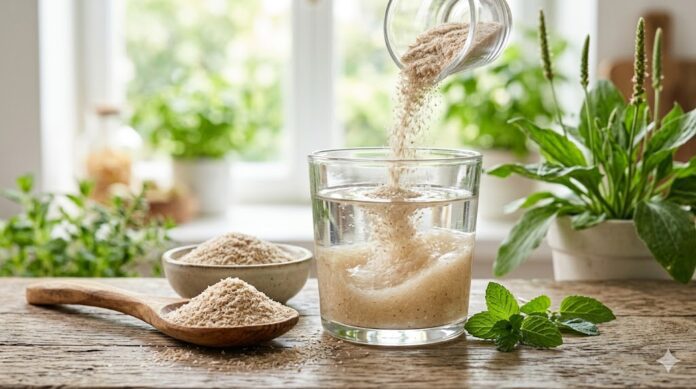
If you’re searching for the best psyllium husk for constipation relief, this is the only guide you need. Psyllium husk for constipation is one of the most doctor-recommended, evidence-backed solutions available — gentle on your gut, free of dependency risk, and effective for both occasional and chronic constipation. Unlike stimulant laxatives that force the bowel to contract, psyllium works naturally by forming a soft, water-absorbing gel that bulks and softens stool from the inside.
Among fiber supplements, psyllium has the strongest evidence base and is commonly recommended as a first-line option for chronic constipation by gastroenterology guidelines — including those of the American Gastroenterological Association (AGA). The FDA has also granted psyllium a qualified health claim for heart health, a distinction backed by decades of clinical research.
In this 2026 expert guide, we review the 6 best psyllium husk products for constipation, explain the science behind how they work, compare them side by side, and give you a clear dosage plan — so you can start feeling relief fast.
🔬 Quick FactsPsyllium husk comes from the Plantago ovata plant. It is ~85–90% dietary fiber by weight, with 70–80% being soluble fiber. Among supplemental fibers, psyllium has the strongest clinical evidence base for constipation and is commonly recommended as a first-line option by gastroenterology guidelines. It also carries an FDA-approved health claim for reducing heart disease risk.
What Is Psyllium Husk?
Psyllium husk is the outer seed coat (husk) of the Plantago ovata plant — a small annual herb primarily grown in the Rajasthan region of India, which is the world’s leading commercial producer of psyllium husk. The husk is harvested, cleaned, and milled into various forms: whole husks, fine powder, and capsules.
What makes psyllium remarkable is its fiber composition. The husk is approximately 85–90% dietary fiber by dry weight (by most estimates), with about 70–80% of that being soluble fiber — specifically arabinoxylan, a branched hemicellulose polysaccharide. When psyllium contacts water, this compound can absorb many times its weight in fluid and forms a thick, viscous gel. This gel-forming property is unique among common fiber supplements and underpins psyllium’s effectiveness across multiple health outcomes — from constipation to cholesterol to blood sugar management.
Psyllium is sold under many brand names — most famously as Metamucil — but also as plain organic powder, whole husks, and capsules from brands like Organic India and NOW Foods. The active ingredient is identical regardless of brand; what differs is purity, additives, price, and certification.
How Psyllium Husk Helps With Constipation
The Gel-Forming Mechanism
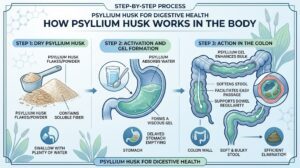
When you swallow psyllium husk with water, the arabinoxylan begins absorbing liquid almost immediately. By the time it reaches your colon, it has formed a soft, slippery gel that surrounds the stool — serving two critical functions:
- Stool softening: The gel adds moisture to hard, dry stool, making it softer and easier to pass — without the cramping associated with stimulant laxatives.
- Bulk addition: The expanded fiber mass increases stool size, which stimulates the natural rhythmic contractions of your colon (peristalsis) and moves stool toward the rectum.
Critically, psyllium is largely non-fermentable, meaning it doesn’t get broken down by gut bacteria the way fermentable fibers like inulin do. This significantly reduces excess gas production — a common complaint with other fiber supplements.
Scientific Evidence
The clinical backing for psyllium is extensive. A 2024 systematic review and meta-analysis published in Nutrients found that psyllium supplements — particularly at doses above 10 g/day — were most effective at improving stool consistency and constipation symptoms in elderly patients, with significant results after four or more weeks of treatment.[4]
A randomized, placebo-controlled clinical trial[2] found that psyllium husk significantly relieved constipation symptoms in women of reproductive age — including reductions in hard stool frequency (36%), pain with bowel movement (24%), and feelings of incomplete defecation (56%) — compared to placebo, with no serious adverse effects.
Research published in Gastroenterology (2023) further confirmed that psyllium positively alters gut microbiota composition, has anti-inflammatory effects in the intestine, and functions as a bowel-regulating agent — benefits that work through independent mechanisms simultaneously.[3]
📚 Research HighlightUnlike stimulant laxatives (e.g., senna, bisacodyl), psyllium husk does not stimulate the bowel muscles or cause dependency. It functions as a bulk-forming fiber, making it one of the few constipation treatments that gastroenterology guidelines consider appropriate for daily long-term use.
Psyllium Husk vs. Metamucil: The Real Difference
Before diving into product reviews, one critical point: Metamucil is psyllium husk. The active ingredient is exactly the same. Metamucil simply adds flavoring, sweeteners, and brand recognition to what is otherwise identical fiber. Here’s how they compare across the factors that actually matter:
| Feature | Pure Psyllium Husk Brands | Metamucil |
|---|---|---|
| Active Ingredient | Psyllium husk | Psyllium husk (identical) |
| Added Ingredients | None (unflavored products) | Citric acid, natural flavors, sweeteners |
| Flavor Options | Unflavored (most brands) | Orange, berry, unflavored |
| Price per Serving | $0.08–$0.15 | $0.22–$0.35 |
| Organic Options | Yes (Organic India, Viva Naturals) | No |
| USP Verification | Rare (most brands do not carry USP) | Select SKUs carry USP verification (check label) |
| Fiber per Serving | 5–6g (higher in most pure brands) | 3.4g soluble fiber |
| Artificial Sweeteners | None (unflavored versions) | Stevia or aspartame (sugar-free versions) |
Bottom line: Pure psyllium powders cost 40–60% less per serving than Metamucil and deliver more fiber per serving without additives. Metamucil’s advantages are USP quality verification and flavor options that genuinely help some people stay consistent. If you can tolerate the unflavored taste, a pure brand like NOW Foods or Organic India gives you the same benefit for significantly less money.
Affiliate Disclosure: This article may contain affiliate links. If you purchase through these links, we may earn a small commission at no extra cost to you. Our recommendations are based on research and editorial evaluation, not affiliate partnerships.
Best Psyllium Husk Products for Constipation (2026 Reviews)
We evaluated more than a dozen psyllium husk supplements based on fiber content per serving, ingredient purity, organic certification, value for money, user reviews, and third-party quality testing. Here are our top 6 picks across key categories.
1. Organic India Psyllium Husk Whole Husk Fiber Powder
| Feature | Details |
|---|---|
| ⭐ Rating | Highly Rated by Amazon Customers (Avg. 4.8/5 at time of review — check current listing) |
| Type | Whole Husk Powder |
| Fiber Content | 5g per serving |
| Price | Approximately $18–22 (12 oz) |
| Certification | USDA Organic & Non-GMO |
Organic India is widely regarded as the gold standard in psyllium supplementation. Sourced from Rajasthan farmers through Fair Trade and regenerative agriculture practices, this whole-husk powder dissolves evenly in liquid, has a mild neutral taste, and delivers a clean 5g of fiber per serving with no additives, artificial sweeteners, or fillers.
It is USDA Certified Organic, Non-GMO Verified, vegan, and gluten-free — ticking every clean-label box. For people who use psyllium daily and want the highest quality with ethically sourced ingredients, Organic India is the standout choice.
✅ Pros
- USDA Organic & Fair Trade certified
- No artificial additives or sweeteners
- Excellent mixability and neutral taste
- High user satisfaction (4.8 stars)
- Vegan and gluten-free
❌ Cons
- Slightly pricier than generic brands
- 5g fiber per serving (some want more)
- Unflavored only
Check Price: Organic India Psyllium Husk →Price and availability may change. Check Amazon for current pricing.

2. NOW Foods Psyllium Husk Powder
NOW Foods delivers 6g of fiber per serving at approximately $0.12 per serving — the highest fiber-per-dollar ratio in this review. It is Non-GMO Project Verified, contains no additives, and is manufactured in GMP-certified facilities. The finely milled powder blends more smoothly than coarser whole-husk products, making it a practical choice for daily use in water, juice, or oatmeal.
✅ Pros
- Highest fiber per serving (6g) in this category
- Outstanding value ($0.12/serving)
- Non-GMO Verified
- Smooth powder, easy to mix
- GMP-certified manufacturing
❌ Cons
- Not USDA Organic certified
- Unflavored only
- May thicken quickly if not consumed fast
Check Price: NOW Foods Psyllium Powder →Price and availability may change. Check Amazon for current pricing.

3. Metamucil 4-in-1 Psyllium Husk Fiber Supplement (Orange)
| Specification | Information |
|---|---|
| Customer Rating | ⭐ 4.6/5 (at time of review) |
| Form | Flavored Powder |
| Soluble Fiber | 3.4g per serving |
| Package Size | 114 tsp |
| Price Range | $28–35 |
| Quality Verification | Select SKUs USP Verified |
Metamucil is the category-defining psyllium brand — the one most gastroenterologists are likely to name. Its 4-in-1 formula holds USP (United States Pharmacopeia) third-party quality verification on select SKUs — always check the label of the specific product you’re purchasing, as not every Metamucil variant carries this certification. The orange flavored powder makes compliance easier for people who dislike plain fiber drinks. Available in regular (with sugar), sugar-free (with stevia), and an unflavored “Clear Mixing” version.
The main trade-off is cost. At $0.25–$0.30 per serving, you are paying a significant brand premium for the same active ingredient found in pure alternatives — and getting less fiber per serving (3.4g soluble vs. 5–6g in pure powders).
✅ Pros
- Certain SKUs carry USP third-party quality verification
- Pleasant orange flavor aids compliance
- Most widely recognized / doctor-recommended
- Multiple formats (powder, capsules, wafers)
❌ Cons
- Highest cost per serving ($0.25–$0.35)
- Contains artificial sweeteners or sugar
- Lower fiber per serving (3.4g) than pure powders
- Not organic
Check Price: Metamucil Psyllium Fiber →Price and availability may change. Check Amazon for current pricing.

4. Viva Naturals Organic Psyllium Husk Powder
For individuals with sensitive digestive systems, ingredient purity matters most. Viva Naturals delivers 100% pure organic psyllium husk powder with zero additives, binders, fillers, sweeteners, or flavors of any kind. It is USDA Certified Organic, Non-GMO, vegan, keto-friendly, and gluten-free. The finely ground texture mixes into liquids more smoothly than whole husk products, reducing grittiness for texture-sensitive users.
Users with IBS, food sensitivities, or reactions to additives in other fiber supplements frequently report better tolerance with this clean-label option.
✅ Pros
- Zero additives — purest clean label option
- USDA Organic & Non-GMO
- Finely ground for smooth mixing
- Good for keto and low-carb diets
- Large 24 oz jar = good value
❌ Cons
- Unflavored (some find it bland)
- Slightly pricier than non-organic options
Check Price: Viva Naturals Psyllium Husk →Price and availability may change. Check Amazon for current pricing.

5. NOW Foods Psyllium Husk Caps (500 mg)
Capsules are the most convenient format for travelers, office workers, or anyone who dislikes mixing powders. NOW Foods Psyllium Husk Caps are made with vegetarian capsule shells (unlike many competing brands that use gelatin), are Non-GMO Project Verified, and contain no artificial colors, preservatives, or fillers beyond the capsule shell itself.
The key trade-off: you’ll need 5–10 capsules to reach the 5–7g therapeutic range for constipation. For mild maintenance, capsules are ideal. For moderate-to-severe constipation, powder forms deliver the dose more efficiently.
✅ Pros
- Most convenient — no measuring or mixing
- Vegetarian-friendly capsule shell
- Non-GMO Verified
- Portable & travel-friendly
- Good value for capsule form
❌ Cons
- Requires 5–10 caps to reach therapeutic dose
- Higher cost per gram of fiber vs. powder
- Slower onset (capsule dissolve time)
Check Price: NOW Foods Psyllium Caps →Price and availability may change. Check Amazon for current pricing.

6. Frontier Co-op Organic Psyllium Husk
Frontier Co-op is a well-established brand in the organic supplement space. Their psyllium husk is USDA Certified Organic, Non-GMO, free of artificial additives, and sold in bulk bags. The slightly coarser texture gives it a more whole-food quality, and it works excellently as a gluten-free binding agent in baking — making it a versatile choice for health-conscious households who want one ingredient doing double duty.
✅ Pros
- USDA Organic & Non-GMO
- Co-op ethical sourcing model
- Versatile — works for baking too
- Good bulk value
❌ Cons
- Coarser texture than finely milled options
- Less widely available (primarily online)
- Fewer reviews than top brands
Check Price: Frontier Co-op Psyllium →Price and availability may change. Check Amazon for current pricing.

📋 Note on Ratings: Star ratings shown are based on Amazon listing data available at the time of writing (May 2026). Rating counts and scores change frequently — always check the current Amazon listing for up-to-date information before purchasing.
Psyllium Husk Product Comparison Table (2026)
| Brand / Product | Type | Fiber / Serving | Taste | Price Range | Best For | Rating |
|---|---|---|---|---|---|---|
| Organic India Best Overall | Whole Husk Powder | 5g | Neutral | $$ | Daily use, organic | ★★★★★ 4.8 |
| NOW Foods Powder Best Value | Fine Powder | 6g | Neutral | $ | Budget buyers | ★★★★★ 4.7 |
| Metamucil Orange | Flavored Powder | 3.4g soluble | Orange | $$$ | Flavor & compliance | ★★★★☆ 4.6 |
| Viva Naturals | Fine Powder | 5g | Neutral | $$ | Sensitive stomach | ★★★★½ 4.5 |
| NOW Foods Caps | Capsules | 2.5g/5 caps | None | $$ | Travel & convenience | ★★★★½ 4.5 |
| Frontier Co-op | Whole Husk | ~5g | Neutral | $$ | Ethical/premium buyers | ★★★★½ 4.6 |
Price key: $ = under $0.15/serving | $$ = $0.15–0.25/serving | $$$ = over $0.25/serving
How to Use Psyllium Husk Properly
Getting the dosage and timing right makes a significant difference in both effectiveness and tolerability. The vast majority of side effects — especially bloating and gas — are caused by starting at too high a dose or not drinking enough water. This applies equally to powder and capsule forms.
Dosage Guidelines
🌱 Beginners (Week 1–2)
Start with one serving (approximately 1 teaspoon of powder or 5 capsules) in at least 8 oz of water, once per day. Give your gut time to adjust before increasing.
📈 Regular Use (Week 3+)
Most clinical studies use 10–15g daily, split across 2–3 doses. The FDA heart health claim is based on at least 7g of soluble fiber from psyllium per day (approximately 10–12g of husk).
⚠️ Critical: Drink Plenty of WaterAlways take psyllium husk with at least 8 oz (240 ml) of water immediately after mixing, and drink an additional glass of water throughout the day. Psyllium can swell and form a thick mass if taken with insufficient fluid, which may cause choking or intestinal blockage. This is the single most important safety rule with this supplement.
Best Time to Take Psyllium Husk
- Morning (before breakfast): Most popular timing. An empty stomach allows psyllium to move through the gut efficiently, and morning bowel movements are common for most people.
- With meals: Taking psyllium with meals helps slow glucose absorption and increases satiety. The bile acid binding effect for cholesterol also requires psyllium to be present during digestion.
- Before bed: Some people prefer an evening dose for a morning bowel movement. Works well for those who find morning preparation inconvenient.
How to Mix It
- Water: Mix 1 teaspoon in 8 oz of water and drink immediately — it gels quickly.
- Juice (orange, apple): Improves palatability. Mix and drink immediately.
- Smoothies: Add to your blender with other ingredients for easy daily incorporation.
- Oatmeal or yogurt: Stir in 1 teaspoon — it thickens the mixture and adds fiber with minimal flavor change.
Common Mistakes to Avoid
- ❌ Not drinking enough water — the most common error and primary cause of side effects
- ❌ Starting with too high a dose — causes bloating; build up gradually over 1–2 weeks
- ❌ Letting it sit too long before drinking — psyllium gels within minutes; drink immediately after mixing
- ❌ Taking medications at the same time — psyllium can reduce absorption of some drugs; always take medications 1–2 hours before or after
- ❌ Expecting instant results — most people need 12–72 hours for the first response; maximum benefit comes from consistent daily use
Full Benefits of Psyllium Husk
Constipation relief is the most well-known benefit, but the research on psyllium spans a wide range of health outcomes.
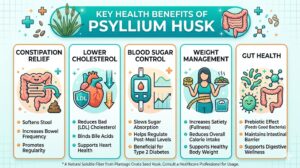
1. Relieves Constipation
Psyllium is the most evidence-supported bulk-forming fiber for constipation. It softens stool, adds bulk, and shortens bowel transit time. For related guidance, see our article on natural constipation relief remedies and fast constipation relief at home.
2. Helps with Diarrhea (Paradoxical Effect)
Because psyllium normalizes stool water content rather than simply adding to it, it also helps firm up loose stools. The same gel that softens hard stool in constipation absorbs excess water in diarrhea — making it a true bowel-regulating agent useful for people with IBS who alternate between both extremes. For a detailed comparison with insoluble fibers, see our guide on psyllium husk vs. wheat bran for constipation.
3. Lowers LDL Cholesterol
Psyllium binds bile acids in the small intestine, preventing their reabsorption. The liver compensates by pulling LDL cholesterol from the bloodstream to synthesize new bile acids — resulting in lower circulating LDL. The FDA has recognized this mechanism with a qualified health claim since 1998.[5] Clinical evidence supports a 7–9% reduction in LDL cholesterol with 10–15g of psyllium daily.[6]
4. Improves Blood Sugar Control
The viscous gel formed by psyllium slows gastric emptying and delays glucose absorption, reducing post-meal blood sugar spikes. This effect is clinically meaningful in people with type 2 diabetes or prediabetes and may complement dietary changes and medication.
5. Supports Weight Management
Psyllium increases satiety by slowing stomach emptying and promoting longer-lasting fullness. A 2023 randomized controlled trial found that 10g of psyllium daily produced meaningful improvements in body weight in patients with type 2 diabetes and chronic constipation, in addition to constipation symptom relief.[7] For more on diet and digestive health, see our guide on plant-based diet for constipation relief.
6. Supports Gut Microbiota
Recent research has shown that psyllium supplementation positively alters gut microbiota composition in constipated patients, promoting a more diverse and beneficial bacterial environment.[1] This microbiome-supporting effect may contribute to long-term digestive health beyond the mechanical effects on stool consistency.
Side Effects of Psyllium Husk: What You Must Know Before Starting
Psyllium husk is well tolerated by most people — but “well tolerated” does not mean “side-effect free.” Many people stop taking psyllium unnecessarily because they experience avoidable discomfort in the first week. Understanding what to expect, and why, can prevent most problems before they start.
Side Effect Severity at a Glance
🟢 Mild (Common)
Bloating, gas, minor cramping — usually resolves within 1–2 weeks
🟡 Moderate (Less Common)
Nausea, excessive stool frequency, loose stools — typically dose-related
🔴 Serious (Rare)
Choking, esophageal blockage, intestinal obstruction — caused by taking without sufficient water
Common Side Effects in the First 1–2 Weeks
- Bloating and gas: The most frequently reported complaint. Occurs because psyllium rapidly increases stool bulk, causing temporary pressure and gas as your gut adjusts. Starting at a low dose (5g/day) and increasing gradually over 1–2 weeks dramatically reduces this problem. Do not start at the full clinical dose.
- Abdominal cramping: Mild cramping can occur as the colon responds to increased bulk. This usually resolves within 5–7 days. If cramping is severe, persistent, or worsening — stop and consult your doctor immediately.
- Increased stool frequency: Expected for constipation sufferers — this is the goal. However, if frequency becomes excessive or stools become very loose, reduce your dose.
- Nausea: Usually occurs when psyllium is taken without enough water or on a very empty stomach. Always take with a full glass of water and consider taking it with food.
⚠️ Serious Risk: Choking and Intestinal Blockage
🚨 Critical Safety Warning — Read Before Taking PsylliumPsyllium husk can cause choking or esophageal blockage if swallowed without sufficient water, particularly in people who have any difficulty swallowing. It can also cause intestinal obstruction if taken with inadequate fluids — a rare but potentially life-threatening complication.
Always take psyllium with a minimum of 240 ml (8 oz) of water immediately after mixing, and drink at least 6–8 additional glasses of water throughout the day.
Never take psyllium:
- Dry or with just a sip of liquid
- If you have trouble swallowing
- If you have a history of bowel obstruction or esophageal narrowing — without medical clearance first

How to Minimize Side Effects
- ✅ Start low, go slow: Begin at 5g (1 tsp) once daily for the first week, then increase by 5g every 5–7 days as tolerated
- ✅ Drink immediately: Always mix and drink within 30 seconds — psyllium gels fast and becomes hard to swallow if left standing
- ✅ Stay hydrated all day: At least 8 glasses of water daily, not just at dose time
- ✅ Take with food: Reduces nausea and cramping for many people, particularly in the first two weeks
- ✅ Be patient: Most gut-adjustment side effects resolve on their own within 1–2 weeks of consistent use — don’t give up too early
Who Should Avoid or Use Caution With Psyllium
- Difficulty swallowing or a history of esophageal narrowing / stricture
- A history of bowel obstruction, Crohn’s disease with strictures, or severe diverticulitis
- Phenylketonuria (PKU) — some flavored products contain phenylalanine
- Known psyllium allergy (rare but documented; healthcare workers with regular inhalation exposure are at higher risk of sensitization)
- Pregnancy or breastfeeding — generally considered safe, but always confirm with your OB-GYN
- Diabetes — psyllium may lower blood sugar and require medication dose adjustment
Drug Interactions — Separate Your Medications
This is a frequently overlooked but important safety concern. Psyllium’s gel can physically bind to certain medications in the GI tract and significantly reduce their absorption — altering drug levels in your bloodstream. Take the following medications at least 1–2 hours before or 2–4 hours after your psyllium dose:
- Digoxin and other cardiac glycosides
- Lithium (mood stabilizer)
- Carbamazepine / Tegretol (anti-seizure)
- Warfarin and other anticoagulants (blood thinners)
- Metformin and insulin — psyllium may enhance blood sugar lowering and require dose adjustment
- Levothyroxine (thyroid medications)
If you take any prescription medications regularly, inform your prescribing physician that you are starting psyllium supplementation. Do not assume it is harmless alongside medications — the interaction is real and clinically documented.
Psyllium Husk vs. Other Laxatives: Which Is Right for You?
Psyllium Husk
Bulk-forming fiber. Works with your body’s natural process. Safe for long-term daily use. No dependency risk. Also benefits cholesterol and blood sugar.
Best for: Long-term, regular use
Senna (Senokot)
Stimulant laxative. Fast-acting (6–12 hours). Can cause cramping. Not recommended for long-term daily use as it may cause bowel dependency and electrolyte imbalance.
Best for: Occasional, short-term use
Magnesium Citrate
Osmotic laxative. Draws water into the intestine. Works within 1–3 hours. Effective for acute constipation or bowel prep. Not for long-term daily use. See our magnesium supplements guide.
Best for: Acute or short-term relief
Psyllium vs. Prunes / Prune Juice
Prunes and prune juice contain sorbitol (a natural laxative sugar) and fiber, making them an effective natural remedy. However, psyllium provides a more concentrated, predictable dose of soluble fiber without the sugar content of prune juice. For many people, combining psyllium with dietary changes (including prunes) produces the best results. Read our detailed guide on prune juice for constipation relief.
For a broader look at why fiber alone sometimes isn’t enough, see: Why fiber isn’t working for your constipation. If you’re also exploring food-based options, our guide on kiwi for constipation relief is worth reading — kiwi pairs well with a psyllium routine.
Frequently Asked Questions
How long does psyllium husk take to work for constipation?
Can I take psyllium husk every day?
Is psyllium husk better than Metamucil?
Does psyllium husk cause dependency?
Can psyllium husk help with IBS?
What is the best psyllium husk for elderly people?
Conclusion: Our Final Pick for the Best Psyllium Husk for Constipation
Choosing the best psyllium husk for constipation doesn’t have to be complicated — and the clinical evidence makes it clear why psyllium stands apart from most constipation remedies. It works gently, supports long-term gut health, benefits cholesterol and blood sugar as secondary effects, and carries no dependency risk — making it one of the most well-rounded daily supplements available for digestive wellness.
Here’s a quick summary of our recommendations:
- Best Overall: Organic India Psyllium Husk — cleanest label, USDA Organic, excellent reviews
- Best Value: NOW Foods Psyllium Husk Powder — highest fiber per serving at the lowest cost
- Best Flavored: Metamucil Orange — USP verified, flavor-forward for compliance
- Best for Sensitive Stomachs: Viva Naturals Organic — zero additives, finely ground
- Best Capsules: NOW Foods Psyllium Husk Caps — vegetarian, clean label, convenient
- Premium Pick: Frontier Co-op Organic — ethical sourcing, whole-husk quality
For most budget-conscious users, NOW Foods Psyllium Husk Powder offers the best value-to-quality ratio — 6g of fiber per serving at around $0.12, with no additives. For users who prioritize organic certification and ingredient sourcing, Organic India remains our Best Overall choice. Either way, start with 5g per day with a full glass of water, and give it 2–4 consistent weeks before evaluating results — most users notice improvement in 1–3 days.
Your next step: Pick the product that matches your budget and preferences from the table above, and start today. The longer you wait, the longer you’re uncomfortable — and psyllium is one of the safest, most evidence-backed fixes available without a prescription.
⚠️ If your constipation is severe, persistent, accompanied by blood in the stool, unexplained weight loss, or other concerning symptoms — please consult a healthcare provider before starting any supplement.
✅ Ready to Choose the Best Psyllium Husk for Constipation?
Don’t spend another day uncomfortable. Our top picks are clinically backed, highly rated, and available on Amazon with fast shipping. Start with 5g daily, drink plenty of water, and most people notice a difference within 24–72 hours.
More Guides to Help You Find Relief
Still researching the best psyllium husk option for your situation, or exploring other constipation relief strategies? These guides from ConstipationRelief.net cover the full picture:
- Psyllium Husk vs. Wheat Bran: Which Fiber Is Better for Constipation?
- Best Magnesium Supplements for Constipation (2026 Guide)
- Natural Constipation Relief Remedies: Evidence-Based Guide
- Prune Juice for Constipation: Does It Actually Work?
- Fiber Foods & Gut Health for Constipation Relief
- Does Dehydration Cause Constipation? What the Science Says
- Why Fiber Isn’t Working for Your Constipation
 Medical Disclaimer: This article is for informational purposes only and is not a substitute for professional medical advice. If you are pregnant, breastfeeding, have kidney disease, liver disease, inflammatory bowel disease, or take prescription medications, consult your doctor before using any herbal laxative. If constipation is sudden or severe, or is accompanied by blood in the stool, significant pain, or unexplained weight loss, seek medical attention immediately.
- Jalanka J, et al. (2019). The Effect of Psyllium Husk on Intestinal Microbiota in Constipated Patients and Healthy Controls. International Journal of Molecular Sciences. PMID: 30654519. PubMed ↗
- Xu L, et al. (2021). The effects of psyllium husk on gut microbiota composition and function in chronically constipated women. PMID: 34200308. PubMed Central ↗
- Garg PK. (2023). Psyllium Husk Positively Alters Gut Microbiota, Decreases Inflammation, and Has Bowel-Regulatory Action. Gastroenterology. DOI ↗
- Weng Y, et al. (2024). Effects of Dietary Fiber Supplementation on Chronic Constipation in the Elderly: A Systematic Review and Meta-Analysis. Nutrients. PubMed Central ↗
- US FDA. (1998, amended). CFR 21 §101.81 — Health claims: Soluble fiber from certain foods and risk of coronary heart disease. eCFR ↗
- Jenkins DJ, et al. (2002). Soluble fiber intake at a dose approved by the FDA for a health benefits claim. American Journal of Clinical Nutrition. PMID: 11976156.
- Mane K & Mhasalkar A. (2025). Role of psyllium husk in metabolic disease management: A review. Journal of Applied & Natural Science. 17(3):1034–1045.




[…] that keeps coming back, senna is not the long-term solution. Explore sustainable options like psyllium husk fiber supplements or dietary changes that address the root […]
[…] If your current supplement is wheat bran-based, switching to psyllium may resolve your worsening constipation within 2 to 4 weeks. For a full comparison of psyllium products, see our guide to the best psyllium husk products for constipation relief in 2026. […]
[…] Best Psyllium Husk for Constipation Relief in 2026 […]