

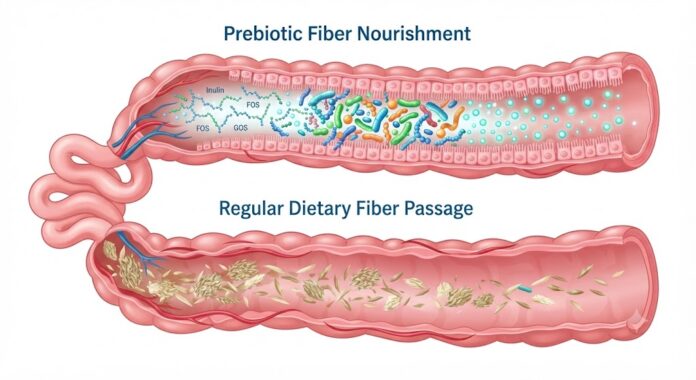
Prebiotics vs fiber is one of the most confusing pairs of terms in gut health, mostly because the two overlap without being the same thing. Nearly all naturally occurring dietary prebiotics are a type of fiber, but most fiber is not a prebiotic. The distinction matters for constipation specifically, because a bulk-forming fiber like wheat bran and a fermentable prebiotic like inulin relieve constipation through different mechanisms, and choosing the wrong one for your symptoms can leave you bloated without much improvement. Understanding prebiotic fiber vs regular fiber up front makes it easier to pick the right approach for your symptoms.
⚡ Quick Answer: Dietary fiber consists of non-digestible carbohydrates and lignin that resist digestion in the small intestine. A prebiotic is a narrower category: a substrate that gut bacteria selectively utilize to produce a health benefit.1 In practice, this means inulin, fructo-oligosaccharides (FOS), and galacto-oligosaccharides (GOS) count as prebiotic fibers, while wheat bran, cellulose, and most insoluble fibers do not. For hard, dry stool, gel-forming fiber such as psyllium generally has stronger evidence for symptom relief than prebiotic fibers. For long-term support of beneficial gut bacteria, prebiotic fibers have more specific evidence, though the effect on stool frequency is usually more modest.
| Topic | Key Point |
|---|---|
| Prebiotic | Feeds beneficial bacteria |
| Fiber | Resists digestion |
| Relationship | All prebiotics are (in practice) a type of fiber |
| Key Difference | Most fiber is not a prebiotic |
| Best for Hard Stool | Psyllium → Strongest evidence |
| Best for Microbiome Support | FOS/GOS → Strongest evidence |
What Is Dietary Fiber, Exactly?
Dietary fiber refers to carbohydrates and lignin that resist digestion in the small intestine. The FDA’s current U.S. regulatory definition covers two groups: fiber that is naturally intact in plants, and isolated or synthetic non-digestible carbohydrates that the FDA has reviewed and confirmed have a beneficial physiological effect, such as improved bowel function or lower cholesterol.2
Fiber is traditionally split into soluble and insoluble categories, though researchers increasingly argue that how a fiber behaves in the gut (whether it dissolves, ferments, or holds water) matters more than this label alone. For a full breakdown of that distinction, see our guide to soluble vs insoluble fiber for constipation.
The important point for this comparison: being classified as “dietary fiber” only requires that a substance resist digestion. It says nothing about what happens once that fiber reaches your gut bacteria, which is exactly where prebiotics come in.
What Is a Prebiotic?
The internationally recognized definition, published by a 2016 expert panel convened by the International Scientific Association for Probiotics and Prebiotics (ISAPP), defines a prebiotic as a substrate that is selectively utilized by host microorganisms, conferring a health benefit.1 Three conditions have to be met at the same time:
- The substance must resist digestion and reach the colon largely intact
- Gut bacteria must selectively utilize it (usually, though not always, through fermentation), favoring certain beneficial species (most commonly Bifidobacterium) over others
- That selective utilization must produce a demonstrated health benefit, not just a change in bacterial counts
This is a stricter, more specific definition than “fiber.” A substance can pass through the colon completely undigested and still fail to qualify as a prebiotic if gut bacteria do not use it selectively, or if no health benefit has actually been shown.
So Are Prebiotics Fiber, or Not?
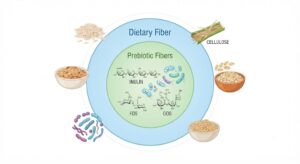
Both, depending on which direction you look at it. Naturally occurring prebiotics, such as inulin, FOS, and GOS, are chemically classified as soluble, fermentable fiber. In that sense, dietary prebiotics are, in practice, a type of fiber.
The reverse is not true. Most fiber in a typical diet, including cellulose, most wheat bran, and lignin, is either not fermented at all or is fermented in a broad, non-selective way that does not meet the ISAPP criteria for a prebiotic. Think of two overlapping circles: fiber is the larger circle, and prebiotics sit almost entirely inside it, occupying only the subset of fibers that gut bacteria utilize selectively and beneficially.
A practical, real-world example of this overlap shows up when comparing two common fiber supplements: Metamucil, built on psyllium husk, and Benefiber, built on wheat dextrin. In vitro and animal fermentation studies suggest wheat dextrin is more readily fermented by gut bacteria than psyllium, though the evidence on whether it meets the full ISAPP criteria for a classic prebiotic is mixed.
One controlled in vitro fermentation study found it altered gut bacteria populations but did not produce the classic increase in Bifidobacterium seen with inulin or GOS.8 Psyllium, by contrast, works mainly by forming a gel that physically softens stool. Our side by side breakdown in Benefiber vs Metamucil for Constipation walks through how that difference plays out for symptom relief.
Affiliate disclosure: ConstipationRelief.net may earn a small commission from qualifying purchases made through links on this page, at no extra cost to you. Recommendations are based on clinical evidence discussed in this guide.
Fiber and prebiotics work through genuinely different mechanisms — and picking the right one for your symptoms makes a bigger difference than most people expect. Here are the top evidence-aligned picks for each approach covered in this guide:
- Best for hard, dry stool (gel-forming fiber, strongest evidence): Konsyl Daily Psyllium Fiber Powder (19oz) — 100% pure psyllium husk, forms a water-holding gel that softens stool directly, the strongest overall evidence for hard stool per the 2023 AGA-ACG guideline — always take with at least 8oz water
- Best FOS prebiotic (stool frequency + Bifidobacteria support): NOW Foods Organic Inulin Powder — 100% pure chicory root inulin (FOS source), certified organic, selectively feeds the Bifidobacteria discussed throughout this guide — start at 2-3g daily and increase gradually to reduce gas
- Best GOS prebiotic (the type tested in clinical trials for constipation): Bimuno Daily Prebiotic Fibre Supplement — galacto-oligosaccharides, the exact prebiotic type shown to increase stool frequency and Bifidobacterium counts in the randomized trial cited in this guide
- Best synbiotic (prebiotic + probiotic combined): Seed DS-01 Daily Synbiotic — 24 clinically studied strains plus built-in prebiotic outer capsule, the synbiotic approach this guide identifies as potentially more consistent than either prebiotic or probiotic alone
Prebiotics vs Fiber at a Glance
| Feature | Fiber (general) | Prebiotic Fiber |
|---|---|---|
| Definition basis | Resists digestion in the small intestine | Selectively utilized by gut bacteria with a proven benefit |
| Meets FDA “dietary fiber” definition | Yes, by definition | Most naturally occurring dietary prebiotics qualify as dietary fiber under FDA regulations |
| Meets ISAPP “prebiotic” definition | Not necessarily; most fiber does not | Yes, by definition |
| Examples | Wheat bran, cellulose, psyllium, oat bran | Inulin, FOS, GOS; some RS2 and RS3 resistant starch preparations |
| Primary mechanism in constipation | Adds bulk or forms a water-holding gel | Feeds health-promoting gut bacteria, which produce short chain fatty acids linked to motility |
| Fermentability | Varies widely, low to high | Typically highly fermentable, though the rate varies by compound (inulin, FOS, and GOS ferment rapidly; some resistant starch and other prebiotics ferment more slowly) |
| Typical side effect | Depends on type; bran can cause bloating | Gas and bloating are common at higher doses |
| Strongest evidence for | Softening hard stool (psyllium) | Promoting beneficial gut bacteria (especially Bifidobacteria) and modestly improving stool frequency |
How Prebiotics Actually Relieve Constipation
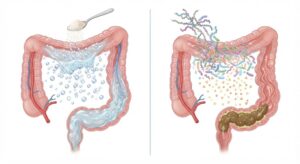
This is one of the clearest ways to frame prebiotic fiber vs regular fiber: prebiotic fibers do not soften stool by holding water the way psyllium does. Instead, gut bacteria, particularly Bifidobacteria, ferment them into short chain fatty acids (SCFAs) such as acetate, propionate, and butyrate. These SCFAs are not just fermentation byproducts.
Research in mouse and cell-culture models suggests that SCFAs may promote serotonin production by enterochromaffin cells, potentially influencing the motor and secretory activity that moves stool along. Direct human trial evidence for this specific pathway is still limited.7
This mechanism is explored in more depth in our guide to gut health and constipation, which covers how an imbalanced gut microbiome, low in beneficial bacteria like Bifidobacteria, is associated with harder stool and slower colon transit.
What Research Says About Prebiotics for Constipation
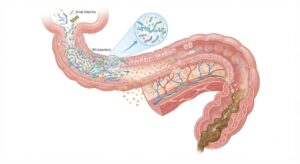
A 2024 systematic review and meta-analysis of randomized controlled trials examined fructo-oligosaccharides (FOS) specifically for functional constipation. Across the pooled trials, FOS supplementation significantly increased bowel movement frequency and modestly improved stool consistency, while also reducing straining during defecation.3 Mild bloating was the most common side effect, and no serious adverse events were reported. The authors noted that dosage and duration still need to be more precisely established across future trials.3
A separate randomized, double-blind, placebo-controlled trial tested galacto-oligosaccharides (GOS) in 132 adults with self-reported constipation. GOS supplementation increased stool frequency compared with placebo, particularly in adults who started with three or fewer bowel movements per week and in participants aged 35 and older. The intervention also produced a clear, dose-dependent increase in fecal Bifidobacterium.4
For comparison, the current joint clinical guideline from the American Gastroenterological Association and American College of Gastroenterology reviews fiber supplements as a group, including psyllium, bran, and inulin, and suggests fiber supplementation over no fiber supplementation for adults with chronic idiopathic constipation.5
This is a conditional recommendation based on the overall evidence for fiber as a class, not a strong endorsement of any single prebiotic fiber specifically, and psyllium in particular has more robust clinical evidence than inulin within that guideline.5
What the Research Shows: Fiber and Probiotics
It’s worth separating prebiotics from probiotics as well, since the two are often confused. Probiotics are live beneficial bacteria taken directly, while prebiotics are the food that feeds bacteria already living in your gut.
A meta-analysis of randomized controlled trials found that probiotic supplementation modestly increased stool frequency and reduced whole gut transit time in adults with functional constipation.6 For a deeper look at which specific probiotic strains have the best supporting evidence, see 9 Best Probiotic Supplements 2026 and our related breakdown of whether probiotics actually work for chronic constipation.
Combining a prebiotic with a probiotic, an approach called a synbiotic, is another growing area of research. If you are trying to decide between the two approaches, our comparison of synbiotics vs probiotics for constipation covers how the combined strategy stacks up against using either one alone.
Common Sources of Prebiotic Fiber
- Inulin: chicory root, Jerusalem artichoke, garlic, onions, leeks, asparagus
- Fructo-oligosaccharides (FOS): bananas, onions, garlic, wheat, and available as a standalone supplement
- Galacto-oligosaccharides (GOS): naturally present in human breast milk and legumes; also produced commercially from lactose
- Resistant starch: particularly the RS2 and RS3 forms found in cooked and cooled potatoes and rice, green bananas, and legumes. Not all resistant starch behaves as a classic prebiotic
For dosing, side effects, and a full comparison of these prebiotic fibers against non-prebiotic options like psyllium and wheat bran, see our guide to 7 Natural Fiber Supplements for Chronic Constipation.
Side Effects: Why Prebiotics Tend to Cause More Gas
Many prebiotic fibers, particularly inulin and FOS, are rapidly and almost completely fermented by gut bacteria, and that fermentation process produces gas as a natural byproduct. This is a key reason inulin and FOS are more commonly associated with bloating than slower-fermenting prebiotics such as some resistant starches, or than non-fermented fibers. Starting with a small dose and increasing gradually over several weeks tends to reduce this effect considerably as the gut microbiome adapts.
If you have already tried increasing fiber intake generally and are not seeing the results you expected, our guide to why fiber isn’t working for your constipation covers other underlying causes worth ruling out before switching fiber types. Timing can also make a difference in how well a fiber or prebiotic is tolerated; see our guide to the best time to take fiber for more on that.
Should You Choose Fiber or Prebiotics for Constipation?
- Hard, dry stool that needs softening quickly: a gel-forming fiber such as psyllium usually has the strongest and fastest evidence base.
- Low stool frequency with a goal of longer term microbiome support: a prebiotic fiber such as GOS or FOS, introduced gradually, has more specific evidence for promoting beneficial gut bacteria.
- History of bloating with fermentable fibers or IBS-C: starting with a low fermentation option and increasing prebiotic fiber slowly, or trying a probiotic instead, may be more comfortable.
- No clear preference: most whole plant foods naturally contain a mix of prebiotic and non-prebiotic fiber, which is usually the simplest way to get some benefit from both.
The Bottom Line
Prebiotics vs regular dietary fiber is not really an either-or choice. Prebiotics are a specific, well-defined subset of fiber, distinguished by being selectively utilized by beneficial gut bacteria to produce a measurable health benefit.
For constipation specifically, gel-forming fibers like psyllium tend to work faster on hard stool, while prebiotic fibers like FOS and GOS offer more modest improvements in stool frequency while also supporting beneficial gut bacteria and producing documented changes in the gut microbiota.
Many people can benefit from including both types of fiber as part of a balanced diet, alongside adequate hydration, since fiber and prebiotics generally need enough water to work as intended.
Seek prompt medical evaluation if constipation persists for more than three weeks despite dietary changes, is new after age 50, or is accompanied by rectal bleeding, unexplained weight loss, or severe abdominal pain.
⚠️ Medical Disclaimer: This article is for informational and educational purposes only and is not a substitute for professional medical advice, diagnosis, or treatment. Always consult a qualified healthcare provider before making significant changes to your diet or starting a new supplement.
Frequently Asked Questions
Are prebiotics the same thing as fiber?
No. Nearly all naturally occurring dietary prebiotics are a type of fiber, but most fiber is not a prebiotic. Fiber is characterized by resisting digestion in the small intestine, while a prebiotic must also be selectively utilized by beneficial gut bacteria to produce a measurable health benefit. Bulk fibers like wheat bran and cellulose are not prebiotics because gut bacteria do not use them selectively.
Is psyllium husk a prebiotic?
Psyllium husk is mostly a gel-forming, minimally fermented fiber rather than a classic prebiotic. It relieves constipation mainly by holding water and softening stool, not by selectively feeding specific gut bacteria the way inulin or GOS do.
Which is better for constipation, fiber or prebiotics?
It depends on the type of constipation. Gel forming fibers such as psyllium have the strongest overall evidence for softening hard stool. Prebiotic fibers such as FOS and GOS show more modest but still measurable improvements in stool frequency, largely through promoting beneficial bacteria such as Bifidobacteria.
Do prebiotics cause more gas than regular fiber?
Often, yes. Prebiotic fibers such as inulin and FOS are rapidly and almost completely fermented by gut bacteria, which tends to produce more gas and bloating than slowly fermented or non-fermented fibers. Starting with a small dose and increasing gradually reduces this effect for most people.
Can you take prebiotics and psyllium together?
Yes, and many people do, since the two work through different mechanisms. Psyllium forms a gel that softens stool mechanically, while a prebiotic fiber like GOS or FOS feeds beneficial gut bacteria. Pairing them may help address both hard stool and longer-term microbiome support, though introducing a prebiotic gradually alongside psyllium may reduce the chance of excess gas.
Is resistant starch a prebiotic?
Some forms are. Resistant starch is a broad category, and only certain types, particularly RS2 and RS3, have demonstrated prebiotic properties such as promoting Bifidobacteria and increasing butyrate production. Not every source of resistant starch meets the full criteria for a classic prebiotic.
Can you take probiotics and prebiotics together?
Yes. Taking a probiotic and a prebiotic together is often called a synbiotic approach. The prebiotic provides fuel for the live bacteria in the probiotic as well as for bacteria already present in the gut, which may support colonization and give a more consistent effect than either one used alone.
Is Benefiber a prebiotic?
Benefiber is made from wheat dextrin, a fiber that is more readily fermented by gut bacteria than psyllium and has shown some prebiotic effects on gut bacteria in research. However, evidence on whether it meets the full criteria for a classic prebiotic is mixed, since some studies have not found the same increase in Bifidobacteria seen with inulin or GOS.
References
- Gibson GR, Hutkins R, Sanders ME, et al. Expert consensus document: The International Scientific Association for Probiotics and Prebiotics (ISAPP) consensus statement on the definition and scope of prebiotics. Nat Rev Gastroenterol Hepatol. 2017;14(8):491-502. doi: 10.1038/nrgastro.2017.75. PMID: 28611480.
- U.S. Food and Drug Administration. Questions and Answers on Dietary Fiber. https://www.fda.gov/food/nutrition-food-labeling-and-critical-foods/questions-and-answers-dietary-fiber
- Zhen H, Qian H, Liu X, Tan C. Fructooligosaccharides for relieving functional constipation: a systematic review and meta-analysis of randomized controlled trials. Foods. 2024;13(24):3993. doi: 10.3390/foods13243993. PMID: 39766936.
- Schoemaker MH, Hageman JHJ, Ten Haaf D, et al. Prebiotic galacto-oligosaccharides impact stool frequency and fecal microbiota in self-reported constipated adults: a randomized clinical trial. Nutrients. 2022;14(2):309. doi: 10.3390/nu14020309. PMID: 35057489.
- Chang L, Chey WD, Imdad A, et al. American Gastroenterological Association-American College of Gastroenterology Clinical Practice Guideline: Pharmacological Management of Chronic Idiopathic Constipation. Am J Gastroenterol. 2023;118(6):936-954. doi: 10.14309/ajg.0000000000002227. PMID: 37211380.
- Dimidi E, Christodoulides S, Fragkos KC, Scott SM, Whelan K. The effect of probiotics on functional constipation in adults: a systematic review and meta-analysis of randomized controlled trials. Am J Clin Nutr. 2014;100(4):1075-1084. doi: 10.3945/ajcn.114.089151. PMID: 25099542.
- Reigstad CS, Salmonson CE, Rainey JF 3rd, et al. Gut microbes promote colonic serotonin production through an effect of short-chain fatty acids on enterochromaffin cells. FASEB J. 2015;29(4):1395-1403. doi: 10.1096/fj.14-259598. PMID: 25550456.
- Hobden MR, Martin-Morales A, Guérin-Deremaux L, et al. In vitro fermentation of NUTRIOSE® FB06, a wheat dextrin soluble fibre, in a continuous culture human colonic model system. PLoS One. 2013;8(10):e77128. doi: 10.1371/journal.pone.0077128.