


Why is my stool hard even after eating fiber? This is one of the most common frustrations in digestive health, and research suggests that several factors commonly contribute: the type of fiber you are eating, how much water you are drinking alongside it, an underlying gut motility problem, irritable bowel syndrome with constipation (IBS-C), or a medication or health condition that fiber alone cannot fix.
If you have been diligently adding oats, chia seeds, or a fiber supplement to your diet and your stool is still hard, dry, or difficult to pass, you are not imagining it, and it does not necessarily mean you are doing anything wrong. A 2011 systematic review of randomized controlled trials found that the benefit of fiber for chronic constipation depends heavily on the type of fiber used, with soluble fiber showing more consistent improvement than insoluble fiber.[1]
A larger 2022 meta-analysis reached a similar conclusion: fiber supplementation helps stool frequency and consistency on average, but the effect size varies widely by fiber type, dose, and how long it is used.[2]
Why Is My Stool Hard Even After Eating Fiber? (Quick Answer)
- Wrong fiber type: Insoluble fiber (some wheat bran, cereal husks) does not reliably soften stool the way soluble, gel-forming fiber like psyllium does.
- Not enough water: Soluble fiber needs fluid to form a soft gel; without it, fiber can increase stool bulk without adequately softening it.
- Underlying motility problem: Slow-transit constipation and pelvic floor dysfunction (dyssynergic defecation) often do not respond to fiber at all.
- IBS-C: Highly fermentable fibers can worsen bloating and hard stool in some IBS-C patients.
- Medications or conditions: Opioids, iron, certain antidepressants, and hypothyroidism can override the effect of dietary fiber.
Is It Really “Hard Stool”? A Quick Self-Check
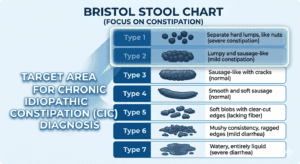
Before troubleshooting further, it helps to confirm what you are actually dealing with. Clinicians commonly use the Bristol Stool Form Scale to describe stool consistency:
- Type 1: Separate hard lumps, like nuts (hard to pass)
- Type 2: Sausage-shaped but lumpy
- Type 3 to 4: Generally considered normal
- Type 5: Softer than normal but often still acceptable
- Type 6 to 7: Loose or watery
A large U.S. survey using National Health and Nutrition Examination Survey (NHANES) data defined constipation specifically as stool falling into Bristol Type 1 or Type 2.[3] If your stool consistently falls into these two categories despite eating fiber, the sections below walk through the most likely reasons and what tends to help with each one.
ConstipationRelief.net is reader-supported. As an Amazon Associate and iHerb affiliate, we may earn a commission from qualifying purchases made through links on this page, at no extra cost to you.
At a Glance: What Actually Helps When Fiber Alone Isn’t Softening Your Stool
The right fix depends on which cause applies to you — here are the most evidence-aligned options for each approach covered in this guide:
- Best soluble gel-forming fiber (strongest evidence for softening stool): Konsyl Daily Psyllium Fiber Powder (19oz) — 100% pure psyllium husk, single ingredient, forms a water-holding gel that softens stool directly — shown to be ~3.4x more effective than wheat bran for stool output, always take with at least 8oz water
- Best osmotic option (when hard stool persists despite fiber): MiraLAX Laxative Powder (45-Dose) — PEG 3350 draws water into the colon through a mechanism that does not depend on gut motility, the only OTC laxative with a strong 2023 AGA-ACG recommendation for chronic use
- Best magnesium option (osmotic, works independently of fiber): Natural Vitality CALM Magnesium Citrate Powder — draws water into the colon directly, works in 30 minutes to 6 hours — ⚠️ avoid or use only under medical supervision with kidney disease
- Best probiotic (if gut dysbiosis is contributing): Garden of Life Dr. Formulated Probiotics for Constipation (50B CFU) — contains Bifidobacterium lactis and 15 other clinically studied strains, the article recommends considering a probiotic when gut dysbiosis may be contributing to hard stool
1. Why Fiber Doesn’t Always Soften Hard Stool
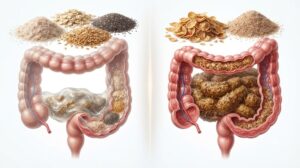
Dietary fiber is not one uniform substance. Soluble fiber, found in psyllium husk, oats, and flaxseed, dissolves in water and forms a viscous gel that holds water inside the stool, making it softer and easier to pass. Insoluble fiber, found in wheat bran and many vegetable skins, adds bulk mechanically but does not reliably increase stool water content in the same way.[4]
This distinction has practical implications. A detailed 2020 review comparing coarse wheat bran and psyllium in patients with chronic idiopathic constipation found that psyllium was roughly 3.4 times more effective than wheat bran at increasing stool output.
Finely ground wheat bran actually decreased stool water content in some patients, a stool-hardening effect rather than a softening one.[4] In other words, if the fiber in your diet is coming mostly from bran cereal, added wheat bran, or other coarsely processed insoluble sources, this may explain why increasing your intake does not improve stool consistency.
For a full breakdown of which fiber sources fall into each category and how to choose between them, see our guide on Best Fiber Foods and Fiber Therapy for Gut Health.
2. Your Fiber Isn’t Getting Enough Water to Work With
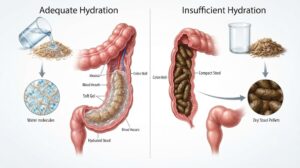
Soluble fiber works best when there is enough water in the gut for it to absorb. Without adequate fluid, fiber can swell and compact rather than softening, sometimes described colloquially as fiber “drying out” in the digestive tract.
The evidence on exactly how much fluid intake affects constipation is more mixed than commonly presented. The same NHANES survey mentioned above found that, after adjusting for other factors, low liquid intake was a significant predictor of constipation in both men and women, while dietary fiber intake on its own was not a significant predictor in that particular dataset.[3]
This does not mean fiber is useless (the clinical trial evidence above shows otherwise), but it does suggest that hydration may play a larger independent role than people expect, especially in cases where fiber alone is not producing softer stool.
At the same time, the relationship is not as simple as “just drink more water.” A widely cited review of constipation myths concluded that increasing fluid intake beyond normal levels is unlikely to meaningfully help constipation unless a person is genuinely dehydrated to begin with.[5]
The practical takeaway is that hydration matters most as a baseline requirement for fiber to function properly, not as an unlimited fix on its own. If you suspect dehydration may be part of your picture, our article on Does Dehydration Cause Constipation? walks through the signs and how much water is actually needed.
3. An Underlying Motility Problem Fiber Cannot Fix
For a meaningful share of people with chronic constipation, the issue is not diet at all. It is how the colon or the pelvic floor is functioning.
Slow-transit constipation occurs when the muscular contractions that move stool through the colon are too weak or infrequent, regardless of how much fiber or bulk is present. A well-known 1997 clinical trial gave 149 chronic constipation patients psyllium fiber for six weeks and found that 80 percent of those with slow-transit constipation saw no meaningful improvement.[6] Adding fiber to a colon that is not contracting efficiently adds bulk without correcting the underlying motility problem.
Dyssynergic defecation, also called pelvic floor dysfunction, is a coordination problem where the pelvic floor muscles contract instead of relaxing during an attempted bowel movement. This condition affects roughly half of people evaluated for chronic constipation, and it typically responds best to biofeedback therapy and neuromuscular retraining rather than dietary changes alone.[7]
This has been demonstrated directly in a randomized trial of patients with functional dyspepsia and coexisting constipation with dyssynergia. Correcting dyssynergic defecation through biofeedback therapy meaningfully reduced symptoms, while fiber supplementation given to a comparable group of patients did not reduce symptoms at all.[8]
This particular trial focused on patients who also had functional dyspepsia, but its finding that fiber did not help dyssynergia-related symptoms is consistent with the broader clinical understanding of this condition.
If fiber has not helped after a genuine 4 to 6 week trial, an underlying motility problem is one of the most likely explanations, and it is worth raising with a gastroenterologist rather than continuing to increase fiber intake indefinitely. We cover this scenario, along with alternatives that work through different mechanisms, in Why Fiber Isn’t Working for Your Constipation.
4. IBS-C and Fermentable Fiber
If you have constipation-predominant irritable bowel syndrome (IBS-C), the type of fiber matters even more than usual. Many high-fiber foods, particularly legumes, some fruits, and short-chain fermentable fibers like inulin and fructooligosaccharides, are rapidly fermented by gut bacteria. In people with IBS-C, this fermentation can increase gas production, bloating, and abdominal discomfort. As a result, constipation can feel worse even though the fiber is increasing stool bulk.[9]
Longer-chain, more slowly fermented soluble fibers such as psyllium are generally tolerated better than rapidly fermentable options in people with IBS-C.[9] If bloating and hard stool both worsen shortly after eating high-fiber foods, IBS-C is worth discussing with your doctor, and choosing psyllium over bran-based or highly fermentable fiber sources is a reasonable first adjustment.
5. Medications and Underlying Health Conditions
Dietary fiber may not be sufficient to overcome the effects of medications that slow colonic motility. Common contributing medications include opioid pain relievers, iron supplements, some antidepressants (particularly tricyclic antidepressants), anticholinergic medications, and certain blood pressure drugs such as calcium channel blockers. Underlying conditions including hypothyroidism, diabetes, and neurological disorders can also slow colonic motility independently of diet.[10]
If you started a new medication around the same time your constipation began, or if you have an underlying condition that affects nerve or muscle function, that timeline is a more useful clue than how much fiber you are eating. A healthcare provider can determine whether a medication adjustment, rather than more dietary fiber, is the appropriate next step.
6. What Actually Helps When Fiber Alone Isn’t Enough
If you have identified one or more of the issues above, here is how the evidence lines up for what to try next:
- Switch to soluble, gel-forming fiber such as psyllium husk rather than coarse bran, and increase the dose gradually over several weeks rather than all at once.[2][4]
- Pair fiber with adequate, not excessive, water intake so the fiber has fluid to form a gel with. See our guide on Benefiber vs Metamucil for Constipation for a direct comparison of two common soluble fiber products.
- Consider an osmotic agent like magnesium if hard stool persists, since magnesium works by drawing water into the colon through a mechanism that does not depend on gut motility the way fiber does. Magnesium-containing laxatives and supplements should be avoided or used only under medical supervision in people with kidney disease, since impaired kidneys cannot clear excess magnesium efficiently. See 5 Best Magnesium Supplements for Constipation.
- Ask about biofeedback therapy if a pelvic floor or dyssynergic defecation problem is suspected, since this addresses the root coordination issue rather than adding more bulk.[7]
- Review your full over-the-counter (OTC) and prescription medication list with a pharmacist or doctor, particularly if you take opioids, iron, or antidepressants. Our Best OTC Laxatives for Constipation in the US guide covers options that work independently of fiber.
- Consider a probiotic if gut dysbiosis is contributing, since several meta-analyses show modest but consistent improvements in stool frequency with specific strains. See 9 Best Probiotic Supplements 2026.
7. When to See a Doctor
See a healthcare provider promptly if hard stool is accompanied by any of the following: rectal bleeding, unexplained weight loss, severe abdominal pain, new-onset constipation after age 50, no bowel movement for more than three weeks despite treatment, or constipation alternating with diarrhea. These can be signs of a condition that needs direct medical evaluation rather than dietary adjustment alone.[10]
Frequently Asked Questions
Why is my stool still hard even though I eat a lot of fiber?
The most common reasons are eating mostly insoluble fiber instead of soluble fiber, not drinking enough water to let the fiber form a gel, an underlying slow-transit or pelvic floor problem that fiber cannot fix, IBS-C, or a medication side effect. Soluble fiber needs water to work as intended, and without enough fluid it can make stool firmer rather than softer.
Can too much fiber make constipation worse?
Yes, for some people. Highly fermentable fibers can increase gas and bloating, and finely ground insoluble fiber such as some wheat bran products can reduce stool water content in certain individuals, effectively hardening stool instead of softening it.[4]
How long should I try fiber before assuming it isn’t working?
Most clinical trials evaluate fiber over at least 4 weeks of consistent daily use at an adequate dose.[2] If hard stool, straining, or infrequent bowel movements persist after 4 to 6 weeks of consistent soluble fiber intake with adequate water, it is reasonable to consider other causes and speak with a healthcare provider.
Does drinking more water help if my stool is hard?
Extra water helps most when someone is genuinely under-hydrated, since dehydration causes the colon to pull more water out of stool. In people who are already adequately hydrated, adding more water on top of normal intake has a smaller and less consistent effect, so hydration is best treated as a baseline requirement for fiber to work rather than a standalone fix.[5]
What type of fiber is best for hard stool?
Soluble, gel-forming fiber such as psyllium husk has the strongest evidence for softening stool and increasing stool water content. Finely ground insoluble fibers, including some wheat bran products, do not reliably soften stool and can sometimes have the opposite effect.[4]
The Bottom Line
Hard stool that persists despite eating fiber does not necessarily mean anything is being done wrong. It more often reflects a mismatch between the fiber type, hydration level, or underlying cause of the constipation and the generic “just eat more fiber” advice that is commonly repeated.
Identifying which of the five factors above applies to you, whether that is switching from bran to psyllium, addressing hydration properly, investigating a motility disorder, managing IBS-C, or reviewing your medications, is a more productive next step than simply adding more of the same type of fiber.
Scientific References
All claims in this article are supported by peer-reviewed literature. References are numbered in order of first appearance.
- Suares NC, Ford AC. Systematic review: the effects of fibre in the management of chronic idiopathic constipation. Aliment Pharmacol Ther. 2011;33(8):895-901. PMID: 21332763
- van der Schoot A, Drysdale C, Whelan K, Dimidi E. The Effect of Fiber Supplementation on Chronic Constipation in Adults: An Updated Systematic Review and Meta-Analysis of Randomized Controlled Trials. Am J Clin Nutr. 2022;116(4):953-969. PMID: 35816465
- Markland AD, Palsson O, Goode PS, Burgio KL, Busby-Whitehead J, Whitehead WE. Association of low dietary intake of fiber and liquids with constipation: evidence from the National Health and Nutrition Examination Survey. Am J Gastroenterol. 2013;108(5):796-803. PMID: 23567352
- McRorie JW. Laxative effects of wheat bran and psyllium: Resolving enduring misconceptions about fiber in treatment guidelines for chronic idiopathic constipation. J Am Assoc Nurse Pract. 2020;32(1):15-23. PMID: 31764399
- Müller-Lissner SA, Kamm MA, Scarpignato C, Wald A. Myths and misconceptions about chronic constipation. Am J Gastroenterol. 2005;100(1):232-242. PMID: 15654804
- Voderholzer WA, Schatke W, Mühldorfer BE, Klauser AG, Birkner B, Müller-Lissner SA. Clinical response to dietary fiber treatment of chronic constipation. Am J Gastroenterol. 1997;92(1):95-98. PMID: 8995945
- Rao SS. Dyssynergic defecation. Gastroenterol Clin North Am. 2001;30(1):97-114. PMID: 11394039
- Huaman JW, Mego M, Bendezu A, Monrroy H, Samino S, Accarino A, Saperas E, Azpiroz F. Correction of Dyssynergic Defecation, but Not Fiber Supplementation, Reduces Symptoms of Functional Dyspepsia in Patients With Constipation in a Randomized Trial. Clin Gastroenterol Hepatol. 2020;18(11):2463-2470.e1. PMID: 31811952
- El-Salhy M, Ystad SO, Mazzawi T, Gundersen D. Dietary fiber in irritable bowel syndrome. Int J Mol Med. 2017;40(3):607-613. PMC5548066
- Bharucha AE, Lacy BE. Mechanisms, Evaluation, and Management of Chronic Constipation. Gastroenterology. 2020;158(5):1232-1249.e3. PMID: 31945360
Medical Disclaimer: This article is for informational purposes only and does not constitute medical advice. Always consult a qualified healthcare provider before starting any new supplement, especially if you are pregnant, elderly, or taking other medications. If you experience severe abdominal pain, blood in your stool, or constipation that lasts more than 7 days, worsens, or fails to improve despite treatment, seek medical attention promptly.






[…] fiber alone has not helped, it is worth reading why stool stays hard even after eating fiber, since low water intake, certain fiber types, or an underlying motility problem can all blunt the […]