


⏱ Quick Answer: Psyllium husk typically produces its first noticeable bowel movement within 12 to 72 hours, the generally reported onset window for bulk-forming laxatives.[1] For chronic constipation, the fullest improvement in stool frequency and consistency takes longer, usually at least 4 weeks of consistent daily use at doses above 10 grams per day.[2] PRO TIP: Take it with a full 8 oz glass of water and drink it immediately, since psyllium begins forming a gel almost immediately after being mixed with water.
How Long Does Psyllium Husk Take to Work?
How long does psyllium husk take to work is one of the most common questions people ask after starting a fiber supplement for constipation, and the honest answer has two parts. The first bowel movement typically occurs within roughly 12 to 72 hours. Most references describe this as the standard onset window for bulk-forming laxatives as a drug category, although some pharmacology sources cite a narrower 24 to 72 hour range.[1] However, that initial response is often modest. The more meaningful clinical benefit, meaning a consistent increase in weekly bowel movements and softer, easier-to-pass stool, builds gradually and is usually clearest after 4 weeks or more of regular use.[2]
This two-stage timeline differs from stimulant laxatives and osmotic laxatives, which work through very different mechanisms, and understanding this difference is key to using psyllium husk successfully instead of giving up on it too early.
Disclosure: This article contains affiliate links. If you purchase through our links, we may earn a small commission at no extra cost to you. Our information is based solely on clinical evidence, not affiliate relationships.
At a Glance: Best Psyllium Husk Products for Constipation Relief
Psyllium works best when taken consistently at doses above 10 grams per day with plenty of water. Here are trusted options by format:
- Best powder form (well-studied, starts absorbing water immediately when mixed): Metamucil Psyllium Fiber Supplement — one of the most widely available and extensively studied psyllium brands, offered in powder, capsule, and wafer form with multiple flavors including sugar-free.
- Best single-ingredient, no-additive powder: Konsyl Daily Psyllium Fiber Powder (19 oz) — 100% pure psyllium husk, unflavored, with no artificial colors or sweeteners, suited to people avoiding additives.
- Best capsule form (no mixing, no taste): NOW Foods Psyllium Husk Caps 500mg (200 Veg Capsules) — pure psyllium husk, Non-GMO Project Verified, vegan, gluten-free, GMP certified. Capsules must dissolve before the husk can begin absorbing water, but both capsules and powder generally fall within the same 12 to 72 hour onset window.[1][7]
- Best faster-acting option while psyllium builds up: Natural Vitality CALM Magnesium Citrate Powder — typically acts within 30 minutes to 6 hours, compared with psyllium’s 12 to 72 hour onset, making it useful for occasional acute relief while psyllium’s full 4-week benefit builds up. Avoid with kidney problems and use only occasionally, not as a daily fiber replacement.
This is a curated shortlist rather than an exhaustive comparison; always check current pricing, ingredients, and reviews before purchasing, and consult a healthcare professional if you are unsure which option fits your situation.
Why Psyllium Husk Works Slowly (And That’s Actually the Point)
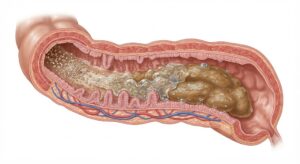
Psyllium husk is a soluble fiber derived from the seeds of Plantago ovata. When it reaches water, it absorbs many times its weight and forms a viscous gel. That gel adds bulk and moisture to stool, which softens it and gently stimulates the intestinal wall to contract.
This is fundamentally different from a stimulant laxative like senna or bisacodyl, which directly triggers muscle contractions in the colon, typically within 6 to 12 hours.[1] Psyllium has no such direct trigger. Instead, it changes the physical properties of what is already moving through your digestive tract, and that process needs time to travel the full length of the colon before it shows up as a bowel movement. For a broader comparison of how different laxative categories differ in speed and mechanism, see our guide to Best OTC Laxatives for Constipation.
What the Clinical Research Actually Shows
The most detailed picture of psyllium’s timeline comes from a 2022 systematic review and meta-analysis published in the American Journal of Clinical Nutrition, which pooled data from randomized controlled trials of fiber supplementation in adults with chronic constipation. The review found that fiber supplementation significantly increased stool frequency, with psyllium showing some of the strongest and most consistent evidence among the fiber types studied. The improvement was reliably apparent only at doses above 10 grams per day and treatment durations of at least 4 weeks.[2]
An earlier trial published in Alimentary Pharmacology & Therapeutics illustrates this well. Researchers gave adults with chronic idiopathic constipation 5 grams of psyllium twice daily for 8 weeks and tracked stool diaries throughout. Stool frequency rose from an average of 2.9 to 3.8 bowel movements per week, and stool weight and consistency also improved significantly, but these changes were measured and reported at the end of the full 8-week period rather than in the first days of treatment.[3]
The joint 2023 clinical practice guideline from the American Gastroenterological Association and the American College of Gastroenterology reviewed this same body of evidence and issued a conditional recommendation for psyllium as a first-line therapy for chronic idiopathic constipation, while noting that the certainty of the underlying evidence is low.[4] This reflects limitations in the available studies rather than a lack of effectiveness: fiber trials tend to be smaller and more heterogeneous than trials of drugs like polyethylene glycol, which has a stronger evidence base for daily long-term use.
An earlier 2016 meta-analysis in the same journal reached a similar conclusion using a smaller set of trials available at the time, finding that fiber supplementation, including psyllium, produced a statistically significant but moderate improvement in both stool frequency and consistency compared with placebo.[5]
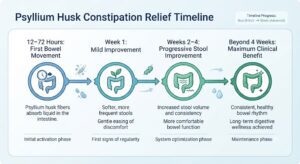
Timeline at a Glance
| Stage | Typical Timing | What You Should Notice |
|---|---|---|
| First response | 12–72 hours | An initial bowel movement, though it may be mild |
| Week 1 | Days 1–7 | Stool frequency may increase slightly; mild gas and bloating are common as your gut adjusts |
| Weeks 2–4 | Days 8–28 | Progressive improvement in stool consistency, less straining, and better overall bowel satisfaction |
| Beyond 4 weeks | Day 29+ | Greatest improvement seen in clinical studies, with the most reliable increase in complete bowel movements per week |
What Actually Determines How Fast Psyllium Works for You
1. Dose
Current evidence suggests that doses above 10 grams per day, usually split into two servings, produce a more reliable response than lower doses.[2] Serving sizes and fiber content vary considerably by brand and product form, so a teaspoon-based estimate can be misleading. Always follow the product label for exact dosing rather than estimating by teaspoons. Many people who feel like “psyllium isn’t working” are simply taking less than the amounts used in clinical trials. For sugar-free and senior-friendly product options at the correct dosing, see our guide to Best Sugar-Free Fiber Supplements.
2. Powder vs. Capsules
Powdered psyllium mixed directly into water starts absorbing fluid immediately, whereas capsules must first dissolve before the fiber can hydrate. In practice, any difference in onset is likely to be small, and both formulations fall within the same general onset window reported for psyllium.[1][7]
3. Water Intake
Psyllium’s mechanism depends entirely on absorbing water. Each dose should be taken with at least 8 ounces of water, followed by additional fluid through the day. Insufficient water does not just slow psyllium down, it can cause the fiber to thicken in the esophagus or intestine, which increases the risk of choking or intestinal obstruction, particularly in older adults or anyone with swallowing difficulty.[1] This is a genuine safety issue, not just an effectiveness one. If dehydration is a recurring problem for you, our guide on Does Dehydration Cause Constipation? explains why fluid intake matters for every type of fiber, not psyllium alone.
4. Baseline Severity
Someone with mild, occasional constipation may notice a difference within a day or two. Someone with longstanding chronic constipation, slow colonic transit, or a diet that has been very low in fiber for years is likely to need the fuller 4-week window before seeing consistent results. For background on what drives longer-term cases, see our guide to What Causes Chronic Constipation.
5. Consistency
Skipping doses resets the clock in a practical sense. Psyllium works best as a daily habit rather than an occasional rescue remedy, which is a key difference between it and faster-acting options like magnesium citrate or a stimulant laxative. If you want something with a faster onset for occasional, acute constipation, our guide to Best Magnesium Supplements for Constipation covers options that typically act within hours rather than days.
How to Take Psyllium Husk for the Best Results
- Start low. Begin with about 3 to 5 grams once daily to let your gut adjust, then increase gradually over one to two weeks.
- Build up to an effective dose. Most of the research supporting meaningful relief for chronic constipation used 10 grams per day or more, typically split into two doses after meals.[2][3]
- Mix with a full glass of water. Use at least 8 ounces of water or another liquid, stir, and drink right away, before it thickens.
- Follow with more water. Have another glass of water shortly after to support the fiber as it moves through your digestive tract.
- Give it the full 4 weeks. Track your bowel movements in a simple diary so you can see gradual improvement rather than judging results day to day.
The product below is one example of a psyllium supplement mentioned under the affiliate disclosure above. Metamucil Psyllium Fiber Supplement is available in powder, capsule, and wafer form and is one of the most widely available and extensively studied psyllium brands on the market.
Psyllium Husk vs. Other Constipation Remedies: Onset Compared
| Remedy | Typical Onset | Best For |
|---|---|---|
| Psyllium husk | 12–72 hours (initial); 4+ weeks (full benefit) | Daily, long-term prevention |
| Prune juice | 1–3 hours | Acute, occasional relief |
| Magnesium citrate | 30 minutes–6 hours | Fast occasional relief |
| Bisacodyl (stimulant) | 6–12 hours | Short-term rescue use |
| Polyethylene glycol (PEG) | 24–72 hours | Daily, long-term chronic constipation |
For a full breakdown of how psyllium compares with other everyday fiber sources, see our guide to Best Fiber Foods and Fiber Therapy for Gut Health, and for a head-to-head look at psyllium against a non-gelling fiber, see Benefiber vs. Metamucil for Constipation. To understand the broader distinction between fiber types, our guide to Soluble vs. Insoluble Fiber explains why psyllium’s gel-forming behavior sets it apart.
What If Psyllium Husk Isn’t Working for You?
If you have taken an adequate dose consistently for a full 4 weeks with plenty of water and still see no improvement, psyllium may not be the right fit for your particular pattern of constipation. Some people simply respond better to other fiber types or mechanisms. Our guide on Why Fiber Isn’t Working for Your Constipation walks through the most common reasons fiber supplements fail to deliver and what to try next.
It is also worth ruling out an underlying cause. Constipation that persists despite adequate fiber and fluid intake, or that comes with red-flag symptoms, deserves a medical evaluation rather than simply switching supplements.
Special Populations
Pregnancy: Bulk-forming fiber supplements like psyllium are generally considered safe to use during pregnancy, since they work mechanically rather than through stimulation, though a healthcare team should always be consulted first.[6] The same 4-week patience principle still applies. See our guide to High-Fiber Foods for Pregnancy Constipation for more.
Children: Most psyllium product labels restrict use to children 12 years and older. More broadly, laxatives of any kind should not be given to children under 6 without a healthcare professional’s guidance.[6] Always check the product label and talk with a pediatrician before giving psyllium to a child.
Older adults: Adequate water intake becomes even more important with age, since swallowing difficulties raise the risk of esophageal thickening if psyllium is taken without enough fluid.[1] Our guide to Immediate Constipation Relief for Elderly Adults at Home covers safer alternatives for anyone who needs faster relief while psyllium builds up its full effect.
Safety Notes
- Always take psyllium with a full glass of water, and never take it dry. Taking it without enough fluid raises the risk of esophageal or intestinal obstruction.[1]
- Take psyllium at least 2 hours before or after other oral medications unless your healthcare professional advises otherwise, since it can reduce the absorption of certain drugs, including digoxin, some anticoagulants such as warfarin, and certain antibiotics.[7]
- Avoid psyllium if you have a diagnosed intestinal obstruction, difficulty swallowing, or a sudden, unexplained change in bowel habits lasting more than 2 weeks, and speak with a doctor first in these situations.[1]
- Introduce it gradually. A sudden jump to a high dose commonly causes gas and bloating that settles down within the first week or two.
- Most psyllium labels restrict use to children 12 and older. More broadly, do not give any laxative to a child under 6 without a healthcare professional’s guidance.[6]
Frequently Asked Questions
How long does psyllium husk take to work?
Most people notice a bowel movement within 12 to 72 hours of the first dose. For chronic constipation, the fullest benefit in stool frequency and consistency generally takes at least 4 weeks of consistent daily use.
Why is psyllium husk not working after 3 days?
A few days is often too soon to judge psyllium husk. Meaningful improvement in stool frequency builds over at least 4 weeks, and results are dose-dependent, so a dose below 10 grams per day is a more common cause of no results than the fiber failing to work.
Does psyllium husk powder work faster than capsules?
Powder starts absorbing fluid as soon as it is mixed with water, whereas capsules must dissolve first before the husk can swell. Any difference in onset is likely to be small, and both formulations fall within the same general onset window reported for psyllium.
How much water do I need with psyllium husk?
Each dose should be mixed with at least 8 ounces (240 ml) of water or another liquid and followed with additional water. Taking psyllium without enough fluid can cause it to thicken before it reaches the colon, which can worsen constipation or, rarely, cause a blockage.
Can I take psyllium husk every day long term?
Yes. Psyllium husk is a bulk-forming fiber, not a stimulant laxative, so it does not carry the dependency risk of stimulant products and is generally considered safe for daily long-term use with adequate water.
The Bottom Line
Psyllium husk is not designed to give you the fast, dramatic effect of a stimulant laxative, and that is by design. Expect a first response within the first few days, expect gradual improvement over the following weeks, and give it a full 4-week trial at an adequate dose with plenty of water before deciding whether it works for you. Patience and consistent daily use are key to achieving the full benefits of psyllium therapy, and used this way, it remains one of the best-studied bulk-forming fiber supplements for long-term management of chronic constipation.
Want to compare psyllium against faster-acting natural options? Read our guide on 15 Best Natural Laxatives for Constipation That Actually Work.
Medical Disclaimer: This article is for informational purposes only and does not constitute medical advice. Always consult a qualified healthcare provider before starting any new supplement, especially if you are pregnant, elderly, or taking other medications. If you experience severe abdominal pain, blood in your stool, or constipation that lasts more than 7 days, worsens, or fails to improve despite treatment, seek medical attention promptly.
References
- OpenStax. Laxatives and Stool Softeners. In: Pharmacology for Nurses. https://openstax.org/books/pharmacology/pages/30-3-laxatives-and-stool-softeners
- van der Schoot A, Drysdale C, Whelan K, Dimidi E. The Effect of Fiber Supplementation on Chronic Constipation in Adults: An Updated Systematic Review and Meta-Analysis of Randomized Controlled Trials. Am J Clin Nutr. 2022;116(4):953-969. https://pmc.ncbi.nlm.nih.gov/articles/PMC9535527/
- Ashraf W, Park F, Lof J, Quigley EM. Effects of psyllium therapy on stool characteristics, colon transit and anorectal function in chronic idiopathic constipation. Aliment Pharmacol Ther. 1995;9(6):639-647. https://pubmed.ncbi.nlm.nih.gov/8824651/
- Lacy BE, et al. American Gastroenterological Association-American College of Gastroenterology Clinical Practice Guideline: Pharmacological Management of Chronic Idiopathic Constipation. Gastroenterology. 2023. https://doi.org/10.1053/j.gastro.2023.03.214
- Moayyedi P, et al. Systematic review with meta-analysis: effect of fibre supplementation on chronic idiopathic constipation in adults. Aliment Pharmacol Ther. 2016;44(2):103-116. https://pubmed.ncbi.nlm.nih.gov/27170558/
- Mayo Clinic. Nonprescription laxatives for constipation: Use with caution. https://www.mayoclinic.org/diseases-conditions/constipation/in-depth/laxatives/art-20045906
- MedlinePlus. Psyllium. National Library of Medicine. https://medlineplus.gov/druginfo/meds/a601104.html