

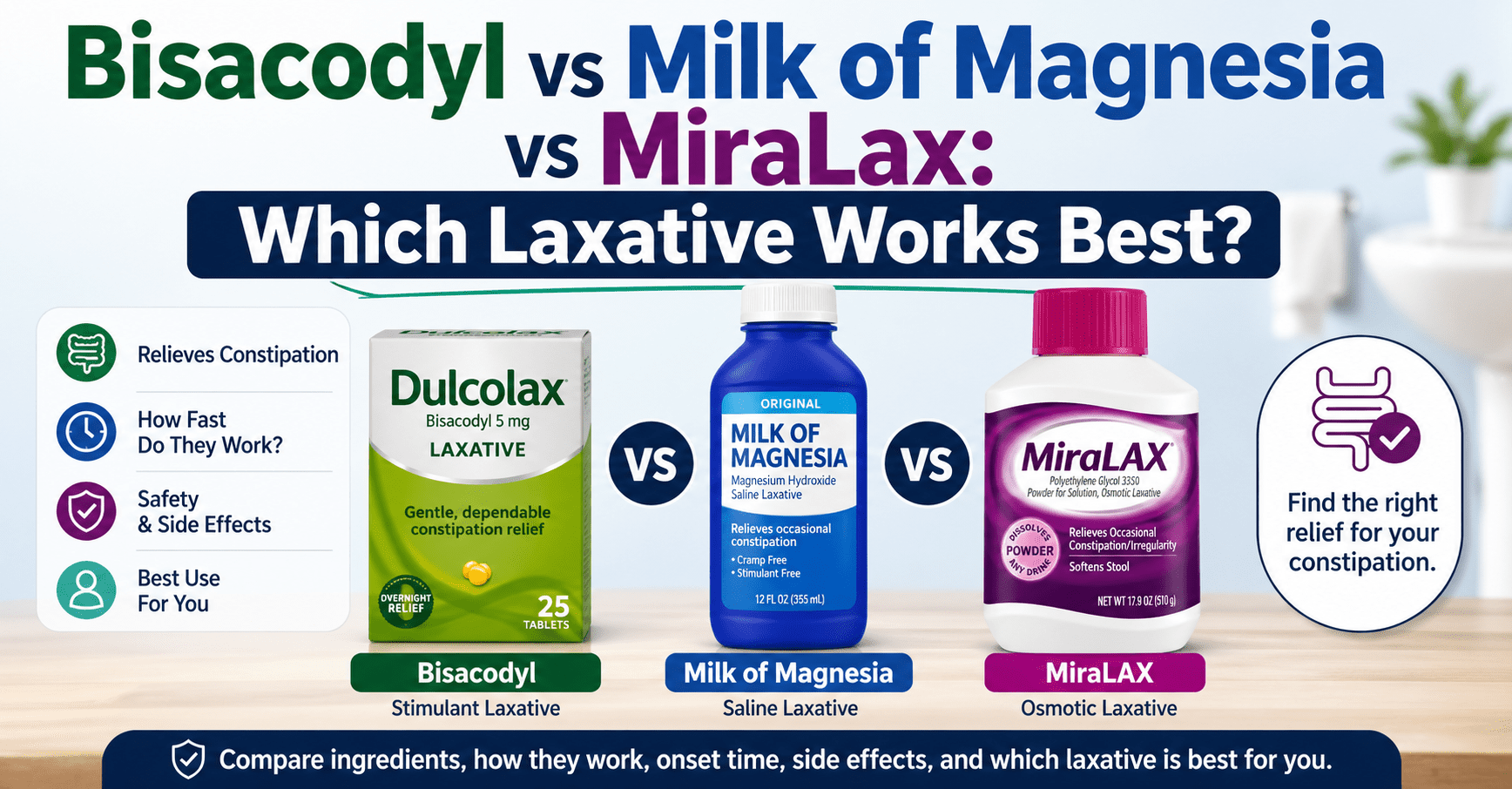
When constipation hits, you want relief fast, but the drugstore shelf is full of options. This guide compares the three most common OTC choices, Bisacodyl vs Milk of Magnesia vs MiraLax: Bisacodyl (Dulcolax) works fast and can be intense, Milk of Magnesia (magnesium hydroxide) is a classic liquid used for over a century, and MiraLax (PEG 3350) is a gentle powder you can stir into any drink.
Below: how each one works, how fast it acts, the correct dose, and which fits your situation, in plain English.
A Quick Overview: What Are These Three Laxatives?
Before comparing them side by side, here is a brief breakdown of what each one is and the laxative class it belongs to:
- Bisacodyl (Dulcolax): A stimulant laxative. It activates colon muscle contractions to push stool toward the exit. Available as swallowable tablets or rectal suppositories.
- Milk of Magnesia (magnesium hydroxide): A saline laxative. It draws water into the intestines through osmotic activity, increasing stool water content to stimulate bowel movement. Taken as a liquid and can also be used as an antacid for occasional heartburn.
- MiraLax (PEG 3350): An osmotic laxative. A tasteless powder mixed into any drink. It travels through the gut retaining water in the stool, keeping it soft until it passes naturally. Generally considered the gentlest option of the three. See our guide on MiraLax side effects and cramping causes.
| Feature | Bisacodyl (Dulcolax) | Milk of Magnesia (magnesium hydroxide) | MiraLax (PEG 3350) |
|---|---|---|---|
| Type | Stimulant laxative | Saline laxative | Osmotic laxative |
| Mechanism | Stimulates colon contractions | Draws water into the intestines through osmotic activity | Retains water in stool |
| Onset time | 6 to 12 hours (tablet); 15 to 60 minutes (suppository) | 30 minutes to 6 hours | 1 to 3 days |
| Standard adult dose | 5 to 10 mg tablet / 10 mg suppository | 30 to 60 mL liquid | 17 g powder (1 capful) |
| Max OTC duration | Up to 7 days | Up to 3 consecutive days | Up to 7 days |
| Available forms | Tablet, suppository, enema | Liquid, chewable tablet | Powder (mix in drink) |
| Taste / ease of use | Easy to swallow tablet | Chalky, minty flavor | Tasteless, dissolves completely |
| Best for | Fast or overnight relief | Same day relief and heartburn | Gentle, multi day relief |
| Gentleness | Lower: can cause cramping and urgency | Moderate: faster but may cause loose stools | Higher: low cramping and urgency |
| FDA regulated | Available over the counter (OTC) in the United States | Available over the counter (OTC) in the United States | Available over the counter (OTC) in the United States |
📋 Quick Comparison Summary
- Fastest relief: Bisacodyl suppository (15 to 60 minutes)
- Same day liquid relief: Milk of Magnesia (30 minutes to 6 hours)
- Overnight tablets: Bisacodyl tablet (6 to 12 hours, take at bedtime)
- Gentle multi day relief: MiraLax (1 to 3 days)
- Easiest to take: MiraLax (tasteless powder, mixes into any drink)
- Antacid for occasional heartburn: Milk of Magnesia (doubles as antacid)
- Avoid with kidney disease: Milk of Magnesia
Related Read: Mag O7 vs Oxy-Powder: Which Oxygen-Based Colon Cleanser Is Best for You?
Bisacodyl (Dulcolax): The Fast Acting Stimulant Laxative
STIMULANT LAXATIVE
Bisacodyl: What You Should Know
Bisacodyl has been used for constipation relief since 1953. Sold under the brand name Dulcolax, it comes as enteric coated tablets (designed to dissolve in the intestines, not the stomach), rectal suppositories, and enemas. A well studied and widely used OTC laxative, it is included on the World Health Organization’s List of Essential Medicines.
🛒 Shop on Amazon 🌿 Shop on iHerb
How Does Bisacodyl Work?
Bisacodyl is a stimulant laxative. Once swallowed, it acts directly on the large intestine (colon) wall in two ways:
- Stimulates colon contractions: It triggers the colon muscles to contract rhythmically, moving stool toward the exit.
- Increases intestinal fluid: It stimulates the colon lining to secrete water, softening stool and easing passage.
It acts locally in the colon with minimal systemic absorption, which is why it does not affect the rest of the body.
Bisacodyl Dosage: How Much to Take
Adult Dosage (Age 12+)
🔹 Tablet (oral): 5 to 10 mg once daily, best taken at bedtime for an overnight result and morning bowel movement.
🔹 Suppository (rectal): 10 mg once daily in the morning, onset within 15 to 60 minutes.
🔹 Bowel prep (before colonoscopy): 10 to 20 mg by mouth plus a suppository the following morning (only under medical instruction).
⚠️ Do NOT take bisacodyl within 1 hour of eating dairy products or taking antacids.
⚠️ Swallow tablets whole with a full glass of water. Do not crush, split, or chew.
How Long Can You Take Bisacodyl?
Bisacodyl is intended for short term use only. Do not use it for more than 7 consecutive days without medical guidance. It is not associated with true chemical dependence, but prolonged use may reduce natural bowel motility: the colon can become accustomed to stimulation and less responsive on its own. Use bisacodyl for occasional constipation, not as a daily routine. If symptoms persist beyond 7 days, medical evaluation is advised.
Bisacodyl Side Effects
- Stomach cramps (most common, can range from mild to significant)
- Nausea, particularly on an empty stomach
- Diarrhea with excessive dosing
- Low potassium (hypokalemia) with long term overuse
- Rectal irritation when using the suppository form
⚠️ Who Should Avoid Bisacodyl: Do not use bisacodyl if you have sudden or severe abdominal pain, are vomiting, notice blood in your stool, or have a known bowel obstruction or inflammatory bowel condition such as Crohn’s disease. These may indicate a serious underlying condition that a stimulant laxative could worsen. Seek medical evaluation instead.
📖 Related Read: Want to understand all your options? See our complete OTC laxatives guide for a full breakdown of every category.
Bisacodyl vs Milk of Magnesia: What Is Different About the Classic Saline Laxative?
SALINE LAXATIVE
Milk of Magnesia (magnesium hydroxide): What You Should Know
This saline laxative has been used medicinally for over 150 years. The active ingredient is magnesium hydroxide. Sold primarily under the Phillips’ brand, it comes as a liquid suspension that is shaken before use and taken orally, or as chewable tablets. It also doubles as an antacid for occasional heartburn and indigestion.
🛒 View on Amazon 🌿 View on iHerb
How Does Milk of Magnesia Work?
After ingestion, magnesium hydroxide remains largely unabsorbed in the intestinal tract, where it acts as an osmotic agent, drawing water into the intestines. This increased fluid volume:
- Softens and loosens hard, dry stool
- Increases stool volume and pressure within the intestines
- Stimulates peristalsis (the natural muscle contractions that move stool forward)
Because magnesium pulls water into the intestines relatively quickly, it acts faster than MiraLax. The tradeoff is that higher doses or sensitive individuals may experience watery stools or dehydration.
Milk of Magnesia Dosage: How Much to Take
Adult Dosage for Constipation (Age 12+)
🔹 Liquid: 30 to 60 mL (approximately 2 to 4 tablespoons) once daily, preferably at bedtime.
🔹 Chewable tablets: Follow package directions (typically 2 to 4 tablets).
🔹 Take with a full 8 ounce glass of water to support efficacy.
⚠️ Ages 6 to 11: 15 to 30 mL per day (consult a doctor first).
⚠️ Under age 6: Do not use without a physician’s approval.
How Long Can You Take Milk of Magnesia?
As a laxative, do not use Milk of Magnesia for more than 3 consecutive days. If constipation persists, contact your doctor. (As an antacid, it may be used for up to 14 days under OTC labeling.)
Milk of Magnesia Side Effects
- Diarrhea (most common, particularly with higher doses)
- Stomach cramps or bloating
- Nausea
- Hypermagnesemia (elevated blood magnesium), rare, primarily a risk in kidney disease
⚠️ Kidney Disease Warning: People with chronic kidney disease should not use this saline laxative without close medical supervision. The kidneys are responsible for clearing excess magnesium; impaired kidney function can allow magnesium to accumulate to unsafe levels in the blood.
Bisacodyl vs Milk of Magnesia: Key Differences
The core difference is mechanism. Bisacodyl directly stimulates colon muscle contractions to move stool, an active push. Milk of Magnesia draws water into the intestines through osmotic activity, increasing stool water content until pressure moves it naturally. In terms of speed, Milk of Magnesia can work in as little as 30 minutes, while bisacodyl tablets require 6 to 12 hours (though the suppository form acts in 15 to 60 minutes).
📖 Related Read: Curious about magnesium based approaches beyond laxatives? Read our natural constipation remedies guide.
MiraLax vs Milk of Magnesia: Why MiraLax Is One of the Most Commonly Recommended OTC Laxatives in the US
OSMOTIC LAXATIVE (PEG 3350)
MiraLax (polyethylene glycol 3350): What You Should Know
MiraLax is one of the most commonly recommended OTC laxatives in the United States. Its active ingredient is polyethylene glycol 3350 (PEG 3350), a substance that passes through the digestive system completely unabsorbed, retaining water in the stool along the way. It comes as an odorless, tasteless powder that dissolves fully in any drink.
🛒 View on Amazon 🌿 View on iHerb
How Does MiraLax Work?
The active ingredient, PEG 3350, is a large, inert molecule that is neither digested nor absorbed. It passes through the entire digestive tract unchanged, retaining water in the stool and keeping it soft throughout transit.
Unlike bisacodyl, MiraLax works more gradually by retaining water in the stool rather than rapidly drawing fluid into the intestines. It also does not directly stimulate colon muscle contractions. Instead, bowel movements occur as stool softens and normal intestinal motility is triggered by increased stool volume. This is why MiraLax produces the least cramping and urgency of the three, with the tradeoff of a slower onset of 1 to 3 days.
MiraLax vs Milk of Magnesia: Key Differences
Both increase intestinal water content, but at different speeds and with different intensity. In any Bisacodyl vs Milk of Magnesia vs MiraLax comparison, this distinction matters most: Milk of Magnesia acts within hours through osmotic fluid shift (as described above), but can feel abrupt at higher doses. MiraLax retains moisture in the stool gradually over 1 to 3 days. MiraLax is also fully tasteless, dissolving completely in hot or cold drinks. Milk of Magnesia has a noticeable chalky, mineral taste even in flavored versions.
MiraLax Dosage: How Much to Take
Adult Dosage (Age 17+)
🔹 Standard dose: 17 g once daily, use the measuring line inside the bottle cap. Do not overfill.
🔹 Mix into: 4 to 8 oz of any cold, warm, or hot beverage: water, juice, coffee, tea, or soda. Stir until fully dissolved before drinking.
🔹 Avoid combining with starch based thickeners such as cornstarch, xanthan gum, or arrowroot.
⚠️ Ages 16 and under: Consult a doctor before use.
⚠️ Do not exceed one dose per day.
How Long Can You Take MiraLax?
Do not use MiraLax for more than 7 consecutive days without medical guidance. If constipation remains unresolved after a week, see a doctor. Some clinicians prescribe MiraLax for longer term use in specific populations (such as pediatric chronic constipation), but this requires supervision.
MiraLax Side Effects
- Mild nausea, particularly on an empty stomach
- Gas or bloating
- Loose stools or diarrhea with excessive dosing
- Abdominal cramps (uncommon at normal doses)
- Allergic reaction (rare, discontinue and seek care if hives or difficulty breathing occur)
💡 Practical Tip: MiraLax dissolves completely and has no discernible taste, making it the most discreet option. Many people stir it into their morning coffee without noticing any change in flavor.
📖 Related Read: Taking GLP-1 medications such as Ozempic or Wegovy? Constipation is a documented side effect. See our guide on California Gold Nutrition GLP-1 Complex review 2026: Does It Fix Ozempic Constipation?.
Side Effects Comparison: Which Laxative Is Easiest on Your Body?
All three are considered safe when used as directed and within the recommended timeframe. Their side effect profiles differ meaningfully, however:
| Side Effect | Bisacodyl | Milk of Magnesia | MiraLax |
|---|---|---|---|
| Stomach cramps | Common | Possible | Uncommon at normal dose |
| Diarrhea | Yes, with excessive dosing | Yes, fairly common | Yes, with excessive dosing |
| Nausea | Yes | Yes (especially on empty stomach) | Mild, occasional |
| Urgency | High (especially suppository) | Moderate | Low |
| Electrolyte imbalance risk | With prolonged overuse | With prolonged overuse (magnesium accumulation) | Very unlikely |
| Reduced bowel motility with overuse | Possible with long term daily use | Unlikely | Unlikely |
| Safe with kidney disease? | Generally considered safe; consult a physician | No, avoid | Should be used with medical guidance |
📋 Side Effects at a Glance
- Most cramping and urgency: Bisacodyl (especially suppository form)
- Most likely to cause diarrhea: Milk of Magnesia (with higher doses)
- Generally gentlest overall: MiraLax, lowest urgency, least cramping
- Kidney disease risk: Milk of Magnesia, avoid without medical supervision
- Electrolyte risk: All three with prolonged overuse; MiraLax least likely
Electrolyte imbalances are mainly a concern with prolonged overuse, not short term use as directed in otherwise healthy individuals.
Summary on tolerability: MiraLax is generally considered the gentlest option of the three. Bisacodyl is effective but can cause significant cramping and urgency. Milk of Magnesia falls in between, but requires the most caution for individuals with impaired kidney function.
Best Laxative for Immediate Relief: Which One Works Fastest?
⚡ Quick Answer on Speed
For the fastest relief: a bisacodyl suppository works in 15 to 60 minutes. Milk of Magnesia typically acts within 30 minutes to 6 hours. MiraLax is the slowest at 1 to 3 days, it is not appropriate when same day relief is needed.
Here is how to match your timeline with the right option:
- Results by morning? Take a bisacodyl tablet at bedtime.
- Relief within a few hours? Use Milk of Magnesia liquid.
- Urgent relief right now? A bisacodyl suppository (15 to 60 minutes) is the fastest OTC option.
- Not in a rush, want gentle, gradual relief? MiraLax is the best choice.
How to Choose: The Right Laxative for Your Situation
Choosing the wrong laxative can mean waiting much longer than necessary, or being caught off guard by cramps and urgency. Use this guide to match your situation to the right product:
Choose Bisacodyl If:
- You want overnight relief (take at bedtime)
- You need fast relief right now (use the suppository form)
- You are preparing for a colonoscopy or bowel procedure
- You have not had a bowel movement in 2 to 3 days and feel bloated
- Other laxatives have not produced results
Choose Milk of Magnesia If:
- You want relief within a few hours without using a suppository
- You also have heartburn or indigestion (it doubles as an antacid)
- You prefer a liquid option that acts the same day
- You do not have chronic kidney disease
Choose MiraLax If:
- You want gentle, gradual relief without cramping or urgency
- You prefer to avoid pills or thick liquids
- You are managing ongoing constipation over several days
- You have a sensitive digestive system (always consult a doctor for children)
- You want to mix your laxative into a daily drink without noticing it
Special Situations
- Elderly adults: MiraLax is often preferred, it is gentle and poses minimal risk of electrolyte disruption. This matters more in older adults, who often have reduced kidney reserve, so MiraLax still requires caution if kidney function is diminished. Bisacodyl’s cramping and urgency can also be harder to manage in older individuals.
- Pregnancy: Always consult your obstetrician before using any laxative. MiraLax is sometimes considered acceptable for short term use during pregnancy, but no OTC laxative carries an official pregnancy safety clearance without medical guidance.
- Kidney disease: Avoid Milk of Magnesia. Bisacodyl is minimally absorbed and often considered a safer option. MiraLax should be used with medical guidance, especially in patients with underlying conditions.
- Children: Bisacodyl is approved for ages 6 and up (consult a pediatrician for dosing guidance) but requires physician approval for children under 6. MiraLax use in children should be guided by a pediatrician, as dosing and duration vary.
📖 Related Read: Dealing with constipation from opioid pain medication? See our guide on Plant Based Diet for Constipation Relief and Better Gut Health.
Where to Buy These Laxatives
All three are available without a prescription at any pharmacy and through major online retailers. Current product listings:
BISACODYL / DULCOLAX
Dulcolax Laxative Tablets (Bisacodyl 5 mg)
Available as 5 mg enteric coated tablets and 10 mg suppositories. One of the longest established OTC laxatives on the market, used clinically since the 1950s.
🛒 Shop on Amazon 🌿 Shop on iHerb
MILK OF MAGNESIA
Phillips’ Milk of Magnesia (Original & Mint Flavor)
The classic saline laxative. Available in original, mint, and fresh strawberry flavors. Also sold as chewable tablets for those who prefer not to drink the liquid.
🛒 Shop on Amazon 🌿 Shop on iHerb
MIRALAX (PEG 3350)
MiraLax Laxative Powder (17g Doses)
A widely recommended OTC laxative brand. Flavorless powder that dissolves completely in any hot or cold beverage, no taste, no grit, no aftertaste.
🛒 Shop on Amazon 🌿 Shop on iHerb
Frequently Asked Questions
Which laxative works the fastest for immediate relief?
Bisacodyl suppositories are fastest, onset is typically 15 to 60 minutes. Milk of Magnesia liquid is next, typically acting within 30 minutes to 6 hours. MiraLax takes 1 to 3 days and is not suitable for same day or urgent relief.
What is the difference between Bisacodyl and Milk of Magnesia?
Bisacodyl is a stimulant laxative, it directly stimulates colon muscle contractions to move stool. Milk of Magnesia (magnesium hydroxide) is a saline laxative, it increases water in the intestines, softening stool (see mechanism details above). Bisacodyl more commonly causes cramping and urgency. Milk of Magnesia is gentler overall but is contraindicated in people with kidney disease.
MiraLax vs Milk of Magnesia, which is better?
For fast relief, Milk of Magnesia is the better choice. For gentle, multi day relief with minimal cramping or urgency, MiraLax is preferred. MiraLax is also completely tasteless and easier to incorporate into a daily drink. For individuals with kidney disease, MiraLax should be used with medical guidance, especially in patients with underlying conditions.
Can I take MiraLax and Milk of Magnesia at the same time?
No, do not combine laxatives without medical guidance. Using two at once significantly increases the risk of severe diarrhea, dehydration, and electrolyte imbalances (affecting potassium, sodium, and magnesium levels), which can lead to muscle weakness, dizziness, or cardiac complications.
Which laxative is safest for daily use?
Of the three, MiraLax is generally the gentlest for short term daily use (up to 7 days). Milk of Magnesia should not be used as a laxative for more than 3 consecutive days. Bisacodyl can be used up to 7 days but carries a higher risk of cramping and urgency with regular use.
Is bisacodyl safe to take every day?
Not long term. The OTC label permits up to 7 consecutive days. Bisacodyl is not associated with true chemical dependence, but prolonged daily use can reduce natural bowel motility over time. If you find yourself reaching for it regularly, speak with your doctor, there may be an underlying cause worth addressing.
Final Thoughts: Which Laxative Should You Choose?
The best laxative depends on one simple factor: how fast you need relief, and how gentle you want it to be. Here is the short version to match your situation:
- 🏃 Fastest relief right now: Bisacodyl suppository
- 🌙 Results by morning: Bisacodyl tablet (take at bedtime)
- ⚡ Same day liquid relief: Milk of Magnesia
- 🌿 Gentle, gradual, low urgency relief: MiraLax
- ❤️ Easiest to take (tasteless, mix in any drink): MiraLax
- 🫀 Heartburn alongside constipation? Milk of Magnesia (can also be used as an antacid for occasional heartburn)
Regardless of which you choose, all three options in this Bisacodyl vs Milk of Magnesia vs MiraLax comparison are designed for short term, occasional constipation relief. If you find yourself needing a laxative regularly over more than a couple of weeks, consult your doctor, persistent constipation may have an underlying cause worth identifying.
For long term digestive health, prioritize dietary fiber, adequate hydration, regular physical activity, and, where appropriate, probiotics. These approaches help address the root causes of constipation rather than just the symptoms.
These recommendations align with standard OTC labeling and common clinical practice for short term constipation relief.
Not sure where to start? Choose MiraLax for gentle, low urgency relief. Need faster results? Take bisacodyl at bedtime. Want same day liquid relief? Go with Milk of Magnesia.
Want to go deeper? See our natural constipation remedies guide and our high fiber foods for constipation list for lasting strategies.
Disclosure:ConstipationRelief.net is reader supported. We may earn a commission from purchases made through our links, at no extra cost to you. This information is for educational use only and is not a substitute for professional medical advice. Reviewed for accuracy by Dr. ABM Sadikullah. Always consult your doctor before starting any new supplement, particularly if you have underlying health conditions.
References & Sources
- Lawrensia S, Patel P, Raja A. Bisacodyl. StatPearls [Internet]. Updated February 28, 2024. NCBI Bookshelf. https://www.ncbi.nlm.nih.gov/books/NBK547733/
- Bharucha AE, Pemberton JH, Locke GR. American Gastroenterological Association Technical Review on Constipation. Gastroenterology. 2013;144(1):218-238. doi:10.1053/j.gastro.2012.10.028
- Kamm MA, Mueller-Lissner S, Wald A, et al. Oral bisacodyl is effective and well tolerated in patients with chronic constipation. Clin Gastroenterol Hepatol. 2011;9(7):577-583. doi:10.1016/j.cgh.2011.03.026
- MedlinePlus. Bisacodyl. U.S. National Library of Medicine. https://medlineplus.gov/druginfo/meds/a601027.html
- MedlinePlus. Polyethylene Glycol 3350. U.S. National Library of Medicine. https://medlineplus.gov/druginfo/meds/a603032.html
- Medical News Today. What is milk of magnesia? Uses, types, and side effects. Reviewed February 25, 2025. https://www.medicalnewstoday.com/articles/323763
- Drugs.com. Bisacodyl Monograph. Updated October 2025. https://www.drugs.com/monograph/bisacodyl.html
- Drugs.com. MiraLAX Uses, Dosage & Side Effects. Updated March 2026. https://www.drugs.com/miralax.html
- Efsm.online. Are all stimulant laxatives the same? September 2024. Sanofi / EFSM review, 2024
- Healthline. MiraLAX: Side Effects and How to Manage Them. Updated September 2024. https://www.healthline.com/health/drugs/miralax-side-effects






[…] Need relief tonight — use magnesium citrate liquid or MiraLAX instead for faster action. See our Magnesium Citrate guide and our Bisacodyl vs Milk of Magnesia vs MiraLAX comparison […]
[…] you are considering reducing your laxative use, please follow the same approach — speak to your doctor first, particularly if you have been […]
[…] a head-to-head comparison against other OTC options, see Bisacodyl vs Milk of Magnesia vs MiraLAX and our full OTC laxatives […]
[…] a closer look at how PEG compares to other options, see our guide on Bisacodyl vs. Milk of Magnesia vs. MiraLAX and our MiraLAX vs. Metamucil […]
[…] stimulant laxatives like bisacodyl. If you want to see how those two options actually compare, our Bisacodyl vs Milk of Magnesia vs MiraLAX comparison breaks down the mechanism differences in more […]
[…] a closer look at how PEG compares with a saline option, our guide on Bisacodyl vs Milk of Magnesia vs MiraLax breaks down onset time and side effects for […]
[…] evidence behind it. For a head-to-head look at PEG against other common OTC options, see Bisacodyl vs Milk of Magnesia vs MiraLax. Compare top-rated MiraLAX (polyethylene glycol) options on […]