
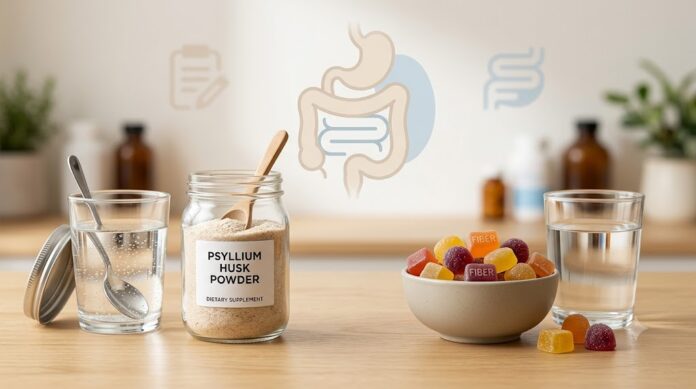
Fiber gummies vs psyllium husk for constipation is one of the first questions people ask once they decide to close their fiber gap. Both are marketed as an easy way to hit your daily fiber target. But they work in genuinely different ways.
Picking the wrong one can mean weeks of no results, or unnecessary bloating.
Quick answer:
Psyllium husk has the strongest clinical evidence for constipation relief. It works through a direct, gel-forming mechanism.
Fiber gummies are far more convenient. But most rely on fermentable prebiotic fibers like inulin or FOS, at only 3 to 8 grams per serving. These support gut health gradually, rather than producing a fast, direct laxative effect.
A mild or occasional case may respond fine to a gummy. Chronic or stubborn constipation usually needs psyllium.
Key Takeaways
- Psyllium forms a water-holding gel that softens stool and increases stool bulk. Most fiber gummies use inulin or FOS, which are fermented by gut bacteria and act more slowly.
- The 2023 AGA-ACG guideline names psyllium as the only fiber supplement with strong enough evidence for chronic constipation; evidence for inulin is described as limited.1
- Gummies typically deliver 3 to 8 grams of fiber per serving, roughly half of what a standard psyllium dose provides.
- Inulin and FOS are fermentable FODMAPs and tend to cause more gas than psyllium, especially in people with IBS.
- Convenience is the one area gummies clearly win, and consistency matters more than potency if a supplement keeps getting skipped.
Want more detail before you decide? These guides go deeper on each piece of the picture:
- Our research-based guide to the best fiber gummies for constipation ranks nine current options label by label.
- Our psyllium husk vs wheat bran comparison covers dosage and side effects against another common fiber source.
- Our roundup of 7 Natural Fiber Supplements for Chronic Constipation covers the wider field, including bran, methylcellulose, and acacia fiber.
At a Glance: Fiber Gummies vs Psyllium Husk for Constipation
| Feature | Fiber Gummies | Psyllium Husk |
|---|---|---|
| Typical fiber type | Inulin, FOS, chicory root (fermentable soluble fiber) | Gel-forming soluble fiber (Plantago ovata) |
| Mechanism | Prebiotic; fermented by gut bacteria over time | Forms a viscous gel that holds water and softens stool directly |
| Fiber per serving | 3 to 8 grams | 2.4 to 6 grams per teaspoon, depending on brand; clinical trial doses of 5 to 15 g/day, with a typical starting dose of 5 to 10 g/day |
| Clinical evidence for constipation | Limited and uncertain, per the 2023 AGA-ACG guideline1 | Strongest evidence among all fiber supplements, per the same guideline1 |
| Time to notice results | Several days to a few weeks | 12 to 72 hours, with fuller benefit generally building over several weeks of consistent use1,2 |
| Bloating and gas risk | Higher; inulin and FOS are fermentable FODMAPs | Lower; psyllium is only partially fermented |
| Water requirement | Hydration is recommended for best results, but gummies do not carry the same choking risk as dry psyllium | Essential; minimum 8 oz (240 ml) per dose |
| Convenience | Very high; chew and go, no mixing | Lower; must be mixed with water and taken right away |
| Added sugar or sugar alcohols | Common; varies widely by brand | Rare; most products are unsweetened |
| Best suited for | Mild or occasional constipation, daily consistency | Chronic constipation, IBS-C, cholesterol and blood sugar goals |
Affiliate disclosure: This article contains affiliate links. If you purchase through them, we may earn a small commission at no extra cost to you. This never influences our editorial recommendations.
At a Glance: Best Picks — Fiber Gummies vs Psyllium Husk for Constipation
Not sure which format to start with? Here are the top-recommended options for each type covered in this guide:
🏆 Psyllium Husk (strongest clinical evidence for constipation)
- Best overall psyllium (unflavored powder, no additives): Konsyl Daily Psyllium Fiber Powder (19oz, 90 Servings) — 100% pure psyllium husk, single ingredient, sugar-free, the fiber type with the strongest 2023 AGA-ACG recommendation for chronic constipation
- Best psyllium for convenience (no mixing, no taste): NOW Foods Psyllium Husk Caps 500mg (200 Veg Capsules) — pure psyllium husk, Non-GMO Project Verified, Kosher, vegan, gluten-free, GMP certified, easy to take consistently without texture or taste concerns
🍬 Fiber Gummies (best for mild/occasional constipation, daily consistency)
- Best sugar-free gummy (widely available, trusted brand): Vitafusion Fiber Well Sugar Free — 5g chicory root inulin per 2-gummy serving, no added sugar or sweeteners, gluten-free, free from synthetic dyes
- Best gummy for quality control (third-party tested): Physician’s Choice Fiber Gummies — 5g chicory root inulin, cGMP certified, no sugar alcohols, 100% plant-based
- Best all-in-one gummy (fiber + probiotics + vitamin D3): Lemme Fiber Gummies — 4g FOS fiber, zero sugar alcohols, two clinically studied probiotic strains, gelatin-free
What Is Psyllium Husk?
Psyllium husk is a soluble fiber taken from the seeds of Plantago ovata. It’s best known as the active ingredient in Metamucil.
Mixed with water, it absorbs many times its own weight in liquid. It forms a thick gel that softens stool and increases stool bulk, which helps promote more regular bowel movements.
The 2023 joint American Gastroenterological Association and American College of Gastroenterology (AGA-ACG) clinical practice guideline reviewed every major fiber supplement. Psyllium was the only one with evidence strong enough to earn a conditional recommendation as first-line therapy for chronic idiopathic constipation.1
Clinical trials generally use total daily doses between 5 and 15 grams. A typical starting point is 5 to 10 grams per day, and some trials have tested higher doses under medical supervision.2
Psyllium is naturally gluten-free and unflavored in most formulations. That makes it a straightforward choice if you’re also watching sugar or additive intake. For how it compares against another widely used insoluble fiber, including IBS safety and cholesterol benefits, see our detailed Psyllium Husk vs Wheat Bran for Constipation guide.

What Are Fiber Gummies?
Fiber gummies are chewable supplements built around inulin, FOS, or chicory root extract, delivered in a flavored, candy-like format. Gel-forming fibers like psyllium are gritty and hard to turn into a stable chewable. So almost every fiber gummy on the market defaults to fermentable prebiotic fibers instead.
These fibers aren’t broken down in the small intestine. They travel intact to the colon, where gut bacteria ferment them and produce short-chain fatty acids. This process supports the gut microbiome over time. But it doesn’t create the same direct, mechanical laxative effect that a gel-forming fiber produces.
A smaller number of gummies use soluble corn fiber (often labeled Fibersol) blended with inulin. This blend tends to ferment more slowly and cause less gas than inulin alone, though it still lacks psyllium’s bulk-forming gel.
Most adult gummy servings provide 3 to 8 grams of fiber, well short of the 25 to 38 grams most adults need daily. USDA Economic Research Service data indicate that average fiber intake remains well below recommendations across the U.S. population.3 Our Best Fiber Gummies for Constipation guide breaks down nine specific products by exact fiber dose, sweetener, and third-party testing.

A Common Point of Confusion Worth Knowing
Because Metamucil is famous for psyllium, many people assume its gummy line contains psyllium too. It does not.
Metamucil’s fiber gummies use an inulin and Fibersol blend. The same is true of most major fiber gummy brands, since psyllium simply cannot be formed into a stable gummy. If a specific gummy product’s laxative strength matters to you, check the supplement facts panel rather than relying on the brand name alone.
Fiber Gummies vs Psyllium Husk: Head-to-Head Comparison
1. Clinical Evidence for Constipation
Winner: psyllium husk. The 2023 AGA-ACG joint guideline specifically evaluated psyllium, bran, methylcellulose, and inulin for chronic idiopathic constipation. Psyllium was the only fiber with evidence sufficient to support a conditional recommendation as first-line therapy, particularly for people with low dietary fiber intake.1 Evidence for inulin, the fiber behind most gummies, was described as limited and uncertain.
A separate clinical review cites a randomized trial of 170 patients. In it, psyllium outperformed the stool softener docusate at increasing stool water content and bowel movement frequency.2 A 2009 systematic review in the BMJ similarly found psyllium significantly more effective than bran-type insoluble fiber for overall symptom relief in IBS patients.4
2. Mechanism of Action
Psyllium works mechanically. It absorbs water and forms a viscous gel that directly softens stool and adds bulk, independent of your gut bacteria composition.
Fiber gummies work biologically. Inulin and FOS are fermented by colonic bacteria into short-chain fatty acids. This is genuinely useful for gut health, but it’s a slower, more indirect route to relieving constipation.
A randomized trial compared a mixed soluble and insoluble fiber blend against psyllium alone. Both groups saw significant improvements in stool frequency and consistency, with broadly similar overall effectiveness, though the mixed-fiber group reported slightly better tolerability.5

3. Fiber Dose Per Serving
Fiber gummies typically deliver 3 to 8 grams of fiber per serving. Psyllium products generally deliver 2.4 to 6 grams of soluble fiber per teaspoon or capsule serving, and clinical trials for constipation commonly use total daily doses of 5 to 15 grams.2
Psyllium is typically taken in larger cumulative daily amounts, and it forms a gel rather than relying on fermentation. That combination tends to produce a more noticeable, direct effect on stool consistency and frequency.
4. Bloating and Gas
Inulin and FOS are fermentable FODMAPs. Gut bacteria break them down quickly, a process that generates gas as a byproduct. This makes fiber gummies more likely to cause bloating, especially above 10 to 15 grams a day or when intake increases too fast.
Psyllium is only partially fermented, so it produces noticeably less gas at comparable doses. That’s one reason it tends to be better tolerated for daily, long-term use, including in people with IBS.4
5. Water Requirements and Safety
Psyllium requires adequate water without exception. Without at least 8 ounces (240 ml) per dose, the gel can form in the throat or esophagus and create a choking hazard. It can also compact in the colon and worsen constipation instead of relieving it.
Fiber gummies don’t carry the same acute choking risk, since they’re chewed and swallowed like candy. Hydration still improves how any soluble fiber performs in the gut, gummy or otherwise.
6. Convenience and Real-World Consistency
Winner: fiber gummies. This is where gummies have a genuine, practical edge. No mixing, no water requirement at the moment of dosing, no gritty texture, no unpleasant aftertaste.
The single biggest predictor of whether any fiber supplement actually works is whether someone takes it every day. A gummy that a person will reliably use can outperform, in practice, a more clinically potent powder that keeps getting left in the cupboard.
7. Sugar, Sweeteners, and Additives
Many fiber gummies contain added sugar or sugar alcohols such as sorbitol, maltitol, or xylitol to improve taste and texture. Sorbitol and mannitol are FODMAPs, and they’re the sweeteners most likely to cause gas and loose stools.
Erythritol is generally well tolerated in small amounts for digestive purposes.6 However, a 2023 study in Nature Medicine found that people with higher blood erythritol levels had a greater rate of cardiovascular events over follow-up. Follow-up lab work by the same research group found that erythritol increased platelet reactivity in blood samples.7
This research is observational and mechanistic, not a randomized trial of erythritol intake itself. A direct cause-and-effect relationship between eating erythritol-sweetened foods and cardiovascular risk has not been established, and the findings are still being evaluated by the broader research community.6,7 Allulose appears to cause fewer digestive side effects than most sugar alcohols.6
Psyllium products, by contrast, are usually unsweetened or use a single flavoring agent. That matters if you’re managing blood sugar or avoiding sugar alcohols entirely.
8. Additional Health Benefits Beyond Constipation
Psyllium is one of the few fiber supplements covered by an FDA-authorized health claim relating to coronary heart disease risk reduction through LDL cholesterol lowering. Clinical research also supports a role in blunting post-meal blood sugar spikes.8
Fiber gummies built on inulin do offer prebiotic support for gut bacteria diversity. But they don’t carry the same cardiovascular or glycemic evidence base as psyllium.
9. Who Actually Reads the Label
Look past the front-of-package marketing on either product:
- For gummies: check the supplement facts panel for the actual fiber source and gram count, not just the word “fiber” on the label. Note whether the sweetener is a sugar alcohol.
- For psyllium: check whether the product is genuinely unflavored or sugar-free if that matters to you, since some flavored psyllium powders do contain added sugar.
- For either format: third-party testing certifications, such as USP or NSF, add a layer of quality assurance. Supplements aren’t FDA-reviewed for effectiveness before they reach the shelf, and not every gummy brand currently carries one of these certifications.
Fiber Gummies and GLP-1 Medications
A growing share of fiber gummy marketing now targets people on GLP-1 medications such as Ozempic, Wegovy, Mounjaro, or Zepbound. There’s a real reason for that.
A 2025 review in Mayo Clinic Proceedings notes that gastrointestinal side effects occur in roughly 40 to 70 percent of patients treated with these medications.9 These include nausea, vomiting, diarrhea, and constipation. They’re driven largely by the way GLP-1 drugs slow gastric emptying as part of their effect on appetite and blood sugar.
That same slowed-transit mechanism affects the rest of the digestive tract too, which is why constipation is one of the most frequently reported side effects. Reduced appetite compounds the issue: eating less food overall usually means eating less fiber, even before slowed transit is factored in.
Because GLP-1 medications slow gastric emptying, anyone with persistent vomiting, severe abdominal pain, or symptoms of bowel obstruction should seek medical evaluation rather than simply increasing fiber intake.
A fiber gummy can be a reasonable, low-friction way to close the fiber gap for someone eating smaller meals. The same principles apply here as anywhere else: start with a low dose, increase gradually, and prioritize water intake, since appetite suppression from these medications often reduces fluid intake too.
If constipation doesn’t improve with fiber and adequate hydration, that’s a reasonable point to involve your prescribing doctor rather than continuing to escalate supplements on your own. Psyllium remains a reasonable option here as well, and for some people with more persistent GLP-1-related constipation, its stronger direct effect may be the better starting point.
Who Should Choose Psyllium Husk
- You have chronic or recurring constipation, not just occasional irregularity
- You have IBS-C (constipation-predominant irritable bowel syndrome), where psyllium is generally better tolerated than insoluble, highly fermentable fibers4
- You also want to address elevated LDL cholesterol or post-meal blood sugar spikes
- You are comfortable mixing a powder with water or taking capsules consistently
- You want the most extensively studied fiber supplement option available
Who Should Choose Fiber Gummies
- Your constipation is mild or occasional rather than chronic
- You struggle to take powders or capsules consistently and need something you will actually use every day
- You are supplementing a generally low-fiber diet rather than treating an active constipation problem
- You want a gentler entry point before considering a stronger fiber source
- You are not managing IBS or notable FODMAP sensitivity, since inulin and FOS can aggravate both
Special Situations: Pregnancy, Children, and Sensitive Guts
Pregnancy. Bulk-forming fibers such as psyllium are typically considered safe to use during pregnancy, because they aren’t absorbed by the body. This is according to Mayo Clinic guidance on pregnancy-related constipation.10 Still, confirm with your own obstetric provider before starting any new supplement, since individual circumstances vary.
Children. Fiber gummies marketed for kids typically use smaller inulin or FOS doses, formulated for a milder effect. A commonly used rule of thumb for pediatric fiber needs is “age plus 5 grams per day.” Official recommendations vary by age and sex, so check the specific target with a pediatrician rather than relying on a single product to cover it.
IBS, SIBO, and FODMAP sensitivity. Both inulin-based gummies and, to a lesser extent, psyllium can trigger symptoms in some people. Psyllium is the better-tolerated option in most controlled studies.4 Anyone with a history of bowel obstruction, strictures, or Crohn’s disease should talk to a clinician before adding either type of bulk-forming fiber.
Can You Use Both Together?
Yes, in principle. Some people use psyllium as their primary daily fiber source and add a fiber gummy occasionally when travel or a busy schedule makes mixing a powder impractical.
If you’re new to fiber supplementation, though, introduce only one product at a time. Starting both together makes it hard to tell which one is responsible if you get gas, bloating, or cramping. Stacking two fiber sources too quickly also raises the risk of both.
Curious about other fiber types you could rotate in? Our guide to 7 Natural Fiber Supplements for Chronic Constipation covers dosage and side effects for several additional options.
A Simple Two-Week Test If You Are Deciding Between the Two
- Week 1: Pick one product only. If trying a gummy, start at half the labeled serving; if trying psyllium, start at half the standard dose (about 2.5 to 5 grams) mixed with a full glass of water.
- Days 4 to 7: If tolerated well, move up to the full labeled dose for gummies, or the standard 5 to 10 gram daily dose for psyllium.
- Week 2: Keep the dose steady and track stool frequency, consistency, and any bloating. Two weeks is generally enough for many people to judge whether a fiber supplement is working, since fermentable fibers in particular need this long to show their full effect.
- If a gummy has not helped by the end of week two, switching to psyllium is a reasonable next step given its stronger evidence base for direct constipation relief.
Dosage and Safety Guidelines
Psyllium Husk
- Standard adult dose: 5 to 10 grams per day; some people may require higher doses under medical supervision
- Timing: 30 minutes before a meal or at bedtime, taken consistently at the same time each day. See our guide to the best time of day to take fiber supplements for more on how timing affects results
- Critical rule: Always mix with at least 8 oz (240 ml) of water and drink immediately; never take it dry or with too little liquid
- Start low: Begin with half the target dose for the first 5 to 7 days, then increase
Fiber Gummies
- Standard adult dose: Follow the label; most servings provide 3 to 8 grams of fiber
- Start low: Begin with a half serving for the first few days, adding no more than 5 grams of total fiber per week
- Hydration: Drink extra water even though it is not required for safe swallowing the way psyllium’s water requirement is
- Medication spacing: Take fiber supplements of either type at least 1 to 2 hours away from other medications. Fiber can reduce the absorption of certain medications, including levothyroxine, carbamazepine, digoxin, and some diabetes medicines, so check with a pharmacist if you take any of these regularly.11
When to See a Doctor
- Constipation lasting longer than three weeks despite fiber and adequate hydration
- Blood in the stool, severe abdominal pain, or unexplained weight loss
- A diagnosed history of bowel obstruction, strictures, or Crohn’s disease before adding any bulk-forming fiber
- Pregnancy, breastfeeding, or multiple prescription medications, before starting any new supplement
Frequently Asked Questions
Are fiber gummies as effective as psyllium husk for constipation?
Not for most people with an active constipation problem. Fiber gummies use fermentable prebiotic fibers at lower doses and lack psyllium’s direct, gel-forming laxative mechanism.
The 2023 AGA-ACG guideline identifies psyllium as the fiber supplement with the strongest evidence of benefit. Inulin, the fiber behind most gummies, has limited and uncertain evidence for constipation specifically.1
Can I switch from fiber gummies to psyllium husk if gummies aren’t working?
Yes. If you’ve used a fiber gummy consistently for two to three weeks with adequate water and diet and haven’t seen improvement, switching to psyllium is a reasonable next step. It has considerably stronger clinical support for direct constipation relief. See our psyllium husk comparison guide for dosage details if you’re making that switch.
Do fiber gummies cause less gas than psyllium?
Generally no, often the opposite. Inulin and FOS, the primary fibers in most gummies, are fermentable FODMAPs. They tend to cause more gas and bloating than psyllium, which is only partially fermented in the colon.
Which one is better for IBS?
Psyllium husk, in most head-to-head research. Clinical guidelines and studies support psyllium for IBS-C symptom relief. Fermentable fibers like inulin and FOS are known FODMAP triggers that can worsen IBS symptoms in sensitive individuals.4
Can I take fiber gummies and psyllium husk on the same day?
You can, but introduce them separately first to confirm how your body tolerates each one, and stay mindful of total daily fiber intake. Increasing fiber too quickly from any combined source is the most common reason people experience bloating and abandon fiber supplementation altogether.
Do any fiber gummies actually contain psyllium?
Virtually no mainstream fiber gummies contain psyllium. Its gritty, gel-forming texture can’t be stabilized into a chewable gummy, so brands including Metamucil use inulin, FOS, or soluble corn fiber blends in their gummy lines instead, even though their original powders are psyllium-based.
If the laxative strength of psyllium is what you’re after, a powder or capsule is currently the more reliable format. Our fiber gummies review lists exactly which fiber source each current gummy product uses.
Is psyllium better than fiber gummies for weight loss?
Neither is designed as a weight-loss product, and this article focuses on constipation rather than weight management. That said, psyllium’s larger fiber dose and gel-forming effect may support fullness more than a typical gummy serving, since viscous soluble fibers are generally associated with increased satiety.
Anyone considering a fiber supplement specifically for weight management should discuss it with a doctor or dietitian rather than relying on either product as a standalone strategy.
This article is for informational purposes only and is not a substitute for professional medical advice, diagnosis, or treatment. Always consult your physician before starting any new supplement, particularly if you have kidney disease, IBS, or take prescription medications.
References
- Chang L, Chey WD, Imdad A, et al. American Gastroenterological Association-American College of Gastroenterology Clinical Practice Guideline: Pharmacological Management of Chronic Idiopathic Constipation. Gastroenterology. 2023;164(7):1086-1106. https://pmc.ncbi.nlm.nih.gov/articles/PMC10542656/
- McRorie JW Jr. Evidence-Based Approach to Fiber Supplements and Clinically Meaningful Health Benefits. Nutr Today. 2015. https://pubmed.ncbi.nlm.nih.gov/27680987/
- USDA Economic Research Service. Over time, racial and ethnic gaps in dietary fiber consumption per 1,000 calories have widened. https://www.ers.usda.gov/data-products/charts-of-note/chart-detail?chartId=106189
- Bijkerk CJ, de Wit NJ, Muris JW, et al. Soluble or insoluble fibre in irritable bowel syndrome in primary care? BMJ. 2009;339:b3154. https://www.bmj.com/content/339/bmj.b3154
- Randomized Clinical Trial: Soluble/Insoluble Fiber or Psyllium for Chronic Constipation. PMC4891216. https://pmc.ncbi.nlm.nih.gov/articles/PMC4891216/
- Cleveland Clinic. Sugar Alcohols May Not Be as Safe as You Thought. https://health.clevelandclinic.org/what-to-know-about-sugar-alcohols
- Witkowski M, Nemet I, Alamri H, et al. The artificial sweetener erythritol and cardiovascular event risk. Nat Med. 2023;29(3):710-718. https://pubmed.ncbi.nlm.nih.gov/36849732/
- FDA Authorized Health Claim: Psyllium and Reduced Risk of Heart Disease. https://www.fda.gov/food/nutrition-labeling-and-value-daily/authorized-health-claims-meet-significant-scientific-agreement-ssa-standard
- GLP1 and GIP Receptor Agonists: Effects on the Gastrointestinal Tract and Management Strategies for Primary Care Physicians. Mayo Clin Proc. 2025. https://www.mayoclinicproceedings.org/article/S0025-6196(25)00551-8/fulltext
- Mayo Clinic. Pregnancy constipation: Are stool softeners safe? https://www.mayoclinic.org/healthy-lifestyle/pregnancy-week-by-week/expert-answers/pregnancy-constipation/faq-20058550
- Mayo Clinic. Fiber supplements: Safe to take every day? https://www.mayoclinic.org/healthy-lifestyle/nutrition-and-healthy-eating/expert-answers/fiber-supplements/faq-20058513