

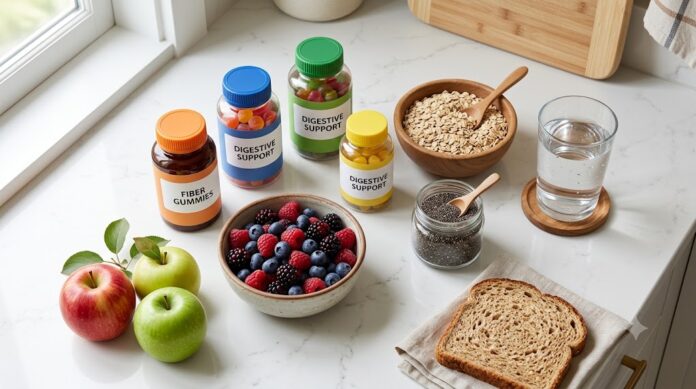
Plain water and oatmeal haven’t cut it, so you’re looking at fiber gummies. Fair question: do they actually work, or is this just candy with a health claim on the label?
Short answer: it depends on the fiber type, the dose, and how bad your constipation is.
This guide covers what the research says on the best fiber gummies for constipation, reviews nine specific fiber gummy products with verified label data, and flags when a fiber gummy supplement won’t be enough on its own.
Quick Verdict:
If you’re looking for the best fiber gummies for constipation, MiraFIBER offers the highest fiber dose (8g), while Vitafusion Fiber Well Sugar Free is one of the best sugar-free options. However, if you have chronic constipation, a psyllium-based fiber supplement or another evidence-based treatment may be more effective than gummies alone.
Disclosure: This post contains affiliate links. If you buy through them, we may earn a commission at no extra cost to you. It doesn’t affect which products we recommend or how we rank them.
At a Glance: Our Best Fiber Gummies for Constipation (2026)
Not all fiber gummies are equal — here are the top picks by use case, ranked by fiber dose and ingredient quality:
- 🥇 Best overall (highest fiber dose): MiraFIBER Gummies — 8g fiber per serving (4 gummies), inulin + pectin blend, added B vitamins, from the makers of MiraLAX — not vegan (gelatin-based), ramp up slowly to avoid gas
- Best sugar-free, high-dose option: Vitamatic Prebiotic Fiber Gummies Extra Strength — 7g FOS from beet per serving, zero added sugar, vegan and non-GMO, pectin-based gel
- Best trusted brand, mid-dose: Nature Made Fiber Gummies — 6g inulin per serving, no artificial dyes, pharmacist-recommended brand, contains sugar
- Best for flexible daily dosing: Benefiber Prebiotic Fiber Gummies — 6g inulin per serving, up to 12g daily (6 gummies), gluten-free, established brand, contains sugar
- Best multivitamin + fiber combo: SmartyPants Adult Complete + Fiber — 6g chicory root inulin at full serving (6 gummies), plus omega-3, vitamin D3, B12, third-party tested — build up over 1 week
- Best no-sugar from a major brand: Metamucil Fiber Gummies — 5g inulin + Fibersol blend per serving, zero added sugar, orange flavored, up to 3 servings daily — note: does NOT contain the psyllium the brand is known for
- Best sugar-free, smallest serving size: Vitafusion Fiber Well Sugar Free — 5g chicory root inulin in just 2 gummies, zero sugar, vegan, gluten-free, well-rated for taste
- Best widely available drugstore pick: OLLY Fiber Gummy Rings — 5g FOS in 2 gummies, gluten-free, strawberry watermelon flavor, contains sugar
- Best for kids or gentle start: BeLive Fiber Gummies — ~3.35g inulin per serving, sugar-free, vegan, family-friendly — lowest dose on this list, best as a starting point only
Full reviews, pros/cons, and who each one suits are below.
How Fiber Relieves Constipation
Dietary fiber is the part of plant food your body can’t digest. It travels to your colon and does one of two things.
Soluble fiber (inulin, psyllium, oat fiber) dissolves in water into a gel that softens stool and adds bulk.
Insoluble fiber (wheat bran, vegetable skins) doesn’t dissolve. It adds bulk and speeds transit instead.
Most fiber gummies use soluble, fermentable fibers like inulin, FOS, or chicory root, since gritty insoluble fibers such as psyllium husk are hard to turn into a chewable candy.
Mayo Clinic gastroenterologists note that fiber is well recognized to relieve constipation at the right intake levels, and that supplements can reasonably fill the gap when diet falls short. The general advice is to start with a small amount, follow the label dose, and drink plenty of fluids.
Related reading: natural laxatives for constipation and, if poor fat or dairy digestion is the actual issue rather than low fiber intake, digestive enzymes for constipation.

What the Research Actually Shows
There’s little research on fiber gummies specifically. Most studies look at the underlying fiber ingredient, such as inulin, psyllium, or wheat dextrin, rather than the gummy format itself. That distinction matters when you’re comparing products.
Psyllium has the strongest evidence. The American Gastroenterological Association and American College of Gastroenterology published a joint clinical practice guideline on chronic idiopathic constipation in 2023. Among the fiber supplements it evaluated, only psyllium had sufficient evidence of benefit. Evidence for bran and inulin was described as limited and uncertain.
A separate 2015 clinical review cites a randomized trial of 170 patients. In that trial, psyllium outperformed the stool softener docusate at increasing stool water content and bowel movement frequency.
Inulin and FOS work differently. Rather than bulking stool directly, they’re prebiotics fermented by gut bacteria, which is the mechanism behind almost every gummy on the market. A randomized trial comparing a mixed soluble/insoluble fiber blend against psyllium found roughly 75% of participants in both groups responded, with similar improvement in stool consistency and straining, though the mixed-fiber group tolerated it better.
Dose and fermentability are the real catch. Gummies typically deliver 3 to 8 grams of fiber per serving, well under the 25 to 30 grams recommended daily. That’s enough for mild, occasional constipation but often not enough alone for persistent cases. Inulin and FOS are also fermentable FODMAPs, the fiber type most linked to gas and bloating, especially above 10 to 15g/day, and people with IBS are often advised to avoid them.
If you’ve been at this a while without results, read why fiber isn’t working for your constipation.

Fiber Gummies and GLP-1 Medications
A large share of newer fiber gummies are now marketed specifically toward people on GLP-1 medications like Ozempic, Wegovy, Mounjaro, or Zepbound, and there’s a real reason for that. These drugs slow gastric emptying, which is part of how they work for appetite and blood sugar, but the same mechanism slows the entire digestive tract. Estimates of how many users experience constipation vary by study and dose, ranging from roughly 15% up to 40 to 50% in some surveys, making it one of the most commonly reported side effects.
Reduced appetite compounds the problem. Eating less food overall usually means eating less fiber, even before the slowed transit is factored in. A fiber gummy can be a practical way to close that gap without needing to eat more volume.
The same rules apply as for anyone else: start low, increase gradually, and prioritize water intake, since appetite suppression often reduces fluid intake too. If constipation on a GLP-1 medication doesn’t improve with fiber and water, that’s a reasonable point to loop in your prescribing doctor rather than escalating supplements on your own.

9 Best Fiber Gummies for Constipation, Reviewed
Fiber content and ingredients below are pulled from each brand’s current label for these fiber gummies for constipation relief. Always confirm on the bottle you actually receive, since formulas and package sizes change.
1. MiraFIBER Gummies (from the makers of MiraLAX)
Fiber: 8g per serving (4 gummies) · Sugar: ~1g added · Extras: B vitamins (B3, B6, B12)
Dosage: Adults, fully chew 4 gummies once daily. Not for children.
The highest dose on this list, from a brand best known for its laxative line. Good if a standard 5g gummy hasn’t moved the needle. Note it’s gelatin-based (not vegan) — the label lists gelatin and beeswax, so it’s not suitable for vegans or vegetarians.
Pros
- Highest fiber dose available in gummy form
- Recognizable, trusted brand
- Added B vitamins
Cons
- Higher dose means a bigger chance of gas if you don’t ramp up slowly
- Contains a small amount of added sugar
- Not vegan or vegetarian (gelatin-based)
Best for: People who’ve tried lower-dose gummies without enough effect.
2. Vitamatic Prebiotic Fiber Gummies, Extra Strength
Fiber: 7g FOS (fructooligosaccharides from beet) per serving · Sugar: Zero added
Dosage: Chew 3 gummies daily with 8–12 oz of water, or as directed by your healthcare provider.
A high-dose, sugar-free option. Pectin is used as the gel base here, not the fiber source. The fiber itself is FOS.
Pros
- Strong fiber dose
- Zero added sugar
- Vegan and non-GMO
Cons
- Less brand recognition than the drugstore names
- Start slow given the dose
Best for: Sugar-conscious buyers who still want a high fiber count.
3. Nature Made Fiber Gummies
Fiber: 6g inulin per 3-gummy serving · Sugar: Contains sugar · Extras: No synthetic dyes
Dosage: Adults, chew 3 gummies daily. Kids 4–18: start with 1 gummy and gradually increase to 3.
A solid mid-range dose from a long-standing, pharmacist-recommended supplement brand.
Pros
- Reputable manufacturer
- Decent fiber dose
- No artificial dyes
Cons
- Not sugar-free
- Single-ingredient inulin, so bloating risk is on the higher side
Best for: Buyers who want a trusted big-brand name at a moderate dose.
4. Benefiber Prebiotic Fiber Gummies
Fiber: 6g inulin per 3-gummy serving · Sugar: Contains sugar
Dosage: Ages 12+, chew 3 gummies, up to twice daily. Do not exceed 6 gummies per day.
Benefiber’s powder line is a familiar name. Its gummies match Nature Made’s dose almost exactly.
Pros
- Established brand
- Flexible dosing, up to 6 gummies per day per the label
- Gluten-free
Cons
- Contains sugar
- Same single-ingredient inulin bloating risk as other high-inulin gummies
Best for: People who want flexibility to adjust total daily fiber intake.
5. SmartyPants Adult Complete + Fiber
Fiber: 6g soluble fiber (chicory root inulin) at the full 6-gummy serving · Sugar: Low · Extras: Omega-3 EPA/DHA, 900 IU vitamin D3, B12, multivitamin blend
Dosage: Adults, take 3 gummies daily for the first week, then 6 gummies daily thereafter.
Less a dedicated fiber product than an all-in-one gummy multivitamin that happens to include a real fiber dose. You build up to the full serving over about a week.
Pros
- Covers fiber plus several nutrient gaps in one product
- Third-party tested
- Decent fiber dose at full serving
Cons
- Full fiber dose requires 6 gummies a day, not 2 to 3 like dedicated fiber gummies
- More ingredients to react to if you’re sensitive
Best for: People who want a multivitamin and a fiber supplement combined, not just fiber.
6. Metamucil Fiber Gummies
Fiber: 5g per 3 gummies (inulin + Fibersol soluble corn fiber) · Sugar: None added · Flavor: Orange
Dosage: Ages 12+, 3 gummies = 1 full serving, up to 3 servings a day. New users: start with 1–3 gummies and increase gradually.
Metamucil’s gummy line uses a different fiber blend than its famous psyllium powder. It’s inulin plus Fibersol, a soluble corn fiber, since psyllium doesn’t work well in gummy form.
Pros
- No added sugar
- Well-known, widely available brand
- Blended fiber source may be gentler than inulin alone
Cons
- Doesn’t deliver the bulk-forming psyllium effect the brand is best known for
Best for: People who want a familiar name without added sugar.
7. Vitafusion Fiber Well Sugar Free
Fiber: 5g chicory root inulin per 2-gummy serving · Sugar: 0g · Flavor: Peach, strawberry, berry
Dosage: Take 2 gummies per day (one serving).
Consistently rated well for taste, which matters since a fiber supplement only works if you take it daily. This is the sugar-free formula specifically. Other Vitafusion fiber lines contain sugar, so check the listing before buying.
Pros
- Zero sugar
- Only 2 gummies for a full 5g dose
- Vegan, gluten-free
Cons
- Single-ingredient inulin, so bloating risk is on the higher side
Best for: Anyone who wants a high dose in the smallest possible serving size.
8. OLLY Fiber Gummy Rings
Fiber: 5g FOS per 2 gummies · Sugar: Contains sugar · Flavor: Strawberry watermelon
Dosage: Adults, take 2 gummies daily.
OLLY’s adult fiber gummies deliver a full 5g dose in just 2 rings, using FOS, a prebiotic fiber closely related to inulin.
Pros
- Solid fiber dose for only 2 gummies
- Gluten-free
- Widely available
Cons
- Contains sugar
- FOS is fermentable like inulin, so similar bloating profile
Best for: People who want a familiar drugstore brand at a full-strength dose.
9. BeLive Fiber Gummies
Fiber: ~3.35g inulin/chicory root per serving · Sugar: Sugar-free · Flavor: Apple
Dosage: Take 1–2 gummies per day, preferably with a meal. Unlike the other products here, the label doesn’t specify a fixed number of gummies as “one serving” — check your bottle’s supplement facts panel to confirm fiber grams at your chosen dose.
A lower-dose, sugar-free, family-friendly option suitable for both adults and older kids. Fine as a gentle starting point, but the modest dose means adults with more than mild constipation will likely need to pair it with dietary changes or a higher-dose product.
Pros
- Sugar-free
- Family-friendly
- Vegan
Cons
- Lowest dose on this list, unlikely to be enough alone for more than mild constipation
Best for: Kids, sugar-sensitive adults, or as a gentle starting point.
Bottom line:
- Highest fiber dose: MiraFIBER and Vitamatic lead the pack.
- Zero sugar, small serving: Vitafusion Fiber Well and Metamucil stand out.
- All-in-one multivitamin + fiber: SmartyPants is the only real option here.
- Chronic constipation: none of these substitute for a psyllium-based product or medical care. Consider a magnesium supplement instead.
Types of Fiber Used in Gummies
| Fiber type | Common in gummies? | Constipation evidence | Bloating risk |
|---|---|---|---|
| Inulin / chicory root | Very common | Prebiotic effect; improves stool frequency over weeks | Higher, a fermentable FODMAP |
| FOS (fructooligosaccharides) | Common | Similar prebiotic mechanism to inulin | Higher, also fermentable |
| Soluble corn fiber (Fibersol) | Often blended with inulin | Limited direct constipation-specific data | Lower to moderate |
| Psyllium husk | Rare (hard to make into a gummy) | Strongest evidence of any fiber supplement | Lower |
Because psyllium is difficult to put into a gummy, most products default to inulin or FOS. These are fine ingredients, but the ones most likely to cause gas at higher doses.
What to Look For
- At least 5 grams of fiber per serving. Below that, effects are often minimal for adults with regular constipation. Lower-dose products can still be a reasonable choice for children or for anyone who prefers to start slowly.
- A named fiber source, such as inulin, FOS, or Fibersol, rather than a vague “fiber blend.”
- Sugar content that fits your needs. Several solid options are now fully sugar-free Fiber Gummies.
- Third-party testing, since supplements aren’t FDA-reviewed for effectiveness before sale.
- Realistic expectations. Gummies suit mild, occasional constipation, not chronic cases on their own.
If you’re unsure whether low fiber intake is even the issue, read Constipation Relief: Hidden Causes, Fiber Therapy & Best Treatments for a fuller picture of daily fiber needs and how constipation fiber gummies fit into a broader routine.
How to Start Without Bloating
- Start with a half serving for the first few days.
- Increase gradually over 1 to 2 weeks.
- Drink extra water. Soluble fiber needs fluid to gel properly.
- If gas doesn’t settle after 2 to 3 weeks, try switching fiber type rather than just cutting the dose.
More on this in our guide to constipation and gas.
Who Should Be Cautious
- IBS or FODMAP-sensitive people. Inulin and FOS are both fructans, a known IBS trigger.
- History of bowel obstruction, strictures, or Crohn’s disease. Check with a clinician before adding bulk.
- Anyone on medications timed around meals. Mayo Clinic advises spacing fiber supplements away from medication doses.
- Children. Pediatric fiber needs run roughly age plus 5 grams per day; check with a pediatrician first.
When a Gummy Won’t Be Enough
For chronic constipation, meaning infrequent stools, straining, or incomplete emptying lasting weeks, a low-dose gummy usually isn’t enough alone. Worth a look:
- Magnesium supplements, which draw water into the bowel by a different mechanism.
- Probiotic supplements, which complement fiber’s prebiotic effect.
- OTC laxatives, for faster relief.
- Whole-food fiber sources.
For a recurring problem, browse the constipation research hub or talk to a healthcare provider, since chronic constipation can point to something a gummy won’t fix.
💡 Expert Tip If you experience severe abdominal pain, blood in the stool, unexplained weight loss, or constipation lasting longer than three weeks despite fiber, seek medical evaluation instead of continuing to increase fiber intake.
FAQ
How many fiber gummies should I take per day?
Follow the label, starting with half the recommended serving and increasing gradually. Most servings among the products reviewed here provide 3 to 8 grams of fiber. Don’t exceed the labeled amount without medical advice.
Do fiber gummies work as fast as laxatives?
No. Fiber typically takes days to a couple of weeks of consistent use, since much of the effect, especially with inulin or FOS, comes from gradually shifting gut bacteria, unlike stimulant laxatives that act within hours.
Are fiber gummies better than fiber powder?
Not necessarily better, just more convenient. Powders, especially psyllium-based ones, usually deliver more fiber per dose with stronger constipation-specific research.
Can fiber gummies cause bloating?
Yes, particularly those made with inulin or FOS, since both are fermented by gut bacteria. Bloating is usually dose-dependent and eases as your gut adjusts. If it doesn’t, a lower-fermentation fiber like psyllium may suit you better.
Are fiber gummies safe with GLP-1 medications like Ozempic?
Fiber itself is generally considered a first-line, safe approach to GLP-1-related constipation. Start with a low dose and increase gradually, and check with your prescribing doctor if constipation persists despite fiber and adequate water intake.
This article is for general educational purposes and isn’t a substitute for personalized medical advice. Talk to your doctor before starting any new supplement, especially if you have a chronic digestive condition.
References
- Mayo Clinic: Fiber supplements, safe to take every day?
- Mayo Clinic News Network: Increasing fiber intake for constipation relief
- American Journal of Gastroenterology / PMC: Evidence-Based Approach to Fiber Supplements, Part 2
- PMC: Randomized Clinical Trial, Soluble/Insoluble Fiber or Psyllium for Chronic Constipation
- GoodRx: Ozempic Can Cause Constipation, Here’s How to Get Relief
- Oshi Health: Ozempic Constipation, How to Treat It and Prevent Another Bout




[…] Our research-based guide to the best fiber gummies for constipation ranks nine current options label by label. […]