

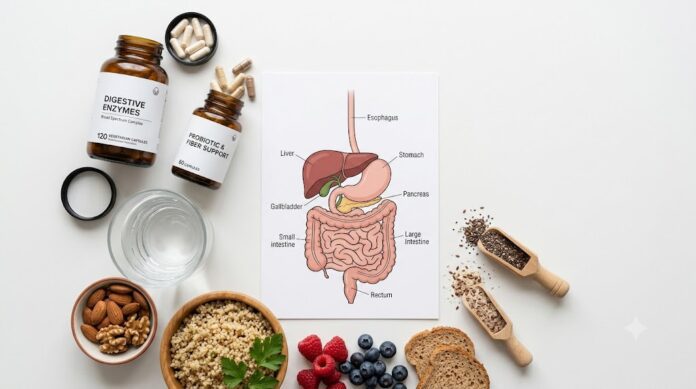
Best digestive enzymes for constipation only help a specific type of constipation, the kind caused by poor breakdown of fats, dairy, or heavy meals. They are not a proven fix for the most common form of constipation, which is caused by low fiber, low fluid intake, or slow colon transit.
- If your main complaints are bloating, gas, and heaviness after meals, an enzyme blend built around lipase, protease, and amylase, such as Enzymedica Digest Gold or Physician’s Choice Digestive Enzymes, may ease the discomfort that makes bowel movements feel worse.
- If your main complaint is straight-up infrequent, hard stool with no bloating involved, the stronger evidence points to psyllium fiber, magnesium, or a probiotic containing Bifidobacterium lactis instead. Skip ahead to the “vs Probiotics” and “vs Fiber” sections below for the specifics.
Do Digestive Enzymes Actually Help Constipation? (Evidence-Based)
The honest answer: sometimes, and usually indirectly.
Digestive enzymes (amylase, protease, lipase, and often lactase) are proteins your pancreas and small intestine normally produce to break food down into absorbable pieces. According to Johns Hopkins Medicine, over-the-counter enzyme blends are commonly used for gas, bloating, and diarrhea. There is ongoing research into their role in IBS, but “so far there’s no definitive evidence to suggest that enzymes can help” with that condition specifically.1 That matters here, because constipation is not the primary condition these supplements were built for.
The clearer clinical picture comes from pancreatic enzyme replacement therapy (PERT), the prescription-strength version of enzyme supplementation used for exocrine pancreatic insufficiency (EPI). A 2023 American Gastroenterological Association clinical practice update confirms that PERT reliably improves fat digestion and nutrient absorption in people whose pancreas cannot produce enough enzymes on its own.2 A meta-analysis of seven randomized controlled trials found PERT significantly improved fat absorption compared with placebo.3
So enzyme replacement clearly works, but for a narrow, diagnosable problem, not for everyday constipation in someone with a normally functioning pancreas.
At a Glance: Best Digestive Enzymes for Constipation and Bloating (2026)
⚠️ Digestive enzymes are not a proven fix for common constipation caused by low fiber, low fluid intake, or slow transit. They work best when constipation comes with bloating, gas, or heaviness after specific meals. If plain infrequent hard stool is your only symptom, see the fiber and probiotic guides linked below instead.
- Best overall (broad-spectrum, fast-acting): Enzymedica Digest Gold + ATPro (180 Capsules) — Thera-blend technology active across full digestive pH range, covers fat, protein, carbs, and dairy in one capsule, vegan and allergen-free, best for large or fatty meals that leave you feeling blocked
- Best combined enzyme + probiotic (bloating with mild irregularity): Physician’s Choice Digestive Enzymes (60 Count) — 16-enzyme blend plus organic prebiotics and 3 probiotic strains, peppermint and ginger added, budget-friendly daily option for gut-microbiome-related discomfort
- Best for sensitive stomachs (gentle fruit-derived enzymes): Zenwise Digestive Enzymes (180 Vegetarian Capsules) — bromelain and papain from pineapple and papaya, includes spore-form probiotic and prebiotic inulin, vegetarian-friendly, gentler for people who find stronger blends too intense
- Best for fat-heavy meals (ox bile formula): NOW Super Enzymes (90 Capsules) — pancreatin and ox bile target fat emulsification specifically, most affordable on this list, GMP-certified manufacturer since 1968 — not suitable for vegetarians or vegans
- Best for multiple food sensitivities (clean-label): Pure Encapsulations Digestive Enzymes Ultra (90 Capsules) — hypoallergenic, no fillers or artificial ingredients, every enzyme activity unit disclosed on label, includes alpha-galactosidase for beans and cruciferous vegetables
- Best chewable option (no capsule to swallow): Garden of Life Organic Digest+ (90 Chewables) — USDA certified organic, 13 plant-based enzymes plus 29 organic fruits and vegetables, vegan, Non-GMO verified — lower enzyme activity per serving than capsule-based picks above
- Best value for long-term daily use: Source Naturals Essential Enzymes (240 Capsules) — includes cellulase and hemicellulase for plant fiber breakdown, best cost-per-capsule of all seven picks, vegetarian capsule
If infrequent hard stool — not bloating — is your main problem, stronger evidence points to psyllium fiber or a targeted probiotic strain instead.
When Digestive Enzymes May Help
- Post-meal bloating that makes you feel too “blocked up” to go. A large, rich, or high-fat meal that sits undigested can create abdominal pressure and gas that mimics or worsens the feeling of constipation.
- Known lactose intolerance. Lactase-containing formulas can reduce the gas and cramping that come from dairy, which indirectly eases the discomfort around bowel movements.
- Diagnosed exocrine pancreatic insufficiency (EPI), chronic pancreatitis, or after pancreatic surgery. This is where prescription-strength PERT has the strongest evidence base, and where a doctor should be guiding dosage.2,3
- FODMAP-sensitive digestion. Alpha-galactosidase, the enzyme in products marketed for beans and cruciferous vegetables, can reduce gas from those specific foods.

When They Probably Won’t Help
This is a point many supplement roundups overlook. If your constipation looks like any of the following, digestive enzymes are unlikely to move the needle:
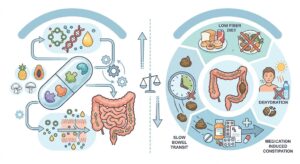
- Low-fiber, low-fluid, sedentary-lifestyle constipation. This is by far the most common cause, and enzymes do not add bulk, water, or motility stimulation to the colon the way fiber, magnesium, or hydration do.
- Chronic idiopathic constipation with no digestive discomfort after meals. If bloating and gas are not part of your symptom picture, there is no clear mechanism for enzymes to help.
- Constipation caused by medications such as opioids, iron supplements, or antidepressants. This calls for an osmotic laxative, a stool softener, or a conversation with your prescriber, not an enzyme blend.
- Slow-transit constipation or pelvic floor dysfunction. These are motility and mechanical issues, and enzymes have no physiological pathway to fix them.
Worth stating plainly: a genuine side effect of prescription-strength PERT itself can be constipation, per the Pancreatic Cancer Action Network, usually signaling that the dose needs adjusting rather than that more enzymes are needed.4 The exact tool marketed to fix digestion can occasionally cause the opposite problem in the people who actually need it medically.
If your constipation comes with unintentional weight loss, blood in the stool, or persistent pain, see a doctor before trying any supplement.
How We Chose the Best Digestive Enzymes
We shortlisted products against five criteria:
- Broad-spectrum enzyme coverage (amylase, protease, and lipase at minimum)
- Third-party or in-house potency testing
- Transparent labeling of enzyme activity units, not vague “proprietary blends”
- Realistic price per serving
- A track record of consistent manufacturing, favoring established brands over newer, unverified startups
We did not test these products ourselves. This is a research-based comparison of publicly available ingredient panels, brand documentation, and verified Amazon listings.
Best Digestive Enzymes for Constipation (Top Picks)
1. Enzymedica Digest Gold + ATPro
Digest Gold uses Enzymedica’s Thera-blend technology, meaning each enzyme is manufactured as several strains active across different pH levels of the digestive tract, from the stomach through the small intestine. One capsule is rated to break down up to 34g of fat, 16g of protein, and 86g of carbohydrates, plus it includes lactase for dairy. This is the most broad-spectrum, fast-acting option on our list, which is why it is our top overall pick for post-meal bloating that contributes to a “backed up” feeling.
Pros:
- Thera-blend enzymes stay active across the whole digestive pH range, not just one narrow window
- Includes lactase, so it covers dairy digestion in the same capsule
- Vegan, and free of the most common allergens (gluten, soy, egg, dairy)
Cons:
- Priced higher per capsule than most budget options on this list
- Some users with very large or very fatty meals report needing a second capsule
Best for: Large or fatty meals, dairy sensitivity, fast-acting relief.
Check Price on Amazon: Enzymedica Digest Gold + ATPro, 180 Capsules
2. Physician’s Choice Digestive Enzymes
This formula pairs a 16-enzyme blend with organic prebiotics and three soil-based probiotic strains (Bacillus subtilis, B. coagulans, B. clausii), plus organic peppermint and ginger. The combined enzyme-and-probiotic approach makes it a reasonable middle-ground pick for people whose bloating and irregularity both seem to be gut-microbiome related rather than purely mechanical.
Pros:
- Only product on this list combining enzymes, prebiotics, and probiotics in one capsule
- Peppermint and ginger add soothing, stomach-calming ingredients
- Budget-friendly, one-month supply at 60 count
Cons:
- Total enzyme blend weight (85mg) is lower than dedicated enzyme-only formulas
- Probiotic dose is modest compared to standalone probiotic supplements, so don’t expect it to replace one
Best for: Combined bloating and mild irregularity, budget-conscious daily use.
Check Price on Amazon: Physician’s Choice Digestive Enzymes, 60 Count
3. Zenwise Digestive Enzymes with Bromelain & Papaya
Zenwise combines a plant-based enzyme system (amylase, glucoamylase, lipase, protease, bromelain, papain, and others) with a spore-form probiotic and prebiotic inulin. Bromelain and papain are protein-digesting enzymes derived from pineapple and papaya, a gentler starting point for people who find stronger fungal-derived blends too intense.
Pros:
- Fruit-derived enzymes (bromelain, papain) tend to be gentle on sensitive stomachs
- Includes a spore-form probiotic and prebiotic inulin in the same capsule
- Vegetarian capsule, widely available in several bottle sizes
Cons:
- Longer ingredient list (turmeric, ginger, sea vegetable complex) than some people want in a simple enzyme supplement
- Less potent for heavy fat digestion compared with pancreatin- or ox-bile-based formulas
Best for: Sensitive stomachs, protein-heavy meals, vegetarians.
Check Price on Amazon: Zenwise Digestive Enzymes, 180 Vegetarian Capsules
4. NOW Super Enzymes
NOW’s formula leans on pancreatin, ox bile, bromelain, and papain rather than the fungal-derived enzyme blends common in newer brands. The inclusion of ox bile is notable because bile supports fat emulsification, which is why this formula is sometimes favored by people who feel sluggish specifically after fatty or fried meals.
Pros:
- Ox bile specifically targets fat emulsification, useful after heavy or fried meals
- One of the most affordable options per serving on this list
- Long-established, GMP-certified manufacturer (NOW Foods, founded 1968)
Cons:
- Ox bile and pepsin are animal-derived, so this formula is not vegetarian or vegan
- No probiotic or prebiotic included, so it addresses digestion only, not gut flora
Best for: Fat-heavy meals, budget shoppers, no-frills formulation.
Check Price on Amazon: NOW Super Enzymes, 90 Capsules
5. Pure Encapsulations Digestive Enzymes Ultra
Pure Encapsulations is a hypoallergenic-focused brand, and this formula is free from the common allergens, fillers, and unnecessary additives found in some competitors. The enzyme panel covers protein, carbohydrate, fat, fiber, and dairy digestion, with clearly labeled activity units instead of a vague blend.
Pros:
- Free from major allergens, artificial ingredients, and unnecessary fillers
- Every enzyme activity unit is disclosed on the label, nothing hidden in a “proprietary blend”
- Includes alpha-galactosidase, useful for gas from beans and cruciferous vegetables
Cons:
- Label directions call for 2 capsules per meal, so a 90-count bottle runs out faster than it looks
- Priced at the premium end of this list
Best for: Sensitive individuals, clean-label preference, multiple food intolerances.
Check Price on Amazon: Pure Encapsulations Digestive Enzymes Ultra, 90 Capsules
6. Garden of Life Dr. Formulated Organic Digest+
This is the only chewable, food-based option on our list. Formulated by Dr. David Perlmutter, it combines 13 plant-based enzymes with a powdered blend of 29 certified organic fruits and vegetables plus prebiotic acacia fiber. It is USDA certified organic and vegan.
Pros:
- Chewable format, no capsule to swallow
- USDA certified organic, Non-GMO Project Verified, and vegan
- Whole-food fruit and vegetable blend adds antioxidants alongside the enzymes
Cons:
- Enzyme activity units per serving are generally lower than dedicated capsule formulas
- Contains organic dextrose and natural fruit flavoring for taste, a consideration for anyone avoiding all added sweeteners
- Less suited to very large or very high-fat meals than the capsule-based picks above
Best for: People who dislike swallowing capsules, whole-food preference, organic shoppers.
Check Price on Amazon: Garden of Life Organic Digest+, 90 Chewables
7. Source Naturals Essential Enzymes
A long-standing, no-frills 500mg broad-spectrum formula (pancreatin, acid-stable protease, lipase, alpha-amylase, amyloglucosidase, cellulase, hemicellulase, and lactase) sold in vegetarian capsules and in bulk counts as high as 240. The inclusion of cellulase and hemicellulase, enzymes that help break down plant fiber, makes it a reasonable pick for people who eat a lot of raw vegetables and beans but still feel gassy and bloated.
Pros:
- Best value per capsule of the seven products reviewed here
- Cellulase and hemicellulase specifically target plant fiber breakdown
- Available in large 240-count bottles, practical for long-term daily use
Cons:
- Simple formula with no probiotics, prebiotics, or soothing herbs added
- No dedicated alpha-galactosidase for FODMAP-specific gas from beans and cruciferous vegetables
Best for: Long-term daily use, high fiber and vegetable intake, best value per capsule.
Check Price on Amazon: Source Naturals Essential Enzymes, 240 Capsules
Comparison Table
| Product | Key Enzymes | Format | Package Size | Best For |
|---|---|---|---|---|
| Enzymedica Digest Gold + ATPro | Amylase, protease, lipase, lactase (Thera-blend) | Capsule | 180 | Large or fatty meals |
| Physician’s Choice Digestive Enzymes | 16-enzyme blend + prebiotics + probiotics | Capsule | 60 | Bloating with mild irregularity |
| Zenwise Digestive Enzymes | Bromelain, papain, amylase, lipase, protease | Vegetarian capsule | 180 | Sensitive stomachs |
| NOW Super Enzymes | Pancreatin, ox bile, bromelain, papain | Capsule | 90 | Fat-heavy meals, budget |
| Pure Encapsulations Digestive Enzymes Ultra | Full-spectrum, hypoallergenic | Vegetarian capsule | 90 | Multiple food sensitivities |
| Garden of Life Organic Digest+ | 13 plant enzymes + 29 organic whole foods | Chewable | 90 | Capsule-averse, whole-food fans |
| Source Naturals Essential Enzymes | Pancreatin, protease, lipase, cellulase | Capsule | 240 | Best value, daily long-term use |
Digestive Enzymes vs Probiotics
These solve different problems. Digestive enzymes break food down mechanically and chemically in the moment you eat it. Probiotics work over weeks by shifting the balance of bacteria living in your colon, and specific strains such as Bifidobacterium lactis have the strongest published evidence for actually increasing bowel movement frequency in people with functional constipation.5
If bloating after meals is your main issue, start with enzymes. If infrequent, hard stools over the long term are the main issue, a probiotic is the better-evidenced first step. Our guide to the best probiotic supplements of 2026 breaks down strain-by-strain evidence for constipation specifically.
Digestive Enzymes vs Fiber Supplements
Fiber supplements such as psyllium husk work through an entirely different mechanism: they add bulk and retain water in the stool, which is the single most-studied intervention for chronic constipation.6 Enzymes do not add bulk or water at all, which is exactly why they are not a substitute for fiber if low fiber intake is the actual root cause of your constipation.
Our Benefiber vs Metamucil comparison is a good next stop if fiber, not bloating, is your primary concern.
Who Should Take Digestive Enzymes?
- Adults who feel bloated, gassy, or heavy after meals, especially larger or fattier meals
- People with diagnosed lactose intolerance who want to eat dairy occasionally without discomfort
- People with confirmed EPI, chronic pancreatitis, or a history of pancreatic or upper GI surgery, under a doctor’s supervision
- People whose constipation seems to specifically worsen after certain hard-to-digest foods
Digestive enzymes are generally not the first thing to reach for if your only symptom is infrequent, hard stool with no bloating or post-meal discomfort.
Side Effects
Over-the-counter digestive enzyme blends are generally well tolerated. Reported side effects are typically mild, including stomach upset, nausea, or diarrhea, usually when taken above the labeled dose.
People with a history of pancreatitis, gallbladder disease, or peptic ulcers should talk to a doctor before starting any enzyme supplement. Pregnant or breastfeeding individuals should check with their healthcare provider first, per standard label guidance across the brands reviewed here.
Self-treating persistent constipation with any supplement, enzyme or otherwise, is not a substitute for identifying the underlying cause with a healthcare provider if symptoms last more than a few weeks.
FAQs
Can digestive enzymes cause constipation?
Standard over-the-counter enzyme blends are not typically associated with causing constipation. However, prescription-strength pancreatic enzyme replacement therapy (PERT) can cause constipation as a side effect in some patients, according to the Pancreatic Cancer Action Network, usually meaning the dose needs review with a doctor.4
How long does it take digestive enzymes to work?
Enzymes act on the meal you take them with, so any effect on bloating or heaviness is typically noticeable within 30 to 90 minutes. They do not build up an effect on colon transit the way fiber or probiotics do over weeks.
Do digestive enzymes help with bloating and constipation together?
They can ease the bloating and gas that often accompany constipation, which may make bowel movements feel less uncomfortable. But they do not directly increase stool frequency the way fiber, magnesium, or certain probiotic strains do.5,6
What is the best digestive enzyme for constipation with bloating?
Broad-spectrum formulas that include lipase, protease, and amylase together, such as Enzymedica Digest Gold or Physician’s Choice Digestive Enzymes, are reasonable choices when bloating is the dominant symptom alongside occasional irregularity.
Should I take digestive enzymes before or after meals?
Most brands recommend taking the capsule right before or at the start of a meal, so the enzymes are present in the stomach and small intestine as food arrives. Always follow the specific product’s label instructions.
Final Verdict
Digestive enzymes are a reasonable, generally well-tolerated option if your constipation shows up alongside bloating, gas, or discomfort after specific foods. Enzymedica Digest Gold is our top pick for that use case because of its broad Thera-blend coverage.
But if your constipation is really about infrequent, hard stools with no digestive discomfort attached, the stronger evidence points toward fiber, hydration, movement, and, for some people, a targeted probiotic strain, not an enzyme supplement. Matching the tool to the actual mechanism behind your constipation matters more than which brand you pick.
References
- Johns Hopkins Medicine. Digestive Enzymes and Digestive Enzyme Supplements. hopkinsmedicine.org.
- Whitcomb DC, et al. AGA Clinical Practice Update on the Epidemiology, Evaluation, and Management of Exocrine Pancreatic Insufficiency: Expert Review. Gastroenterology. 2023.
- de la Iglesia-García D, et al. Efficacy and safety of pancreatic enzyme replacement therapy on exocrine pancreatic insufficiency: a meta-analysis. PMC5706924.
- Pancreatic Cancer Action Network. Pancreatic Enzymes and Supplements. pancan.org.
- Dimidi E, Christodoulides S, Fragkos KC, Scott SM, Whelan K. The effect of probiotics on functional constipation in adults: a systematic review and meta-analysis of randomized controlled trials. Am J Clin Nutr. 2014;100(4):1075-84. PMID: 25099542.
- van der Schoot A, Drysdale C, Whelan K, Dimidi E. The Effect of Fiber Supplementation on Chronic Constipation in Adults: An Updated Systematic Review and Meta-Analysis of Randomized Controlled Trials. Am J Clin Nutr. 2022;116(4):953-969. PMID: 35816465.
Medical Disclaimer: This article is for educational purposes only and is not a substitute for professional medical advice. If constipation persists beyond two to three weeks, or is accompanied by blood in the stool, unexplained weight loss, or severe pain, consult a healthcare provider.
Affiliate Disclosure: This article contains affiliate links. If you purchase through our links, we may earn a small commission at no extra cost to you. Our recommendations are based on the available research discussed above, not on affiliate relationships.




[…] Related reading: natural laxatives for constipation and, if poor fat or dairy digestion is the actual issue rather than low fiber intake, digestive enzymes for constipation. […]