

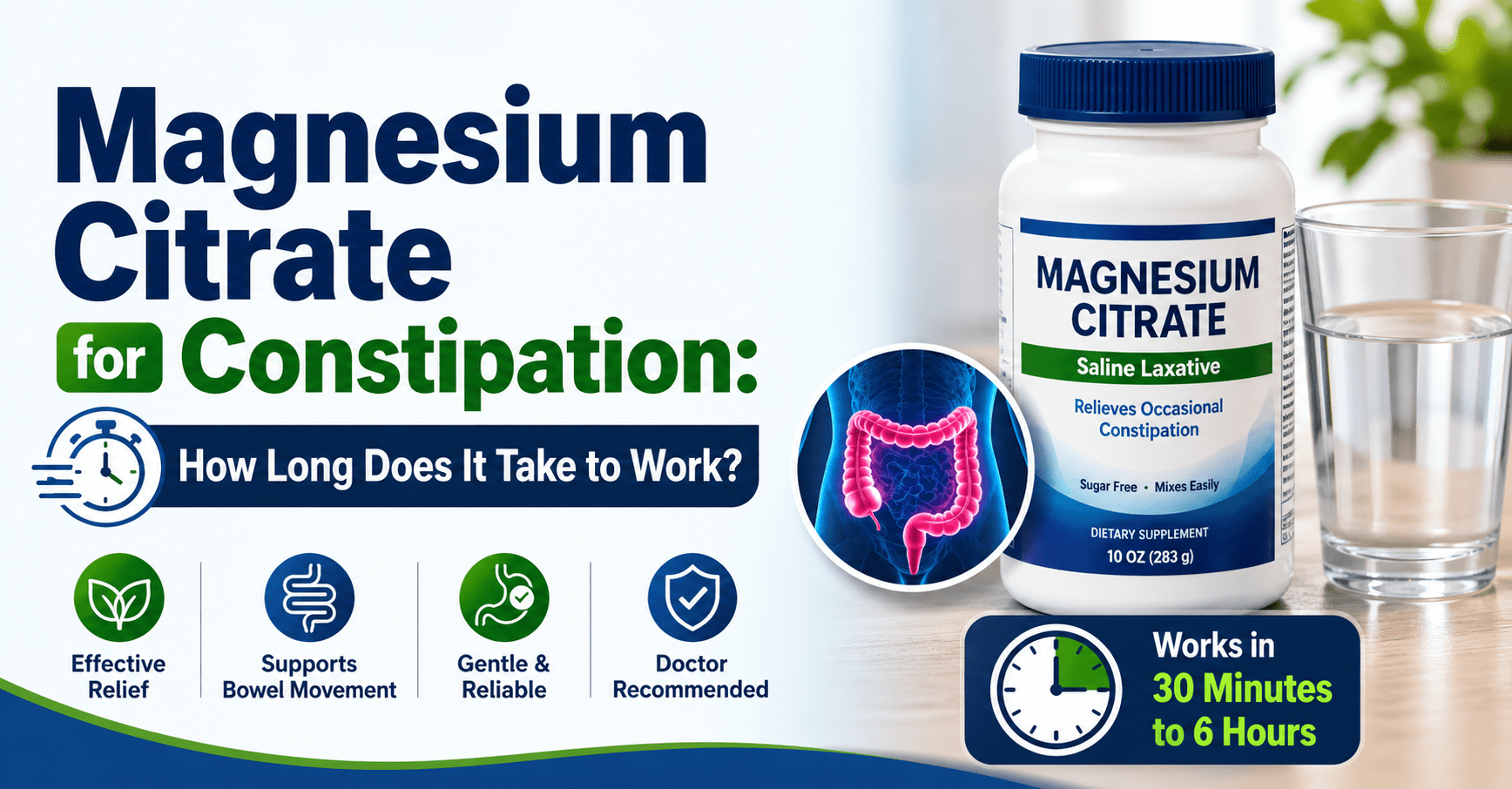
Magnesium citrate for constipation is one of the most commonly used over-the-counter remedies for fast relief. It works quickly in most people, often producing a bowel movement within 30 minutes to 6 hours.
It is widely recommended by doctors for occasional constipation because it is fast, effective, and generally affordable. However, incorrect use — such as taking the wrong dose, not drinking enough water, or overusing it — can lead to cramping, diarrhea, or reduced effectiveness.
This research-based guide explains how magnesium citrate works in the body, how long it takes to act, proper dosage, possible side effects, who should avoid it, and the best product options — in simple and easy-to-understand language.
⚡ Quick Answer:
Magnesium citrate usually causes a bowel movement within 30 minutes to 6 hours. Most people feel relief within 1 to 3 hours. It works as an osmotic laxative by drawing water into the intestines, softening stool and making it easier to pass.
Magnesium citrate is a combination of the mineral magnesium and citric acid. When used for constipation, magnesium citrate works as an osmotic (saline) laxative — pulling water into the intestines to soften stool and trigger bowel movements. It is better absorbed by the body than other magnesium forms like magnesium oxide, which makes it both effective as a digestive aid and as a magnesium supplement.
It is sold over the counter (OTC) in pharmacies and online in several forms — most commonly as a clear liquid solution (often lemon, cherry, or grape flavoured) or as capsules and powder.
Doctors and gastroenterologists classify it as a “saline laxative” or “osmotic laxative.” It is used for:
- Occasional constipation (short-term relief)
- Bowel preparation before a colonoscopy or surgery
- Supplementing magnesium levels in people who are deficient
It is not a stimulant laxative (like senna or bisacodyl) — it does not force your intestines to contract. Instead, it works more gently by softening the stool with water.

2. How Magnesium Citrate for Constipation Works
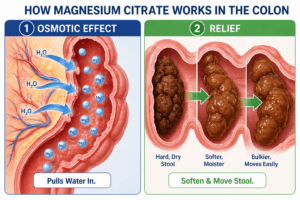
Think of your colon like a sponge. When you are dehydrated or constipated, your colon soaks up too much water from the stool, leaving it hard and dry — and very difficult to pass.
Magnesium citrate flips this process around. Here is what happens step by step:
This mechanism is well-documented in medical literature. According to MedlinePlus (US National Library of Medicine), magnesium citrate works by retaining water within the stool, which increases bowel movement frequency and softens the consistency — making it far easier to pass.
3. How Long Does Magnesium Citrate Take to Work for Constipation?
This is the most important question for anyone considering magnesium citrate for constipation relief. The clinical answer is clear:
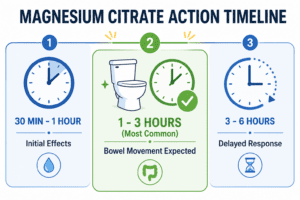
This timeline is confirmed by MedlinePlus and multiple clinical pharmacology references. Here is a more detailed breakdown:
| Time After Taking | What Happens | Who Experiences This |
|---|---|---|
| 30 min – 1 hour | First bowel urge possible; early softening begins | Sensitive individuals, liquid form, empty stomach |
| 1 – 3 hours | Most common onset window; clear bowel movement | Most adults taking the full dose with water |
| 3 – 6 hours | Delayed but still normal response | Those who took a smaller dose, ate a high-fiber meal beforehand, or have slow gut transit |
| After 6 hours (no result) | May indicate dehydration, dose issue, or underlying problem | Consult a doctor if this occurs |
 Related Articles You May Find Helpful
- 5 Best Magnesium Supplements for Constipation (2026 Review)
- Magnesium Citrate vs Glycinate: The 2026 iHerb Guide for GLP-1 Users
- Mag O7 vs ColonBroom: Which Is Better for Colon Cleanse?
- Best OTC Laxatives for Constipation in the US (Fast & Gentle Options)
- 9 Best Probiotic Supplements 2026: Expert Guide for Gut Health
- 7 Best Natural Constipation Relief Remedies in 2026
- Does Dehydration Cause Constipation? The Science-Backed Link
- Best Fiber Foods for Gut Health & Constipation Relief
4. What Affects How Fast It Works?
Several factors can speed up or slow down how quickly magnesium citrate takes effect:
Factors That Speed It Up
- Taking it on an empty stomach — absorption is faster when the stomach is empty.
- Drinking plenty of water with and after the dose — magnesium citrate needs water to do its job. A full 8 oz (240 ml) glass of water per dose is recommended.
- Using the liquid form — the liquid solution acts faster than capsules because it is already dissolved.
- Chilling the liquid bottle before drinking — cold temperature makes the taste considerably more tolerable, which helps you drink the full dose without gagging. There is no clinical evidence it speeds up onset, but completing the full dose is what matters most.
Factors That Slow It Down
- Dehydration — if you are already dehydrated, there is less water available for magnesium to draw into the intestines, reducing its effectiveness.
- High-fat meal before taking it — a heavy meal can slow gastric emptying and delay absorption.
- Taking too small a dose — under-dosing reduces the osmotic effect.
- Slow gut motility — people with chronic slow-transit constipation may need longer.
- Certain medications — antibiotics (tetracyclines, fluoroquinolones) bind to magnesium and should be taken at least 2 hours apart.
5. Dosage of Magnesium Citrate for Constipation
Always follow the label instructions of the specific product you are using. Here are the general guidelines from clinical pharmacology references:
For Adults (Liquid Form)
- Standard dose: Half a bottle (148 ml / 5 fl oz) to one full bottle (296 ml / 10 fl oz) once per day
- Drink with: A full 8-oz (240 ml) glass of water — and more fluids afterwards
- Best time: Evening (so relief comes overnight or in the morning)
- Maximum duration: Do NOT use for more than 7 consecutive days without a doctor’s advice
For Adults (Capsule or Powder Form)
- Follow the product label — typical doses range from 200 mg to 400 mg of elemental magnesium per day
- Always take with a full glass of water
- Start with the lowest effective dose and increase gradually if needed
For Children
- Children under 6: Do not use without explicit medical guidance
- Children 6–12: Consult your paediatrician for appropriate dosing (typically half the adult liquid dose)
- The liquid or hydroxide form is generally easier for children to swallow
⚠️ Do Not Exceed the Dose:Taking more than recommended does not speed up results — it increases the risk of severe diarrhea, painful cramping, dehydration, and in people with kidney problems, dangerously high blood magnesium levels (hypermagnesemia). More is not better here.

6. Different Forms of Magnesium Citrate
| Form | Speed of Action | Best For | Notes |
|---|---|---|---|
| Liquid solution | Fastest (30 min–3 hrs) | Acute constipation, colonoscopy prep | Sold in 10 oz bottles; lemon/cherry flavoured |
| Powder (mix with water) | Fast (1–4 hrs) | Ongoing digestive support; also relaxation | Natural Vitality CALM is the most popular brand |
| Capsules / Softgels | Moderate (2–6 hrs) | Mild, ongoing constipation; travel convenience | Must be taken with plenty of water |
| Tablets | Moderate (2–6 hrs) | Supplement users who prefer pills | Solgar, NOW Foods are well-known brands |
7. Magnesium Citrate vs. Other Magnesium Types
Not all magnesium supplements work the same way for constipation. Here is a clear comparison:
| Type | Laxative Effect | Absorption | Best Use |
|---|---|---|---|
| Magnesium Citrate | ✅ Good – moderate and predictable | Good (~16–30%) | Constipation + magnesium deficiency |
| Magnesium Oxide | ✅ Strong – high laxative effect | Poor (~4%) | Constipation, antacid; more cramping risk |
| Magnesium Hydroxide (Milk of Magnesia) | ✅ Fast and strong | Poor – stays in gut longer | Acute constipation; child-friendly liquid |
| Magnesium Glycinate | ❌ Minimal laxative effect | Excellent (~80%) | Sleep, anxiety, muscle cramps — NOT constipation |
| Magnesium Sulfate (Epsom Salt) | ✅✅ Very strong – use with caution | Poor | Bowel prep, soaking baths |
| Magnesium L-Threonate | ❌ No significant laxative effect | Very good (brain-targeted) | Cognitive function — NOT constipation |
8. Side Effects of Magnesium Citrate for Constipation
Magnesium citrate is generally safe when used correctly and occasionally. But it does come with potential side effects:
Common Side Effects
- Diarrhea — the most common side effect, especially if you take a full bottle
- Abdominal cramping or bloating — usually mild; passes after the bowel movement
- Nausea — more likely on an empty stomach or with a large dose
- Gas and flatulence
- Urgent need to use the bathroom — be near a toilet once you take it!
Serious Side Effects (Rare but Important)
- Hypermagnesemia (too much magnesium in blood) — especially dangerous in people with kidney disease. Symptoms include weakness, drowsiness, slow heartbeat, difficulty breathing.
- Electrolyte imbalance — prolonged use can lower sodium, calcium, or potassium levels
- Dehydration — if diarrhea is severe, you can lose too much fluid
9. Who Should NOT Take Magnesium Citrate
Magnesium citrate is not for everyone. Avoid it or consult your doctor first if you have any of the following:
- Kidney disease or reduced kidney function — the kidneys filter magnesium. If they are not working well, magnesium can build up to dangerous levels in the blood (hypermagnesemia).
- Heart problems or heart block — excess magnesium affects the electrical system of the heart.
- Myasthenia gravis — a muscle disease that can be worsened by magnesium’s muscle-relaxing effect.
- Existing electrolyte imbalance (low sodium, potassium, or calcium) — magnesium citrate can worsen this.
- Suspected intestinal obstruction (blockage) — using a laxative when your intestine is blocked can be dangerous and even fatal.
- Appendicitis or acute abdominal pain of unknown cause — always see a doctor before using any laxative.
- Pregnancy or breastfeeding — consult your doctor. Short-term use may be considered safe, but it is not routinely recommended without medical advice.
- Children under 6 years old — without medical guidance.
10. What If It Is Not Working?
If you have taken magnesium citrate and it has been more than 6 hours without a bowel movement, consider the following:
- Check your hydration: Have you drunk enough water? Magnesium citrate needs water to work. Drink another large glass immediately (unless your doctor has restricted your fluid intake).
- Check the dose: Did you take enough? A half-bottle may not be sufficient for severe constipation. Re-read the label.
- Avoid certain combinations: Did you take antibiotics or calcium supplements at the same time? These can reduce magnesium absorption. Always separate them by at least 2 hours.
- Warm water can help: Some users report that drinking warm water after magnesium citrate speeds up results.
- Consider gentle movement: A short walk can stimulate gut motility and support the laxative effect.
- If still no result after 6 hours: Do not take another dose. Contact a healthcare provider. Persistent constipation despite laxative use may indicate a bowel obstruction, severe dehydration, or a medical condition requiring investigation.
11. Best Magnesium Citrate Products (Amazon & iHerb)
If you are looking for Magnesium Citrate for Constipation, choosing the right product can make a big difference in how fast and effectively it works. Below are some of the best-reviewed options available on Amazon and iHerb, selected based on customer reviews, ingredient quality, and third-party testing.
🏆 Editor’s Top Pick – Powder Form
Natural Vitality CALM Magnesium Citrate Powder
Natural Vitality CALM is the most popular magnesium citrate supplement in the United States. The powder dissolves in water to create an ionic magnesium citrate solution — the fizzy drink format means it is absorbed quickly. It contains no sugar, artificial flavours, or synthetic colours, and is non-GMO, vegan, and gluten-free.
Available in flavours: Raspberry Lemon, Orange, Lemon, Watermelon, Unflavoured. Start with half a teaspoon and gradually increase to 2 teaspoons per day.
✅ Pros
- Fast-acting (ionic form)
- No fillers or artificial ingredients
- Adjustable dose — easy to start low
- Multiple flavours available
- Non-GMO, vegan, gluten-free
- Award-winning formula
❌ Cons
- Citrusy/tart taste not for everyone
- Can cause diarrhea if dose is too high
- Slightly more expensive than basic capsules
💊 Best Capsule – iHerb Pick
NOW Foods Magnesium Citrate Capsules (120–180 ct)
NOW Foods is one of the most trusted supplement manufacturers in the US, with GMP-certified manufacturing and non-GMO verification. Their magnesium citrate capsules provide 400 mg of elemental magnesium per serving (3 veg capsules) — a therapeutic dose for constipation. Verified iHerb reviewers consistently mention improvement in constipation, sleep, and digestion.
“I’ve struggled with constipation since childhood. I take three at night, and the results are impressive.” — iHerb verified reviewer
✅ Pros
- Clean ingredients, no unnecessary fillers
- Vegan capsule shell
- Non-GMO, GMP certified
- Good value — large bottle available
- Effective for constipation and sleep
❌ Cons
- 3 capsules per dose (some find inconvenient)
- Capsules are slightly large
- Acts slower than liquid form
🔬 Best Premium Option – Purity Focused
Pure Encapsulations Magnesium (Citrate) Capsules
Pure Encapsulations is the gold standard in clean supplements. Their magnesium citrate capsules contain 150 mg of elemental magnesium per capsule with absolutely no fillers, binders, artificial colours, or allergens. This is the choice of naturopathic doctors, integrative health coaches, and people with multiple sensitivities. The lower dose per capsule is actually an advantage — it lets you take 1–2 capsules for gentle daily support without triggering urgency.
“Love this brand. Gentle on the stomach but helpful for constipation. Good quality.” — iHerb verified reviewer
✅ Pros
- Hypoallergenic — no fillers or common allergens
- NSF registered facility
- Highly bioavailable citrate form
- Gentle — lower per-capsule dose reduces urgency risk
- Trusted by healthcare professionals
❌ Cons
- More expensive than other brands
- Lower dose means more capsules for full effect
- May work slowly for acute constipation
💧 Best Powder – iHerb Budget Option
NOW Foods Magnesium Citrate Pure Powder (8 oz)
If you want the effectiveness of a powder form without the premium price tag, NOW Foods also makes a plain magnesium citrate powder. Mix one level teaspoon (3 g) in water for 450 mg of elemental magnesium. It has a slightly tart, citrus-like taste. Multiple iHerb reviewers specifically purchased it for constipation and reported gentle, effective relief. A good option if you want flexibility in dosing.
“It worked wonderfully. A small dose mixed with water provided gentle, effective relief within a few hours.” — iHerb verified reviewer
✅ Pros
- Best value per dose
- Fast-acting (powder dissolved in water)
- Flexible dosing
- No fillers, vegetarian, non-GMO
❌ Cons
- Tart/sour taste — mix with juice or cold water
- Unflavoured — less pleasant than CALM
- Measuring required (no scoop included)
🛒 View on iHerb
🛒 View on Amazon
12. Tips to Make Magnesium Citrate for Constipation Work Better
If you are using Magnesium Citrate for Constipation, these simple but effective tips can help it work faster, reduce side effects, and give more reliable results.
Drink plenty of water before, during, and after taking it. Magnesium citrate works by drawing water into the intestines, so proper hydration is essential for it to soften stool effectively and reduce cramping.
Chill the liquid before drinking it. A cold temperature can make the taste easier to tolerate, helping you finish the full dose properly, which is important for full effectiveness.
Take it in the evening if possible. This allows it to work overnight so you can usually experience relief in the morning, instead of dealing with urgency during the day.
Avoid taking it with heavy meals. An empty or lightly full stomach helps it absorb faster and work more efficiently.
Keep a gap of at least 2 hours from antibiotics and calcium supplements, as these can interfere with magnesium absorption and reduce its effectiveness.
Start with a lower dose if you are sensitive to laxatives, especially in capsule or powder form. You can always increase gradually if needed based on your response.
Remember that Magnesium Citrate for Constipation is meant for short-term relief only. For long-term digestive health, focus on fiber-rich foods, adequate hydration, and regular physical activity.
13. Beyond Magnesium: Building a Long-Term Constipation Solution
Magnesium citrate is excellent for rescuing you on a bad day — but it does not fix what caused the constipation in the first place. If you find yourself reaching for it more than once or twice a week, that is a signal worth taking seriously.
💬 A Note from Our Community
One of our readers shared this from their own experience — and it aligns well with what clinical evidence and gut physiology suggest:
“Magnesium citrate has been a lifesaver on the rough days. But I learned the hard way it’s more of a rescue tool than a daily fix. If I take it too often I get loose stools and cramps, and it doesn’t actually address why I’m backed up in the first place — it just forces the issue. What’s worked way better as a daily foundation is gentle prebiotic fiber — psyllium, baobab, acacia are the easiest on the gut. NOT inulin or chicory, those bloated me to misery. Once I got that combo dialed in, I barely need the magnesium anymore except occasionally.”
This is a textbook example of using laxatives correctly: acute relief first, root-cause correction second.
Here is how to build that long-term foundation, backed by the evidence:
1. Choose the Right Prebiotic Fibre — Not All Are Equal
Many people try to add fibre and end up bloated and miserable because they reach for the wrong type. The key distinction is fermentation rate and tolerability:
| Fibre Type | Fermentation Speed | Bloating Risk | Best For Constipation? |
|---|---|---|---|
| Psyllium husk | Very slow | Low ✅ | ✅ Yes — adds bulk, improves stool consistency |
| Acacia fibre | Slow | Very low ✅ | ✅ Yes — gentle, ideal for sensitive guts |
| Baobab | Slow–moderate | Low–moderate ✅ | ✅ Yes — also provides polyphenols |
| Inulin / Chicory root | Fast | High ⚠️ | ⚠️ Can help, but often causes bloating |
| FOS (Fructooligosaccharides) | Fast | High ⚠️ | ⚠️ Similar to inulin — start very small |
A large body of clinical evidence shows that psyllium husk improves stool frequency and consistency in chronic constipation, with better tolerability than many other fibre types and stimulant laxatives. This has been consistently demonstrated across multiple randomized controlled trials and systematic reviews in gastroenterology journals.
2. Feed Your Gut — Polyphenols and the Microbiome
Polyphenols — the colourful compounds found in berries, pomegranate, dark chocolate, green tea, and olive oil — can act as prebiotic-like substrates for beneficial gut bacteria.
A key nuance: much of the research (including studies on pomegranate) is preclinical (in vitro or animal-based). These studies show that polyphenols can promote the growth of beneficial species like Bifidobacterium and Lactobacillus and influence short-chain fatty acid (SCFA) production — which plays a role in gut motility.
However, human evidence is still emerging, so it is more accurate to view polyphenols as supportive, not a standalone treatment for constipation.
Practical polyphenol sources to include daily:
- A small handful of blueberries, raspberries, or blackberries
- Pomegranate (whole fruit or 100% juice, no added sugar)
- Extra virgin olive oil — 1 tablespoon daily (can be taken with meals)
- Green tea (1–2 cups)
- Dark chocolate (≥70% cacao) — a small square is enough
3. The Daily Habit Stack That Reduces Laxative Dependency
🌿 Daily Foundation Protocol (Evidence-Informed)
Morning:
- 1 tablespoon psyllium husk or acacia fibre in a large glass of water
- Drink immediately before it thickens
With meals:
- Include polyphenol-rich foods (berries, olive oil, etc.)
Throughout the day:
- Minimum 6–8 glasses of water
- (Fibre without enough fluid can worsen constipation)
After meals:
- 10–15 minute gentle walk
- (Gastrocolic reflex + movement = improved bowel motility)
Magnesium citrate:
- Reserve for occasional use only — not as a daily solution
14. Frequently Asked Questions
How long does Magnesium Citrate for Constipation take to work?
It typically takes 30 minutes to 6 hours. Most people experience a bowel movement within 1 to 3 hours. The liquid form acts faster than capsules or tablets.
How much magnesium citrate should I take for constipation?
For the liquid form, the standard adult dose is half a bottle (148 ml) to one full bottle (296 ml), taken once. For capsules or powder, follow the label and use no more than 400 mg elemental magnesium per day without medical advice. Always drink an 8 oz glass of water with each dose.
Can I take magnesium citrate every day?
No. Magnesium citrate is for occasional, short-term use only — a maximum of 7 consecutive days without consulting a doctor. Regular daily use can cause diarrhea, electrolyte imbalances, and may mask underlying bowel problems. If you need daily laxative support, speak with your doctor about safer long-term options.
Is Magnesium Citrate for Constipation safe during pregnancy?
It is not routinely recommended during pregnancy without medical supervision. Consult your doctor or midwife before using any laxative while pregnant. Some doctors may approve short-term use for occasional constipation in pregnancy, while others prefer gentler alternatives.
What if magnesium citrate does not work after 6 hours?
If there is no bowel movement within 6 hours — and especially if you have blood in your stool, severe abdominal pain, or signs of dehydration — stop taking it and contact a healthcare provider. Do not take a second dose without medical guidance.
Can I take magnesium citrate if I have kidney disease?
No — not without medical supervision. The kidneys filter excess magnesium from the blood. In people with reduced kidney function, magnesium can accumulate to dangerous levels (hypermagnesemia). Always check with your nephrologist or GP before using any magnesium supplement.
Does magnesium citrate cause cramping?
Mild abdominal cramping is common, especially with larger doses. It usually passes once the bowel movement occurs. Reduce the dose and drink more water if cramping is severe.
Is magnesium citrate the same as Milk of Magnesia?
No. Milk of Magnesia is magnesium hydroxide, which is a different compound. Both are osmotic laxatives that work in similar ways, but magnesium hydroxide tends to act faster and stronger while magnesium citrate is better absorbed and has a more predictable, gentler effect. They are not interchangeable at the same doses.
Disclaimer :
This content has been reviewed by Dr. ABM Sadikullah for educational purposes only. It is not a substitute for professional medical advice. Always consult your healthcare provider before using magnesium citrate or any laxative for constipation. Some links may be affiliate links, which help support our work at no extra cost to you.
References
- MedlinePlus (US National Library of Medicine). Magnesium citrate. Updated 2019. https://medlineplus.gov/druginfo/meds/a619019.html
- Mori H, et al. Magnesium oxide in constipation. Nutrients. 2021;13(2):421. PMC7911806
- Bharucha AE, Lacy BE. Mechanisms, Evaluation, and Management of Chronic Constipation. Gastroenterology. 2020;158(5):1232–1249. PMC7573977
- Zacharias N, et al. Comparison of MiraLAX and magnesium citrate for bowel preparation at CT colonography. Radiology. 2023. PubMed: 37644134
- Lindberg JS, et al. Magnesium bioavailability from magnesium citrate and magnesium oxide. J Am Coll Nutr. 1990;9(1):48–55. PubMed: 2407766
- Morishita D, et al. Senna versus magnesium oxide for the treatment of chronic constipation: A randomized, placebo-controlled trial. Am J Gastroenterol. 2021;116(1):152–161. DOI: 10.14309/ajg.0000000000000942
- Jani B, Marsicano E. Constipation: Evaluation and Management. Mo Med. 2018;115(3):236–240. PMC6140151
- Mayo Clinic. Nonprescription laxatives for constipation: Use with caution. Reviewed 2023. mayoclinic.org
- GoodRx Health. Magnesium for Constipation: Benefits, Side Effects, and Dosage. Updated 2023. goodrx.com
- Zdravkovic M, et al. Magnesium Sulfate-Rich Natural Mineral Waters in the Treatment of Functional Constipation – A Review. Nutrients. 2020;12(7):2025. PMC7400933
- Erdogan, A., Rao, S. S. C., Thiruvaiyaru, D., Lee, Y. Y., Coss Adame, E., Valestin, J., & O’Banion, M. (2016).
Randomised clinical trial: Mixed soluble/insoluble fibre vs. psyllium for chronic constipation.
Alimentary Pharmacology & Therapeutics, 44(1), 35–44.
PMID: 27125883🔗 Read on PubMed 🔗 Full text (PMC) - Sivamani, R. K., et al. (2023).
Prospective randomized, double-blind, placebo-controlled study of a standardized oral pomegranate extract on the gut microbiome and short-chain fatty acids.
Foods, 13(1), 15.
PMCID: PMC10778484 🔗 View study (PubMed)






[…] Calm is the #1 bestselling magnesium supplement on Amazon — and for good reason. It delivers magnesium citrate, the most bioavailable form for constipation relief, in a pleasant fizzy drink format. Mix it with […]
[…] same way, which matters when you are choosing one for period-related constipation specifically. Magnesium citrate is the fastest-acting and the usual first choice for occasional constipation. Magnesium […]