

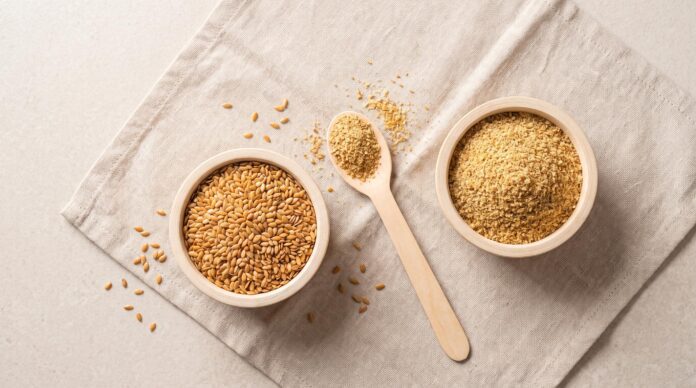
Ask ten people how much flaxseed to take for constipation and you will hear ten different answers. Here is what the trials and regulators say, a cautious way to start, and who should skip it. Where the evidence is thin, we say so.
Flaxseed for constipation: how much? There is no established dose. A cautious, food-based starting point for adults is about 6 to 7 grams (roughly 1 tablespoon) of ground flaxseed once a day with a full glass of water. That is our own suggestion, not a dose established by research, and it does not apply to children or teens. Before taking more, talk to a doctor or pharmacist. Follow the product label. If it instructs you to cook or bake the flaxseed before eating, do not consume it raw.
How flaxseed may help constipation
Flaxseed is about a quarter fiber by weight.[1] The soluble part forms a gel with water that helps soften stool, and the insoluble part adds bulk, the same basic idea as psyllium (see psyllium husk vs. wheat bran). Think of it as a mild, bulk-forming food rather than a quick fix: patience, plenty of fluid, and a slow build-up.
What the research says about flaxseed for constipation
There are only a handful of human trials, and all are small. Four matter most for everyday use.
| Study | Who took part | Amount | Main finding |
|---|---|---|---|
| Sun et al., 2020 | 90 adults with functional constipation, Shanghai; 4 weeks | 50 g flaxseed flour a day vs lactulose (no placebo group) | Bowel movements per week rose from 2 to 7 (flaxseed) and 2 to 6 (lactulose)[1] |
| Soltanian and Janghorbani, 2018 | 53 adults with type 2 diabetes and constipation; 12 weeks | Dose reported inconsistently: abstract says 20 g/day, methods describe about 10 g/day. Vs placebo cookies. | Symptom scores improved by 2.46 vs 0.41 with placebo[2] |
| Soltanian and Janghorbani, 2019 | 77 adults with type 2 diabetes and constipation; 12 weeks | Flaxseed or psyllium in cookies, reported as 10 g twice a day for each (the amount used in the study, not a personal recommendation), or placebo | Both beat placebo; flaxseed appeared superior to psyllium[3] |
| Ma et al., 2022 | 60 older adults with functional constipation; 1 month | 50 g flaxseed a day, no comparison group | More frequent bowel movements, less bloating[4] |
In the Shanghai trial, hard stools fell from more than 78 percent of participants to 3.3 percent on flaxseed (25 percent on lactulose), but 10 percent of the flaxseed group had watery stools. It was small, from one city, about 90 percent women, and a flaxseed supplier provided the flour.[1]
The diabetes trials came from one research group and may not apply to people without diabetes, and because the 2018 dose is inconsistent we do not treat it as evidence for a specific amount.[2,3] The older adult study had no control group.[4] All were small and short, so they offer limited reassurance about safety. The absence of reported side effects is not proof that flaxseed is safe for everyone.
A fifth study of 70 intensive care patients after a heart attack, none with chronic constipation, found no significant difference between 18 g a day of flaxseed powder and magnesium hydroxide syrup over four days, and flaxseed took longer to work (about 35 versus 25 hours).[17] It cannot be applied directly to chronic constipation.[5]
Overall, the evidence is early and low in certainty. A 2022 meta-analysis of 16 randomized trials found significant effects for psyllium and pectin, mainly at higher doses and with at least 4 weeks of treatment,[6] and the 2023 AGA and ACG guideline gave psyllium a conditional recommendation.[7] For the better studied option, see our reviews of the best psyllium husk for constipation relief.

How much flaxseed should you take for constipation?
There is no official dose. The table shows what other sources reported or advise. These rows are not recommendations for you.
| Source | Amount | Approximate tablespoons (ground flaxseed) |
|---|---|---|
| EU herbal monograph for linseed (EMA), a medicinal product guideline[8] | 10 to 15 g, two to three times a day, each with at least 150 mL of liquid | About 1.5 to 2.3 tablespoons per dose |
| Diabetes trials[2,3] | Reported as 10 g twice a day; the 2018 abstract and methods disagree, so not a verified dose | About 3 tablespoons a day for 20 g, or 1.5 for 10 g |
| Shanghai and older adult trials[1,4] | 50 g a day (amount studied, not a recommendation) | About 7 to 8 tablespoons a day |
| Austrian food safety agency (AGES), adults[9] | No more than 1 tablespoon of ground flaxseed per meal (Austrian guidance from the Food Codex label warning; a cyanide-safety limit, not a constipation dose) | 1 tablespoon per meal |
| Natural medicines monograph[10] | Safety above 50 g a day is not established | More than 7 to 8 tablespoons a day |
Grams are more reliable than tablespoons, which vary by brand and grind. The EMA figures apply to linseed as a medicinal product, while the AGES advice is food-safety guidance on ground flaxseed, so they are not equivalents. The plan below stays within the lower AGES per-meal figure.
A cautious way to build up
This plan is our own conservative, food-based suggestion, not a medical instruction, a trial-proven dose, or an established dose. How far you go depends on how you tolerate it, your product’s label, and your health, so ask a doctor or pharmacist if you are unsure. Always follow the package instructions: if the product says to cook or bake before eating, do not consume it raw.
- Days 1 to 3: about 6 to 7 grams (roughly 1 tablespoon) of ground flaxseed once a day with a meal, plus a full glass of water (the EU monograph asks for at least 150 mL per dose). If this is enough, stay here. If there is no improvement by the end of day 3, talk to a doctor or pharmacist rather than increasing on your own.
- Next: Only consider this step if your symptoms have improved, you tolerate the first step well, and a healthcare professional has advised that increasing is appropriate. If stools are still hard in that case, you could move to the same amount twice a day with two separate meals.
- More than this is not an expected next step. If you are thinking of taking more, such as a serving with each of three meals (about 20 grams a day, roughly 3 tablespoons), ask a doctor or pharmacist first. The AGES per-meal advice is not evidence that three tablespoons a day is safe for everyone.
Get advice early. The EU monograph advises talking to a doctor or pharmacist if constipation has not improved within 3 days of use.[8] That advice is written for linseed medicinal products and has not been tested for flaxseed eaten as food, but it is a sensible precaution here too.
How long it takes: there is no reliable timeframe for flaxseed eaten as food. An older, now superseded EMA assessment of linseed medicinal products said it usually acts within 12 to 24 hours, sometimes taking 2 to 3 days to peak;[11] treat that as historical guidance, not a promise. More is not better: higher amounts can cause bloating and diarrhea,[12] and too little fluid can leave you more constipated.[13] See how dehydration causes constipation.
Ground, whole, or oil?
Ground flaxseed is easiest to mix into food, and several trials used flaxseed flour or flaxseed baked into food. The EU monograph also allows whole or crushed seeds,[8] and AGES notes that cyanide is hardly released from whole, unground seeds, though it says similar consumption advice applies to them.[9] We found no head-to-head comparison for constipation. Not every flaxseed product is meant to be eaten raw. If your label says to cook or bake it, do that and skip the no-cook ideas below. Flaxseed oil lacks the seed’s fiber,[14] so it is not a stand-in.
Easy ways to take flaxseed
If your label permits eating it without cooking, stir it into yogurt (see fermented foods for constipation), oatmeal, or a smoothie, or mix it into water and drink it right away. If the label says to cook or bake, baking it into muffins or cookies is the safer route. Spread servings across the day. Prunes are another food-based option with clinical research behind them (prune juice, prunes vs. kiwifruit), and if fiber is not working, see why fiber isn’t working.
If you take medication, one drug reference advises taking flaxseed at least 1 to 2 hours before or after other medicines taken by mouth.[15] That gap may not be enough for every medicine, so ask your doctor or pharmacist how to space yours. For general timing, see the best time of day to take fiber supplements.
Side effects and who should be careful
- Digestive symptoms. Gas, bloating, and loose stools are the most common complaints, especially at higher amounts.[12]
- Children and teens. This guide is for adults. Please do not work out a flaxseed dose for a child yourself; ask their doctor. AGES advises that children under 4 generally should not eat ground flaxseed,[9] European regulators advise against linseed medicines under 12,[16] and teens should talk to a healthcare professional instead of following adult amounts.
- Who else should not use it. European regulators advise against linseed for people with swallowing or throat problems, abnormal narrowing of the digestive tract, a sudden change in bowel habit lasting more than 2 weeks, undiagnosed bleeding from the anus, or constipation that laxatives have not relieved.[16]
- Pregnancy and breastfeeding. Mayo Clinic advises avoiding flaxseed and flaxseed oil,[14] and NCCIH says safety evidence in pregnancy is limited and information on breastfeeding is insufficient.[12] This is a precaution, not proof of harm, so talk to your doctor first. See safe laxatives during pregnancy and high fiber foods for pregnancy constipation.
- Medicines and allergy. Flaxseed may lower blood pressure and blood sugar, so ask your clinician if you take medicine for either, and flaxseed oil may reduce blood clotting before surgery. Flaxseed can also cause allergic reactions.[14]
- Cyanide-forming compounds. Crushed flaxseed releases small amounts of hydrogen cyanide. AGES advises adults to limit ground flaxseed to about 1 tablespoon per meal;[9] spread servings across meals and follow your product’s instructions and safety warnings. That per-meal guidance is not proof that any particular daily total is safe for everyone.
When to see a doctor
Seek urgent medical care if you have severe abdominal pain, vomiting, or cannot pass gas. These can be signs of a blockage. Stop self-treating and get medical advice if you notice blood in or on the stool, unexplained weight loss, severe or worsening abdominal pain, or new, persistent, or worsening constipation, particularly if it begins after age 50 (you do not need to wait three weeks before asking for advice). Our guides to science-backed chronic constipation strategies and the best OTC laxatives cover what comes next, and for older adults see immediate relief at home.
Flaxseed products and tools worth considering
Disclosure: As an Amazon Associate, Constipation Relief earns from qualifying purchases at no extra cost to you. Product links are included for convenience, not as medical recommendations.
Prices change, so check each listing and read the label for any cooking or baking instructions. For something ready to stir into yogurt or oatmeal, try Bob’s Red Mill Organic Flaxseed Meal (16 oz) or Viva Naturals Organic Ground Flaxseed (15 oz), a smaller bag that is easier to finish before it goes stale. To grind your own, Bob’s Red Mill Resealable Organic Whole Golden Flaxseed (13 oz) pairs with a small blade grinder such as the KRUPS GX4100 Electric Spice and Coffee Grinder.
The bottom line
Flaxseed is a food-based option some adults may reasonably try for mild to moderate constipation, but it is not a proven treatment or an established equivalent to psyllium, and the evidence is early. If you try it, increase slowly, drink enough fluid, and follow your product’s label, including any instruction to cook or bake it. Get medical advice if constipation has not improved within 3 days, if you have any of the warning signs above, or if you need it every day for more than a few weeks.
Frequently asked questions
How much flaxseed should I take for constipation?
There is no established dose. Our cautious, food-based suggestion for adults is to start with about 6 to 7 grams (roughly 1 tablespoon) of ground flaxseed a day with a full glass of water. This is not a trial-tested or established dose. Ask a doctor or pharmacist before taking more, and follow your product’s label.
How long does flaxseed take to work for constipation?
There is no reliable timeframe for flaxseed eaten as food. An older European regulatory assessment of linseed medicinal products described it as usually acting within 12 to 24 hours, but that should not be read as a guaranteed timeframe. If there is no improvement within 3 days, check in with a doctor or pharmacist rather than waiting.
Can children or teens take flaxseed for constipation?
Please do not work out a flaxseed dose for a child yourself. Ask their doctor or pediatrician about safer options. Austria’s food safety agency advises that children under 4 generally should not eat ground flaxseed. Teens should check with a healthcare professional before using flaxseed for constipation instead of following the adult plan.
Is it safe to take flaxseed every day?
The NIH says limited amounts of flaxseed may be safe for short-term use, up to 6 months, and the trials ran 4 to 12 weeks. That is not a recommendation to use flaxseed daily for six months to treat constipation. If you still need it daily after a few weeks, talk to a healthcare provider about the underlying cause.
This article is for educational and informational purposes only and does not constitute medical advice. Always consult a qualified healthcare provider before starting new supplements or making significant dietary changes, especially if you have chronic health conditions, are pregnant, or take regular medications.
Research references
-
- Sun J, Bai H, Ma J, Zhang R, Xie H, Zhang Y, et al. Effects of flaxseed supplementation on functional constipation and quality of life in a Chinese population: a randomized trial. Asia Pac J Clin Nutr. 2020;29(1):61. Full text (PDF)
- Soltanian N, Janghorbani M. A randomized trial of the effects of flaxseed to manage constipation, weight, glycemia, and lipids in constipated patients with type 2 diabetes. Nutr Metab (Lond). 2018;15:36. doi:10.1186/s12986-018-0273-z
- Soltanian N, Janghorbani M. Effect of flaxseed or psyllium vs. placebo on management of constipation, weight, glycemia, and lipids: a randomized trial in constipated patients with type 2 diabetes. Clin Nutr ESPEN. 2019. PMID: 30661699
- Ma J, Sun J, Bai H, Ma H, Wang K, Wang J, et al. Influence of flax seeds on the gut microbiota of elderly patients with constipation. J Multidiscip Healthc. 2022;15:2407. PMID: 36299564
- European Medicines Agency, Committee on Herbal Medicinal Products. Addendum to assessment report on Linum usitatissimum L., semen. EMA/HMPC/416377/2024 (addendum to the assessment report, not the monograph itself; adopted by the HMPC on 20 November 2024). ema.europa.eu
- van der Schoot A, Drysdale C, Whelan K, Dimidi E. The effect of fiber supplementation on chronic constipation in adults: an updated systematic review and meta-analysis of randomized controlled trials. Am J Clin Nutr. 2022;116(4):953. PMID: 35816465
- Chang L, Chey WD, Imdad A, et al. American Gastroenterological Association and American College of Gastroenterology clinical practice guideline: pharmacological management of chronic idiopathic constipation. Gastroenterology. 2023;164(7):1086. PMID: 37116919
- European Medicines Agency, Committee on Herbal Medicinal Products. European Union herbal monograph on Linum usitatissimum L., semen. EMA/HMPC/377675/2014. 2015. ema.europa.eu
- AGES (Austrian Agency for Health and Food Safety). Prussic acid (hydrogen cyanide), including guidance on ground flaxseed. Last updated 25 November 2025. ages.at
- Natural Medicines monograph: flax. Drugs.com. drugs.com
- European Medicines Agency, Committee on Herbal Medicinal Products. Assessment report on Linum usitatissimum L., semen. EMEA/HMPC/167395/2006, 25 October 2006 (earlier version, superseded). ema.europa.eu
- National Center for Complementary and Integrative Health (NCCIH). Flaxseed and flaxseed oil. nccih.nih.gov
- Medical News Today. Flaxseed for constipation. medicalnewstoday.com
- Mayo Clinic. Flaxseed and flaxseed oil. mayoclinic.org
- MedicineNet. Flaxseed (Linum usitatissimum) oral: uses, side effects, precautions. medicinenet.com
- European Medicines Agency. Herbal medicine: summary for the public, linseed. EMA/492394/2015. ema.europa.eu
- Amjadi Suraki S, Bagheri-Nesami M, Nabati M, Moosazadeh M, Habibi E. Flaxseed powder and magnesium hydroxide syrup on the intestinal function of patients with acute myocardial infarction in intensive care units. Caspian J Intern Med. 2024;15(2):234-243. PMID: 38807721





[…] detail, who should avoid it, and why some products must be cooked before eating, read our guide to flaxseed for constipation and how much to take. Chia seeds are a similar idea, and we cover them in our chia seeds guide. Whichever you choose, […]
[…] the label, and see how much flaxseed to take before you […]