

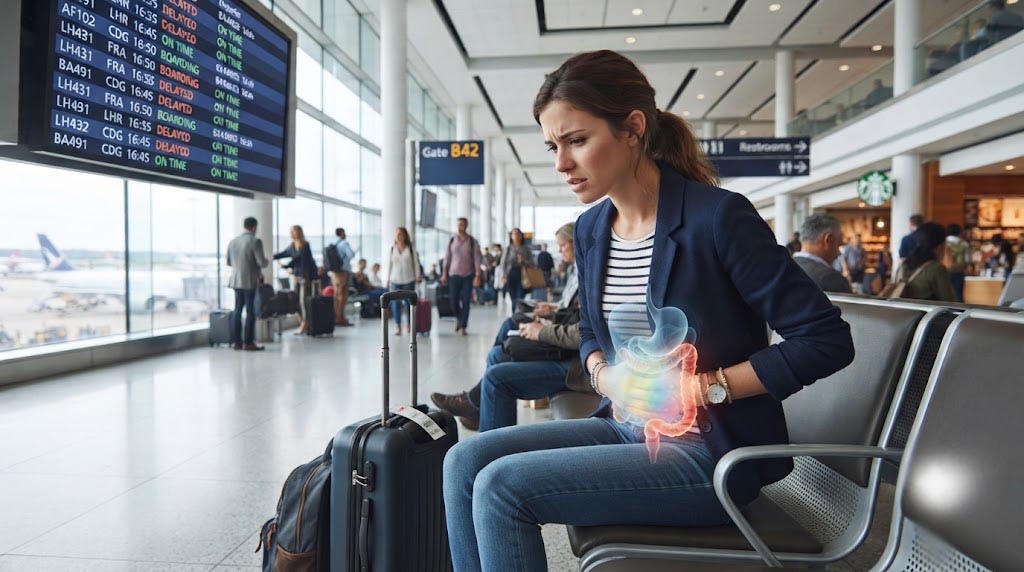
Why am I constipated after traveling? If you rarely have bathroom trouble at home but suddenly find yourself blocked up on a trip, you are dealing with a well-documented and surprisingly common condition sometimes called “traveler’s constipation.”[1] It is not in your head, and it usually is not a sign of anything serious.
It happens because travel disrupts several everyday habits your gut relies on to stay regular, often all at once. This guide covers what the evidence shows about why it happens, how long it typically lasts, and which prevention and relief strategies actually hold up.
What Is “Traveler’s Constipation”?
Traveler’s constipation describes the onset of infrequent, hard, or difficult-to-pass stools in people who travel, including many who rarely have digestive complaints at home. The term was formally used in a 2003 report in the American Journal of Gastroenterology, which described new-onset constipation as a recognizable pattern among travelers rather than a coincidence.[1]
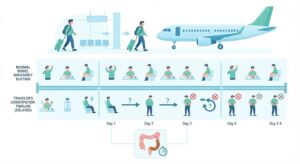
A small prospective cohort study followed travelers before, during, and after a week-long trip abroad involving a medium-haul flight. On average, the first bowel movement after arrival was delayed by about six hours compared with each traveler’s usual pattern.
Among the slowest quarter of the group, defined as the constipated subgroup, the wait stretched to a median of roughly 47 hours, compared with about 24 hours for everyone else. Some participants also reported significant bloating, discomfort, and abdominal pain that affected their trip.[2] While small, the findings are consistent with the pattern described in the original 2003 report and with everyday clinical experience.
Gastroenterologist Leyla Maric, MD, of Cleveland Clinic, describes travel constipation as a genuinely common phenomenon driven by a combination of changes to routine, environment, stress, and diet happening at the same time, rather than any single trigger.[3]
Affiliate Disclosure: ConstipationRelief.net may earn a small commission from qualifying purchases made through links on this page, at no extra cost to you. Product recommendations are based on clinical evidence discussed in this guide.
Travel constipation happens fast, and unfamiliar pharmacies in a foreign country are not the time to figure out what works for you. Based on the strategies covered in this guide, here are the most practical options to pack before you leave:
- Best osmotic laxative to pack (PEG 3350, single-dose): MiraLAX Mix-In Pax Single-Dose Packets — pre-measured PEG 3350, dissolves in any drink hot or cold, the osmotic laxative recommended in this guide and the 2023 AGA-ACG guideline, no urgency or cramping
- Best natural fast-acting option: Sunsweet Amazin Prune Juice — sorbitol and pectin draw water into the colon naturally, works within 1-3 hours, referenced in the food-based relief section above
- Best individually wrapped travel snack: Sunsweet Individually Wrapped Prunes — shelf-stable, TSA-friendly, no refrigeration needed, easy to pack in a carry-on alongside your other essentials
- Best magnesium for faster relief: Natural Vitality CALM Magnesium Citrate Powder — individual sachets, works in 30 minutes to 6 hours, no refrigeration needed — ⚠️ avoid with kidney disease
- Best probiotic (start 3-5 days before departure): Align Probiotic 24/7 Digestive Support (42 Capsules) — Bifidobacterium 35624, shelf-stable, no cold storage needed, supports the gut bacteria balance that diet disruption during travel can upset
Why Am I Constipated After Traveling? The Main Causes
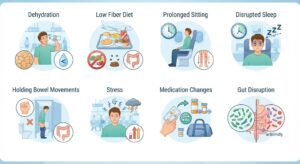
Travel constipation is rarely caused by just one thing. It is usually several small disruptions stacking on top of each other. Here are the factors with the most consistent support.
1. Dehydration
Long flights, hot climates, extra walking, and alcohol all increase fluid loss, and travelers often drink less water than usual simply because a bottle is not always within reach. Even mild fluid restriction may contribute to slower colonic transit and harder stools, since the colon pulls more water out of stool when the body is short on fluid.[4]
This is also one of the easiest factors to address once you are aware of it. For a full explanation of the mechanism, see our guide on does dehydration cause constipation. If you are already drinking water but still struggling, our article on why am I constipated even though I drink water covers the other variables that may be at play.
2. A change in diet and eating schedule
Travel almost always means eating different food at different times, often with far less fiber than usual. Airport food, fast food on a road trip, and rich vacation meals tend to be low in the fiber your digestive system relies on for bulk and regular movement, and a diet that leans heavily on processed food or alcohol can disturb the balance of beneficial bacteria in the gut, which also plays a role in healthy digestion.[3]
Our guide to fiber foods and fiber therapy for gut health and our breakdown of soluble vs insoluble fiber for constipation explain how to close that gap. The dedicated food section below covers exactly what to eat, and what to limit, on the road.
3. Reduced physical activity
Hours spent sitting on a plane, train, or in a car cut down on the physical movement that stimulates peristalsis, the wave-like muscle contractions that move stool through the colon. A 2019 systematic review and meta-analysis of randomized controlled trials found that structured exercise meaningfully improved constipation symptoms, including stool frequency and gut transit time, which is part of why physical activity is recommended as a first-line, non-drug strategy in current clinical guidelines.[5,6]
Even short walking breaks during a trip support the same motility that a normal daily routine would. Our fast constipation relief guide details how much walking tends to help, and our yoga for constipation relief guide includes gentle poses that work well in a hotel room or airport lounge.
4. Disrupted routine and circadian rhythm
Your gut has its own internal clock, and it prefers predictable meal times, sleep times, and bathroom times. Travel is one of the most common ways this gets disrupted, since a trip can shift meal timing, sleep patterns, bathroom patterns, and the body’s internal clock all at once, and it can take the digestive system a few days to catch up.[3]
5. Holding in the urge
Unfamiliar, shared, or public restrooms lead many travelers to delay a bowel movement until conditions feel more comfortable, and switching to a bathroom that is not your own can itself bring on a bit of anxiety for some people. Repeatedly overriding the urge to go can gradually suppress that signal, letting stool sit longer in the large intestine and lose more water, which makes it harder to pass later and can further worsen constipation.[3]
6. Stress and anxiety
Packing, schedules, unfamiliar surroundings, and the general mental load of travel can activate the body’s stress response, and there is a well-documented bidirectional link between the brain and the gut in which psychological stress can alter gut motility and sensitivity.[7] Some travelers even develop a low-grade worry about becoming constipated before it happens, and that anticipation alone can play a role.
7. Medication timing changes
If you normally take medication at a set time each day, a new time zone or a looser vacation schedule can throw that off. A small number of medications carry their own constipation risk independent of travel, most notably opioid pain relievers, and calcium- or aluminum-containing antacids in particular, which can compound the effect of a disrupted routine.[8] Not all antacids behave this way, so this is worth checking on your specific product rather than assuming.
8. Overlap with other travel-related gut symptoms
Some travelers develop constipation, bloating, and abdominal discomfort that resemble post-infectious irritable bowel syndrome, particularly after international travel. One prospective study found that new-onset diarrhea, constipation, IBS-type symptoms, and dyspepsia were all common in the weeks following travel abroad.[9]
People who already have IBS or inflammatory bowel disease tend to be more susceptible to a flare while traveling, since shifts in diet, medication timing, and routine can all worsen symptoms.[3] If your symptoms feel more like alternating constipation and looseness, and not just straightforward hard stools, this overlap may explain it.
Best Foods to Prevent Constipation While Traveling
Diet is one of the few travel-constipation triggers you can control almost completely, even without your own kitchen. You do not need to overhaul what you eat on a trip. Small, consistent choices at each meal make the biggest difference.[3]
Foods that help
- High-fiber fruit: apples, pears, berries, oranges, and especially prunes or kiwifruit, which have some of the strongest evidence among natural remedies. See our natural laxatives for constipation guide for the full evidence-based list.
- High-fiber vegetables: carrots, celery, and broccoli travel well as a snack and add fiber without any preparation.
- Whole-grain crackers and nuts: a shelf-stable way to add fiber at breakfast or between meals, especially at airports where fresh produce is limited.
- Probiotic-rich foods: yogurt, kefir, and other fermented foods can help support a healthy gut microbiome during travel. Our guide to the best probiotic supplements covers supplement options if fermented foods are hard to find.
- Water-rich foods: cucumber, watermelon, soups, and similar high-moisture foods help increase both fluid and fiber intake at once, which matters since fiber needs water to work properly.
- A simple daily target: aim for at least one serving of fruit or vegetables at every meal, even if the rest of the meal is far from your usual diet.
Foods and drinks to limit
- Heavy, low-fiber vacation food: large amounts of cheese, pizza, fried food, chips, candy, and ice cream can work against you, even though they are easy to justify on a trip.
- Excess alcohol: alcohol is a diuretic and adds to the dehydration risk that travel already carries.[4]
- Heavy reliance on processed or fast food: convenient, but consistently low in fiber, especially over several days in a row.
- Very high caffeine intake: a normal amount of coffee is fine for most people and can even encourage a bowel movement, since research shows caffeinated coffee measurably increases colonic motor activity and propagating contractions, but leaning on caffeine instead of water for hydration can backfire.[10]
Practical meal-by-meal ideas
- Airport or layover: choose a fruit cup, a trail mix with nuts and dried fruit, or a whole-grain sandwich over pastries or fried food.
- Long flight: pack a small bag of dried figs, prunes, or almonds, and ask for water with every drink service instead of only soda, coffee, or alcohol.
- Road trip: keep a cooler bag with apples, carrots, or a small bottle of prune juice for stops, instead of relying only on gas-station food.
- Hotel breakfast: pick fruit, oatmeal, or whole-grain toast over pastries alone, and add yogurt when it is available.
- Eating out at every meal: ask for a side salad or steamed vegetables when ordering, and treat it as a small, repeatable habit instead of an occasional extra.

How Long Does Travel Constipation Last?
Regularity looks different for everyone, but going three or more days without a bowel movement is generally considered constipation.[3] Most cases resolve on their own within a couple of days, or once you settle into your destination or return home.
If it drags on for more than a few days, up to about two weeks, it is worth checking in with a healthcare provider.[3] In the cohort study described earlier, even the slowest-recovering travelers were typically back to a bowel movement within about two days of arrival.[2]
Who Is Most at Risk?
- People who already lean constipated at home, since travel tends to amplify an existing tendency
- Women, who report constipation more often than men in most population studies
- Older travelers, particularly those with reduced mobility or on medications that slow the gut
- People with irritable bowel syndrome, whose symptoms are especially sensitive to shifts in diet, stress, and routine
- Long-haul and international travelers crossing multiple time zones
- Anyone relying heavily on restaurant or convenience food for the length of the trip
Science-Backed Ways to Prevent and Relieve Travel Constipation
Before you go
- Start hydrating a day or two early. Do not wait until you feel thirsty on the plane. Pale, straw-colored urine is a simple daily check.
- Pack fiber-rich, portable snacks. Dried fruit, nuts, whole-grain crackers, or a fiber supplement travel well and need no refrigeration. Our list of natural laxatives for constipation covers the food-based options with the strongest evidence.
- Bring a familiar backup option. A fiber supplement or a gentle osmotic laxative such as PEG 3350, one you already know agrees with you, can keep a minor slowdown from turning into several uncomfortable days. See our guides to magnesium supplements for constipation and OTC laxatives for constipation to choose ahead of time instead of scrambling in an unfamiliar pharmacy.
During the trip
- Drink water on a schedule, not just when thirsty. On flights, ask for water with every beverage service and go easy on alcohol, since it adds to fluid loss.[4] A moderate amount of coffee is fine for most people, and may even encourage a bowel movement.[10]
- Move your body every couple of hours. Walk the aisle on a plane, or take short walking breaks on a road trip. Regular movement supports the same gut motility a normal daily routine would.[5]
- Do not ignore the urge. Use the bathroom when your body signals it, even if the facilities are not ideal, since repeated delays make constipation more likely.
- Keep some fiber at each meal. One high-fiber item, such as fruit, a salad, or whole grains, can offset a few days of lower-fiber travel food.
- Protect a consistent sleep and meal window where your schedule allows it, since regularity supports your gut’s internal clock in adjusting faster.
If constipation has already started
- Increase water intake right away and add a naturally laxative food such as prunes or kiwifruit
- An osmotic laxative such as polyethylene glycol (PEG 3350, sold in the US as MiraLAX) is a well-studied option if a few days pass without relief.[6] Some people also use magnesium-based products, but these are not appropriate for everyone, especially those with kidney disease. Follow the product label, and check with a doctor first if you have kidney disease or another chronic condition, since dosing needs vary by individual.
- Gentle movement, a warm drink in the morning, and unhurried time on the toilet can all help trigger the natural urge to go
- Our roundup of fast constipation relief strategies and how to soften stool naturally covers step-by-step options that work well outside your normal kitchen and routine
When to See a Doctor
Travel constipation is usually temporary and clears up once your routine normalizes. Persistent constipation with severe abdominal pain, vomiting, rectal bleeding, or an inability to pass gas requires medical evaluation. The same applies if you go three or more days with no bowel movement, or if symptoms continue for more than about two weeks after returning home.[3]
Straining from travel constipation can also aggravate or trigger hemorrhoids. Our guide to natural ways to relieve hemorrhoids and constipation covers safe, gentle remedies if that becomes an issue after a trip.
Frequently Asked Questions
How long does constipation after traveling usually last?
In the majority of cases, things settle within a couple of days of getting back to normal eating, hydration, and activity. If a few days pass, stretching toward two weeks, without improvement, it makes sense to check in with a healthcare provider rather than wait it out.[3]
Is it normal to not poop for several days while traveling?
A day or two of delay is genuinely common and not usually a red flag. In cohort research, travelers typically saw their first bowel movement delayed by about six hours, and the slowest quarter of travelers waited close to two days.[2] Three days or more without a bowel movement crosses into what is clinically defined as constipation, so treat that as your cue to act.[3]
Can flying itself cause constipation?
Yes, on its own it can. Cabin air runs very dry, hours in a seat cut down on movement, and plenty of travelers avoid the airplane bathroom altogether, and each of these can slow the gut down during and right after a flight.
What should I eat while traveling to avoid constipation?
Build a fruit or vegetable into every meal, whether that is an apple, a handful of berries, carrot sticks, or steamed broccoli, and keep whole-grain crackers, nuts, or dried fruit within reach for snacking. Yogurt, kefir, and other fermented foods can help your gut bacteria along the way. Go easy on cheese, fried food, chips, candy, and alcohol, and remember that fiber needs water to actually work, so keep drinking alongside it.
Should I bring laxatives or fiber supplements when I travel?
Plenty of frequent travelers pack a gentle, familiar option, such as a fiber supplement or an osmotic laxative like PEG 3350, and use it proactively at the first sign of slowing down instead of waiting for full-blown constipation. If you manage a chronic digestive condition, loop in your doctor before the trip so you have a plan in place.
Key Takeaways
- Travel constipation is a real, well-documented condition, not just a coincidence, and it affects even people who have no digestive issues at home[1,2]
- The main causes are dehydration, lower fiber intake, less physical activity, disrupted routine and circadian rhythm, holding in the urge, medication timing, and travel-related stress
- Most people recover within a few days once normal eating, hydration, and activity return[2,3]
- Proactive hydration, fiber-rich food, movement, and not delaying bathroom visits are the most effective prevention strategies
- Packing a familiar fiber supplement or gentle osmotic laxative can keep a minor slowdown from turning into several uncomfortable days
- See a doctor if you go three or more days with no bowel movement, or if you have severe pain, bleeding, or symptoms lasting more than about two weeks after returning home[3]
References
- Mearin F, Zárate N, Sardi JA, Moreno-Osset E, Salis G, et al. Traveler’s constipation. Am J Gastroenterol. 2003 Feb;98(2):507-509. PMID: 12591084.
- Hansen S, et al. Traveler’s constipation: a prospective cohort study. Athenaeum Scientific Publishers, 2024.
- Maric L. On the Road Again With Constipation: Why You Get Constipated While Traveling. Cleveland Clinic, Health Essentials. September 19, 2023. https://health.clevelandclinic.org/travel-constipation
- Arnaud MJ. Mild dehydration: a risk factor of constipation? Eur J Clin Nutr. 2003;57(Suppl 2):S88-S95. PMID: 14681719.
- Gao R, Tao Y, Zhou C, et al. Exercise therapy in patients with constipation: a systematic review and meta-analysis of randomized controlled trials. Scand J Gastroenterol. 2019;54(2):169-177. PMID: 30843436.
- Chang L, Chey WD, Imdad A, et al. American Gastroenterological Association-American College of Gastroenterology Clinical Practice Guideline: Pharmacological Management of Chronic Idiopathic Constipation. Gastroenterology. 2023;164(7):1086-1106. PMID: 37116919.
- Stengel A, Mori M. Stress and the brain-gut axis in functional and chronic-inflammatory gastrointestinal diseases: a transdisciplinary challenge. Psychother Psychosom Med Psychol. PMID: 31715444.
- Kumar L, Barker C, Emmanuel A. Opioid-induced constipation: pathophysiology, clinical consequences, and management. Gastroenterol Res Pract. 2014;2014:141737. PMID: 24883055.
- Ilnyckyj A, Balachandra B, Elliott L, Choudhri S, Duerksen DR. Post-traveler’s diarrhea irritable bowel syndrome: a prospective study. Am J Gastroenterol. 2003;98(3):596-599. PMID: 12650793.
- Iriondo-DeHond A, Uranga JA, Del Castillo MD, Abalo R. Effects of Coffee and Its Components on the Gastrointestinal Tract and the Brain-Gut Axis. Nutrients. 2020;13(1):88.
Medical Disclaimer: This article is for informational purposes only and does not constitute medical advice. Always consult a qualified healthcare provider for diagnosis and treatment of any medical condition, including constipation.






[…] have not measured how much each one contributes. They are, however, real and fixable. Our guides on constipation after traveling (another kind of routine disruption), dehydration and constipation, and simple morning habits cover […]