

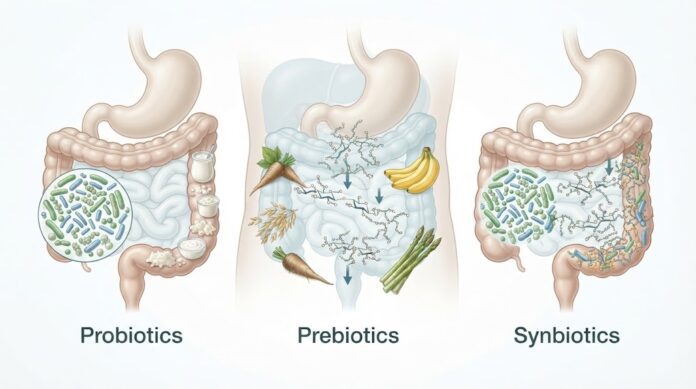
Prebiotic vs probiotic for gut health is one of the most common digestive questions, and it is easy to see why. Walk down any supplement aisle and the two words sit side by side on the shelves. They look alike, they sound alike, and plenty of labels use both in the same sentence.
The two do very different jobs in your gut, though, and a third term, synbiotic, now describes products that combine them. This guide explains what prebiotics and probiotics are, how they differ, what the research says about digestion and constipation, and where synbiotics fit in. We also point out where the evidence is solid and where it is still thin, because both matter when you decide what to buy or eat.
Constipation is the main focus of this site, so we look closely at that evidence. For a wider overview, see our guide on how gut health can affect constipation.
Prebiotic vs Probiotic: The Quick Answer
- Probiotics are live microorganisms that can benefit your health when you take enough of them [1].
- Prebiotics are substances that microbes in your gut selectively use as fuel, and many of them are types of dietary fiber [2].
- Synbiotics are mixtures of live microbes and a substrate that host microbes selectively use [3].
A garden makes a handy picture. Probiotics are the seeds, prebiotics are the fertilizer, and a synbiotic is a seed packet with the fertilizer already mixed in. The picture is imperfect, since your gut is a crowded ecosystem and not an empty plot, but it is enough to keep the terms straight.
What Are Probiotics?
Probiotics are live microorganisms that, when administered in adequate amounts, confer a health benefit on the host [1]. In simpler terms, they are specific live microbes that have evidence of a benefit when used in the right amount. Most are bacteria from groups such as Lactobacillus and Bifidobacterium, and one common yeast is Saccharomyces boulardii. Probiotic microbes do not always settle permanently in the gut, so how they work is more complicated than simply adding microbes.
The wording of that definition matters. A food that simply contains live microbes is not automatically a probiotic. The strain should be identified, and there should be evidence that it does something useful at the dose you are getting [1]. That is why a plain yogurt and a clinically studied probiotic capsule are not the same thing, even though both contain living bacteria.
Strain matters more than the category
Probiotic effects are strain-specific, so a result seen with one strain does not automatically apply to another [7]. Reviews of constipation trials keep running into this problem, because the studies use different strains, doses, and durations, which makes the results hard to compare [7]. To see how individual strains stack up, our guide to the best probiotic strains for constipation and bloating goes through them one by one.
What research says about probiotics and constipation
Proposed mechanisms include changes to gut acidity, mucus production, immune signaling, and the gut barrier, although the exact ways probiotics affect bowel habits are still being worked out [7]. One of the strongest recent summaries comes from a 2022 meta-analysis of 30 randomized trials in adults with chronic constipation. In that pooled analysis, 57% of people (369 of 647) responded to probiotics compared with 44% (252 of 567) on control, a statistically significant difference [4].
Probiotics also increased stool frequency. When the trials were grouped by type, Bifidobacterium lactis (now often labeled Bifidobacterium animalis subsp. lactis) had a significant effect on stool frequency, while probiotic mixtures, Bacillus coagulans Unique IS2, and Lactobacillus casei Shirota did not. Because effects are strain-specific, that finding should not be read as applying to every B. lactis product. Stool consistency was not significantly changed overall [4].
The authors described their conclusion as cautious optimism [4]. The trials also differ in strains, doses, and duration, which limits how firmly the results can be compared [7]. In plain language, some probiotics seem to help some adults with chronic constipation, but the evidence is not strong enough to promise a result. For a beginner-friendly overview, see our article on whether probiotics can help constipation.
What Are Prebiotics?
Prebiotics are substances that microbes in and on the body selectively use, and that bring a health benefit as a result [2]. Many are types of dietary fiber. The word selectively does real work here. Plenty of fibers feed gut microbes in a general way, but a true prebiotic is used by particular microbes and has documented benefits [2].
The prebiotics researchers study most include inulin, fructooligosaccharides (FOS), and galactooligosaccharides (GOS). Prebiotic fibers are also sold as powders and capsules. Food sources are covered in the foods section below.
What research says about prebiotics and constipation
Prebiotic research in constipation is smaller and less tidy than the probiotic research. A 2017 meta-analysis included 5 randomized trials of prebiotics involving 199 patients and 8 trials of synbiotics involving 825 patients. Overall, prebiotics increased weekly stool frequency and improved stool consistency, although the number of trials was small. Subgroup analyses suggested that galactooligosaccharides may improve stool frequency, stool consistency, ease of defecation, and abdominal pain [6].
A 2022 integrative review that included 39 clinical trials concluded that inulin appeared to be the most promising prebiotic in humans, while noting that results were difficult to compare across studies [7].
A 2024 network meta-analysis of 37 trials involving 3,903 adults found that prebiotics and synbiotics increased weekly stool frequency, although the certainty of evidence varied from moderate to very low. Lactulose showed a clear effect in the analysis, but lactulose is an established osmotic laxative rather than a typical prebiotic fiber. Its result therefore should not be interpreted as proof that ordinary prebiotic foods work in the same way [5].
The catch: gas and bloating
Many prebiotics are fermented by gut microbes, and that fermentation can produce gas. Some people notice more bloating, gas, or loose stools when they add prebiotic fiber, especially if they increase it quickly. Going slowly and changing one thing at a time makes it easier to tell what is helping.
People with irritable bowel syndrome, or with symptoms that worsen after fermentable fibers, may be more sensitive to these foods. If you have diagnosed small intestinal bacterial overgrowth (SIBO), severe bloating, or slow-transit constipation, talk with a healthcare professional before making a large increase in supplemental fiber.
If fiber in general has not been helping, read our article on why fiber is not working for constipation. You can also compare options in our guide to natural fiber supplements for chronic constipation. Fluid intake matters too, as we explain in our article on dehydration and constipation.
Prebiotic vs Probiotic vs Synbiotic: Key Differences
| Feature | Probiotics | Prebiotics | Synbiotics |
|---|---|---|---|
| What it is | Live microorganisms | A substrate that microbes selectively use | A mixture of live microbes and such a substrate |
| Common examples | Bifidobacterium and Lactobacillus strains, Saccharomyces boulardii | Inulin, FOS, GOS | Products that pair a probiotic strain with a prebiotic fiber |
| How it may help | Adds specific live microbes that may influence the gut | Feeds microbes already living in your gut | Aims to do both at once |
| Where you find it | Supplements, some yogurts and kefir, fermented vegetables | Onions, garlic, leeks, asparagus, oats, legumes, fiber supplements | Mostly supplements |
| Possible side effects | Gas or bloating in some people | Gas, bloating, loose stools, especially at higher amounts | Gas or bloating, depending on the probiotic and prebiotic used |
| Constipation research | Some strains have shown benefit; B. lactis had a significant effect on stool frequency in one meta-analysis [4] | Some evidence of increased stool frequency, but certainty varies by intervention [5,6,7] | Mixed: insufficient in 2022 [4], positive but uncertain in 2024 [5] |
Probiotic and Prebiotic Foods
Foods that may contain probiotics
Yogurt with live cultures, kefir, and some traditionally fermented vegetables such as sauerkraut and kimchi may contain live microorganisms. Other fermented foods, such as miso, tempeh, and kombucha, vary a lot in what they contain. An international expert panel defines fermented foods as foods made through desired microbial growth and enzymatic conversion of food components, and it treats them as distinct from probiotics [11].
Many contain live microbes, but they count as probiotics only when the strain is identified and shown to help [1,11]. Products that are heated or pasteurized after fermentation may no longer contain live microorganisms, so check the label for live and active cultures.
Foods that contain prebiotic fibers
Chicory root, onions, garlic, leeks, asparagus, slightly underripe bananas, oats, and legumes contain inulin-type fibers or other fermentable carbohydrates. Each food carries a mix of fibers, and the amounts vary, so treat these as sources of fermentable fiber and not as precise prebiotic doses. Whole foods also bring other nutrients, which is one reason food is a sensible place to start.

What Is a Synbiotic?
A synbiotic is a mixture of live microorganisms and a substrate that host microorganisms selectively use, which together confer a health benefit on the host [3]. The idea of pairing a probiotic with a prebiotic goes back to 1995 [3].
In 2020 an international expert panel published an updated definition, based on its 2019 meeting, and split synbiotics into two types [3]:
- Complementary synbiotics combine a probiotic and a prebiotic that are each meant to work on their own, so each component is expected to meet the criteria for a probiotic or prebiotic.
- Synergistic synbiotics use a substrate designed to feed the specific microbes that come in the same product. The components do not have to qualify individually, but the combination itself must be shown to give a health benefit.
One detail is easy to miss. On a supplement shelf, the word synbiotic suggests a product has both parts. It does not, by itself, tell you how strong the evidence is for that particular combination. Product pages such as our Seed Daily Synbiotic review and Physician’s Choice probiotic review show how individual formulas marketed as synbiotics compare.
You may also see the term postbiotic. That is a separate category, defined as a preparation of inanimate microorganisms and their components that confers a health benefit [10]. It is outside the scope of this article.
Where Does a Synbiotic Fit In?
The most useful way to think about it is that a synbiotic is a format, not an automatic upgrade. You have four practical routes to a routine that supports gut health: prebiotic foods alone, a probiotic alone, a probiotic and prebiotic taken separately, or one synbiotic product that includes both. A synbiotic is simply a single product that covers the fourth route, so it is a convenience choice as much as a scientific one.
Whether that format actually performs better for constipation is still an open question, and the research points in different directions:
- A 2022 meta-analysis pooled four synbiotic trials and found no significant effect on stool output or integrative symptom scores. Its authors concluded that there was insufficient evidence to recommend synbiotics for chronic constipation [4].
- A 2024 network meta-analysis reported that synbiotics increased weekly stool movements, but it rated the certainty of the evidence as moderate to very low [5].
- A 2017 meta-analysis found subgroup signals, including for fructooligosaccharides and for probiotic combinations on stool frequency, consistency, straining, and bloating [6].
Read together, the fair conclusion is that synbiotics are plausible and may help some people, but they have not been shown to consistently provide greater benefits than probiotics alone. For a head-to-head look, see our full comparison of synbiotics vs probiotics for constipation.
Who might consider a synbiotic?
A synbiotic may suit you if you like the convenience of one product and you tolerate fermentable fiber well. If fiber usually leaves you gassy or bloated, it may be easier to start with a single probiotic strain, or to build up prebiotic foods slowly, and see how you respond before adding both at once.
Prebiotic vs Probiotic: Which Is Better for Gut Health?
Neither one wins outright, because they are not competitors. They do different jobs, and the better choice depends on what you are trying to do.
- For constipation, some of the more consistent evidence is for specific probiotic strains, including Bifidobacterium lactis, which showed a significant effect on stool frequency in a 2022 meta-analysis [4]. However, probiotic effects are strain-specific, and the evidence does not establish one strain as universally best. Prebiotics look promising but rest on fewer and smaller trials [5,6,7].
- For a food-first approach, prebiotic fibers are easy to add through meals, and they also raise your overall fiber intake.
- For sensitive digestion, prebiotic fibers may cause more gas and bloating at first, so a single probiotic strain may feel gentler. Individual responses vary.
In other words, start from your symptoms and your tolerance, not from the label that sounds more impressive.
What the Research Can and Cannot Tell You
Three limits are worth keeping in mind whenever you read about gut health products.
- Studies are not uniform. Trials use different strains, doses, lengths, and forms, which is why reviews of this field report so much variation between studies [4,7].
- Averages hide individual results. A pooled response rate of 57% against 44% still means many people on probiotics did not respond, and some people on placebo did [4].
- Product claims can go beyond the available evidence. The National Center for Complementary and Integrative Health notes that the FDA has not approved health claims for probiotics, and that long-term safety data are limited [8].
How to Read a Supplement Label
If you decide to buy a supplement, a few checks make the label far more useful.
- Full strain name. Look for genus, species, and strain code, not just a species name. The strain is what links a product to published research.
- Amount and how it is stated. Colony-forming units (CFU) show the number of live microbes, and it helps when the label says whether that number holds through the expiration date. A higher CFU number does not automatically mean a probiotic will work better. The strain, dose, and evidence for the intended use all matter.
- Prebiotic type and amount in synbiotic products, such as inulin, FOS, or GOS.
- Independent testing. Third-party testing can help verify product quality and label accuracy, but it does not prove that the product is effective for constipation.
- Storage instructions. Some products need refrigeration.
- Realistic claims. Be wary of promises to cure constipation or any other condition.
How to Use Them Sensibly
- Cover the basics first. Drink enough fluids, eat a range of fiber-rich foods, stay active, and keep a regular bathroom routine.
- Add prebiotic foods gradually. Introduce one new food at a time and give your gut a few days to adjust.
- If you try a probiotic, check the label for the strain. A named strain lets you look up the research on that exact strain, which a species name alone does not.
- Change one thing at a time. If you add a probiotic, a prebiotic, and a new fiber all in one week, you will not know which one did what.
- Give it several weeks. For many probiotics and prebiotics, several weeks gives a more useful trial period than just a few days, although the appropriate duration depends on the specific product and goal. Many clinical trials have lasted around four weeks or longer.
- Keep simple notes. Track how often you go, stool form, and bloating so you can see real change.
If none of this moves the needle, our article on when fiber and probiotics are not working walks through what to try next. Other options include a magnesium supplement for constipation or an occasional over-the-counter laxative, and our list of natural ways to relieve constipation fast covers gentler habits. If you want product-level detail, see our reviews of the best probiotics for constipation and bloating and probiotic picks for IBS with constipation. A healthcare provider can help you choose safely.
Who Should Be Careful
Probiotics usually cause few side effects, but the safety data are limited, especially over the long term, and the risk of serious side effects may be greater in people with underlying health conditions. Severe and even fatal infections have been reported in premature infants given probiotics, and in 2023 the FDA warned health care providers about this risk [8].
Talk with a healthcare provider before using probiotics if you have a weakened immune system or a serious illness. Extra caution is needed when probiotics are being considered for infants, particularly premature infants. If you are pregnant or breastfeeding, ask your healthcare professional whether a specific product is appropriate for you.
Pregnancy and older age both change how constipation is best managed. You can read more in our guides to safe laxatives during pregnancy and constipation relief for older adults at home.
Probiotics should never be a reason to delay a medical check for a health problem [9]. Book an appointment if you notice blood in your stool or black, tarry stools, unexplained weight loss, severe or worsening abdominal pain, or constipation that is new, persistent, or not improving. A sudden change in bowel habits later in life, or a family history of bowel cancer, is another reason to get checked.
Frequently Asked Questions
What is the main difference between a prebiotic and a probiotic?
A probiotic is a live microorganism that can benefit your health when taken in adequate amounts. A prebiotic is a substance, often a type of dietary fiber, that microbes in your gut selectively use as fuel. Probiotics add microbes, while prebiotics feed microbes.
Should I take prebiotics and probiotics together?
You can take them together, either as separate products or as a synbiotic. Current research does not show that combining them always works better than a well-chosen probiotic alone. If you want to try both, introducing one at a time can make it easier to tell how your body responds.
Can prebiotics cause gas and bloating?
They can, especially when the amount jumps quickly, because many prebiotic fibers are fermented by gut microbes, and that fermentation can produce gas. Starting with small amounts and increasing slowly is usually easier on the gut. If symptoms get worse or do not settle, stop and check with a healthcare provider.
Which foods are probiotic and which are prebiotic?
Fermented foods such as yogurt with live cultures, kefir, and some traditionally fermented vegetables like sauerkraut and kimchi may contain live microbes, although they only count as probiotics when the strain is identified and shown to help. Prebiotic fibers are found in foods such as onions, garlic, leeks, asparagus, oats, slightly underripe bananas, and legumes. Always check labels, since products that are heated or pasteurized after fermentation may no longer contain live microorganisms.
Is yogurt a probiotic or a prebiotic?
Yogurt with live cultures contains living microbes, but it is not a prebiotic. Whether it counts as a probiotic depends on whether the specific strains are identified and supported by evidence of a health benefit. Check the label for live and active cultures and named strains.
Are synbiotics better than probiotics for constipation?
This is not proven. A 2022 meta-analysis of four synbiotic trials found no significant effect on stool output or symptom scores, while a 2024 network meta-analysis reported higher weekly stool frequency with synbiotics, with moderate to very low certainty. The specific strain and prebiotic may matter more than the word synbiotic on the label.
How long does it take to notice a difference?
Clinical trials often last several weeks, but the ideal trial period varies by the specific probiotic strain or prebiotic. It is usually better to assess a new routine over several weeks rather than after only a few days. Track stool frequency, stool form, and symptoms so you can see whether it is helping. Some people notice nothing, and that is a useful result too.
Do I need a supplement, or is food enough?
Food is a sensible place to start, especially for prebiotic fibers. Probiotic supplements are strain-specific, and the National Center for Complementary and Integrative Health notes that the FDA has not approved health claims for probiotics, so big promises deserve caution. Talk with a healthcare provider if you are unsure.
When should I see a doctor?
See a healthcare provider for blood in the stool, black or tarry stools, unexplained weight loss, severe or worsening abdominal pain, or constipation that is new, persistent, or not improving. Supplements should not replace a medical check when these signs appear.
The Bottom Line
Probiotics add live microbes, prebiotics feed the microbes you already have, and synbiotics bundle the two into one product. For constipation, some probiotic strains have shown benefits in clinical trials, with Bifidobacterium lactis showing a significant effect on stool frequency in one 2022 meta-analysis, though no single strain is proven best. Prebiotics look promising in small trials, and synbiotics remain unsettled.
A sensible starting point is a balanced diet with adequate fiber and fluids, regular physical activity, and a consistent bathroom routine. If you want to add prebiotic foods, do it slowly, and if you try a probiotic, choose one well-identified product and assess it over several weeks. If constipation persists, or symptoms worsen or warning signs appear, see a healthcare provider. That approach costs little, gives you clear feedback, and keeps you from paying for promises the research does not yet support.
This article is for information and education only. It does not replace medical advice, diagnosis, or treatment. Talk with a qualified healthcare provider before starting any new supplement, especially if you have a health condition or take medication.
References
- Hill C, Guarner F, Reid G, Gibson GR, Merenstein DJ, Pot B, et al. Expert consensus document: the International Scientific Association for Probiotics and Prebiotics consensus statement on the scope and appropriate use of the term probiotic. Nat Rev Gastroenterol Hepatol. 2014;11(8):506. doi:10.1038/nrgastro.2014.66. PMID: 24912386. https://doi.org/10.1038/nrgastro.2014.66
- Gibson GR, Hutkins R, Sanders ME, Prescott SL, Reimer RA, Salminen SJ, et al. Expert consensus document: the International Scientific Association for Probiotics and Prebiotics (ISAPP) consensus statement on the definition and scope of prebiotics. Nat Rev Gastroenterol Hepatol. 2017;14(8):491. doi:10.1038/nrgastro.2017.75. PMID: 28611480. https://pubmed.ncbi.nlm.nih.gov/28611480/
- Swanson KS, Gibson GR, Hutkins R, Reimer RA, Reid G, Verbeke K, et al. The International Scientific Association for Probiotics and Prebiotics (ISAPP) consensus statement on the definition and scope of synbiotics. Nat Rev Gastroenterol Hepatol. 2020;17(11):687. doi:10.1038/s41575-020-0344-2. https://www.nature.com/articles/s41575-020-0344-2
- van der Schoot A, Helander C, Whelan K, Dimidi E. Probiotics and synbiotics in chronic constipation in adults: a systematic review and meta-analysis of randomized controlled trials. Clin Nutr. 2022;41(12):2759. doi:10.1016/j.clnu.2022.10.015. PMID: 36372047. https://pubmed.ncbi.nlm.nih.gov/36372047/
- Deng X, Liang C, Zhou L, Shang X, Hui X, Hou L, et al. Network meta-analysis of probiotics, prebiotics, and synbiotics for the treatment of chronic constipation in adults. Eur J Nutr. 2024;63(6):1999. doi:10.1007/s00394-024-03410-1. PMID: 38693449. https://pubmed.ncbi.nlm.nih.gov/38693449/
- Yu T, Zheng YP, Tan JC, Xiong WJ, Wang Y, Lin L. Effects of prebiotics and synbiotics on functional constipation. Am J Med Sci. 2017;353(3):282. doi:10.1016/j.amjms.2016.09.014. PMID: 28262216. https://pubmed.ncbi.nlm.nih.gov/28262216/
- Araujo MM, Botelho PB. Probiotics, prebiotics, and synbiotics in chronic constipation: outstanding aspects to be considered for the current evidence. Front Nutr. 2022;9:935830. doi:10.3389/fnut.2022.935830. PMID: 36570175. https://pubmed.ncbi.nlm.nih.gov/36570175/
- National Center for Complementary and Integrative Health. 5 things to know about probiotics [Internet]. Bethesda (MD): NCCIH [cited 2026 Sep 30]. https://www.nccih.nih.gov/health/tips/things-to-know-about-probiotics
- National Center for Complementary and Integrative Health. Probiotics: usefulness and safety [Internet]. Bethesda (MD): NCCIH [cited 2026 Sep 30]. https://www.nccih.nih.gov/health/probiotics-usefulness-and-safety
- Salminen S, Collado MC, Endo A, Hill C, Lebeer S, Quigley EMM, et al. The International Scientific Association of Probiotics and Prebiotics (ISAPP) consensus statement on the definition and scope of postbiotics. Nat Rev Gastroenterol Hepatol. 2021;18(9):649. https://pmc.ncbi.nlm.nih.gov/articles/PMC8387231/
- Marco ML, Sanders ME, Gaenzle M, Arrieta MC, Cotter PD, De Vuyst L, et al. The International Scientific Association for Probiotics and Prebiotics (ISAPP) consensus statement on fermented foods. Nat Rev Gastroenterol Hepatol. 2021;18(3):196. doi:10.1038/s41575-020-00390-5. https://www.ncbi.nlm.nih.gov/pmc/articles/PMC7925329/