

You did everything right. You added vegetables, whole grains, and maybe even a fiber supplement. And yet — nothing changed.
If you have been asking yourself “Why Fiber Isn’t Working for Constipation?” — you are far from alone. It is one of the most common complaints we hear in our digestive health community.
The truth is, fiber is helpful — but only when it matches your actual problem. Research shows that fiber reliably works for people whose constipation stems from low dietary fiber intake with normal gut transit. For everyone else — people with slow-transit constipation, IBS-C, gut dysbiosis, or inadequate hydration — fiber alone often falls short, and sometimes makes things worse.[1,2]
This article covers the 5 reasons fiber may not be working for your constipation — with clinical evidence behind each one — and explains what to do instead.
If you are wondering why fiber is not helping your constipation or even why fiber makes constipation worse, the answers are usually more complex than simply “eating more fiber.
Table of Contents
- You Increased Fiber Too Quickly
- You Are Not Drinking Enough Water
- You Are Using the Wrong Type of Fiber
- Your Gut Has Slow Motility — Fiber Alone May Not Be Enough
- An Underlying Condition Is the Real Cause (IBS-C or Dysbiosis)
- Can Fiber Actually Make Constipation Worse?
- What Actually Works When Fiber Fails
- When to See a Doctor
- Key Takeaways
- Frequently Asked Questions
- References
1. You Increased Fiber Too Quickly
One of the most common mistakes is adding a large amount of fiber all at once — for example, jumping from 10 grams to 35 grams per day overnight.
When you increase fiber too fast, your gut bacteria cannot keep pace. They begin fermenting the excess fiber rapidly, producing large volumes of gas. At the same time, your colon fills with bulky material that it does not yet have the microbial balance to process smoothly.
The result? You feel bloated, gassy, and — paradoxically — more constipated than before.

What the Research Says
A 2022 systematic review and meta-analysis in the American Journal of Clinical Nutrition confirmed that psyllium supplementation at more than 10 g per day for at least 4 weeks produces the best outcomes — and that individuals should build up their intake gradually to avoid sudden symptom flares.[3]
The Fix
- Start with a low dose — half a teaspoon of psyllium or 1 to 2 grams of a fiber supplement daily
- Increase by no more than 2 to 3 grams per week
- Allow 7 to 14 days for your gut bacteria to adapt at each level before increasing again
- Always pair each dose increase with more water (see Reason 2 below)
Patience is not optional here — it is the strategy.
2. You Are Not Drinking Enough Water
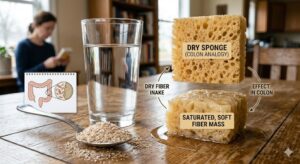
This is probably the single most overlooked reason fiber fails. Fiber — especially soluble fiber — works by absorbing water and forming a soft, gel-like mass that moves easily through your colon.
Without enough fluid, fiber does the opposite. It draws whatever moisture is available in your colon, leaving the stool harder and drier than before you started.
Think of it this way: dry oatmeal is stiff and crumbly. Add water, and it becomes soft and easy to move. Your colon works on the same principle.
What the Research Says
Mayo Clinic guidelines recommend that adults trying to relieve constipation drink 8 to 10 glasses of water per day — and increase fluid intake whenever they increase fiber.[4] Our guide on the best OTC laxatives for constipation also highlights this: dehydration is a foundational driver of constipation that no laxative or fiber product can fully overcome on its own.
The Fix
- Aim for at least 2 to 3 liters (8 to 10 glasses) of water daily
- Always take any fiber supplement with a full 8 oz (240 ml) glass of water
- Add one extra glass of water for every 5 grams of fiber you increase
- A glass of warm water in the morning can stimulate the gastrocolic reflex and help trigger a bowel movement
- Herbal teas such as ginger or oolong count toward daily hydration and may also support gut motility
If you are already well hydrated and fiber still is not helping, keep reading — the cause is likely one of the next three reasons.
3. You Are Using the Wrong Type of Fiber
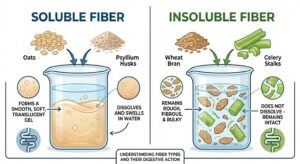
Not all fiber works the same way. There are two main categories, and they affect your gut very differently:
| Fiber Type | How It Works | Common Examples | Best For |
|---|---|---|---|
| Soluble fiber | Dissolves in water, forms a soft gel, moves through the colon gently | Psyllium husk, PHGG (Sunfiber), oats, flaxseed | Softening stool, IBS-C, sensitive guts |
| Insoluble fiber | Does not dissolve; adds bulk and speeds up transit | Wheat bran, corn bran, celery skins | Low-fiber constipation with normal gut motility |
| Highly fermentable fiber | Rapidly broken down by bacteria, producing gas | Inulin, FOS, chicory root extract | Prebiotic support — not suitable for IBS or bloating |
Many people with chronic constipation reach for wheat bran or high-inulin fiber products — and end up feeling worse. Insoluble fibers and rapidly fermentable fibers add bulk and gas without forming the soft, moist stool that most constipated people actually need.
What the Research Says
The 2023 joint clinical practice guideline from the American Gastroenterological Association and the American College of Gastroenterology (AGA-ACG) reviewed all major fiber supplements for chronic idiopathic constipation. Among commonly studied fiber supplements, psyllium has the most consistent clinical evidence, while evidence for other fibers remains limited or less certain. This recommendation for psyllium was issued as a conditional recommendation based on low-certainty evidence, meaning results may vary between individuals. Evidence for other fibers such as bran and inulin remains more limited and uncertain.[5]
Psyllium’s advantage over highly fermentable fibers like inulin comes from its physical properties: its strong water-holding capacity and viscous gel formation soften stool effectively, while its relatively low fermentation rate means far less gas production than rapidly fermentable short-chain prebiotics. A 2019 study in the International Journal of Molecular Sciences also found that psyllium beneficially shifts gut microbiota composition in constipated patients, adding another potential mechanism beyond stool bulking.[6]
The Fix
- Switch to psyllium husk (sold as Metamucil or in generic form) — it has the strongest clinical evidence among fiber supplements for constipation
- Consider partially hydrolyzed guar gum (PHGG, sold as Sunfiber) if you have a very sensitive gut — it produces even less gas than psyllium
- Avoid inulin, FOS, and chicory-root-based fiber products if you experience bloating or abdominal discomfort
- For dietary fiber, favor oats, chia seeds, and flaxseed over bran cereals
For a detailed comparison of fiber products and laxative options, see our guide on the best OTC laxatives for constipation.
4. Your Gut Has Slow Motility — Fiber Alone May Not Be Enough
This is where many people’s frustration makes the most sense. You can be eating 35 grams of fiber daily, drinking 3 liters of water, and using psyllium correctly — and still not be going.
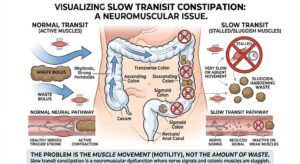
Why? Because fiber adds bulk — but it does not directly address impaired gut motility.
Gut motility refers to the wave-like muscle contractions — called peristalsis — that move stool through your colon. In slow-transit constipation (STC), these contractions are weak or infrequent. Adding more bulk to a colon that is not contracting properly is like loading more cargo onto a train with a broken engine.
Signs Your Constipation May Be Motility-Related
- Fewer than 3 bowel movements per week even when eating a high-fiber diet
- A persistent feeling of incomplete evacuation after passing stool
- No urge to go for several days at a time
- Hard stool despite drinking adequate water
- Little or no response to dietary fiber changes over 1 to 2 weeks
What the Research Says
A landmark 1997 study by Voderholzer et al., published in the American Journal of Gastroenterology, followed 149 patients with chronic constipation treated with Plantago ovata seeds (a psyllium-type fiber) at 15 to 30 g per day for 6 weeks. The results were striking: 80% of patients with slow-transit constipation saw no improvement from fiber therapy.[2] Fiber added bulk to an already-stalled system — it did nothing to address the underlying motility failure.
The Fix
Daily walking: Physical activity is one of the most evidence-supported ways to stimulate gut motility. A 30-minute daily walk measurably reduces intestinal transit time. Even light movement after meals activates the gastrocolic reflex. Our guide on olive oil for constipation notes that combining exercise with dietary changes produces the most sustainable long-term results.
Magnesium supplementation: Magnesium works as an osmotic agent, drawing water into the colon and stimulating peristalsis — two mechanisms that directly address motility failure. Our full review of the best magnesium supplements for constipation compares citrate, oxide, and glycinate forms and explains which type suits your situation best. Magnesium citrate and magnesium oxide have the strongest evidence for constipation relief.
Bowel routine training: Sitting on the toilet at a consistent time each morning — ideally 20 to 30 minutes after a warm drink — takes advantage of the gastrocolic reflex, which is strongest in the early morning hours. Consistency matters; it typically takes 2 to 4 weeks for the body to establish a new rhythm.
Olive oil: Some clinical studies suggest that one tablespoon of extra virgin olive oil taken on an empty stomach each morning may act as a mild lubricant laxative. It does not primarily add bulk — instead, it may help lubricate the intestinal lining. For full dosing guidance and study details, see our article: Olive Oil for Constipation: Dosage, Timing and What Clinical Studies Actually Show.
MiraLAX (polyethylene glycol / PEG): For relief when motility is severely impaired, osmotic laxatives like PEG are safe and effective. The 2023 AGA-ACG guideline gives PEG a strong recommendation for chronic ongoing use — the only OTC agent to receive this designation for long-term constipation management. Note that bisacodyl and sodium picosulfate also received strong recommendations from the same guideline, but specifically for short-term or rescue use. PEG works by drawing water into the colon rather than adding bulk — a completely different mechanism from fiber. See our full comparison in the best OTC laxatives guide.
5. An Underlying Condition Is the Real Cause (IBS-C or Gut Dysbiosis)
Sometimes constipation has nothing to do with fiber at all. It is a symptom of a deeper gut condition — and treating it with fiber alone is like putting a bandage on something that needs a different kind of care entirely.
The two most common underlying conditions that fiber cannot fix on its own are IBS-C and gut dysbiosis.
IBS-C (Irritable Bowel Syndrome — Constipation Type)
Many high-fiber foods are also high in FODMAPs — so increasing certain types of fiber can trigger IBS symptoms such as cramping, bloating, and worsened constipation. However, not all fiber has the same effect. Low-fermentation soluble fibers, such as psyllium, are generally better tolerated and may help improve symptoms in some individuals.
A Rome Foundation Working Group review on fiber in functional gastrointestinal disorders found that insoluble fibers may worsen symptoms in IBS-C patients, while low-fermentation soluble fibers like psyllium are far better tolerated.[7]
Gut Dysbiosis (Microbiome Imbalance)
Your gut microbiome plays a central role in bowel regularity. Beneficial bacteria produce short-chain fatty acids (SCFAs) — particularly butyrate, acetate, and propionate — that fuel colon cells, maintain motility, and regulate stool consistency.
When the microbiome is disrupted by antibiotics, a poor diet, chronic stress, or illness, SCFA production drops. The colon loses its chemical signals to contract at a normal pace. The result is constipation that persists regardless of how much fiber you consume.
A 2019 review published in Frontiers in Medicine found that gut microbiota dysbiosis is consistently associated with chronic constipation, and that interventions aimed at restoring the microbiome — such as probiotics, prebiotics, or a more diverse plant-based diet — may improve outcomes in some patients.[8] We covered a striking real-world example in our article on how a probiotic brought relief after 12 years of chronic constipation.
The Fix
For IBS-C:
- Follow a low-FODMAP diet temporarily to identify your personal trigger foods
- Use psyllium (a low-fermentation soluble fiber) rather than inulin-based products
- Manage stress actively — the gut-brain axis is real, and chronic stress directly slows gut motility
- Work with a gastroenterologist or registered dietitian for a personalized management plan
For gut dysbiosis:
- Add probiotic-rich fermented foods to your daily diet: plain yogurt, kefir, kimchi, sauerkraut
- Eat a diverse range of plant foods to nourish beneficial gut bacteria
- Consider a clinically studied probiotic supplement — our guide on probiotics for chronic constipation relief reviews the evidence on specific strains including Bifidobacterium lactis
- Reduce ultra-processed foods, which consistently lower microbial diversity
Can Fiber Actually Make Constipation Worse?
Yes — and it happens more often than people expect.
Fiber can worsen constipation in the following situations:
- Water intake is too low — without enough fluid, fiber hardens in the colon rather than softening stool
- You have IBS-C — fermentable fibers increase gas and bloating, which can delay intestinal transit
- You have slow-transit constipation — bulk accumulates in the colon without being propelled forward
- You increased fiber too quickly — gut bacteria cannot adjust fast enough, leading to gas and worsened blockage
- You are using the wrong type — insoluble or highly fermentable fiber in a gut that needs gel-forming soluble fiber
This is why “just eat more fiber” is incomplete advice. It works well for some people and makes things worse for others. Identifying which situation applies to you is the first step toward lasting relief.
What Actually Works When Fiber Fails
When fiber is not enough, the solution is almost always a combination approach matched to your specific root cause. Use this quick-reference table to identify your starting point:
| Root Cause | Primary Fix | Helpful Resource |
|---|---|---|
| Not enough water | 2 to 3 liters per day + water with every fiber dose | OTC Laxatives Guide |
| Wrong fiber type | Switch to psyllium husk (Metamucil) | OTC Laxatives Guide |
| Too much fiber added too fast | Restart at half a teaspoon; increase slowly over several weeks | This article (Reason 1) |
| Slow gut motility | Daily walking + magnesium + consistent morning toilet routine | Magnesium Supplements Guide |
| Needs intestinal lubrication | 1 tablespoon of extra virgin olive oil each morning on an empty stomach | Olive Oil for Constipation |
| Gut dysbiosis | Probiotics + a more diverse plant-based diet | Probiotics and Chronic Constipation |
| IBS-C | Low-FODMAP diet + psyllium + stress management | MCT Oil vs Fiber vs Probiotics |
| Need fast short-term relief | MiraLAX (PEG) or magnesium citrate | OTC Laxatives Guide |
There is no single fix that works for everyone. Constipation is a system-level problem — and the most effective approach identifies and addresses the actual root cause rather than defaulting to more fiber.

When to See a Doctor
Most cases improve with the adjustments described above. However, see a healthcare provider promptly if you experience any of the following:
- Constipation lasting more than 3 weeks despite dietary and lifestyle changes
- Blood in the stool or unexplained rectal bleeding
- Unexplained weight loss
- Severe or progressively worsening abdominal pain
- Constipation alternating with sudden-onset diarrhea
- Over-the-counter options have stopped working entirely
These symptoms can indicate an underlying medical condition that requires professional evaluation. The information in this article is for educational purposes only and does not replace personalized medical advice.
Key Takeaways
- Fiber works reliably only when constipation is caused by low fiber intake with normal gut transit
- The 5 most common reasons fiber fails: adding it too fast, not drinking enough water, using the wrong type, having slow gut motility, and an underlying condition such as IBS-C or gut dysbiosis
- The 2023 AGA-ACG guideline found that, among all fiber supplements, only psyllium showed evidence of potential benefit — as a conditional recommendation, low-certainty evidence; PEG received the only strong recommendation for chronic constipation management
- A 1997 clinical study by Voderholzer et al. found that up to 80% of patients with slow-transit constipation did not respond to fiber therapy. While this was a relatively small and older study, its findings are consistent with current understanding that slow-transit constipation often does not respond well to bulk-forming treatments alone.
- When fiber does not work, the solution usually involves a combination: correct hydration + the right fiber type + motility support + addressing the root cause
- See a doctor if constipation persists beyond 3 weeks, or if you notice blood in the stool or unexplained weight loss
Frequently Asked Questions
Why am I still constipated even after eating more fiber?
The most common reasons are: not drinking enough water alongside your fiber, adding fiber too quickly, using the wrong type of fiber for your gut, having slow gut motility that fiber alone cannot fix, or an underlying condition such as IBS-C or gut dysbiosis. This article covers all five in detail.
Can too much fiber make constipation worse?
Yes. Without sufficient water, fiber hardens in the colon and makes stool harder to pass. Rapidly fermentable fibers such as inulin can also increase gas and bloating, worsening IBS-related constipation. More fiber is not always better — the type and rate of increase matter just as much as the total amount.
What type of fiber is best for constipation?
Psyllium husk is the most clinically supported fiber supplement for constipation. It is a soluble, gel-forming, low-fermentation fiber that softens stool without causing excessive gas. The 2023 AGA-ACG guideline reviewed all major fiber supplements and found that only psyllium showed evidence of potential benefit — issued as a conditional recommendation based on low-certainty evidence, meaning individual responses will vary.[5]
How long does fiber take to work for constipation?
When fiber is the appropriate solution, most people notice improvement within 2 to 5 days. If there is no meaningful improvement after 1 to 2 weeks of using fiber with adequate hydration, the underlying cause is likely something other than low fiber intake.
What should I try when Fiber Isn’t Working for Constipation?
The right approach depends on your root cause. Options include magnesium supplements for motility support, daily walking to stimulate the gut, probiotics for microbiome imbalance, or olive oil for intestinal lubrication. Our magnesium supplement guide and olive oil for constipation guide are practical starting points. For persistent or severe cases, consult a gastroenterologist.
Are prunes better than fiber supplements for constipation?
In some clinical comparisons, yes. A direct study found that prunes outperformed psyllium for stool frequency. Prunes contain sorbitol (a natural osmotic agent), dietary fiber, and polyphenols — a combination that may support motility more broadly than fiber supplements alone. The 2021 systematic review by Rao and Brenner assigned prunes a Grade B recommendation for constipation relief. See our OTC laxatives guide for the full evidence comparison.
Disclaimer :
This content has been medically reviewed by Dr. ABM Sadikullah (MBBS, BCS, FCPS Part-II in Medicine) for educational purposes only. It is not a substitute for professional medical advice, diagnosis, or treatment. Always consult your healthcare provider before using magnesium citrate, probiotics, fiber supplements, or any other gut health or laxative products for constipation or digestive concerns. Some links on this page may be affiliate links, which help support our work at no extra cost to you.
References
- Bharucha AE, Lacy BE. Mechanisms, Evaluation, and Management of Chronic Constipation. Gastroenterology. 2020;158(5):1232–1249. PubMed: 31945360
- Voderholzer WA, Schatke W, Mühldorfer BE, Klauser AG, Birkner B, Müller-Lissner SA. Clinical response to dietary fiber treatment of chronic constipation. Am J Gastroenterol. 1997;92(1):95–98. PubMed: 8995945
- van der Schoot A, Drysdale C, Whelan K, Dimidi E. The Effect of Fiber Supplementation on Chronic Constipation in Adults: An Updated Systematic Review and Meta-Analysis of Randomized Controlled Trials. Am J Clin Nutr. 2022;116(4):953–969. PMC9535527
- Mayo Clinic. Constipation — Symptoms and causes. mayoclinic.org
- Chang L, Chey WD, Imdad A, et al. American Gastroenterological Association–American College of Gastroenterology Clinical Practice Guideline: Pharmacological Management of Chronic Idiopathic Constipation. Gastroenterology. 2023;164(7):1086–1106. [Psyllium: conditional recommendation, low certainty of evidence. PEG: strong recommendation, moderate certainty of evidence.] PubMed: 37078495
- Jalanka J, Major G, Murray K, et al. The Effect of Psyllium Husk on Intestinal Microbiota in Constipated Patients and Healthy Controls. Int J Mol Sci. 2019;20(2):433. PMC6358997
- Eswaran S, Muir J, Chey WD. Fiber and Functional Gastrointestinal Disorders. Am J Gastroenterol. 2013;108(5):718–727. Rome Foundation Working Group for Food and Functional GI Disorders. Rome Foundation PDF
- Ohkusa T, Koido S, Nishikawa Y, Sato N. Gut Microbiota and Chronic Constipation: A Review and Update. Front Med (Lausanne). 2019;6:19. PMC6379309






[…] fiber: Adequate fiber intake is foundational for bowel regularity. Works synergistically with the gut motility improvements […]
[…] or discomfort afterward. If you are also considering other approaches, see our related guide: Why Fiber Isn’t Working for Your Constipation and Dehydration and Constipation: What the Research […]
[…] you have tried fiber and probiotics without results, our article on why fiber is not working for your constipation explains how microbiome dysfunction can block fiber from working — and what to do about […]
[…] 📖 Related: Fiber Supplements for Chronic Constipation | Psyllium Husk vs Wheat Bran | Why Fiber Isn’t Working for Your Constipation […]
[…] ⚡ How to Start Safely: Increase fiber by no more than 5g per week to avoid bloating and gas. Every increase in fiber needs to come with more water too: fiber without enough water can actually make constipation worse. see Why Fiber Isn’t Working for Constipation. […]
[…] and cramping. Common mistake: Eating a high-fiber breakfast without increasing water intake. Fiber works by retaining water in the colon — without adequate fluid, more fiber can actually worsen […]