

Disclosure: This article contains affiliate links — we may earn a commission at no extra cost to you. All reviews are independent and unsponsored. This content is for informational purposes only and is not intended to diagnose, treat, cure, or prevent any disease. Reviewed by: Medical Review Team — Dr. ABM Sadikullah Last updated: May 2026
If you have been struggling with chronic constipation and nothing seems to work long-term, you have probably started researching supplements like Colopril for constipation.
Fiber supplements, laxatives, extra water, more vegetables, daily walks — and still no lasting relief. That is one of the most common frustrations people share in constipation support communities.
This Colopril for constipation review gives you a complete, research-backed breakdown of every ingredient, what clinical studies actually show, who is most likely to benefit, and where this supplement genuinely falls short — so you can make a clear, informed decision before spending your money.
Quick Verdict
| Best for | Mild to moderate chronic constipation |
| Not for | Fast or acute relief |
| Key strength | Multi-action formula (fiber + magnesium + probiotic + ginger) |
| Key limitation | Psyllium dose is significantly below clinically studied amounts |
| Habit-forming? | No |
| Our rating | 7.5 / 10 |
| Time to results | 3–5 days (initial); 2–4 weeks (full benefit) |
Quick Summary
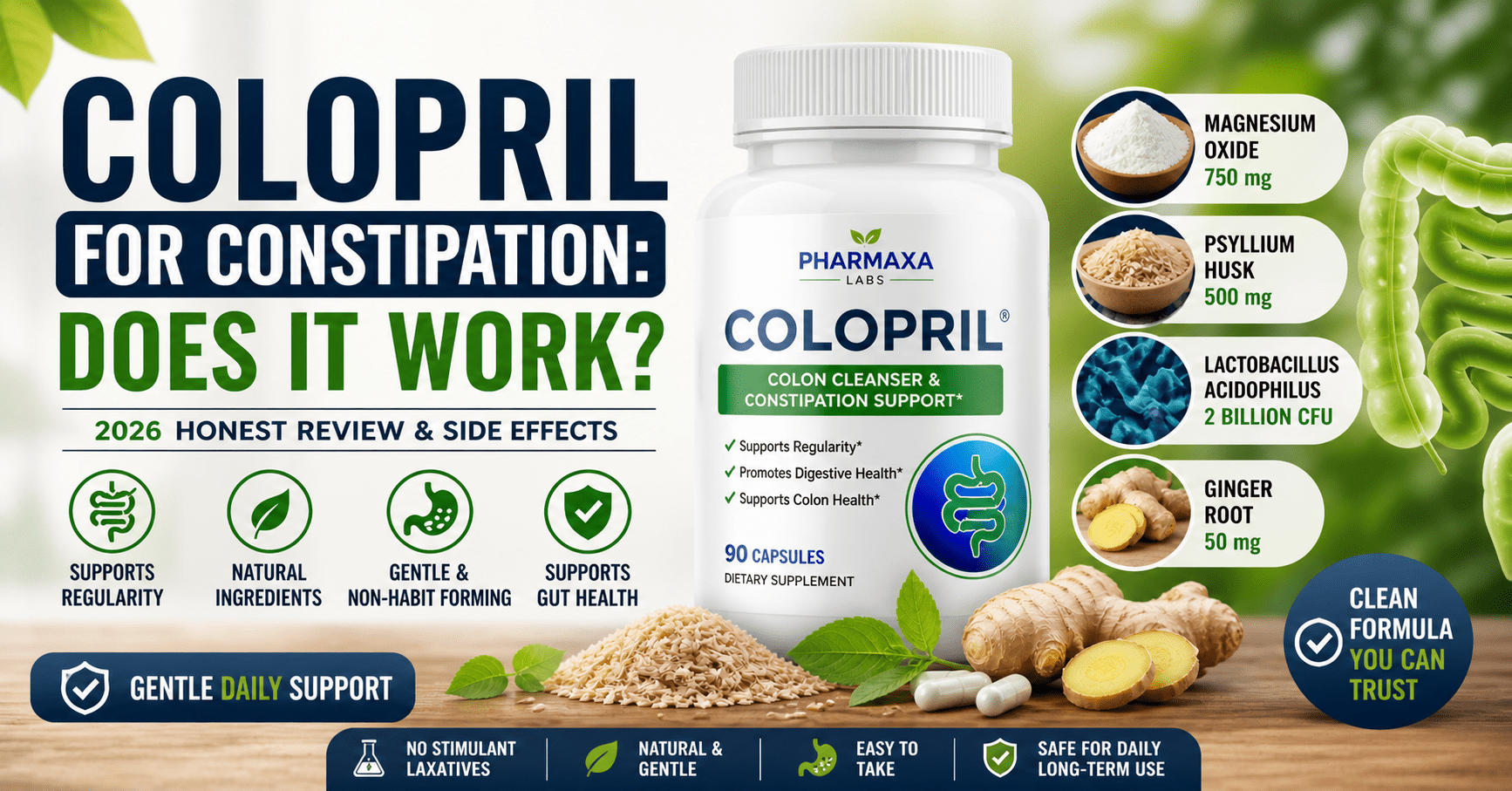
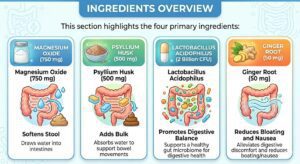
Colopril for constipation is a multi-ingredient colon health supplement made by Pharmaxa Labs. Its formula contains Magnesium Oxide (750 mg), Psyllium Husk (500 mg), Lactobacillus acidophilus (2 billion CFU), and Ginger Root (50 mg).
Every ingredient has genuine clinical backing for digestive health.
Colopril is not a fast-acting laxative. It is a daily maintenance supplement that builds results over one to three weeks with consistent use and adequate hydration. It is a reasonable choice for people seeking gentle, non-habit-forming digestive support — but it is not the right tool for acute or severe constipation.
Contents
- What Is Colopril?
- Who Should (and Should Not) Use It
- Full Ingredient Breakdown with Clinical Evidence
- How Colopril Works for Constipation
- Dosage Instructions
- Realistic Timeline: When to Expect Results
- Side Effects and Safety
- Colopril vs. Metamucil, MiraLAX, Mag O7, and VSL#3
- Pros and Cons
- Verdict
- Frequently Asked Questions
- References
1. What Is Colopril?
Colopril is a dietary supplement manufactured by Pharmaxa Labs, a company that has been producing natural health supplements for over 20 years. It is sold primarily as a colon cleanse and constipation support supplement.
Two important transparency points worth noting upfront:
NIH DSLD Listed: Colopril appears in the National Institutes of Health Dietary Supplement Label Database — a publicly searchable U.S. government database that catalogs supplement label information. Its stated ingredients can be independently verified.
No proprietary blends: The current formula discloses exact amounts for every active ingredient — a meaningful transparency step that many supplements skip.
Colopril comes in 90-capsule bottles (a 30–45 day supply at standard dosage) and is available on Amazon.
➡️ View Colopril on Amazon — 90 Capsules
When people research Colopril for constipation, they are typically looking for a gentler alternative to stimulant laxatives. Colopril fits that description.
It contains no senna, bisacodyl, or cascara sagrada — ingredients that work quickly but carry a risk of bowel dependency with prolonged use. Instead, it uses a layered approach:
- Fiber to bulk stool
- Magnesium to soften it osmotically
- Probiotics to support gut microbiome balance
- Ginger to ease digestive discomfort
This places it in a distinct category from both standard laxatives and single-ingredient fiber supplements.
2. Who Should (and Should Not) Use Colopril
Colopril for constipation may be a good fit if you:
- Have mild to moderate chronic constipation and want a gentler daily supplement rather than a powerful laxative
- Have tried fiber alone (Metamucil, Benefiber) but still struggle with regularity
- Experience bloating, gas, or abdominal discomfort alongside constipation
- Want a non-stimulant, non-habit-forming approach safe for daily long-term use
- Want to support gut microbiome health as part of a digestive health routine
- Prefer an all-in-one capsule format over managing multiple separate supplements
Colopril is likely the wrong choice if you:
- Need relief tonight — use magnesium citrate liquid or MiraLAX instead for faster action. See our Magnesium Citrate guide and our Bisacodyl vs Milk of Magnesia vs MiraLAX comparison
- Have kidney disease or renal impairment — magnesium oxide can cause dangerous magnesium accumulation in people with impaired kidney function
- Have a bowel obstruction or blockage — see a doctor immediately; fiber supplements can worsen this condition
- Are pregnant or nursing — consult your OB-GYN before starting any supplement during pregnancy
- Have difficulty swallowing — psyllium-containing capsules require adequate water intake to be safe
3. Full Ingredient Breakdown with Clinical Evidence
Understanding what is in Colopril — and at what dose — is essential for evaluating whether it is likely to help.
Here is a complete, honest analysis of all four active ingredients.
Ingredient 1: Magnesium Oxide — 750 mg
Magnesium oxide is the most clinically active ingredient in Colopril for constipation. It works as an osmotic laxative: after reaching the intestines, it draws water from surrounding tissues into the bowel through osmotic pressure.
This extra water softens hard, compacted stool and stimulates peristalsis — the wave-like muscle contractions that move waste through the colon.
What the research shows:
A randomized, double-blind, placebo-controlled trial (PMC6786451) confirmed that magnesium oxide significantly increased defecation frequency and improved stool consistency in adults with chronic constipation.
This was the first large-scale placebo-controlled study to validate what clinicians in Japan have used as a first-line treatment for decades. Japanese clinical guidelines give magnesium oxide an evidence level A recommendation for chronic constipation.
A separate 2021 comprehensive review in Nutrients (MDPI) (DOI: 10.3390/nu13020421) summarized magnesium oxide’s mechanism and advantages, noting it is low-cost, non-habit-forming, and well-tolerated in people with normal kidney function.
Dose note: The 750 mg dose is within the clinically used range, though slightly below the 2 g/day commonly prescribed in Japanese clinical practice. This is appropriate for daily long-term use, where excessive softening would be undesirable.
Kidney disease warning: People with renal insufficiency or kidney disease should not use magnesium-containing supplements without medical supervision. Impaired kidneys cannot excrete excess magnesium efficiently, raising the risk of hypermagnesemia, which can affect heart rhythm. This warning is consistent with 2023 AGA–ACG guideline recommendations. See our Best Magnesium Supplements for Constipation guide for the full safety profile.
Ingredient 2: Psyllium Husk — 500 mg
Psyllium husk (from Plantago ovata seeds) is one of the most extensively studied dietary fibers for constipation. It is the gold standard bulk-forming agent in gastroenterology.
When it contacts water in the digestive tract, it swells into a soft, gel-like mass that adds bulk to stool, retains water, and helps move waste forward through the colon.
What the research shows:
- A randomized trial (PMID 30219432) demonstrated that psyllium significantly improved constipation symptoms, increased bowel movement frequency, and improved stool consistency — even in patients with concurrent type 2 diabetes.
- A 2021 study (PMID 34081625) found that psyllium husk not only relieved constipation symptoms but also meaningfully shifted gut microbiota composition — pointing to prebiotic-like benefits beyond simple stool bulking.
- A 2019 placebo-controlled study (PMID 30669509) found that psyllium increased stool water content, which was associated with meaningful changes in gut microbiota — especially in constipated patients.
- A 2025 review published in Przegląd Gastroenterologiczny concluded that psyllium husk is the gold standard among functional fibers for regulating bowel movements. (See References section — PMID requires verification before publishing.)
The 2023 AGA–ACG Guideline recommends psyllium as a conditional first-line therapy for constipation, particularly in people with low dietary fiber intake. Our Best OTC Laxatives Guide gives psyllium a Grade B evidence rating.
Dose note — an important limitation to understand:
The 500 mg dose in Colopril is significantly below the clinically studied range. Research and clinical guidelines typically use 3.5 to 10 grams per day.
At 500 mg, Colopril provides a supplementary fiber contribution — it supports the formula but does not replace the full bulk-forming effect of a dedicated fiber supplement like Metamucil.
If your primary goal is high-dose fiber therapy, a standalone psyllium product should be used alongside Colopril.
For a full comparison of fiber supplements and dosage guidance, see our Benefiber vs Metamucil comparison and our Benefiber Review.
Ingredient 3: Lactobacillus acidophilus — 2 Billion CFU
Lactobacillus acidophilus is one of the most studied probiotic strains. It naturally inhabits the human digestive tract and produces lactic acid, which helps maintain a lower gut pH — an environment less hospitable to harmful bacteria.
It supports gut motility through mechanisms including short-chain fatty acid (SCFA) production and bile salt metabolism, both of which influence how efficiently the colon moves waste.
What the research shows:
A 2017 review of 21 studies (citation needed — verify and add PMID before publishing) found that Lactobacillus-containing probiotics may increase stool frequency and reduce transit time in people with constipation.
However, it is worth being honest about the evidence: the probiotic strains with the strongest published evidence for constipation specifically are Bifidobacterium lactis strains — particularly B. lactis BB-12 and B. lactis HN019 — not L. acidophilus.
L. acidophilus has a stronger evidence base for diarrhea, bloating, and general gut microbiome balance than for constipation frequency specifically.
The probiotic component in Colopril is best understood as a gut health maintenance ingredient, not a primary constipation driver.
Our full article on how probiotics helped someone with 12 years of chronic constipation explores what the evidence really says about probiotic strains for long-term bowel health. For a deeper dive, see our 9 Best Probiotic Supplements 2026 guide, or our VSL#3 for Constipation review.
Ingredient 4: Ginger Root — 50 mg
Ginger (Zingiber officinale) is a well-established digestive aid with anti-inflammatory, carminative (gas-relieving), and prokinetic properties.
Prokinetic means it helps stimulate the movement of food and waste through the digestive tract by accelerating gastric emptying and supporting intestinal motility.
Dose note: Clinical studies examining ginger’s meaningful effects on motility typically use 1,000 to 2,000 mg per day. At 50 mg, ginger in Colopril is well below those dosages.
Its contribution here is best understood as mild soothing and comfort support — particularly for bloating and nausea — rather than a meaningful motility driver.
That said, even at lower doses, ginger’s anti-inflammatory activity on the gut lining can contribute to a more comfortable digestive experience, especially during the adjustment period when fiber and magnesium are doing their primary work.
4. How Colopril Works for Constipation
Colopril’s approach is layered — different ingredients address different aspects of constipation simultaneously. This is its core advantage over single-ingredient products.
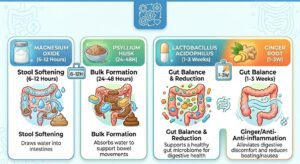
Step 1 — Stool softening (Magnesium Oxide, 6–12 hours)
Magnesium oxide acts osmotically in the intestines, drawing water from surrounding tissues into the bowel. This softens hard, dry stool and creates conditions for easier passage. This is the fastest-acting mechanism in the formula and the primary driver of early results.
Step 2 — Bulk formation (Psyllium Husk, 24–48 hours)
Psyllium absorbs water and swells into a soft gel that surrounds and bulks up the stool, giving it the size and consistency needed to trigger the bowel’s natural urge reflex (the gastrocolic reflex). This builds over 24–72 hours of consistent use.
Step 3 — Gut environment restoration (Probiotic and Ginger, 1–3 weeks)
The probiotic component works to shift the gut microbiome toward a more diverse, beneficial composition — which research links to better transit time and stool consistency over the long term. Ginger supports this phase by reducing bloating and easing gut inflammation.
These effects are cumulative and produce the most noticeable improvements after two or more weeks of consistent use.
This layered approach explains why Colopril for constipation works best as a daily maintenance supplement rather than a one-time rescue product.
To understand how fiber therapy fits into a broader constipation treatment plan, see our Complete Guide to Fiber Therapy and Gut Health.
5. Dosage Instructions
The manufacturer’s recommended dosage for Colopril is:
- Starting dose: 1–2 capsules per day with a full 8-ounce (240 ml) glass of water
- Timing: Best taken consistently — taking it with breakfast each morning supports habit formation
- Gradual increase: After one week, if well-tolerated, the dose may be increased to up to 3 capsules daily as needed
- Consistency: Take daily, not just when constipation feels bad — the probiotic and fiber effects are cumulative and require regular use
Hydration is not optional.
Both psyllium husk and magnesium oxide require adequate water intake to work correctly. Without enough fluid, psyllium can actually worsen constipation — it forms a dry, compacted mass rather than a soft gel.
Aim for a minimum of 8–10 glasses (approximately 2–2.5 liters) of water daily while using Colopril. For more on the hydration-constipation connection, see our article on Why Fiber Isn’t Working for Constipation.

➡️ See latest price and reviews on Amazon
6. Realistic Timeline: When to Expect Results
One of the most common reasons people give up on a supplement too early is misaligned expectations. Here is what a realistic Colopril timeline looks like:
| Timeframe | What to Expect | Which Ingredient Is Active |
|---|---|---|
| 6–12 hours | Stool may begin to soften | Magnesium oxide (osmotic) |
| 24–48 hours | Improved stool consistency; easier passage | Magnesium and psyllium gel formation |
| 3–5 days | More regular bowel pattern beginning | Combined fiber and osmotic effect |
| 1–2 weeks | Reduced bloating; consistent regularity | Probiotic and ginger accumulating |
| 3–4 weeks | Full benefit if consistency is maintained | Gut microbiome shift supporting long-term regularity |
If you see no improvement after 4–5 consistent days: Check water intake first — insufficient hydration is the most common reason fiber-containing supplements underperform.
If there is no improvement after two weeks: Constipation may have a different underlying cause — slow transit, pelvic floor dysfunction, or a medication side effect — that requires a different approach or a physician’s evaluation.

7. Side Effects and Safety
Colopril’s ingredients are all generally recognized as safe at the doses used. Most people tolerate the supplement well, though some mild side effects can occur in the first week as the gut adjusts.
Common mild side effects (usually temporary):
- Bloating and increased gas: The most frequently reported experience, especially in the first five to seven days. Caused by the fiber and probiotic components interacting with gut bacteria. Starting at one capsule per day and building up slowly significantly reduces this. See also: Why Fiber Isn’t Working.
- Loose stools or urgency: Particularly in the first few days when the magnesium dose is new to your system. Reduce to one capsule temporarily if this occurs.
- Increased thirst: Both magnesium oxide and psyllium increase the body’s hydration demand. Drink extra water proactively.
- Mild abdominal cramping: Usually a sign that fiber was increased too quickly or water intake is insufficient. Reducing by one capsule and increasing hydration typically helps.
Stop use and see a doctor if:
- There has been no bowel movement after five or more days of consistent use
- There is blood in the stool or rectal bleeding
- There is sudden severe abdominal pain
- Signs of an allergic reaction occur (rash, swelling, difficulty breathing)
- There is difficulty swallowing the capsule — always take with a full glass of water to prevent esophageal obstruction, a rare but known risk with psyllium-containing products
For more information on how osmotic laxative cramping compares, see: Does MiraLAX Cause Cramping?
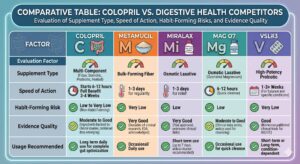
8. Colopril vs. Metamucil, MiraLAX, Mag O7, and VSL#3
Where does Colopril for constipation actually fit relative to the products your doctor might recommend?
| Feature | Colopril | Metamucil | MiraLAX | Mag O7 | VSL#3 |
|---|---|---|---|---|---|
| Type | Multi-action supplement | Psyllium fiber supplement | Osmotic laxative (PEG 3350) | Ozonated magnesium oxide | High-potency probiotic |
| Speed | Moderate (12–48 hrs) | Slow (12–72 hrs) | Moderate–Fast (1–4 days) | Fast (6–12 hrs) | Slow (2–4 weeks) |
| Habit-forming risk | None | None | Very low | None | None |
| Gut microbiome support | Yes (probiotic + fiber) | Partial (fiber only) | No | No | Yes (primary function) |
| Safe for daily long-term use | Yes | Yes | Short-term preferred | Short courses preferred | Yes |
| Overall evidence quality | Moderate (ingredient-level) | Strong (Grade B AGA-ACG) | Strong (Grade A) | Moderate (ozonation unproven) | Moderate for constipation |
| Best for | Daily digestive maintenance | Fiber-related mild constipation | Moderate–severe constipation | Short-course colon cleanse | Microbiome-driven constipation |
| Our review | This article | See Comparison → | MiraLAX Guide → | Mag O7 Review → | VSL#3 Review → |
Key insight: Colopril’s differentiator is its combination approach — it addresses stool softening, bulk formation, and gut microbiome support in one product. Single-ingredient options do not do this.
However, MiraLAX (polyethylene glycol) has a stronger individual evidence base for constipation, and Metamucil’s fiber dose is far more therapeutically meaningful than Colopril’s 500 mg psyllium.
Colopril makes the most sense for daily maintenance or for people who have already tried single-ingredient options without sustained success.
For a broader overview of oxygen-based cleansers, see our Oxy-Powder safety and daily use guide. For natural prune-based relief as a complementary approach, see our Prune Juice for Constipation guide.
9. Pros and Cons
What works well:
- Transparent, exact dosing — no proprietary blends; you know exactly what you are getting
- NIH DSLD listed — a verifiable government reference point for the product’s label claims
- Multi-mechanism formula addressing constipation from fiber, osmotic, probiotic, and motility angles simultaneously
- No stimulant laxatives — no senna, bisacodyl, or cascara sagrada, meaning no dependency risk
- Generally well-tolerated with consistent user feedback supporting gentle, non-harsh action
- Formulated specifically for daily long-term use
What to be aware of:
- Psyllium dose is significantly below clinically studied amounts — Metamucil-level fiber effect is not achievable from Colopril alone
- Ginger dose (50 mg) is well below the 1,000–2,000 mg range used in motility research
- Not suitable for acute relief — if you need to go tonight, this is the wrong product
- Results require both consistency and adequate hydration — neither is optional
- No current third-party certification (USP, NSF, or Informed Sport) visible on the product listing
- Higher cost per dose than standalone Metamucil or MiraLAX for comparable single-ingredient relief
- Lactobacillus acidophilus has less direct evidence for constipation than Bifidobacterium lactis strains
10. Verdict: Does Colopril Work for Constipation?
Colopril is a legitimate, thoughtfully formulated supplement with genuine clinical support for every ingredient it contains. It is not a scam, and it is not an overpriced collection of basic ingredients.
But it will not produce dramatic results — and knowing exactly what it can and cannot do is what separates a good purchase decision from a disappointing one.
Colopril for constipation is worth trying if:
- You want a gentle, non-stimulant daily supplement for mild-to-moderate chronic constipation
- You value the convenience of a single multi-ingredient capsule over managing four separate products
- You have tried standalone fiber supplements (like Metamucil or Benefiber) and want to add an osmotic and probiotic layer
- You want to support long-term gut microbiome health alongside constipation relief
Colopril is not the right choice if:
- You need fast or powerful relief — start with magnesium citrate or MiraLAX instead
- You want maximum fiber therapy — a full-dose psyllium supplement like Metamucil will deliver substantially more fiber per serving
- You want the strongest probiotic for constipation — consider a Bifidobacterium-strain product as reviewed in our 9 Best Probiotic Supplements guide or our VSL#3 review
Colopril for constipation earns a solid recommendation as a daily digestive support supplement for people who want a gentle, multi-action approach. Stay consistent, drink enough water, and give it at least two full weeks before evaluating results.
➡️ Check availability on Amazon — Colopril 90 Capsules
Also see: Best OTC Laxatives for Constipation in the US — a complete evidence-ranked guide to all your options.
11. Frequently Asked Questions
Does Colopril work for constipation?
Yes — with realistic expectations. Colopril for constipation is not a fast-acting laxative.
The magnesium oxide component begins softening stool within 6–12 hours. Noticeable improvement in consistency typically occurs within 24–48 hours, more regular patterns develop over 3–5 days, and the full probiotic benefit takes 2–4 weeks.
It works best as a daily maintenance supplement rather than a rescue remedy.
What are the most common Colopril side effects?
Most people tolerate Colopril well. The most common side effects in the first week are bloating and increased gas as the gut adjusts to added fiber and probiotics, and occasional loose stools or mild cramping from the magnesium oxide component.
Both usually resolve within 5–7 days. Starting at one capsule per day and increasing gradually significantly reduces these early effects. See the full Side Effects section above for the complete list and when to stop use.
Is Colopril safe for daily use?
Yes — Colopril is specifically designed for daily ongoing use. Its active ingredients are non-stimulant and non-habit-forming. There is no bowel dependency risk at recommended doses.
The exception is people with kidney disease or renal impairment, who should not take magnesium oxide without medical supervision.
Can I take Colopril alongside other laxatives?
It depends on what you are already taking.
Combining Colopril with another osmotic laxative (such as MiraLAX) may cause overly loose stools — use one product at a time or reduce both doses. Combining it with a standalone fiber supplement simply adds more fiber, which is generally safe with adequate hydration.
If you take prescription medications, note that psyllium fiber can interfere with absorption of some drugs — including thyroid medications, certain antibiotics, and diabetes medications. Take Colopril at least two hours apart from any prescription medications and discuss this with your doctor.
Does Colopril help with bloating?
It can, though expect a mixed experience in the first week.
The ginger root provides anti-inflammatory and carminative support, and the probiotic helps balance gut bacteria that produce excess gas. However, the psyllium fiber may initially increase bloating as the gut adjusts.
Most people find bloating resolves within 5–10 days of consistent use. Starting at one capsule per day and building up slowly significantly reduces initial bloating.
How does Colopril compare to Mag O7?
Both products use magnesium oxide as a core ingredient.
Mag O7 uses ozonated magnesium oxide and is designed more as a short-course colon cleanse, typically at higher doses for 5–10 days. Colopril is designed for daily long-term maintenance at a gentler dose. Colopril also includes fiber and probiotics that Mag O7 lacks.
For a detailed breakdown, see our Mag O7 Review.
What if no laxatives have worked for me?
If multiple over-the-counter laxatives have consistently failed to produce lasting improvement, this may signal that your constipation has a structural, neurological, or microbiome-related cause that laxatives alone cannot address.
Our article on chronic constipation and the probiotic approach discusses one real-world case of 12-year treatment-resistant constipation. For fiber-specific frustrations, see our guide on Why Fiber Isn’t Working for Constipation.
A gastroenterologist evaluation is always the right next step for persistent cases.
Is Colopril available on iHerb?
Based on available information, Colopril’s primary verified retail channels are Amazon and the Pharmaxa Labs official website. It does not appear to be widely stocked on iHerb. Amazon currently offers a Subscribe & Save option that reduces the per-bottle cost.
12. References and Clinical Sources
- Nakanishi T et al. (2019). A Randomized Double-blind Placebo-controlled Trial on the Effect of Magnesium Oxide in Patients With Chronic Constipation. Journal of Neurogastroenterology and Motility. PMC6786451
- Mori H et al. (2021). Magnesium Oxide in Constipation. Nutrients; MDPI. DOI: 10.3390/nu13020421
- Hess JR et al. (2018). Effects of psyllium vs. placebo on constipation, weight, glycemia, and lipids. PubMed. PMID 30219432
- Yao H et al. (2021). The effects of psyllium husk on gut microbiota composition and function in chronically constipated women. PubMed. PMID 34081625
- Jalanka J et al. (2019). The Effect of Psyllium Husk on Intestinal Microbiota in Constipated Patients and Healthy Controls. Nutrients; MDPI. PMID 30669509
- Przybyszewska J et al. (2025). The role and therapeutic effectiveness of Plantago ovata husk in the treatment of constipation. Przegląd Gastroenterologiczny. ⚠️ [Verify PMID before publishing — original source listed PMID 40620304, which appears unusually high and may be an error. Cross-check at pubmed.ncbi.nlm.nih.gov before publishing.]
- NIH Dietary Supplement Label Database (DSLD) — Colopril listing. dsld.od.nih.gov
- Colopril Official Product Page, Pharmaxa Labs. colopril.com






[…] 👉 View product details and current pricingRead our full review: Colopril for Constipation: Does It Work? (2026) […]