

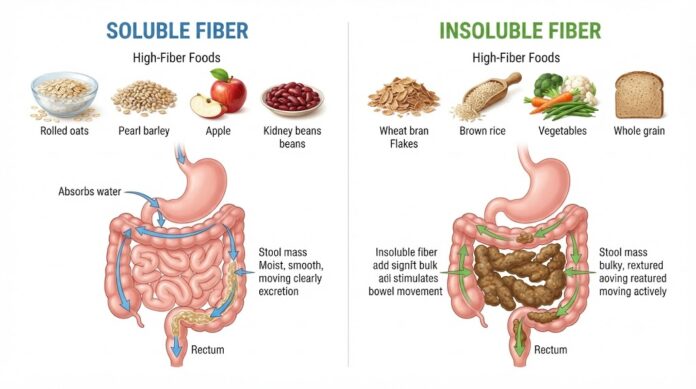
Most people are told to simply “eat more fiber” for constipation. What many don’t realize is that soluble vs insoluble fiber for constipation is not a small technical detail. These two types of fiber work in completely different ways inside your gut.
Choosing the wrong type for your specific situation can leave you bloated without actually improving constipation, while the right type may begin improving stool consistency within days, although the full benefit often takes several weeks.
⚡ Quick Answer: Soluble fiber (found in psyllium husk, oats, barley, and fruits) dissolves in water and forms a gel that softens stool. Insoluble fiber (found in wheat bran, whole grains, and vegetable skins) does not dissolve, and instead adds bulk that mechanically speeds up transit. For most people with constipation, soluble, gel-forming fiber such as psyllium has the strongest research support. Insoluble fiber may help some people with slow-transit constipation, but it can worsen IBS-C symptoms.
Soluble vs Insoluble Fiber for Constipation: What’s the Difference?
What Is Soluble Fiber?
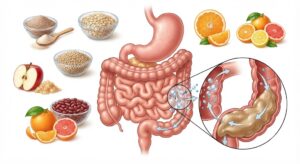
Soluble fiber dissolves in water and forms a thick, gel-like substance inside the digestive tract. As this gel moves through the small intestine and into the colon, it holds onto water, which increases stool softness and bulk at the same time.1 This is the mechanism behind bulk-forming laxatives such as psyllium husk, which is roughly 70 percent soluble fiber and 30 percent insoluble fiber by weight.8
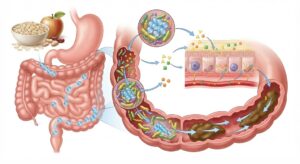
Once soluble fiber reaches the colon, gut bacteria partially ferment it. This produces short-chain fatty acids (SCFAs) such as butyrate, acetate, and propionate. Butyrate is the primary fuel source for the cells lining the colon. SCFAs more broadly appear to stimulate colon motility through serotonin signaling and receptors on gut cells.2 For a deeper look at this mechanism, see our guide on gut health and constipation.
According to Mayo Clinic, common sources of soluble fiber include:3
- Psyllium husk
- Oats and oat bran
- Barley
- Beans, lentils, and peas
- Apples, citrus fruits, and bananas
- Carrots and potatoes (flesh)
- Inulin and other prebiotic fibers (chicory root, onions, garlic)
Note that chia seeds and ground flaxseed are often marketed as soluble fiber sources, but both actually contain a meaningful mix of soluble and insoluble fiber rather than being purely soluble.
It is also worth knowing that not all soluble fibers relieve constipation equally well. Gel-forming, poorly fermented soluble fibers such as psyllium have much stronger clinical evidence for softening stool. Highly fermentable soluble fibers such as inulin work differently. Gut bacteria break them down quickly, before they can hold enough water to soften stool. This can sometimes cause more gas as a result (see the research evidence below).
What Is Insoluble Fiber?
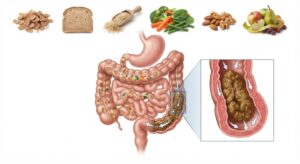
Insoluble fiber does not dissolve in water. Instead, it passes through the digestive tract largely intact, adding physical bulk to the stool.4 That added bulk stretches the colon wall. This is one of the physical triggers for peristalsis, the coordinated muscle contractions that push stool toward the rectum. This mechanism is best described as mechanical stimulation of the intestinal wall that increases stool bulk and transit speed, rather than a softening effect.
Insoluble fiber is generally less fermentable than soluble fiber, so it tends to produce less gas from bacterial activity. Coarse wheat bran is a notable exception, however, and can still cause bloating in some people because of how it interacts with gut bacteria.
Common sources of insoluble fiber include:3
- Wheat bran and whole wheat products
- Brown rice and whole grains
- Nuts and seeds
- Cauliflower, green beans, and other vegetables
- Skins of fruits and root vegetables
- Corn bran
Most whole plant foods contain a mix of both fiber types rather than being purely one or the other. Potatoes and apples, for example, contain soluble fiber in the flesh and insoluble fiber in the skin.1 For a full breakdown of whole-food sources and how to build a fiber-rich plate, see our guide to the best fiber foods and fiber therapy for gut health.
Soluble vs Insoluble Fiber: Side-by-Side Comparison
| Feature | Soluble Fiber | Insoluble Fiber |
|---|---|---|
| Dissolves in water | Yes, forms a gel | No, stays largely intact |
| Primary mechanism | Softens stool by retaining water | Adds bulk, mechanically stimulates the gut wall |
| Best studied source | Psyllium husk | Wheat bran |
| Fermentability | Moderate, produces SCFAs | Lower, though coarse bran can still ferment and cause gas |
| Best for | Hard, dry stool; IBS-C; general constipation | Selected patients with slow-transit constipation |
| IBS-C safety | Generally well tolerated | May worsen bloating and abdominal pain |
| Additional benefits | Lowers LDL cholesterol, slows glucose absorption | Adds bulk, supports satiety |
What the Research Actually Shows
Clinical research on fiber and constipation is more nuanced than most general advice suggests, and the type of fiber studied matters as much as the amount.
A 2011 systematic review looked at randomized controlled trials on fiber for chronic idiopathic constipation. Four of six eligible trials used soluble fiber and reported greater improvement compared with placebo. The two insoluble fiber trials showed more inconsistent results.5 A 2022 updated meta-analysis covered 16 randomized controlled trials in adults with chronic constipation.
It reached a similar conclusion: soluble, viscous fibers work mainly by pulling water into the colon to soften stool. Insoluble, nonviscous fibers work mainly through mechanical stimulation that speeds up gut transit.6
A frequently cited 2017 review looked at how fiber physically behaves in the gut.7 It offers a useful way to think about why some fibers work as laxatives and others do not. The authors argue that a fiber only produces a meaningful laxative effect if it survives fermentation and stays largely intact through the colon.
Two very different fiber types can meet that requirement, but in two different ways. A coarse, poorly fermented insoluble particle, like wheat bran, is rough enough to physically irritate the gut lining. This triggers extra water and mucus release. A soluble, gel-forming fiber, like psyllium, works differently: it holds onto water by itself and simply resists drying out as it travels through the colon.7
The same review points out an important exception. Highly fermentable soluble fibers such as inulin, and finely ground insoluble particles, tend to get broken down or dispersed before they can do either of these things. This is why they often fail to relieve constipation, and can occasionally make it worse.7
Direct head-to-head data on psyllium and wheat bran points in the same direction. Clinical comparisons summarized by McRorie found psyllium to be several times more effective than wheat bran at increasing stool water and volume. Finely milled wheat bran could, in some patients, even reduce stool water content rather than increase it.8
In practical terms, this means the specific form and processing of a fiber matters, not just whether it is labeled “soluble” or “insoluble.” It also helps explain a common frustration covered in our article on why stool can stay hard even after increasing fiber intake.
Laboratory research also suggests the two fiber types may work best together rather than in isolation. A 2024 study tested soluble and insoluble dietary fiber at different ratios.
Combining the two produced the strongest effect on gastric emptying and small intestine movement when the ratio was close to 1:1. The insoluble portion appeared to drive greater gut microbiota diversity within that mixture.9
Which Type of Fiber Should You Choose?
The best choice depends on the type of constipation you’re dealing with, rather than whether one fiber is universally “better.”
Choose soluble fiber if you have:
- Hard, dry, or difficult-to-pass stool
- Irritable bowel syndrome with constipation (IBS-C)
- Elevated LDL cholesterol alongside constipation
- A history of bloating with high-fiber diets
- Type 2 diabetes or blood sugar concerns
Psyllium husk remains the most extensively studied soluble fiber for constipation. For a detailed comparison of psyllium against the other major insoluble option, see our full breakdown in Psyllium Husk vs Wheat Bran for Constipation.
Choose insoluble fiber if you have:
- Suspected slow-transit constipation, without IBS
- No history of IBS or gut sensitivity
- A preference for whole foods over supplements
- No gluten sensitivity, since wheat bran contains gluten
It is worth noting that constipation-predominant IBS responds differently to each fiber type. Highly fermentable and coarse insoluble fibers can increase gas production and abdominal discomfort in IBS-C. Longer-chain, poorly fermented soluble fibers such as psyllium tend to be better tolerated.10 Wheat bran, specifically, has been shown in a randomized primary-care trial to provide no significant symptom improvement over placebo for IBS. Soluble psyllium fiber, on the other hand, did significantly improve symptoms.11
If fiber alone has not resolved your symptoms, our guide on why fiber isn’t working for your constipation covers the other underlying causes worth ruling out, including slow colon motility and pelvic floor dysfunction.
How Much Fiber Do You Actually Need?
Most health authorities recommend a total daily fiber intake of 25 to 30 grams for women and 30 to 38 grams for men, from a combination of whole foods and supplements as needed.1 The average adult in the United States consumes only around 15 grams per day, well below this target.12
Regardless of which type of fiber you choose, three practical rules apply consistently across the research:
- Increase gradually. Adding a large amount of fiber all at once is the most common cause of bloating and gas. Increase intake over two to three weeks rather than switching overnight.
- Drink enough water. Soluble fiber specifically needs water to form its gel. Without adequate fluid intake, fiber supplementation can become less effective, or in some cases even worsen constipation. That said, increasing water intake alone does not reliably treat constipation in people who are already adequately hydrated. Water mainly helps fiber work the way it is supposed to, rather than acting as a standalone fix.13
- Give it time. Clinical trials on fiber for constipation typically measure results after four weeks or more of consistent daily use, though some improvement in stool consistency may appear within the first one to two weeks.6
For a complete list of specific supplement options, dosages, and side effects across both fiber categories, see our guide to 7 Natural Fiber Supplements for Chronic Constipation.
Common Mistakes People Make With Fiber and Constipation
- Assuming all fiber works the same way. As the research above shows, soluble and insoluble fiber act through genuinely different mechanisms, and using the wrong type for your situation can leave symptoms unchanged.
- Relying only on insoluble fiber for hard stool. Insoluble fiber adds bulk but does not reliably soften stool the way soluble, gel-forming fiber does.8
- Skipping water intake. Fiber without adequate fluid can, in some cases, make stool firmer rather than softer.
- Jumping straight to high-fermentation fibers with IBS. People with IBS-C often do better starting with a low-fermentation soluble fiber like psyllium before trying inulin or wheat bran.
Fiber also works best as part of a broader approach rather than in isolation. Pairing fiber with a gut-healthy diet and, where appropriate, a probiotic can produce more consistent results, as covered in our guide to the 9 Best Probiotic Supplements 2026.
Common Myths About Fiber and Constipation
| Myth | Reality |
|---|---|
| All fiber is equally effective for constipation. | Only certain fibers have strong clinical evidence. Gel-forming soluble fiber such as psyllium is far more consistently effective than highly fermentable or finely ground fibers.7 |
| More fiber always means better results. | Adding too much fiber too quickly is the most common cause of bloating and gas, and can worsen symptoms rather than relieve them, especially in people with IBS-C. |
| Fiber supplements are less effective than food. | Psyllium husk is one of the most extensively researched fiber sources available, with clinical evidence that in some respects exceeds many whole-food sources of fiber.8 |
| Drinking more water will fix constipation on its own. | Extra water mainly helps fiber function properly. In people who are already adequately hydrated, additional water has a limited effect by itself.13 |
Quick Decision Guide: Which Fiber Should You Try First?
If you are unsure where to start, this simplified decision path reflects the evidence reviewed above:
- Hard, dry, or difficult-to-pass stool → Start with soluble, gel-forming fiber such as psyllium husk.
- Suspected slow-transit constipation, no IBS → Insoluble fiber such as wheat bran may help; introduce it gradually.
- IBS-C or a history of bloating with fiber → Start with low-fermentation soluble fiber (psyllium) and avoid coarse wheat bran.
- No improvement after 4 to 6 weeks of consistent use → Consider an underlying cause beyond fiber, such as slow colon motility, medication side effects, or pelvic floor dysfunction. See why fiber isn’t working for your constipation.
Affiliate disclosure: ConstipationRelief.net is reader-supported. As an Amazon Associate and iHerb affiliate, we may earn a commission from qualifying purchases made through links on this page, at no extra cost to you.
At a Glance: Best Fiber Supplements Based on Your Constipation Type
Not all fiber works the same way — here are the top picks matched to the decision guide above:
- Best soluble gel-forming fiber (hard stool, IBS-C, general constipation): Konsyl Daily Psyllium Fiber Powder (19oz) — 100% pure psyllium husk, single ingredient, the most extensively researched fiber for constipation, forms a water-holding gel that softens stool directly — always take with at least 8oz water
- Best psyllium capsule (no mixing, no taste): NOW Foods Psyllium Husk Caps 500mg (200 Veg Capsules) — pure psyllium husk, Non-GMO verified, vegan, gluten-free, GMP certified — same gel-forming mechanism as powder in a convenient capsule format
- Best non-fermentable fiber (IBS-C or bloating-sensitive): Citrucel Fiber Therapy Caplets (180 Count) — methylcellulose, not fermented by gut bacteria so causes significantly less gas than inulin or bran, gentler starting point for people with IBS-C sensitivity
- Best probiotic (to pair with fiber for gut microbiota support): Garden of Life Dr. Formulated Probiotics for Constipation (50B CFU) — contains Bifidobacterium lactis and 15 other clinically studied strains, consistent with the article’s recommendation that pairing fiber with a probiotic can produce more consistent results
Frequently Asked Questions
Which is better for constipation, soluble or insoluble fiber?
For most people, soluble, gel-forming fiber such as psyllium husk has the strongest clinical evidence for softening stool and relieving constipation. Insoluble fiber can help when constipation is caused specifically by slow colon transit, but it does not soften stool the same way and can worsen symptoms in people with IBS-C.
Can eating too much insoluble fiber make constipation worse?
Yes. Coarse or finely ground insoluble fiber, such as wheat bran, can increase bloating and gas, and research shows it does not reliably increase stool water content in everyone. In people with slow-transit constipation or IBS-C, insoluble fiber can sometimes worsen symptoms rather than relieve them.
Do I need both soluble and insoluble fiber?
Most whole foods naturally contain a mix of both, and laboratory research suggests a roughly 1:1 ratio of insoluble to soluble fiber may work synergistically to support bowel movements and gut microbiota diversity.9 Most people do not need to separate the two deliberately if they eat a varied, fiber-rich diet.
How much fiber should I eat per day for constipation?
Most health authorities recommend 25 to 30 grams of total fiber per day for women and 30 to 38 grams for men, from a mix of food and supplements if needed.1 Fiber intake should be increased gradually over two to three weeks, along with adequate water, to reduce bloating and gas.
The Bottom Line
The best fiber for constipation isn’t simply the one labeled “high fiber.” It’s the one that matches the underlying cause of your symptoms. For most adults with hard stools or IBS-C, gel-forming soluble fiber such as psyllium husk has the strongest clinical evidence. Insoluble fiber still has a role, particularly for some people with slow-transit constipation, but it isn’t the right choice for everyone.
Most people naturally get both types by eating a variety of plant foods, which is usually the simplest and most effective approach. A targeted soluble fiber supplement can be added on top of that if dietary changes alone are not enough.
If constipation persists for more than three weeks despite adequate fiber and water intake, or is accompanied by rectal bleeding, unexplained weight loss, or severe abdominal pain, consult a healthcare provider for proper evaluation.
⚠️ Medical Disclaimer: This article is for informational and educational purposes only and is not a substitute for professional medical advice, diagnosis, or treatment. Always consult a qualified healthcare provider before making significant changes to your diet or starting a new supplement, particularly if you are pregnant, elderly, or managing an underlying health condition.
References
- Johns Hopkins Medicine. Foods for Constipation. https://www.hopkinsmedicine.org/health/wellness-and-prevention/foods-for-constipation
- Liu SH, Yang XF, Liang L, et al. Regulatory mechanisms of the gut microbiota-short chain fatty acids signaling axis in slow transit constipation and progress in multi-target interventions. Front Microbiol. 2025;16:1689597. https://pmc.ncbi.nlm.nih.gov/articles/PMC12683290/
- Mayo Clinic. Dietary fiber: Essential for a healthy diet. https://www.mayoclinic.org/healthy-lifestyle/nutrition-and-healthy-eating/in-depth/fiber/art-20043983
- Oklahoma State University Extension. Fiber: Bulk of Life. https://extension.okstate.edu/fact-sheets/fiber-bulk-of-life
- Suares NC, Ford AC. Systematic review: the effects of fibre in the management of chronic idiopathic constipation. Aliment Pharmacol Ther. 2011;33(8):895-901. PMID: 21332763. https://pubmed.ncbi.nlm.nih.gov/21332763/
- van der Schoot A, Drysdale C, Whelan K, Dimidi E. The Effect of Fiber Supplementation on Chronic Constipation in Adults: An Updated Systematic Review and Meta-Analysis of Randomized Controlled Trials. Am J Clin Nutr. 2022;116(4):953-969. PMID: 35816465. https://pubmed.ncbi.nlm.nih.gov/35816465/
- McRorie JW Jr, McKeown NM. Understanding the Physics of Functional Fibers in the Gastrointestinal Tract: An Evidence-Based Approach to Resolving Enduring Misconceptions about Insoluble and Soluble Fiber. J Acad Nutr Diet. 2017;117(2):251-264. PMID: 27863994. https://pubmed.ncbi.nlm.nih.gov/27863994/
- McRorie JW. Laxative effects of wheat bran and psyllium: Resolving enduring misconceptions about fiber in treatment guidelines for chronic idiopathic constipation. J Am Assoc Nurse Pract. 2020;32(1):15-23. PMID: 31764399. https://pubmed.ncbi.nlm.nih.gov/31764399/
- Wang L, Wang J, Wang J, et al. Soluble and insoluble dietary fiber at different ratios: Hydration characteristics, rheological properties, and ameliorative effects on constipation. PMID: 39634524. https://pubmed.ncbi.nlm.nih.gov/39634524/
- El-Salhy M, Ystad SO, Mazzawi T, Gundersen D. Dietary fiber in irritable bowel syndrome. Int J Mol Med. 2017;40(3):607-613. PMC5548066. https://pmc.ncbi.nlm.nih.gov/articles/PMC5548066/
- Bijkerk CJ, de Wit NJ, Muris JW, Whorwell PJ, Knottnerus JA, Hoes AW. Soluble or insoluble fibre in irritable bowel syndrome in primary care? Randomised placebo controlled trial. BMJ. 2009;339:b3154. https://www.bmj.com/content/339/bmj.b3154
- Harvard T.H. Chan School of Public Health. The Nutrition Source: Fiber. https://nutritionsource.hsph.harvard.edu/carbohydrates/fiber/
- Müller-Lissner SA, Kamm MA, Scarpignato C, Wald A. Myths and misconceptions about chronic constipation. Am J Gastroenterol. 2005;100(1):232-242. PMID: 15654804. https://pubmed.ncbi.nlm.nih.gov/15654804/




[…] fiber gives the bacteria material to ferment into short-chain fatty acids. See our guide on soluble vs. insoluble fiber for constipation for how to choose the right […]
[…] Fiber is traditionally split into soluble and insoluble categories, though researchers increasingly argue that how a fiber behaves in the gut (whether it dissolves, ferments, or holds water) matters more than this label alone. For a full breakdown of that distinction, see our guide to soluble vs insoluble fiber for constipation. […]
[…] appears effective [14]. If fiber is not helping, read why fiber sometimes stops working, compare soluble and insoluble fiber, or browse the best fruits for chronic […]