

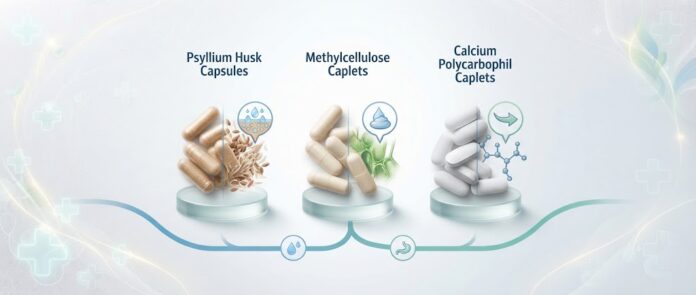
Fiber capsules for constipation are not all built from the same ingredient, and that difference matters more than most product pages let on. Three of the most common fiber types found in capsule or caplet products in the US are psyllium husk, methylcellulose, and calcium polycarbophil. They are not interchangeable. Each one has a different evidence base, a different side-effect profile, and works better for some people than others. This guide walks through how to tell them apart and pick the right one for your specific situation, rather than just naming a single “best” product.
Quick Answer:
The right fiber capsule depends on what you need it to do:
- Psyllium: the evidence leader for constipation; see our dedicated Best Psyllium Capsules for Constipation guide for product picks and dosing.
- Methylcellulose: a gentler, non-fermenting alternative if psyllium causes too much gas or bloating; try Citrucel Caplets.
- Calcium polycarbophil: a potential fit when stool consistency is the main concern, including some people with loose or poorly formed stools; try FiberCon.
Key Takeaways
- Psyllium, methylcellulose, and calcium polycarbophil are chemically different fibers with different mechanisms, not interchangeable versions of the same thing.
- Among these three, psyllium has the strongest evidence for chronic constipation, but the 2023 AGA/ACG guideline did not evaluate calcium polycarbophil in its evidence review and found no qualifying trials for methylcellulose.[1]
- Methylcellulose does not ferment in the colon, so it may be a better-tolerated option if psyllium has caused troublesome gas or bloating.
- Calcium polycarbophil absorbs water and forms a gel-like mass in the digestive tract, which can affect stool consistency and may make it a potential option when stool consistency is an important concern. Some people with alternating stool patterns may also prefer this type of fiber.[3]
- Fiber capsules should be taken with adequate fluid, and product labels may specify a full 8 oz glass of water; both the Citrucel and FiberCon labels warn about choking if taken without enough liquid.[2][3]
Affiliate Disclosure: This article contains affiliate links. If you purchase through our links, we may earn a small commission at no extra cost to you. Our recommendations are based on clinical evidence and ingredient transparency, not on affiliate relationships.
Fiber Capsules for Constipation: Psyllium vs Methylcellulose vs Calcium Polycarbophil
| Fiber Type | Source | Ferments in Colon? | Evidence for Constipation | Best For |
|---|---|---|---|---|
| Psyllium husk | Plantago ovata seed husk (natural) | Partially | Strongest of the three fibers evaluated by the guideline; conditional recommendation, 2023 AGA/ACG guideline[1] | General chronic constipation; strongest-supported option among these three |
| Methylcellulose | Semi-synthetic, derived from plant cellulose | No | No qualifying trials identified in the 2023 AGA/ACG evidence review; long-standing OTC use[1][5] | People who get significant gas or bloating from psyllium |
| Calcium polycarbophil | Fully synthetic | No | Limited direct evidence for chronic constipation; also used to improve stool consistency in selected patients[1][4] | People who want a non-fermenting bulk-forming fiber and are especially focused on stool consistency |
Psyllium Husk Capsules
Psyllium is the fiber type reviewed most favorably in the current constipation treatment guideline from the American Gastroenterological Association and American College of Gastroenterology. Fiber as a category received a conditional recommendation based on low-certainty evidence, and among the fiber types the panel actually evaluated (psyllium, bran, inulin, and methylcellulose), psyllium had the most consistent supporting data.[1] Calcium polycarbophil was not part of that evidence review.
Psyllium is a partially fermentable soluble fiber, which means it can cause gas and bloating in some people, especially when the dose is increased too quickly.
If you’re specifically shopping for psyllium products, dosing math, and brand comparisons, that level of detail lives in our separate Best Psyllium Capsules for Constipation guide rather than here, so this article can stay focused on helping you choose the right fiber category first.
Methylcellulose Capsules (Citrucel)
Methylcellulose is a semi-synthetic fiber that is not fermented by gut bacteria, which is one reason it may be a useful alternative for people who find that psyllium causes noticeable gas or bloating.[5] The 2023 AGA/ACG guideline included methylcellulose among the fiber types it set out to evaluate but did not identify qualifying trial data for it in chronic constipation specifically, so its use rests more on a long OTC track record than on trial evidence.[1]
Citrucel is a US brand that sells methylcellulose fiber in caplet and powder forms. The caplet label lists methylcellulose as a bulk-forming fiber laxative, with a standard adult dose of 2 caplets, increased as needed up to 6 times a day, not exceeding 12 caplets in 24 hours, each dose taken with a full 8 oz glass of water.[2]
Citrucel Caplets are a reasonable pick if you’ve already tried psyllium and the gas and bloating outweighed the benefit. The tradeoff is that its constipation-specific trial base is thinner than psyllium’s, even though its OTC use history is long and its safety profile is well established.

Calcium Polycarbophil Capsules (FiberCon)
Calcium polycarbophil is a fully synthetic bulk-forming fiber. Unlike psyllium and methylcellulose, it absorbs water and forms a gel-like mass in the digestive tract, which can affect stool consistency and may make it a potential option when stool consistency is an important concern.[3] Some people with alternating stool patterns may also prefer this type of fiber. The manufacturer markets FiberCon as a fiber that won’t cause gas or bloating.[3] The current FiberCon label recommends 2 caplets per dose for adults and children 12 and older, with no more than 8 caplets in 24 hours.[3]
FiberCon Caplets are worth considering if psyllium or methylcellulose haven’t produced the stool consistency you need, or if you specifically want a non-fermenting fiber with a relatively compact caplet format that can be taken in divided doses through the day. Some formulations also provide calcium per caplet, which may matter if you closely track calcium intake.

How to Choose Between Them
- Start with psyllium if you have no reason to avoid it. Among the fibers evaluated by the current constipation guideline, it has the strongest research base for constipation specifically.
- Switch to methylcellulose (Citrucel) if psyllium gave you noticeable gas, bloating, or cramping that didn’t settle after a period of gradual dose increases.
- Consider calcium polycarbophil (FiberCon) if your main issue is stool consistency rather than frequency alone, particularly if you alternate between constipation and loose stools, or if a caplet format with divided daily dosing fits your routine better.
- Bulk-forming fibers can begin working within several days, but people with chronic constipation may need longer to judge the overall benefit. Follow the product label and reassess based on your symptoms and tolerance before switching types.
Safety Rules That Apply to All Fiber Capsules
- Take fiber capsules with plenty of water and follow the product label, which may specify a full 8 oz glass of water, and drink additional fluids throughout the day. Citrucel and FiberCon both carry a choking warning on their labels for this exact reason.[2][3]
- Start with a lower dose and increase gradually as tolerated, following the product label, rather than jumping to the maximum labeled dose immediately.
- Follow the label for spacing fiber capsules from other oral medications. Some calcium polycarbophil products specifically advise taking them at least two hours before or after other drugs, since bulk-forming fiber can affect how much of a drug your body absorbs.[3]
- Do not use any bulk-forming fiber laxative if you have a known bowel obstruction, difficulty swallowing, or esophageal narrowing without first talking to a doctor.
- Seek medical attention for chest pain, vomiting, or difficulty swallowing or breathing after a dose. Follow the product label and talk with a healthcare professional if constipation persists despite treatment, if you have rectal bleeding, or if symptoms are new or worsening.[2][3]
Frequently Asked Questions
Is one fiber capsule type simply “better” than the others?
Not universally. Psyllium has the strongest constipation-specific evidence of the three, but the better choice depends on which side effects you’re trying to avoid and what your stool pattern looks like. Methylcellulose and calcium polycarbophil exist specifically because psyllium doesn’t work well for everyone.
Can I switch between fiber capsule types if one isn’t working?
Yes. It is reasonable to try a different fiber type if the first one does not provide enough benefit or causes troublesome side effects, while following the product’s dosing instructions rather than assuming fiber in general won’t work for you.
Do fiber capsules work as fast as fiber powder in the same category?
Generally, the same type of fiber should work through the same basic mechanism, but the amount of fiber you get from capsules can be much lower than from a typical powder serving, so capsules often require several pills to provide a comparable dose. This is more a matter of convenience than of speed or effectiveness.
Can I combine two different fiber types?
There’s no strong evidence that combining fiber types improves results over using one consistently at an adequate dose, and doing so makes it harder to identify which ingredient is causing any side effects you notice. It’s generally more useful to find the right single type first.
Related Reading
- Best Psyllium Capsules for Constipation: dosing math and product picks for the psyllium category specifically
- MiraLAX vs Metamucil: choosing between an osmotic laxative and daily fiber
- Benefiber vs Metamucil: wheat dextrin compared with psyllium husk
- Best Sugar-Free Fiber Supplements for Seniors: fiber dosing considerations for older adults
- Best Stool Softeners for Constipation: how fiber compares with docusate and PEG
Medical Disclaimer: This article is for general informational and educational purposes only and is not a substitute for professional medical advice, diagnosis, or treatment. Always consult a qualified healthcare provider before starting, stopping, or combining any fiber supplement or laxative, especially if you are pregnant, breastfeeding, managing a chronic condition, or taking other medications. If you experience severe abdominal pain, rectal bleeding, or an inability to pass stool or gas, seek medical attention promptly.
References
- Chang L, Chey WD, Imdad A, et al. American Gastroenterological Association-American College of Gastroenterology Clinical Practice Guideline: Pharmacological Management of Chronic Idiopathic Constipation. Am J Gastroenterol. 2023;118(6):936-954. https://pmc.ncbi.nlm.nih.gov/articles/PMC10542656/
- DailyMed. Citrucel – Methylcellulose Tablet (Label). https://dailymed.nlm.nih.gov/dailymed/drugInfo.cfm?setid=d27f6742-2dcc-451e-b803-6ffe183038ec
- DailyMed. FiberCon – Calcium Polycarbophil Tablet (Label). https://dailymed.nlm.nih.gov/dailymed/drugInfo.cfm?setid=7992a4bb-5535-4a1d-867d-a99f7e0c1be7
- GoodRx. Calcium Polycarbophil (FiberCon): Uses, Side Effects, Dosage & More. https://www.goodrx.com/calcium-polycarbophil/what-is
- Medscape. Citrucel (methylcellulose) Dosing, Indications, Interactions, Adverse Effects. https://reference.medscape.com/drug/citrucel-methylcellulose-342020