

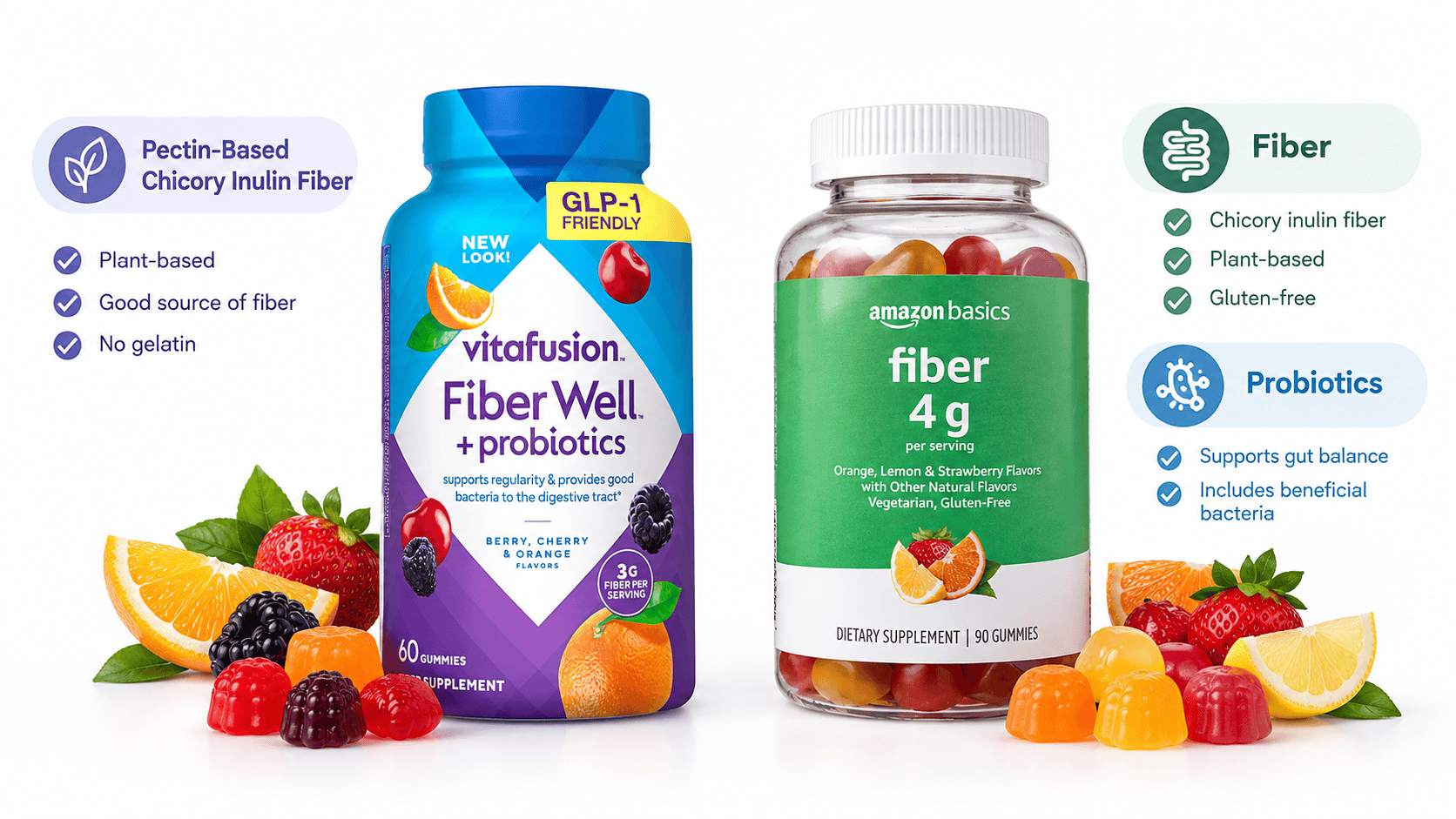
Quick answer: Strip away the branding and these are closer than they look. Both are chicory-root inulin gummies, and both are taken two at a time. Amazon Basics gives you 4g of fiber per 2-gummy serving from a pectin base, no gelatin, sweetened with cane sugar, no probiotics added. Vitafusion Fiber Well + Probiotics gives you 3g per 2-gummy serving from a gelatin base, also sweetened with sugar, and adds 800 million CFU of Bacillus coagulans MTC 5856 per serving.
Neither reaches the fiber doses that showed the clearest benefits in the 2022 meta-analysis. That review found the strongest and most consistent evidence for psyllium, while evidence for other fiber types was more limited, including inulin-type fructans, which improved stool consistency but did not significantly improve stool frequency overall, so it is more accurate to think of either gummy as a small daily top-up than as a stand-alone treatment for constipation. If you want to see how other fiber-based options stack up, we have also covered fiber gummies for kids and reviewed MiraFIBER Gummies.
What We’re Actually Comparing
“Amazon Basics Fiber Gummies” and “Vitafusion” are not single, fixed products. Both brands sell more than one fiber gummy formula, and the labeling has shifted over time. Amazon’s fiber gummies were previously sold under the Solimo name.
For this comparison we use two specific SKUs: Amazon Basics Soft Fiber Gummies, 90 count, orange, lemon and strawberry (ASIN B07GPGQJR4, previously Solimo), and the 60-count Vitafusion Fiber Well + Probiotics formula represented by ASIN B09TQ78Q5C. Listings for that ASIN have also appeared under updated Fiber Well Probiotic + Prebiotic naming with a different flavor blend, so the bottle you receive may not carry the same front-label wording described here.
Check the current Supplement Facts panel before buying. This matters because fiber amount, fiber source, and serving size all vary across each brand’s lineup: Vitafusion’s current sugar-free Fiber Well formula, for example, provides 5g of fiber per serving.
Side-by-Side Comparison
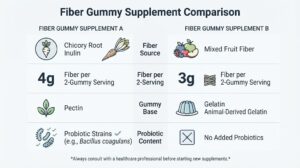
| Attribute | Amazon Basics Fiber Gummies | Vitafusion Fiber Well + Probiotics |
|---|---|---|
| Fiber source | Chicory root fiber (inulin) | Chicory root fiber (inulin) |
| Fiber per serving | 4g per 2 gummies (2g per gummy) | 3g per 2 gummies (1.5g per gummy) |
| Suggested use | Adults, 2 gummies daily | Adults, 2 gummies daily |
| Gummy base | Pectin | Gelatin |
| Gelatin-free | Yes | No |
| Vegetarian | Yes, pectin-based | No, gelatin-based |
| Vegan certification | Not stated on label | No, contains gelatin |
| Sugar per 2 gummies | 3g total sugar, including less than 1g added sugar | 2g total sugar, all of it added sugar |
| Probiotics | None | Bacillus coagulans MTC 5856, 800 million CFU per serving |
| Sweetener/other notables | Monk fruit (lo han) extract, organic sunflower oil, organic colors; gluten-free, no wheat, dairy, soy or egg | Lactic acid, fruit and vegetable juice color concentrates; gluten-free and dairy-free |
| Count / supply | 90 count (45-day supply at 2/day) | 60 count (30-day supply at 2/day) |
| Flavors | Orange, lemon, strawberry | Blue raspberry, cherry and orange on the older packaging; the updated packaging lists a different flavor blend |
Prices on both move around constantly with Subscribe & Save discounts and promotions, so we have not quoted specific figures here. Compare price per serving rather than price per bottle. Amazon Basics gives you 45 servings per bottle and Vitafusion gives you 30, so the sticker price alone does not tell the whole story.
Disclosure: This post contains affiliate links. As an Amazon Associate, ConstipationRelief.net earns from qualifying purchases, at no extra cost to you.
Ingredient Lists: Label Snapshot
Here is the full ingredient list as printed on each label at the time of writing. Formulas do get tweaked occasionally, so treat this as a snapshot and check the bottle you actually receive.
Amazon Basics Soft Fiber Gummies: chicory root fiber (inulin), cane sugar, pectin, citric acid, natural flavors, colors added (organic turmeric, organic black carrot juice concentrate, organic annatto), organic sunflower oil, sodium citrate, lo han fruit concentrate, organic carnauba wax.
Vitafusion Fiber Well + Probiotics: chicory root fiber (inulin), sugar, water, gelatin; less than 2% of citric acid, colors (annatto extract, purple carrot juice concentrate, genipap juice concentrate, watermelon juice concentrate), lactic acid, natural flavors, and sodium citrate.
What actually separates these two is not the fiber itself, since both draw from the same chicory-derived inulin. It is the gummy base and what is built around it. If avoiding gelatin matters to you for dietary or vegetarian reasons, that is the clearest dividing line between them. And if your longer-term plan is to close a fiber gap with food rather than lean on gummies, our piece on fiber foods and fiber therapy for gut health is a reasonable place to start.
What the Research Actually Says About Inulin and Constipation
Both products lean on inulin, a soluble, fermentable fiber pulled from chicory root. A handful of small, placebo-controlled trials have looked at inulin specifically for constipation. In a crossover trial of 44 adults with self-reported constipation, four weeks of 12g/day of chicory inulin (taken as three 4g doses) increased stool frequency compared with placebo, though the size of the change was modest, with a median of 4.0 stools per week on inulin versus 3.0 on placebo.[1]
A more recent randomized, double-blind, placebo-controlled crossover study in 39 adults with Rome III-defined functional constipation found that 12g/day of chicory inulin over four weeks improved stool frequency, abdominal symptoms, and some quality-of-life measures compared with placebo, along with changes in the composition of gut bacteria.[2]
However, the researchers identified a possible carry-over effect in the crossover analysis, so the findings should be interpreted with some caution, although a first-period-only analysis supported the positive finding.
It is worth being blunt about what that means for these two specific products. The 12g/day dose used in those trials is well above what either gummy delivers at its labeled serving. Amazon Basics provides 4g at 2 gummies, and Vitafusion provides 3g at 2 gummies. Reaching 12g from Amazon Basics would take three full servings (six gummies) a day, and from Vitafusion four servings (eight gummies).
Those amounts would exceed the labeled daily serving on both products, and both labels instruct users not to exceed the recommended serving, so the calculation above should not be read as a recommendation to take extra gummies. It is simply a way of showing the gap between the trial dose and what a gummy realistically delivers.
A large 2022 systematic review and meta-analysis pooling 16 randomized controlled trials in 1,251 adults with chronic constipation found that fiber supplementation improved treatment response and stool frequency overall, but the benefit showed up most consistently at fiber doses above 10g/day. In that meta-analysis, psyllium showed significant benefits for treatment response and stool frequency, while the evidence for other fiber types was more limited.[3]
Inulin-type fructans did not show a significant pooled improvement in stool frequency, although they did improve stool consistency. That does not rule out a benefit from inulin itself, especially given the more recent 2025 trial discussed above, which used a single well-defined 12g/day dose in a diagnosed functional constipation population. The two evidence sets are answering slightly different questions.
Put plainly: the standard serving of either gummy sits well below the doses used in the inulin trials described above, so it should not be expected to reproduce those results, and psyllium currently has the stronger pooled evidence for this specific symptom.
That does not make these gummies useless. It means they are better understood as a small addition to daily fiber intake on days your diet comes up short, not as a substitute for closing the broader gap. U.S. dietary guidance generally places adult fiber intake at about 25 to 38 grams per day, depending on age and sex.[5] Many adults do not reach that from food alone.
If constipation is the main thing you are trying to solve and you want a fiber source with a stronger evidence base at doses people can actually reach, our review of OTC laxatives covers psyllium-based options like Metamucil alongside other mechanisms. Our stool softeners guide is also worth a look if psyllium is not the right fit. Worth reading before deciding gummies alone are the right move.

Gas, Bloating, and Other Side Effects
Inulin is a fermentable fiber. Gut bacteria break it down, and gas is a byproduct of that. This is a well-documented, common side effect, not a rare reaction. A randomized crossover study in 26 healthy adults that tested the gastrointestinal tolerance of chicory inulin products found that flatulence was the most commonly reported symptom, followed by bloating, and reported native inulin as generally well tolerated at doses up to 10g/day.[4]
That provides some reassurance about tolerability at lower doses, although individual responses can vary. It also means the 12g/day dose used in the constipation trials is higher than the 10g/day native-inulin dose evaluated in that separate tolerance study, so people who consume larger amounts may be more likely to notice gas or bloating.
The 2022 meta-analysis reported the same pattern at a population level, with flatulence significantly higher in fiber-supplemented groups than in control groups.[3] The Amazon Basics label advises reducing the daily dosage if minor gas or bloating occurs, and gradual introduction of supplemental fiber may also help with tolerance.
If you have IBS or a diagnosed fructan sensitivity, be cautious with inulin specifically. It is classified as a FODMAP and can trigger symptoms in sensitive people even at modest doses. If that describes you, talk to a doctor or dietitian before adding either product, and consider whether a less fermentable fiber source might be easier to tolerate.

Who Amazon Basics Fiber Gummies Make Sense For
- Someone who wants a pectin-based, gelatin-free fiber gummy and does not need added probiotics
- Someone who is fine with cane sugar in a daily supplement
- Someone who wants the slightly higher labeled fiber-per-serving of the two (4g vs 3g)
Who Vitafusion Fiber Well + Probiotics Makes Sense For
- Someone who specifically wants a probiotic alongside fiber. The probiotic is an additional feature, but its presence should not be interpreted as proof that this particular product will improve constipation.
- Someone who is not avoiding gelatin for dietary or vegetarian reasons
- Someone already loyal to the Vitafusion brand or its flavor lineup, since the gummy count and daily routine are otherwise identical between the two products
If probiotics for digestive symptoms are what actually interest you, our separate roundup of best probiotics for constipation and bloating gets into strains and evidence in more depth than a combination fiber-and-probiotic label ever could.
Where to Buy
Both products are widely sold online and through major retailers, but prices and availability can vary. Before you add either to the cart, do the one piece of math that matters: divide the price by servings, not by bottle. Amazon Basics ships 90 gummies, which is 45 servings, while Vitafusion ships 60 gummies, which is 30. A bottle that looks cheaper on the shelf is not always cheaper per day.
For many people comparing these two, the main question is whether they want a probiotic included. If you do not need the added probiotic, Amazon Basics offers slightly more fiber per serving, a pectin-based formula, and more servings per bottle.View Amazon Basics Soft Fiber Gummies (90 count) on Amazon
If the added probiotic is the reason you are here and the gelatin base is not a problem for you, the Vitafusion formula covers both in a single gummy, at the cost of 1g less fiber per serving and a shorter bottle.View Vitafusion Fiber Well + Probiotics Gummies (60 count) on Amazon
Whichever you pick, if you are new to supplemental fiber, introduce it gradually and follow the product label. Do not exceed the recommended serving. Taking fiber with a drink of water is also standard general advice worth following.
If you click through and buy something, Constipationrelief.net may earn a small commission at no extra cost to you. We only recommend products we have researched using publicly available label information and published research.
Frequently Asked Questions
Which has more fiber per serving, Amazon Basics or Vitafusion?
Both are taken as a 2-gummy serving, and Amazon Basics delivers more fiber that way: 4g versus Vitafusion’s 3g. Per individual gummy, that is 2g for Amazon Basics against 1.5g for Vitafusion.
Are Amazon Basics Fiber Gummies vegan or vegetarian?
They use a plant-derived pectin base instead of gelatin, and the label describes them as vegetarian. There is no vegan certification stated on the label, so check current packaging if strict vegan sourcing matters to you.
Do Vitafusion Fiber Well gummies contain probiotics?
The Fiber Well + Probiotics version does, listing Bacillus coagulans MTC 5856 at 800 million CFU per serving. Vitafusion also sells other Fiber Well formulas without added probiotics, so double-check which specific product you are buying.
Can I take fiber gummies every day?
Both are formulated for daily use at the labeled serving, and both labels instruct users not to exceed the recommended serving. As with any increase in fiber, it is generally advised to start with a smaller amount, drink enough water, and increase gradually within the labeled serving, which helps keep gas and bloating manageable.
How long do fiber gummies take to work for constipation?
In clinical trials of chicory inulin, changes in stool frequency were assessed after about four weeks of daily use at doses around 12g/day.[1][2] Those results cannot be assumed to apply directly to the lower doses supplied by these gummies. These results do not establish a rapid onset of action for either gummy, and fiber supplements generally are not expected to act as quickly as stimulant laxatives.
Bottom Line
At the level of their main fiber ingredient, these two are more alike than the branding suggests. Both lean on chicory root inulin, and both are taken two gummies at a time. What separates them is the gummy base (pectin versus gelatin), whether a probiotic is included, and a modest gap in fiber per serving, not the underlying fiber source.
Neither product delivers the doses used in the main inulin constipation trials when taken as directed, so it is reasonable to treat either as a convenient top-up alongside a fiber-rich diet rather than a replacement for one.
If your constipation is persistent, new, or shows up alongside symptoms like unintended weight loss, rectal bleeding, or a persistent change in bowel habits, see a doctor instead of relying on a gummy fiber supplement to sort it out.
References
- Micka A, Siepelmeyer A, Holz A, Theis S, Schön C. Effect of consumption of chicory inulin on bowel function in healthy subjects with constipation: a randomized, double-blind, placebo-controlled trial. Int J Food Sci Nutr. 2017;68(1):82-89. https://www.tandfonline.com/doi/full/10.1080/09637486.2016.1212819
- Puhlmann ML, Wegh CAM, van der Zalm SCC, Dam V, Doolan A, Meyer D, Belzer C, Vaughan EE, Benninga MA, Smidt H. Inulin-induced improvements on bowel habit and gut microbiota in adults with functional constipation: findings of a randomized, double-blind, placebo-controlled study. BMC Gastroenterol. 2025;25(1):806. https://doi.org/10.1186/s12876-025-04409-6
- Van Der Schoot A, Drysdale C, Whelan K, Dimidi E. The effect of fiber supplementation on chronic constipation in adults: an updated systematic review and meta-analysis of randomized controlled trials. Am J Clin Nutr. 2022;116(4):953-969. https://doi.org/10.1093/ajcn/nqac184
- Bonnema AL, Kolberg LW, Thomas W, Slavin JL. Gastrointestinal tolerance of chicory inulin products. J Am Diet Assoc. 2010;110(6):865-868. https://pubmed.ncbi.nlm.nih.gov/20497775/
- Institute of Medicine (US), Food and Nutrition Board. Dietary Reference Intakes for Energy, Carbohydrate, Fiber, Fat, Fatty Acids, Cholesterol, Protein, and Amino Acids. Washington, DC: National Academies Press; 2005.
This article is for general informational purposes and is not a substitute for professional medical advice. Always read the current product label before use and consult a doctor or pharmacist if you are pregnant, nursing, taking prescription medication, or have a chronic digestive condition.