

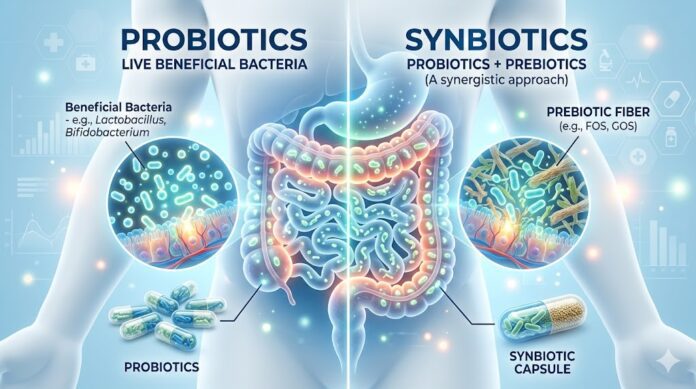
Stand in the gut health aisle for five minutes and you’ll see two labels everywhere: “probiotic” and “synbiotic.” Both promise the same thing: fewer bloated days, more regular bathroom trips, a happier gut. But when it comes to synbiotics vs probiotics for constipation, they’re not the same product, and most people buying them have no idea which one actually has the research to back it up.
Quick answer:
Current research suggests probiotics have a larger and more consistent evidence base for relieving constipation in adults, especially strains like Bifidobacterium lactis. Synbiotics show promising results in some trials, but at least one well designed study found that adding a prebiotic actually reduced the benefit a probiotic provided on its own. The strain you choose matters more than which category it falls into.
This guide breaks it down in plain language. We’ll look at what each one actually is, what the clinical trials say about which works better for constipation, and then walk through 10 specific products, five probiotics and five synbiotics, with an honest review of each.
Synbiotics vs Probiotics for Constipation: Quick Comparison
| Probiotics | Synbiotics | |
|---|---|---|
| Contains | Live bacteria only | Live bacteria + prebiotic fiber |
| Evidence base | Stronger — 30+ RCTs in adult meta-analyses | Emerging — ~4 RCTs in the same meta-analyses; fewer trials means less certainty |
| Best studied strain for constipation | Bifidobacterium lactis | Depends on formula; no single strain dominates |
| Consistency of results | More consistent, but still strain dependent | Mixed — one trial found the prebiotic blunted the probiotic’s effect |
| Typical side effects | Usually mild and well tolerated | More gas and bloating in weeks 1 to 2 as the gut adjusts to the fiber |
| Best choice if… | You want the most researched starting point | A single probiotic hasn’t helped and you want to try a targeted combo |
What’s the Difference Between Probiotics and Synbiotics?
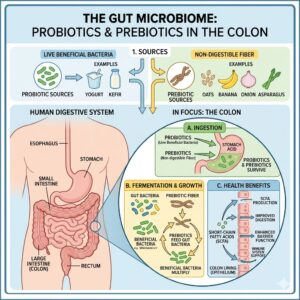
A probiotic is a supplement or food with live, beneficial bacteria in it, strains like Lactobacillus or Bifidobacterium, meant to support the bacteria already living in your gut.
A prebiotic isn’t a bacterium at all. It’s a type of fiber, like inulin or FOS, that feeds the good bacteria already in your colon.
A synbiotic puts both in one product: live bacteria plus the fiber meant to feed them. The theory, first proposed in 1995 and refined since by the International Scientific Association for Probiotics and Prebiotics, is that the fiber helps the bacteria survive and settle in better than they would alone. There are two types: “complementary” synbiotics, where each ingredient works on its own, and “synergistic” synbiotics, where the fiber is specifically chosen to feed the exact strain in the bottle.
In theory, that combination should make synbiotics the better choice for constipation. In practice, the clinical research is more mixed than most product pages let on.
| Factor | Probiotics | Synbiotics |
|---|---|---|
| What’s inside | Live bacteria or yeast strains only | Live strains plus a prebiotic fiber |
| Size of evidence base | 30+ RCTs pooled in adult meta-analyses — a much larger dataset to draw conclusions from | Around 4 RCTs in the same meta-analyses — fewer trials mean less certainty about consistent effects |
| Consistency of results | More consistent, but still strain dependent | Mixed. One trial even found the prebiotic blunted the probiotic’s effect |
| Strongest evidence | Bifidobacterium lactis for stool frequency | “Synergistic” formulas matched to a specific strain |
| Common side effects | Usually mild, well tolerated | More gas and bloating in weeks 1 to 2 as the gut adjusts to the fiber |
Why Strain Choice Matters More Than the Label
Here’s the real pattern across this research: outcomes depend on the specific strain and dose used, not on whether the product is called a “probiotic” or “synbiotic.” A 2022 systematic review pooling 30 randomized trials found that Bifidobacterium lactis reliably increased stool frequency, while probiotic mixtures and other individual strains did not show the same effect (DOI: 10.1016/j.clnu.2022.10.015). Two products can both say “probiotic for constipation” on the label and have very different evidence behind them, depending only on which strain is inside. For a deeper look, see our guide to the best probiotic strains for constipation and bloating.
The way probiotics are thought to help is by shifting gut bacteria toward a more helpful mix, producing short chain fatty acids that soften stool and trigger colon contractions, and influencing the gut brain axis. Synbiotics are meant to boost this by giving the added strain food to survive on right away, though that theoretical edge doesn’t always show up in trial results.
What the Research Actually Shows
Study 1: Synbiotics Outperformed Probiotics Alone for Stool Frequency
A 2024 randomized, double blind, placebo controlled pilot trial in Gastroenterology Report compared probiotics, prebiotics, synbiotics, and placebo head to head in 74 adults with chronic constipation over eight weeks. Stool frequency went up in all three active groups, but the synbiotics group had the biggest jump, from about 2.8 to 5.9 bowel movements per week, and symptom scores improved most in that group too (PMID: 39568915; DOI: 10.1093/gastro/goae101). That’s a real point in favor of synbiotics, but it’s one small pilot study.
Study 2: Adding a Prebiotic Reduced the Probiotic’s Effect
A separate randomized, double blind, placebo controlled trial in 69 healthy adults found a more complicated result. Neither probiotics nor synbiotics increased weekly bowel movement frequency versus control. But on stool condition and constipation symptom scores (PAC-SYM questionnaire), the probiotic-only group improved significantly while the synbiotic group did not. Adding a prebiotic to the exact same strain appeared to cancel out a benefit the probiotic provided on its own, a result the authors themselves called surprising (PMID: 35212286).
What the Meta-Analyses Conclude
Zooming out, current evidence suggests probiotics have an advantage on consistency. A 2022 meta-analysis pooling 30 trials found probiotics significantly increased treatment response rates (57% versus 44% on placebo) and stool frequency, with Bifidobacterium lactis the most consistent performer. Synbiotics, pooled across four trials in that same review, did not show a significant benefit over control on stool output or symptom scores (DOI: 10.1016/j.clnu.2022.10.015).
A separate 2023 meta-analysis across 17 trials and 1,504 children found probiotics alone improved defecation frequency versus placebo, but neither probiotics nor synbiotics showed a meaningful benefit when added on top of standard laxative treatment. The review authors concluded the current evidence doesn’t yet support recommending either as a standard treatment for pediatric functional constipation (PMID: 37625312; DOI: 10.1016/j.clnu.2023.08.015).
Bottom line: If you want the most researched option, start with a well-studied probiotic strain like Bifidobacterium lactis. Synbiotics may help some people, but the evidence is less consistent overall.
Synbiotics vs Probiotics: Which Should You Choose?
Probiotics currently have the more reliable track record, especially well studied strains like Bifidobacterium lactis, Lactobacillus reuteri, and Bifidobacterium longum. For a closer look at L. reuteri, see our guide on does L. reuteri help constipation and bloating.
Synbiotics may work better for some people. If you go this route, look for a “synergistic” formula where the company explains why that specific prebiotic was paired with that strain, rather than a generic fiber-plus-bacteria mix.
Either way, the strain matters more than the category. For more, see our guides on the best probiotics for constipation and bloating, 9 best probiotic supplements of 2026, the best magnesium supplements for constipation, and our MiraLAX vs Colace comparison.
How We Selected These Products
Each product below was chosen based on strain transparency, supporting clinical research on the specific strain or formula, and real-world availability. We did not accept payment from any brand for inclusion. None of these cure constipation on their own. Talk to your doctor before starting any new supplement, especially if you’re pregnant, immunocompromised, or managing a chronic GI condition.
5 Best Probiotics for Constipation, Reviewed
1. Align Probiotic (Bifidobacterium infantis 35624, now classified as B. longum subsp. infantis 35624)
Align uses one well documented strain, originally studied as Bifidobacterium infantis 35624 and reclassified under updated bacterial taxonomy as B. longum subsp. infantis 35624. Multiple placebo controlled trials linked this strain to improvements in combined IBS symptoms including bloating, gas, pain, and difficult stool passage. Effect sizes across its three trials have been inconsistent, and in one trial the placebo group did slightly better on some measures.
Pros: One of the most studied single strains for IBS-related symptoms; well tolerated; simple single-strain formula.
Cons: Inconsistent effect sizes across trials; evidence leans toward general IBS symptoms rather than constipation specifically.
2. Culturelle Digestive Daily (Lactobacillus rhamnosus GG)
Lactobacillus rhamnosus GG (LGG) is one of the most extensively studied probiotic strains in the world, with a long history in trials on antibiotic-related diarrhea and general digestive health. The current Digestive Daily formula pairs LGG with Bifidobacterium animalis CECT 8145.
Pros: One of the largest safety datasets of any commercial probiotic strain; widely available; reasonable price.
Cons: Most of LGG’s strongest evidence is for diarrhea, not constipation; results for regularity specifically may be modest.
3. VSL#3 (also sold as Visbiome)
VSL#3 is a high potency eight-strain blend (up to 900 billion CFU per dose) studied mainly in IBS and inflammatory bowel conditions. The same formula is sold as Visbiome in the US and several other markets following a brand dispute — strains and counts are equivalent. A meta-analysis of five trials found no significant difference from placebo on bloating, abdominal pain, or stool consistency, though there was a near-significant trend toward better overall response. Constipation-specific studies showed short-term colonization but no clinically meaningful change in bowel parameters.
Pros: Very high CFU count; extensively studied in IBS and IBD; available as Visbiome where VSL#3 isn’t stocked.
Cons: No significant benefit over placebo in the largest meta-analysis; premium price; constipation-specific data is weak.
4. MegaSporeBiotic
MegaSporeBiotic uses four spore-forming Bacillus strains that survive stomach acid through a natural protective shell, without relying on capsule coatings. It’s shelf stable for up to five years. Evidence specifically for constipation is mixed: some spore-based studies show non-significant improvement, others show none, though one found a laxative plus a spore-based probiotic outperformed the laxative alone. See our MegaSporeBiotic vs Just Thrive breakdown for more.
Pros: Excellent stomach acid survival; five-year shelf stability; no refrigeration needed.
Cons: Constipation-specific evidence is inconsistent; weaker direct evidence than B. lactis-based products; mild cramping common initially.
5. Just Thrive Probiotic and Antioxidant
Just Thrive uses a similar four-strain spore-based formula to MegaSporeBiotic, adding Bacillus indicus HU36, marketed for antioxidant production in the gut. It’s more widely available than MegaSporeBiotic since it doesn’t require a practitioner code. Over 3,670 customer reviews average 4.65 out of 5, frequently citing improved regularity, though this is self-reported sentiment rather than clinical trial data.
Pros: No practitioner code required; strong customer review volume; spore-based shelf-stable formula.
Cons: Customer reviews are not clinical data; Bacillus strain safety data is more limited than for Lactobacillus or Bifidobacterium; few constipation-specific trials on this exact formula.
5 Best Synbiotics for Constipation, Reviewed
6. Seed DS-01 Daily Synbiotic
DS-01 combines 24 probiotic strains (53.6 billion AFU) with a non-fiber prebiotic, in a two-layer capsule designed to release the prebiotic first and the probiotic later in the gut. A 2026 randomized, double blind, placebo controlled trial in 350 adults found significant improvements in bloating, gas, discomfort, and bowel regularity versus placebo over six weeks, making it one of the larger synbiotic trials conducted to date. See our full Seed DS-01 review for more detail.
Pros: One of the largest recent placebo-controlled synbiotic trials; targeted two-layer delivery system; significant improvements across multiple GI outcomes.
Cons: Subscription only; higher price than most single-strain options; trial was in healthy adults with bloating, not diagnosed chronic constipation.
7. Ritual Synbiotic+
Ritual pairs two well studied strains, LGG and Bifidobacterium animalis BB-12, with the prebiotic PreforPro and a postbiotic (tributyrin) to support butyrate production in the colon. Each individual ingredient has its own clinical rationale, though the assembled three-part formula hasn’t yet been tested as a whole in a large dedicated placebo-controlled trial.
Pros: Combines probiotic, prebiotic, and postbiotic; uses two well-studied strains at clinically informed doses; each ingredient has supporting research.
Cons: Combined formula lacks a large dedicated trial; subscription pricing; mild gas or bloating common in weeks 1 to 2.
8. Ora Organic Trust Your Gut
This formula uses six clinically studied strains at 16 billion CFU, guaranteed through the expiration date rather than just at manufacture, plus organic prebiotic fiber. It’s shelf-stable, non-GMO, vegan, and free of common allergens.
Pros: No subscription required; organic, vegan, allergen-free; CFU count guaranteed through expiry.
Cons: No large placebo-controlled trial on the finished formula; evidence is mostly at the individual-ingredient level.
9. Garden of Life Dr. Formulated Probiotics + Prebiotics
This line combines 15 to 16 probiotic strains, including Lactobacillus acidophilus, Bifidobacterium lactis, and L. plantarum, with an organic whole-food prebiotic blend at 50 to 80 billion CFU depending on the product variant. It’s shelf-stable and available without a subscription.
Pros: Includes Bifidobacterium lactis, the most consistently supported strain in adult meta-analyses; high CFU range; one-time purchase.
Cons: Higher strain count doesn’t automatically mean better results; the complete formula hasn’t been tested in a large dedicated trial.
10. OLLY Probiotic + Prebiotic Gummies
OLLY’s gummy format uses Bacillus coagulans (500 million CFU) with prebiotic FOS fiber. Bacillus coagulans has supporting research for general digestive health, though the CFU count is notably lower than most capsule-based options and constipation-specific evidence is limited.
Pros: Gummy format suits people who dislike capsules; shelf-stable; lowest price point on this list.
Cons: Low CFU count (500 million); contains added sugar; limited constipation-specific research compared to B. lactis-based products.
The Bottom Line
Neither synbiotics nor probiotics are a guaranteed fix, and results depend heavily on what’s causing your constipation, your existing gut bacteria, and the specific strain you choose. If you’re starting from scratch, a single well-studied probiotic strain is the safer, more evidence-backed first step. If that doesn’t help after a few weeks, a targeted synbiotic, ideally one where the prebiotic is matched to the strain, is a reasonable next try.
If your constipation is sudden, severe, or comes with symptoms like rectal bleeding, unexplained weight loss, or ongoing abdominal pain, talk to a healthcare provider before relying on supplements alone.
Frequently Asked Questions
Are synbiotics better than probiotics for constipation?
Not definitively. Some trials show synbiotics produce bigger improvements in stool frequency, while others show that adding a prebiotic can reduce the probiotic’s effectiveness. Current evidence suggests probiotics have the more consistent track record across multiple studies.
Can I just take a probiotic and a prebiotic separately instead of buying a synbiotic?
Yes. Taking them separately gives you more control over dosing, though a well-formulated synergistic synbiotic pairs the two specifically to work together.
How long does it take for synbiotics or probiotics to relieve constipation?
Most clinical trials ran 4 to 8 weeks before measuring meaningful improvement. Give any product at least a few weeks before deciding whether it’s working.
Are there side effects to taking synbiotics for constipation?
Some people experience temporary bloating or gas, especially when starting the prebiotic fiber. This usually settles within the first one to two weeks.
Can synbiotics make constipation worse?
Temporarily, yes, for some people. The prebiotic fiber in synbiotics is fermented by gut bacteria, which can increase gas and bloating in the first week or two. Certain prebiotic fibers in high doses may also slow gut transit in sensitive individuals, particularly those with SIBO (small intestinal bacterial overgrowth). If symptoms worsen beyond two weeks or are severe, stop and speak with a healthcare provider.
What is the best probiotic strain for constipation?
Based on current evidence, Bifidobacterium lactis has the strongest and most consistent track record for increasing stool frequency in adults with chronic constipation, standing out as the top performer in a 2022 meta-analysis of 30 randomized controlled trials. Lactobacillus reuteri and Bifidobacterium longum also have meaningful supporting data. Strain specificity matters far more than brand name or CFU count.
This article is an overview of digestive health research. If you’re dealing with ongoing or severe digestive symptoms, please consult a gastroenterologist or your primary care provider for personalized guidance.
Full Affiliate Disclosure: This post contains affiliate links. As an Amazon Associate, we earn from qualifying purchases at no extra cost to you. We only recommend products supported by clinical research. This article is for informational purposes and is not a substitute for professional medical advice.
References
- Terrén Lora A, et al. Supplementation with probiotics, prebiotics, and synbiotics in patients with chronic functional constipation: a randomized, double-blind, placebo-controlled pilot clinical trial. Gastroenterol Rep (Oxf). 2024;12:goae101. PMID: 39568915. https://doi.org/10.1093/gastro/goae101
- Ito D, et al. Do synbiotics really enhance beneficial probiotics effect on defecation symptoms in healthy adults? Randomized, double-blind, placebo-controlled trial. Medicine (Baltimore). 2022;101(8):e28858. PMID: 35212286. https://doi.org/10.1097/MD.0000000000028858
- van der Schoot A, Helander C, Whelan K, Dimidi E. Probiotics and synbiotics in chronic constipation in adults: a systematic review and meta-analysis of randomised controlled trials. Clin Nutr. 2022;41(12):2759-2777. https://doi.org/10.1016/j.clnu.2022.10.015
- Liu L, Wang A, Shi H, Tao H, Nahata MC. Efficacy and safety of probiotics and synbiotics for functional constipation in children: a systematic review and meta-analysis of randomized clinical trials. Clin Nutr. 2023;42(10):1817-1826. PMID: 37625312. https://doi.org/10.1016/j.clnu.2023.08.015
- Konstantis G, Efstathiou S, Pourzitaki C, Kitsikidou E, Germanidis G, Chourdakis M. Systematic review and meta-analysis: efficacy of patented probiotic, VSL#3, in irritable bowel syndrome. PMID: 30069978. https://pubmed.ncbi.nlm.nih.gov/30069978/
- Kim SE, et al. Change of fecal flora and effectiveness of the short-term VSL#3 probiotic treatment in patients with functional constipation. J Neurogastroenterol Motil. 2015;21:111-120. https://doi.org/10.5056/jnm14048





[…] gut bacteria afterward, our Mag O7 review for constipation discusses why pairing a cleanse with a probiotic or synbiotic afterward is good practice. Our broader guide to fiber foods and fiber therapy for gut health also […]