


Why Constipation Often Feels Worse in the Morning
While you sleep, your digestive system enters a low-activity state. Bowel contractions slow significantly, no new food or fluid is coming in, and by the time you wake up, you’re mildly dehydrated from breathing and perspiration overnight.
Here’s the important counterpoint: your colon is actually primed for activity in the early morning. Research has established that colonic motility follows circadian rhythms — it’s most active in the morning hours and least active at night.[2] On top of that, eating triggers a well-documented physiological response called the gastrocolic reflex — an automatic increase in colon motility in response to food stretching the stomach. According to a StatPearls review on NCBI, this reflex is most active in the morning and immediately after meals.[3]
Modern mornings — rushing, skipping breakfast, sitting down immediately at a desk — often suppress this reflex before it can do its job. The five habits below are designed to work with this natural morning window, not against it.
The 5 Morning Habits That Can Help Relieve Constipation
Habit 1
Drink Warm Water Right After Waking Up
One of the simplest morning habits to relieve constipation is drinking a glass of warm water before coffee, before your phone.
Why it works: When your body is dehydrated, the colon compensates by drawing more water from stool, making it harder, drier, and more difficult to pass. Adequate hydration prevents this. A 2025 large-scale NHANES study published in BMC Public Health found that higher dietary moisture intake was significantly associated with lower constipation risk among U.S. adults.[4] Epidemiological evidence also consistently links low fluid intake with reduced bowel movement frequency and harder stools.[5]
Many people add ginger to their warm morning water — a few slices of fresh ginger steeped for a minute or two, or a small amount of freshly grated ginger infused into the water. Ginger has been studied for its potential digestive and pro-motility effects and is widely used in traditional medicine for gastrointestinal discomfort, though most research focuses on gastric emptying rather than constipation specifically.
Adding a squeeze of lemon is another popular practice; however, there is currently limited direct clinical evidence that lemon water itself relieves constipation. On the question of warm versus cold water: direct clinical trials comparing temperature effects on constipation are limited, but warm water is generally well-tolerated, and many people find it soothing and easier to drink in the morning. Individual responses vary, and warm water works best as part of overall hydration throughout the day.
Practical tip: Keep a glass or small thermos of warm water on your nightstand so it’s the first thing you reach for. Aim for 8–12 oz (240–360 ml). Let boiled water cool for 2–3 minutes — warm is the goal, not scalding. Try adding a few slices of fresh ginger if you enjoy the taste.
Common mistake: Relying on coffee alone and skipping plain water entirely. Coffee can stimulate bowel activity, but relying on it in place of adequate water intake may worsen dehydration in some people — always drink plain water alongside your morning coffee.

Habit 2
Eat a Fiber-Rich Breakfast
Breakfast activates your gastrocolic reflex. If that breakfast contains fiber, you’re delivering both the trigger and the material your colon needs to produce a healthy bowel movement.
Why it works: Dietary fiber adds bulk to stool and retains water in the colon, keeping stool soft and easier to pass. A 2022 systematic review and meta-analysis in the American Journal of Clinical Nutrition (van der Schoot et al.) found that fiber supplementation — particularly psyllium at doses above 10 g/day — significantly improved chronic constipation outcomes, though benefits are generally more noticeable after consistent use over several weeks.[6]
The 2023 joint AGA-ACG clinical practice guideline recommends a gradual increase in dietary fiber as a first-line approach for constipation management.[7] Most U.S. adults consume only 10–15 grams of fiber daily — well below the recommended 25–38 grams for adults.[8] Breakfast is one of the easiest opportunities to close that gap.
High-fiber breakfast options:
- Oatmeal with berries and ground flaxseed — oats contain beta-glucan, a well-studied soluble fiber; ground flaxseed adds roughly 2–3 g of fiber per tablespoon. Many people also eat figs soaked overnight in water — figs are naturally high in fiber and have a long history of use as a traditional digestive aid, though robust clinical trial evidence specific to constipation is limited.
- Whole grain toast with avocado — avocados provide around 6–7 g of fiber per half fruit
- Chia seed pudding — chia seeds absorb water and form a gel that softens and bulks stool
- Prunes or prune juice — prunes and prune juice are widely used natural constipation remedies and have been studied in clinical settings. They contain sorbitol, a naturally occurring sugar alcohol that draws water into the colon. Note that individual response times vary. See our full guide on prune juice for constipation.
- High-fiber cereal with milk or a plant-based alternative
Practical tip: If you’re not currently eating much fiber, increase it gradually over one to two weeks. Going from low to high fiber intake too quickly commonly causes gas, bloating, and cramping.
Common mistake: Eating a high-fiber breakfast without increasing water intake. Fiber works by retaining water in the colon — without adequate fluid, more fiber can actually worsen constipation rather than relieve it.

Habit 3
Move Your Body for 10–15 Minutes
You don’t need a gym session. Even a brisk 10-minute walk can meaningfully stimulate your bowels and support natural constipation relief.
Why it works: Physical movement activates the muscles throughout the digestive tract and may help shorten colonic transit time — the measure of how quickly waste moves through the colon. A 2024 systematic review published in Journal of Global Health analyzed 13 cohort studies involving more than 119,000 participants.[9] Researchers found that higher levels of physical activity were associated with an approximately 31% lower risk of constipation compared with lower activity levels (RR = 0.69; 95% CI = 0.62–0.77). In subgroup analyses, the observed risk reduction ranged from 38% to 48%, depending on the statistical adjustments used in the individual studies.
A controlled trial in middle-aged sedentary patients with chronic constipation demonstrated that a 12-week physical activity programme including brisk walking significantly reduced both rectosigmoid and total colonic transit time compared to controls.[10] The flip side is also telling: just two weeks of reduced physical activity has been shown to significantly slow colonic transit in elderly men who had previously been regularly active.[11]
Effective morning movement options:
- Brisk walk (10–15 minutes)
- Gentle yoga — especially twisting poses, child’s pose, and cat-cow, which may gently stimulate the abdominal area and promote movement. see our guide on the best yoga poses for constipation
- Light jogging or cycling
- Some people find gentle clockwise abdominal massage helpful as a complement to other habits — following the anatomical direction of the colon — though the supporting evidence for this technique alone is limited and it works best alongside movement and dietary changes.
Practical tip: Move before or shortly after breakfast. Eating activates the gastrocolic reflex; movement speeds transit. Together, they deliver a combined stimulus to your digestive system.Common mistake: Thinking only intense exercise counts. Light-to-moderate activity is sufficient and far more sustainable as a daily habit.

Habit 4
Don’t Ignore the Urge to Go
This is one of the most overlooked contributors to chronic constipation: repeatedly suppressing or ignoring the urge to defecate when it arises.
Why it matters: When you feel the urge and voluntarily suppress it — because you’re busy, rushing, or uncomfortable with available bathrooms — stool remains in your rectum longer. Your colon continuously absorbs water from stool over time, so the longer it waits, the harder and drier it becomes. Research has shown that voluntary suppression of defecation also delays gastric emptying — a phenomenon researchers described as a “cologastric brake” — contributing to bloating and upper abdominal symptoms.[12]
Over time, chronically ignoring the urge can diminish rectal sensitivity — meaning your body’s natural signals become less reliable, which compounds constipation further.[13]
Practical tip: Give yourself enough time in the morning to respond when your body signals. If you’re always rushing, try setting your alarm 15–20 minutes earlier. This small buffer has a disproportionately large impact on morning bowel habit.
Common mistake: Trying to force a bowel movement when there’s no natural urge. Straining without a signal may increase rectal irritation and contribute to hemorrhoid symptoms over time. Patience and correct timing matter as much as action.
Habit 5
Build a Consistent Bathroom Routine
Your gut thrives on routine. Going to the bathroom at roughly the same time each morning — even without an urgent need — helps train your colon to be more predictable over time.
Why it works: Colonic motility follows circadian rhythms and is strongest in the morning hours.[2] Sitting on the toilet consistently around the same time each day — ideally 20–30 minutes after breakfast, when the gastrocolic reflex is active — reinforces this rhythm and can encourage more regular bowel movements over time.
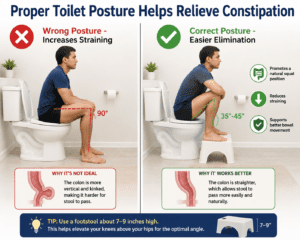
Your toilet posture also matters significantly. A standard Western toilet seat places the hips and knees at approximately 90° — which is not the biomechanically ideal position for defecation. Raising your feet on a small footstool mimics a partial squat, straightening the anorectal angle and relaxing the puborectalis muscle. A 2019 prospective crossover study published in the Journal of Clinical Gastroenterology (Modi et al.) enrolled 52 healthy volunteers and found that using a defecation posture modification device significantly increased bowel emptiness (OR 3.64; 95% CI 2.78–4.77) and reduced straining patterns (OR 0.23; 95% CI 0.18–0.30) compared to standard sitting — though additional research in people with chronic constipation is still needed.[14]
Practical tip: Use a Squatty Potty or a simple step stool (7–9 inches tall) under your feet on the toilet. Lean slightly forward, elbows resting on knees. Relax your belly muscles rather than forcing pressure downward.
Common mistake: Sitting on the toilet for extended periods while using your phone. Prolonged toilet sitting increases venous pressure in the rectal area and may contribute to hemorrhoid symptoms. If nothing happens within 5–10 minutes, get up and try again when the urge returns.
Foods and Habits That May Make Constipation Worse
Morning habits are only part of the picture. These common factors can undermine your progress:
Ultra-Processed Foods and Low-Fiber Diets
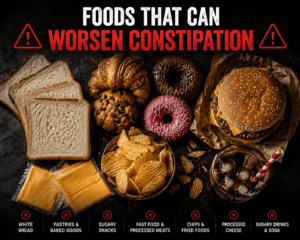
White bread, packaged pastries, fast food, and most pre-packaged snacks are low in fiber and high in refined carbohydrates. They leave little residue to stimulate bowel movement. Population studies consistently associate low dietary fiber intake with higher constipation prevalence.[6]
Not Drinking Enough Water
Dehydration is among the most consistent dietary risk factors for constipation. If your urine is consistently dark yellow, you’re likely not drinking enough. Aim for at least 6–8 cups (1.5–2 liters) of fluid daily — more if you’re physically active or in a hot climate. Fiber and water are interdependent: increasing fiber intake without also increasing fluid intake can worsen rather than improve constipation.[4]
Large Amounts of Dairy
High-fat, low-fiber dairy products like hard cheese and whole milk may slow bowel motility in some individuals, particularly those with mild lactose sensitivity. This varies by person — monitor your own response and adjust accordingly.
A Sedentary Lifestyle
Sitting for most of the day slows colonic transit. Even brief periods of inactivity (two weeks) have been shown to measurably extend colonic transit time.[11] If you have a desk job, short walking breaks every hour are worth building in.
Certain Medications
Several common medications are well-documented causes of constipation: opioid pain relievers, iron supplements, certain antidepressants (particularly TCAs), and antacids containing aluminum or calcium.[15] If you suspect a medication is contributing to your constipation, speak with your doctor before stopping or adjusting anything.
When to See a Doctor About Constipation
For most adults, occasional constipation responds well to the lifestyle changes described above. However, some situations require professional evaluation rather than self-management.
Seek medical attention promptly if you experience any of the following:
- Blood in your stool or on toilet paper — always warrants evaluation, even if you suspect hemorrhoids
- Constipation lasting more than 3 weeks without improvement despite dietary changes
- Severe or persistent abdominal pain or cramping
- Unexplained weight loss alongside changes in bowel habits
- Alternating constipation and diarrhea — may indicate irritable bowel syndrome (IBS) or another functional disorder
- Vomiting alongside constipation — can indicate a bowel obstruction, which is a medical emergency
Constipation can also be a symptom of underlying conditions such as hypothyroidism, diabetes, neurological disorders, or, less commonly, structural conditions affecting the colon. A physician can perform the appropriate tests and, if needed, refer you to a gastroenterologist for specialized care.

Frequently Asked Questions
What is the best morning drink for constipation?
Warm water is a practical first choice — it rehydrates the colon after the overnight fast and may gently stimulate peristalsis. Adding fresh ginger is a popular option with a history of use in traditional digestive medicine. Caffeinated coffee is also effective for many people. A colonic manometry study by Rao et al. (1998) found that caffeinated coffee stimulated colonic motor activity roughly 60% more than water and 23% more than decaffeinated coffee.[16] Effects vary by individual, and coffee should always be paired with adequate water.
Does warm water actually help constipation?
Adequate hydration — including warm water — prevents the colon from absorbing too much water from stool, which keeps stool softer and easier to pass. Epidemiological studies consistently link low fluid intake with harder stools and constipation.[5] Direct clinical trial evidence comparing warm versus cold water specifically is limited, but warm water is safe, well-tolerated, and a sensible first step in the morning.
How quickly do morning habits work for constipation?
It varies by habit and individual. Warm water, ginger water, or coffee may trigger a bowel movement within 30 minutes for some people. Other habits — like increasing dietary fiber or building a consistent exercise routine — typically produce noticeable improvement after several days to a few weeks of consistent practice. Results are not always immediate, and individual responses vary considerably. Gut habits take time to reset, and two to four weeks of consistency often shows the clearest results.
Is coffee good for constipation?
For many people, yes. Caffeinated coffee stimulates colonic contractions — an effect documented in controlled studies going back to the 1990s.[16, 17] Interestingly, decaffeinated coffee also has some colonic stimulant effect, though weaker, suggesting components beyond caffeine are involved. That said, not everyone responds the same way. For people who tolerate coffee well, moderate intake alongside adequate hydration is generally reasonable.
How many bowel movements per week is considered normal?
The medically accepted normal range is 3 bowel movements per day to 3 per week. Fewer than 3 per week is generally considered constipation, particularly when accompanied by straining, hard or lumpy stools, a sensation of incomplete emptying, or the need for manual maneuvers — criteria that form the basis of the Rome IV diagnostic framework for functional constipation.[1]
Can I use fiber supplements if I can’t get enough fiber from food?
Yes. Psyllium husk is the most evidence-backed fiber supplement for constipation and is supported by major gastroenterology guidelines.[7] A 2022 meta-analysis found psyllium at doses above 10 g/day to be particularly effective, with benefits more apparent after consistent use over several weeks.[6] Start with a small dose, increase gradually, and always take it with a full glass of water. Whole food fiber is preferable when achievable, but supplements are a practical bridge when diet falls short.
The Takeaway: Small Habits, Real Results
Constipation doesn’t have to be a fixed feature of your mornings — and these simple morning habits to relieve constipation are proof of that. The five habits outlined here — drinking warm water (with ginger if you like), eating a fiber-rich breakfast, moving your body, responding promptly to the urge to go, and building a consistent bathroom routine — are all supported by clinical and epidemiological research and work with your body’s natural digestive rhythm.
None of these require expensive products or dramatic lifestyle changes. They require consistency. Start with one or two habits this week, and add another the week after. Many people notice a meaningful difference within one to two weeks of sticking with them, though individual results vary and some may need more time or medical support.
If you’ve genuinely tried these strategies consistently and constipation persists, please speak with a healthcare provider. There are effective, evidence-based medical treatments available, and you don’t have to manage this alone.
Editorial & Medical Integrity: This article was written and reviewed for factual accuracy and clinical relevance. All referenced studies are linked directly to their original sources and include peer-reviewed clinical trials, systematic reviews, meta-analyses indexed on PubMed, and American Gastroenterological Association (AGA) clinical practice guidelines. It is for informational purposes only and does not constitute medical advice. Always consult a qualified healthcare provider before starting any new health regimen, particularly if you have an existing medical condition.
References
- Barberio B, Judge C, Savarino EV, Ford AC. Global prevalence of functional constipation according to the Rome criteria: a systematic review and meta-analysis. Lancet Gastroenterol Hepatol. 2021;6(8):638–648. doi:10.1016/S2468-1253(21)00111-4
https://pubmed.ncbi.nlm.nih.gov/34090581/ - Hoogerwerf WA. Role of clock genes in gastrointestinal motility. Am J Physiol Gastrointest Liver Physiol. 2010;299(3):G549–G555. doi:10.1152/ajpgi.00147.2010
https://pmc.ncbi.nlm.nih.gov/articles/PMC2950682/ - Malone JC, Thavamani A. Physiology, Gastrocolic Reflex. In: StatPearls [Internet]. Treasure Island (FL): StatPearls Publishing; updated 2023.
https://www.ncbi.nlm.nih.gov/books/NBK549888/ - Wang DC, et al. The association of moisture intake and constipation among US adults: evidence from NHANES 2005–2010. BMC Public Health. 2025;25:346. doi:10.1186/s12889-025-21346-x
https://link.springer.com/article/10.1186/s12889-025-21346-x - Arnaud MJ. Mild dehydration: a risk factor of constipation? Eur J Clin Nutr. 2003;57 Suppl 2:S88–S95. doi:10.1038/sj.ejcn.1601907
https://pubmed.ncbi.nlm.nih.gov/14681719/ - van der Schoot A, Drysdale C, Whelan K, Dimidi E. The effect of fiber supplementation on chronic constipation in adults: an updated systematic review and meta-analysis of randomized controlled trials. Am J Clin Nutr. 2022;116(4):953–969. doi:10.1093/ajcn/nqac184
https://pubmed.ncbi.nlm.nih.gov/35816465/ - Lacy BE, Wise JL, et al. AGA-ACG Clinical Practice Guideline: Pharmacological Management of Chronic Idiopathic Constipation. Gastroenterology. 2023;164(7):1280–1291. doi:10.1053/j.gastro.2023.03.214
https://www.gastrojournal.org/article/S0016-5085(23)00513-9/fulltext - Slavin JL. Position of the American Dietetic Association: health implications of dietary fiber. J Am Diet Assoc. 2008;108(10):1716–1731. doi:10.1016/j.jada.2008.08.007
https://pubmed.ncbi.nlm.nih.gov/18953766/ - Cui J, Xie F, Yue H, et al. Physical activity and constipation: a systematic review of cohort studies. J Glob Health. 2024;14:04197. doi:10.7189/jogh.14.04197
https://pmc.ncbi.nlm.nih.gov/articles/PMC11583288/ - De Schryver AM, Keulemans YC, Peters HP, et al. Effects of regular physical activity on defecation pattern in middle-aged patients complaining of chronic constipation. Scand J Gastroenterol. 2005;40(4):422–429. doi:10.1080/00365520510012153
https://pubmed.ncbi.nlm.nih.gov/16028436/ - Liu F, Kondo T, Toda Y. Brief physical inactivity prolongs colonic transit time in elderly active men. Int J Sports Med. 1993;14(8):465–467. doi:10.1055/s-2007-1021212
https://pubmed.ncbi.nlm.nih.gov/8300274/ - Meshkinpour H, Nowroozi F, Glick ME. Colonic compliance in response to voluntary suppression of defecation. Dig Dis Sci. 1993;38(6):1138–1142. doi:10.1007/BF01295729
https://pubmed.ncbi.nlm.nih.gov/8482181/ - Rao SSC, Rattanakovit K, Patcharatrakul T. Diagnosis and management of chronic constipation in adults. Nat Rev Gastroenterol Hepatol. 2016;13(5):295–305. doi:10.1038/nrgastro.2016.53
https://pubmed.ncbi.nlm.nih.gov/27033126/ - Modi RM, Hinton A, Pinkhas D, et al. Implementation of a defecation posture modification device: impact on bowel movement patterns in healthy subjects. J Clin Gastroenterol. 2019;53(3):216–219. doi:10.1097/MCG.0000000000001143
https://pubmed.ncbi.nlm.nih.gov/30346317/ - Müller-Lissner SA, Kamm MA, Scarpignato C, Wald A. Myths and misconceptions about chronic constipation. Am J Gastroenterol. 2005;100(1):232–242. doi:10.1111/j.1572-0241.2005.40885.x
https://pubmed.ncbi.nlm.nih.gov/15654804/ - Rao SS, Welcher K, Zimmerman B, Stumbo P. Is coffee a colonic stimulant? Eur J Gastroenterol Hepatol. 1998;10(2):113–118. doi:10.1097/00042737-199802000-00003
https://pubmed.ncbi.nlm.nih.gov/9581985/ - Brown SR, Cann PA, Read NW. Effect of coffee on distal colon function. Gut. 1990;31(4):450–453. doi:10.1136/gut.31.4.450
https://pubmed.ncbi.nlm.nih.gov/2338272/






[…] This approach targets three mechanisms at once and may provide relief within the same day in some individuals with mild-to-moderate constipation — though responses vary. For more morning strategies backed by research, see 5 simple morning habits to relieve constipation naturally. […]
[…] 5 Simple Morning Habits to Relieve Constipation Naturally for building a consistent daily routine […]