

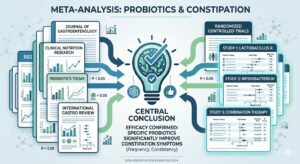
Can Probiotics Help Constipation? yes, for many people. Multiple meta-analyses of randomized controlled trials confirm that probiotics can help constipation, increasing weekly bowel movements by about one extra stool per week and shortening gut transit time by roughly 12 to 15 hours on average (see the meta-analysis table below). The effect isn’t dramatic, and it isn’t universal. But it’s real and reproducible, and the evidence behind it is more consistent than for many other natural constipation remedies. However, probiotic effectiveness depends on the specific strain used, and strain selection matters far more than the CFU number printed on the bottle.
In this guide, we break down exactly what the research says, which probiotic strains have real evidence behind them, who is most likely to benefit, and which products are worth your money, with every claim backed by a clickable PubMed reference.
1. Can Probiotics Help Constipation? What the Research Actually Shows
Probiotics are defined as live microorganisms that, when consumed in adequate amounts, confer a measurable health benefit on the host.[2] Over the past decade, researchers have run dozens of randomized controlled trials (RCTs) testing whether probiotic supplementation can relieve functional constipation. Six major meta-analyses, each pooling data from 14 to 30 individual trials, have reached largely consistent conclusions:
| Study | Trials Pooled | Key Finding |
|---|---|---|
| Dimidi et al. 2014, Am J Clin Nutr[1] | 14 RCTs | Transit time down 12.4 hours; stool frequency up 1.3 per week. Bifidobacterium lactis was the most effective single strain. |
| Miller et al. 2017, Ann Gastroenterol[3] | 21 RCTs | Stool frequency up about 0.8 per week; transit time down about 15 hours. |
| Tian et al. 2020, Int J Surg[4] | 17 RCTs (IBS-C) | Stool frequency up 1.29 per week in IBS-C patients specifically; multispecies blends outperformed single strains. |
| Zhai et al. 2020, Nutrition[5] | 15 RCTs | Transit time down 13.75 hours; stool frequency up 0.98 per week. |
| Dale et al. 2023, Clin Nutr[6] | 30 RCTs (most recent and largest) | B. lactis significantly increased stool frequency (SMD 0.71); mixed strain results were less consistent. |
| Ding et al. 2024, BMJ Open[16] | 17 RCTs | Stool frequency up 0.93 per week; synbiotics (probiotic + prebiotic combinations) outperformed probiotics alone for improving stool frequency. |
Altogether, these six meta-analyses evaluated more than 30 randomized controlled trials in total. It’s worth noting that some individual trials are included in more than one review, so this reflects a large but overlapping body of evidence rather than 30-plus entirely separate studies.
A more recent 2024 systematic review and meta-analysis reinforced these findings, reporting that the large majority of patients in the probiotic groups experienced at least some improvement in constipation symptom scores compared with placebo.[7] The most recent of the six meta-analyses in the table above, Ding and colleagues, also looked beyond symptoms at the gut microbiota itself: probiotic-containing products didn’t necessarily change overall microbial diversity, but they did increase the relative abundance of the specific supplemented strain, consistent with the mechanism described below.[16]
Key takeaway: Probiotics are not a miracle cure and won’t replace a doctor-supervised plan for severe constipation. But across six independent meta-analyses, the direction of effect is the same: modest, consistent, statistically significant improvement in stool frequency and transit time, with Bifidobacterium lactis showing the most consistent results among single strains, and synbiotic (probiotic + prebiotic) combinations performing well in the most recent analysis. That’s a more substantial evidence base than many people assume, even though individual results vary.
If you’re also dealing with abdominal pain alongside constipation, not just infrequent stools, you may actually have IBS-C rather than simple functional constipation. We cover strain selection for that specifically in our guide: Best Probiotics for IBS-C and Constipation.
At a Glance: Best Probiotics for Constipation
- Best overall: Physician’s Choice Probiotics 60 Billion CFU — 10-strain blend including B. lactis, plus organic prebiotics
- Best for IBS-C (pain and bloating): Align Probiotic — built around B. infantis 35624, with dedicated IBS trial data
- Best for stool frequency and transit time: Renew Life Ultimate Flora Extra Care — Bifidobacterium-dense, multi-strain formula
- Best synbiotic (probiotic + prebiotic): Seed DS-01 Daily Synbiotic — 24 studied strains with a non-fermentable, gentler prebiotic
- Best budget option: Culturelle Digestive Daily Probiotic — built around L. rhamnosus GG, one of the most studied strains worldwide
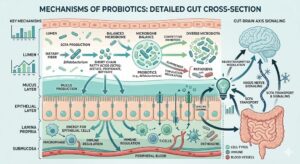
2. How Probiotics Relieve Constipation: The Mechanisms
Probiotics don’t work like a laxative. They don’t force a bowel movement. Instead, they address some of the underlying biological drivers of slow, infrequent stools, which is also why results take weeks, not hours.
Mechanism 1: Short-Chain Fatty Acid (SCFA) Production
Bifidobacterium and Lactobacillus species ferment dietary fiber residue into short-chain fatty acids: butyrate, acetate, and propionate. These SCFAs lower colon pH, draw water into the stool to soften it, and directly stimulate the muscle contractions (peristalsis) that move stool through the colon.[8]
Mechanism 2: Restoring Microbial Balance (Correcting Dysbiosis)
Chronic constipation is consistently associated with gut dysbiosis, meaning a measurable reduction in beneficial Bifidobacterium and Bacteroides species compared to people with normal bowel habits.[9] Probiotic supplementation works partly by competing with less helpful bacteria for resources and re-establishing a healthier microbial balance.
Mechanism 3: Gut-Brain Axis and Motility Signaling
About 90% of the body’s serotonin, a key driver of gut motility, is produced in the digestive tract. Probiotics influence the enteric nervous system (sometimes called the “second brain”) through bacterial signaling pathways that affect this gut-brain communication, contributing to more regular peristalsis.[8]
Mechanism 4: Gut Barrier and Anti-Inflammatory Effects
Probiotics strengthen intestinal tight junctions and reduce pro-inflammatory cytokines. Chronic low-grade gut inflammation can impair normal bowel function, so calming it can indirectly support more regular movements.[7]
3. Best Probiotic Strains for Constipation: Evidence by Strain
This is the part most articles get wrong. A label that says “50 billion CFU!” tells you almost nothing about whether a product will actually help your constipation. What matters is the specific, named strain, down to the strain code, not just the species. Here’s what the clinical evidence actually supports:
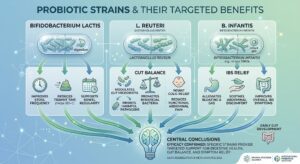
- Bifidobacterium lactis (BB-12® or HN019): The single strain most consistently associated with improvement across major meta-analyses. A 28-day dose-response trial found HN019 significantly reduced whole-gut transit time and improved GI symptoms in adults with functional constipation.[10] The evidence isn’t entirely uniform, however: a more recent placebo-controlled trial found HN019 at a lower dose (about 1.8 billion CFU per day) did not significantly outperform placebo in a general community population, suggesting that dose and the population studied both affect results.[14]
- Lactobacillus reuteri (DSM 17938): Shown in a randomized, double-blind, placebo-controlled trial to improve bowel movement frequency in adults with chronic functional constipation.[11] We cover this strain in depth in Does L. Reuteri Help Constipation and Bloating?
- Bifidobacterium longum: Reduces colonic transit time, though the effect on stool frequency is less consistent across trials than B. lactis.
- Bifidobacterium infantis 35624 (now formally classified as Bifidobacterium longum subsp. infantis 35624, though most product labels and clinical literature still use the older name): The strain with one of the most dedicated trial bases in IBS patients. A landmark study of over 360 women with IBS found significant reductions in abdominal pain, bloating, and bowel difficulty versus placebo.[12] Best suited to people whose constipation comes with pain and bloating (i.e., IBS-C).
- Bacillus coagulans: A spore-forming, highly acid-resistant strain that survives stomach acid exceptionally well. Evidence is stronger for IBS-related bloating and pain than for stool frequency specifically.
- Multispecies blends and synbiotics (probiotic + prebiotic combinations): A 2024 randomized, double-blind trial of 180 people with IBS-C found that a Bifidobacterium lactis BLa80 supplement significantly improved both stool frequency and IBS symptom severity compared to placebo over 4 weeks.[13] More broadly, the most recent meta-analysis in this space found that synbiotics outperformed single-strain probiotics for improving stool frequency, suggesting that pairing a probiotic with a prebiotic substrate may add a meaningful edge over either alone.[16]
Quick reference:
- Stool frequency and transit time: B. lactis (BB-12, HN019), L. reuteri DSM 17938
- Constipation with pain and bloating (IBS-C): B. infantis 35624, B. coagulans
- Broadest general coverage: Multi-strain blends and synbiotics combining Bifidobacterium and Lactobacillus species with a prebiotic
For a head-to-head strain comparison focused specifically on bloating alongside constipation, see Best Probiotic Strains for Constipation and Bloating.
4. Who Is Most Likely to Benefit From Probiotics?
Probiotics aren’t equally helpful for every type of constipation. Based on the clinical evidence, you’re most likely to see a meaningful response if:
- Your constipation is linked to gut dysbiosis, for example, after a course of antibiotics, a GI illness, or a long period of low-fiber eating.
- You have IBS-C (constipation with abdominal pain and bloating), where strains like B. infantis 35624 have dedicated trial data.
- Fiber alone hasn’t worked, particularly if you have slow-transit constipation or IBS-C, where high-fiber diets sometimes make symptoms worse rather than better. We explain this in detail in Why Fiber Isn’t Working for Your Constipation.
- You’re pregnant or postpartum. Several strains, including B. lactis, have safety data supporting use during pregnancy, though you should still check with your OB-GYN before starting any new supplement.
- You’re willing to commit to 4 to 6 weeks of consistent daily use. Probiotics are not a same-day fix.
Community feedback we’ve gathered suggests that probiotic supplementation alone usually isn’t a quick fix, but combined with adequate hydration and a consistent daily routine, some people report meaningful improvement after roughly a month. One reader’s story after more than a decade of chronic constipation is covered in After 12 Years of Chronic Constipation, a Probiotic Brought Relief.

5. Probiotics vs. Fiber, Laxatives, and Magnesium
Probiotics work through an entirely different mechanism than fiber or laxatives, which is exactly why combining approaches often works better than relying on any single one.
| Factor | Probiotics | Fiber | Osmotic Laxatives / Magnesium |
|---|---|---|---|
| Primary mechanism | Microbiome rebalancing, SCFA production, motility signaling | Bulk-forming, water absorption | Draws water into the colon directly |
| Speed of action | Slow (2 to 6 weeks) | Gradual (days to weeks) | Fast (hours) |
| Best for IBS-C | Well tolerated; addresses dysbiosis | Psyllium only; other fibers can worsen symptoms | Effective but not a long-term fix |
| Long-term gut health | High | Moderate | Neutral |
| Typical monthly cost | $20 to $55 | $10 to $25 | $10 to $20 |
The two approaches are not mutually exclusive. A common, well-tolerated combination is a B. lactis-containing probiotic for long-term microbiome support, paired with magnesium as a faster-acting bridge while the probiotic takes effect over several weeks. For a full breakdown of osmotic, stimulant, and lubricant options, see Best OTC Laxatives for Constipation in the US.
6. How to Choose and Take a Probiotic for Constipation
- Check the strain, not just the CFU count. Look for a named strain (e.g., “Bifidobacterium lactis HN019,” not just “Bifidobacterium”).
- Aim for 10 to 60 billion CFU per dose for a therapeutic effect, guaranteed through the expiration date, not just at the time of manufacture.
- Favor an acid-resistant or delayed-release capsule so more live bacteria survive stomach acid and reach the colon.
- Pair with prebiotic foods such as oats, garlic, bananas, and asparagus to feed the probiotic bacteria once they arrive.
- Take it consistently, daily, for at least 4 to 6 weeks before judging whether it’s working. Most clinical trials measured effects at this timeframe, not after a few days.
- Take with food unless your product uses a specialized acid-resistant capsule designed for empty-stomach use.
7. Best Probiotic Products for Constipation Relief (2026 Picks)
These recommendations are based on strain evidence, ingredient transparency, and available clinical research. Individual results may vary, and a product that works well for one person’s gut may not work the same way for another.
These picks are selected for strain specificity, clinical backing, manufacturing quality, and community feedback. Prices and availability may change; ratings reflect Amazon customer reviews at the time of writing. (See the At a Glance list near the top of this guide for a quick summary.)
#1 Best Overall: Physician’s Choice Probiotics 60 Billion CFU
A widely purchased multi-strain probiotic. Contains 10 well-researched strains including Bifidobacterium lactis, one of the most-studied strains for constipation across multiple meta-analyses, plus organic prebiotics. Acid-resistant, delayed-release capsule technology; no refrigeration required.
#2 Best for IBS-C (Pain and Bloating): Align Probiotic
Built around Bifidobacterium infantis 35624, one of the few probiotic strains with large-scale, dedicated IBS trial data covering pain, bloating, and bowel function together.[12] Best suited if abdominal pain and bloating accompany your constipation.
#3 Best for Stool Frequency and Transit Time: Renew Life Ultimate Flora Extra Care
A Bifidobacterium-dense, multi-strain formula (B. lactis, B. longum, B. breve) — a genus with strong direct evidence for constipation. Delayed-release vegetarian capsule. Requires refrigeration.
#4 Best Synbiotic (Probiotic + Prebiotic): Seed DS-01 Daily Synbiotic
A clinically developed 2-in-1 formula with 24 studied strains and a non-fermentable prebiotic (pomegranate-derived), which is gentler for IBS-C and less likely to cause bloating than inulin-based prebiotics. As with most new probiotics, a small number of users still report mild bloating during the first one to two weeks as the gut adjusts. Read our full Seed DS-01 Review.
#5 Best Budget Option: Culturelle Digestive Daily Probiotic
Built around Lactobacillus rhamnosus GG (LGG), one of the most extensively studied probiotic strains in the world, with a strong long-term safety record. A reliable, affordable starting point for anyone new to probiotic supplementation.
For a broader roundup covering general gut-health probiotics beyond constipation specifically, see 9 Best Probiotic Supplements 2026.
8. Side Effects and When to See a Doctor
Probiotics are generally well tolerated. The most common side effects are mild and temporary:
- Gas and bloating in the first 1 to 2 weeks, which typically resolves on its own.
- Temporary changes in stool consistency as the gut microbiome adjusts.
For most healthy adults, long-term probiotic use has a strong safety record.[15] However, certain groups carry a meaningfully higher risk and should consult a doctor before starting any probiotic. This includes people who are immunocompromised, critically ill, or hospitalized; those with a central venous catheter; people undergoing active cancer treatment or recovering from major surgery; premature infants; and anyone with a damaged gut lining, such as severe inflammatory bowel disease. In these higher-risk groups, rare but documented cases of probiotic-related bloodstream infections (bacteremia or fungemia) have been reported in the medical literature.[15] If you fall into any of these groups, talk to your doctor before adding a probiotic to your routine, even an over-the-counter one.
See a doctor promptly if constipation is accompanied by: rectal bleeding, unexplained weight loss, severe abdominal pain, new-onset constipation after age 50, no bowel movement for more than 3 weeks despite treatment, or a family history of colorectal cancer. Chronic constipation can sometimes signal an underlying condition such as hypothyroidism, diabetes, or a structural GI issue that requires proper medical evaluation rather than supplementation alone.
9. Frequently Asked Questions
Do probiotics really help with constipation?
Yes, according to multiple meta-analyses of randomized controlled trials. On average, probiotic supplementation increases bowel movement frequency by about 1 extra stool per week and reduces gut transit time by 12 to 15 hours, with Bifidobacterium lactis showing the most consistent evidence across studies.[1]
How long does it take for probiotics to work for constipation?
Most clinical trials measured results after 4 weeks of consistent daily use, with some showing benefit as early as 2 weeks and others requiring up to 6 weeks. Probiotics are not a same-day solution like a stimulant laxative. Instead, they work by gradually rebalancing the gut microbiome.
What is the best probiotic strain for constipation?
Bifidobacterium lactis (in the BB-12 or HN019 form) tends to have the most consistent supporting evidence across independent meta-analyses for improving stool frequency and transit time. If abdominal pain and bloating are also present, Bifidobacterium infantis 35624 has some of the most dedicated trial data.
Can probiotics make constipation worse?
Temporarily, in some people, particularly with products containing highly fermentable prebiotics like inulin or FOS, which can increase gas and bloating during the first one to two weeks. Starting with a lower dose and choosing a product with a non-fermentable prebiotic can minimize this.
Should I take probiotics with food?
Most evidence supports taking probiotics with or just before a meal, since food helps buffer stomach acid and improves bacterial survival. Spore-based strains (Bacillus species) are less sensitive to timing due to their protective endospore coating.
Are probiotics safer than laxatives for long-term use?
They work through different mechanisms and address different needs. Laxatives, including osmotic agents like magnesium, are appropriate for short-term or as-needed relief and have strong clinical evidence, but they don’t address the underlying gut microbiome. Probiotics work more slowly but support long-term gut health. Many clinicians recommend using both together, with magnesium for near-term relief while a probiotic establishes itself over several weeks. See our guide on magnesium supplements for constipation.
Can I take probiotics every day long-term?
For most healthy adults, yes. Daily long-term use has a strong safety record. As noted in the Side Effects section above, consult your doctor first if you are immunocompromised, pregnant, critically ill, have a central venous catheter, or are undergoing active medical treatment.
The Bottom Line
So, can probiotics help constipation? The clinical evidence says yes, modestly, consistently, and most reliably when you choose a clinically studied strain like Bifidobacterium lactis, take it daily, and give it at least 4 to 6 weeks before judging the results. Probiotics are not a replacement for fiber, hydration, or medical treatment when needed, but they’re one of the few natural constipation remedies with genuine, reproducible randomized-trial evidence behind them.
Start here: Choose a product with a named B. lactis or L. reuteri strain at 10+ billion CFU, take it daily with food, and pair it with adequate hydration. If you experience IBS-C symptoms (pain plus constipation), consider a strain like B. infantis 35624 instead. See our dedicated Best Probiotics for IBS-C and Constipation guide for a deeper strain-by-strain breakdown.
More From ConstipationRelief.net
- Why Fiber Isn’t Working for Your Constipation (And How MCT Oil and Probiotics Can Help)
- Does L. Reuteri Help Constipation and Bloating?
- Best Probiotic Strains for Constipation and Bloating
- Best Spore-Based Probiotic 2026: MegaSporeBiotic vs Just Thrive
- VSL#3 for Constipation: Does It Work?
- Best Kombucha for Gut Health 2026
- 5 Best Magnesium Supplements for Constipation
- When Fiber and Probiotics Are Not Working: Sarah’s 5-Year Relief Story
Scientific References
- Dimidi E, Christodoulides S, Fragkos KC, Scott SM, Whelan K. The effect of probiotics on functional constipation in adults: a systematic review and meta-analysis of randomized controlled trials. Am J Clin Nutr. 2014;100(4):1075 to 1084. PubMed PMID: 25099542
- Hill C, et al. Expert consensus document: The International Scientific Association for Probiotics and Prebiotics consensus statement on the scope and appropriate use of the term probiotic. Nat Rev Gastroenterol Hepatol. 2014;11(8):506 to 514. PubMed PMID: 24912386
- Miller LE, Ouwehand AC, Ibarra A. Effects of probiotic-containing products on stool frequency and intestinal transit in constipated adults: systematic review and meta-analysis of randomized controlled trials. Ann Gastroenterol. 2017;30(6):629 to 639. PubMed PMID: 29118557
- Tian H, Jiang X, Nie M, Qin H. The efficacy and safety of probiotics for patients with constipation-predominant irritable bowel syndrome: a systematic review and meta-analysis based on seventeen randomized controlled trials. Int J Surg. 2020;79:111 to 119. PubMed PMID: 32387213
- Zhai Q, Narbad A, Chen W. Meta-analysis of randomized controlled trials of the effects of probiotics on functional constipation in adults. Nutrition. 2020;75-76:110830. PubMed PMID: 32005532
- Dale HF, Lied GA, Hatlebakk JG. Probiotics and synbiotics in chronic constipation in adults: a systematic review and meta-analysis of randomized controlled trials. Clin Nutr. 2023;42(4):438 to 447. PubMed PMID: 36372047
- Garzon Mora N, Jaramillo AP. Effectiveness of Probiotics in Patients With Constipation: A Systematic Review and Meta-Analysis. Cureus. 2024;16(1):e52013. PubMed PMID: 38344565
- Dimidi E, Christodoulides S, Scott SM, Whelan K. Mechanisms of Action of Probiotics and the Gastrointestinal Microbiota on Gut Motility and Constipation. Adv Nutr. 2017;8(3):484 to 494. PubMed PMID: 28507013
- Yoon JY, et al. Multispecies Probiotic Supplement Improves Metabolic Parameters and the Composition of Gut Microbiota in Patients with Functional Constipation. J Neurogastroenterol Motil. 2015;21(1):111 to 120. PubMed PMID: 25537674
- Waller PA, et al. Dose-response effect of Bifidobacterium lactis HN019 on whole gut transit time and functional gastrointestinal symptoms in adults. Scand J Gastroenterol. 2011;46(9):1057 to 1064. PubMed PMID: 21663486
- Ojetti V, et al. The effect of Lactobacillus reuteri supplementation in adults with chronic functional constipation: a randomized, double-blind, placebo-controlled trial. J Gastrointestin Liver Dis. 2014;23(4):387 to 391. PubMed PMID: 25531996
- Whorwell PJ, et al. Efficacy of an encapsulated probiotic Bifidobacterium infantis 35624 in women with irritable bowel syndrome. Am J Gastroenterol. 2006;101(7):1581 to 1590. PubMed PMID: 16863564
- Randomized, double-blind, placebo-controlled trial of Acacia fiber and Bifidobacterium lactis BLa80 supplementation in 180 individuals with IBS-C. Eur J Nutr. 2024. DOI: 10.1007/s00394-024-03398-8
- Barroso Aranda J, et al. A Dose-Response, Double-Blind, Randomized, Placebo-Controlled Trial of Bifidobacterium animalis subsp. lactis HN019 in Subjects with Functional Constipation. Nutrients. 2023;15(9):2015. PubMed PMID: 37432166
- Doron S, Snydman DR. Risk and Safety of Probiotics. Clin Infect Dis. 2015;60(Suppl 2):S129 to S134. PubMed PMID: 25922398
- Ding F, Hu M, Ding Y, Meng Y, Zhao Y. Efficacy in bowel movement and change of gut microbiota on adult functional constipation patients treated with probiotics-containing products: a systematic review and meta-analysis. BMJ Open. 2024;14(1):e074557. DOI: 10.1136/bmjopen-2023-074557
Medical Disclaimer: The information in this article is for general educational purposes only and is not a substitute for professional medical advice, diagnosis, or treatment. Always consult a qualified healthcare provider before starting, stopping, or changing any supplement, particularly if you are pregnant, nursing, immunocompromised, or managing an underlying health condition.
Affiliate Disclosure: ConstipationRelief.net is reader-supported. Some links in this article are Amazon affiliate links, and we may earn a small commission if you make a purchase, at no additional cost to you. We only recommend products with clinical or strain-level evidence behind them, and our editorial opinions are never influenced by affiliate relationships.





[…] of these beneficial bacteria compared to people with regular bowel habits. Our full guide on probiotics and constipation covers this in […]