

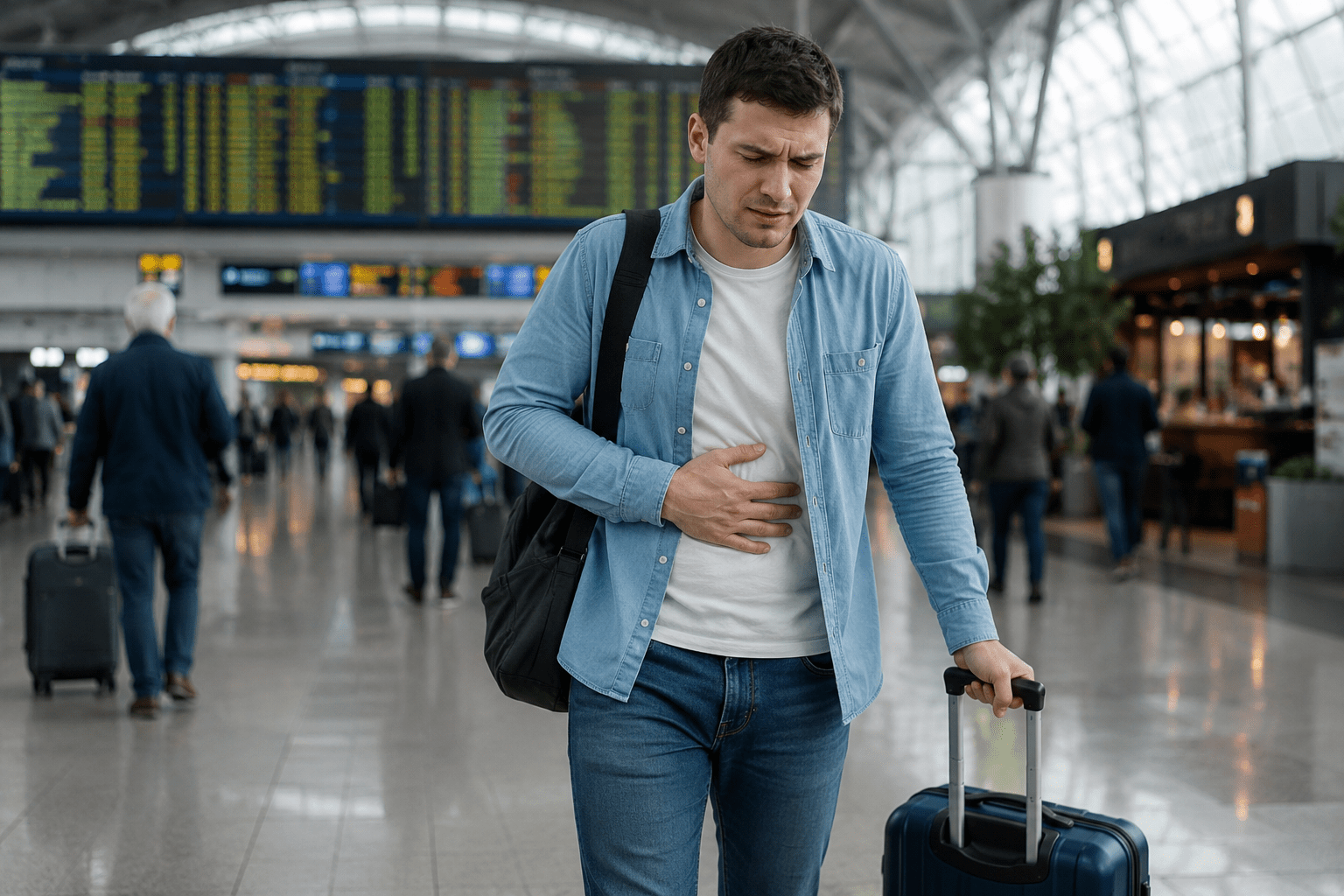
You pack your bags, board the plane, and arrive at your destination feeling excited. Then, somewhere between day one and day three, your digestion goes quiet. No urgency. No movement. Nothing. If you have ever wondered why travel causes constipation, you are not alone. It is so common among frequent travelers that many simply expect it as part of any trip.
The problem is real and well-documented. A 2024 study that followed 30 people on a medium-haul flight found that travelers waited a median of 6 extra hours before their first bowel movement compared to their usual schedule. In the most affected group, people went almost two full days without a bowel movement after arriving abroad. [1]
This article explains the 7 main reasons travel disrupts your digestion, who is most likely to be affected, how to prevent it, and the best remedies if it has already started.
What Is Travel Constipation?
Travel constipation means having harder stools or going to the bathroom less often during or right after a trip. It is not a separate disease. It is a temporary version of constipation caused by the many routine changes that come with travel.
Medically, constipation means fewer than three bowel movements per week, or stools that are hard and difficult to pass. During travel, many people who normally go every day suddenly go two, three, or four days without any movement. Bloating, gas, and stomach discomfort often come along with it.
The good news: constipation after vacation almost always goes away on its own within one to three days of getting home and returning to your normal routine. But there are also steps you can take to prevent it or speed up recovery.
At a Glance: Best Travel-Friendly Constipation Remedies
- Best overall: MiraLAX Mix-In Pax (Single-Dose Packets) — unflavored, dissolves in any drink hot or cold, no harsh urgency, specifically packaged for travel
- Best for fast/rescue relief on the go: Natural Vitality CALM Magnesium Citrate Powder — individual sachets, works within 30 minutes to 6 hours, no refrigeration needed
- Best no-pills snack option: Sunsweet Individually Wrapped Prunes — shelf-stable, TSA-friendly solid snack, no liquid restrictions to worry about
- Best daily fiber to stay regular all trip: Metamucil Fiber Singles (On-the-Go Packets) — pre-measured psyllium husk, mixes into any drink, built for travel use
- Best preventive pick (start before you fly): Align Probiotic — shelf-stable capsules with a clinically studied strain, no cold storage needed, start 3 to 5 days before departure
7 Reasons Why Travel Causes Constipation
These digestive disruptions are rarely caused by just one thing. They usually happen when several factors pile on at the same time. Here is what the research shows.
1. Your Body Clock Gets Confused
Your gut runs on an internal schedule. It does not work on demand. A 2020 study in the Journal of Clinical Gastroenterology confirmed that your colon is most active in the morning after you wake up and after meals. At night, activity slows down significantly. [2]
When you cross time zones or shift your sleep and meal schedule, this internal clock gets thrown off. A 2025 research review in Frontiers in Nutrition introduced the term “gut jet lag” to describe what happens: the biological clock that normally tells your colon when to contract gets out of sync with the new time zone. The result is that your gut’s natural morning “go” signal simply does not fire. [3]
A 2023 review in Frontiers in Physiology added to this by showing that the colon has its own set of internal clock genes that control muscle contractions, mucus production, and fluid balance. All of these get disrupted when you travel across time zones. [4]
Even without major time zone changes, simply sleeping at different hours or eating at irregular times on vacation can be enough to delay your usual bowel routine by a full day or more.
2. Airplane Air Dries You Out
Airplane cabins are much drier than normal indoor environments. The air inside a plane has a humidity level as low as 10 to 20 percent, which is drier than most deserts. You lose water just by breathing in air this dry, often without noticing, and you usually do not feel thirsty until you are already dehydrated.
When your body is low on water, your colon pulls moisture from your stool to help balance fluid levels elsewhere in your body. This turns soft stool into hard, dry stool that is difficult and sometimes painful to pass. Dietitians recommend drinking about one 8-ounce glass of water per hour during a flight to compensate for this loss. [5]
Alcohol and coffee make things worse. Both act as diuretics, meaning they cause your body to lose even more water through urine. Having a couple of drinks on a long flight with no extra water is one of the most common reasons people arrive at their destination already constipated.
Dehydration also continues after you land. A warmer climate, higher altitude, or simply forgetting to drink enough water while sightseeing can keep your body short on fluids throughout your trip.
For more on the link between water intake and bowel health, see our guide: Fast Constipation Relief at Home: 12 Natural Ways That Actually Work.
3. Your Diet Changes Suddenly
Airport food, fast food, convenience store snacks, and restaurant meals eaten while traveling tend to be low in fiber and high in processed carbohydrates, salt, and fat. Fiber is what gives your stool bulk, keeps it moist, and triggers the muscle contractions that push waste through your colon. Without enough fiber, stool becomes small, dry, and slow-moving.
Most adults need 25 to 35 grams of fiber per day for healthy bowel function. On a typical heavy travel day, many people eat fewer than 10 to 15 grams without realizing it.
A sudden change in food also affects your gut bacteria. The trillions of microbes living in your gut are accustomed to your normal diet. When your food changes dramatically, the balance of these bacteria can begin shifting within 24 hours, according to a major review in the Journal of Translational Medicine. This reduces populations of the good bacteria that ferment fiber and produce compounds that stimulate colon movement. [6]
For the best high-fiber foods to eat before and during travel, see our guide to Fiber Foods and Fiber Therapy for Gut Health.
4. You Sit for Too Long
Long flights, road trips, and train journeys can mean sitting still for six, ten, or even more hours at a stretch. Your colon needs movement to work properly. Walking and other physical activity send signals to your gut that trigger muscle contractions, pushing waste forward. When you sit still for hours, those contractions slow down and waste moves through your system more slowly.
Research consistently shows that people who are sedentary have slower digestive transit and a higher risk of constipation. Even a short 10 to 15 minute walk after a meal can meaningfully speed up how quickly food moves through your gut compared to sitting down right after eating.
The sitting problem also compounds throughout a travel day. The hours on the plane are followed by more sitting in a taxi, then sitting at a hotel check-in, then at dinner. A typical long travel day can easily add up to 14 to 18 hours of nearly continuous sitting with almost no physical activity.
5. Travel Stress Slows Your Gut
Travel carries a surprisingly large stress load: getting to the airport, making connections, navigating an unfamiliar place, dealing with delays, adjusting to a new language, and the general anxiety of being out of your normal routine. Your gut responds to all of this directly.
Your digestive system is connected to your brain through a network of nerves sometimes called the “gut-brain connection.” When you feel stressed, your body shifts into survival mode. Blood flow moves away from digestion and toward your muscles and heart, and your gut slows down, according to a 2023 review in The Journal of Physiology. [10]
This is a real biological response, not just in your head. Stress hormones act directly on the intestines to reduce the muscle contractions that move stool forward. The more anxious you feel during travel, the slower your gut works. For some people, even mild travel stress is enough to delay their next trip to the bathroom by a full day or more.
6. You Hold It In
Many people feel uncomfortable going to the bathroom in public restrooms, cramped airplane toilets, or unfamiliar hotel bathrooms. Because of this, they consciously or unconsciously ignore the urge to go, waiting until they feel more comfortable or more private.
This is one of the most underrated causes of bowel changes during travel. The longer stool sits in your colon waiting to come out, the more water your colon absorbs from it. Stool that would have been easy to pass on day one becomes progressively harder and drier the longer it stays in. What starts as a minor delay can turn into a genuinely uncomfortable situation by day three.
There is also a secondary effect: repeatedly ignoring the urge can make the signal weaker over time. Your body eventually stops sending a strong urge because it has learned that the signal will be ignored. This makes it even harder to go when you finally do find a comfortable bathroom.
7. Your Meal Schedule Gets Disrupted
Your gut uses a signal called the gastrocolic reflex to time bowel movements. This reflex is activated when food enters your stomach and tells your colon to start contracting to make room for new material. It is strongest in the morning after your first meal of the day, which is why many people go to the bathroom most reliably after breakfast.
Travel disrupts this entirely. Breakfast gets skipped because your flight leaves at 5 AM. Lunch is a bag of pretzels eaten at the departure gate. Dinner arrives at 10 or 11 PM in a time zone your gut does not yet recognize. Each of these disruptions weakens the signal that normally tells your colon it is time to move. The result is that your gut simply waits, and waits, and nothing happens.
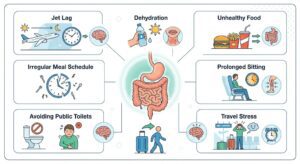
Who Gets Travel Constipation Most?
These digestive problems while traveling can happen to anyone, but some groups are more likely to be affected than others.
Women are more prone to constipation in general and tend to be more affected by travel-related digestive disruption. Women are diagnosed with constipation at about twice the rate of men, partly because of hormonal differences, naturally slower gut transit, and a stronger gut-brain stress response. [7]
People with IBS-C (irritable bowel syndrome with constipation) or existing chronic constipation are at much higher risk. Their gut motility is already slower than average, and even small disruptions to their routine can trigger multi-day episodes.
Long-haul travelers crossing several time zones have more severe gut jet lag than people taking short domestic trips. The more time zones crossed, the bigger the clock disruption and the longer it takes to recover.
Older adults have naturally slower gut transit and a weaker gastrocolic reflex compared to younger people, making them more vulnerable to any extra disruption. For more, see our guide on Constipation Relief for Older Adults.
People taking certain medications including opioid pain relievers, iron supplements, some antidepressants, and anticholinergics (a category that includes certain allergy, bladder, and antidepressant medications) already have slower gut motility as a side effect. Travel adds further disruption on top of an already compromised system.
How to Prevent Constipation While Traveling
Prevention is the most effective approach to constipation while traveling. Most of these steps are simple, low-cost, and can make a significant difference with minimal effort.
Drink More Water, Especially on the Plane
Aim for at least one 8-ounce glass of water per hour on any flight. Bring a refillable water bottle, fill it after going through security, and ask flight attendants for extra water before you feel thirsty. Cut back on alcohol and coffee during flights since both cause your body to lose more water. When you reach your destination, keep drinking regularly and do not let sightseeing distract you from staying hydrated.
Eat More Fiber Before and During Your Trip
In the two to three days before you leave, add more fiber to your meals: fruits, vegetables, beans, and whole grains. This builds up stool bulk and feeds your good gut bacteria before the disruptions of travel begin. For snacks on the road, pack items that do not need refrigeration: dried prunes, dried figs, almonds, or individual sachets of psyllium husk powder. These are portable and genuinely effective. See our guide to dried figs for constipation and our guide to prune juice for the research behind these choices.
Get Up and Move Every Hour or Two
On long flights, get up and walk the aisle for a couple of minutes at least once per hour. On road trips, plan a stop every 90 minutes or so and take a short walk. At your destination, walk to restaurants and attractions when you can instead of always taking taxis or rideshares. Regular movement throughout the day is one of the most reliable ways to keep your gut working normally.
Protect Your Morning Bathroom Routine
Even when traveling, try to keep your usual morning bathroom window open. If you normally go after breakfast, make time for that even on travel days. Eat breakfast, sit down, and give your body the chance, even if nothing happens right away. Most importantly, never ignore the urge when it does come. Acting on it promptly is one of the simplest things you can do to avoid a buildup.
Start a Probiotic a Few Days Before You Leave
Your gut bacteria are sensitive to sudden changes in food, water, and environment. Starting a probiotic supplement three to five days before your trip and continuing through your travel can help keep your gut bacteria balanced during dietary changes. Look for strains with good evidence for constipation, such as Bifidobacterium lactis. For specific product recommendations, see our guide to probiotics for constipation relief.
Bring a Fiber or Magnesium Supplement
Psyllium husk powder sachets are easy to pack and can be stirred into any glass of water or juice. Taking one daily during your trip helps maintain stool bulk and moisture even when your diet is low in fiber. Some travelers also use a low nightly dose of magnesium citrate or magnesium glycinate (commonly 200 to 300 mg) with a full glass of water to help prevent stool from hardening over multiple days, though the right dose depends on your weight, health history, and any medications you take, so it is worth checking with your doctor before starting a daily supplement, especially for trips longer than a week. This is a steady preventive dose, separate from the larger one-time dose used for active relief in the remedies section below. Both options are compact, available in individual-serving formats, and effective for travel use. See our complete guide: 5 Best Magnesium Supplements for Constipation.
Travel Constipation Remedies: How to Get Relief Fast
If you are already dealing with digestive problems while traveling or right after a trip, here are the most effective options, listed from gentlest to strongest.
1. Warm Water First Thing in the Morning
This is the simplest option and it works. Drink a large glass of warm water on an empty stomach as soon as you wake up. Adding a squeeze of fresh lemon makes it slightly more effective. The warm water activates a natural digestive signal (the gastrocolic reflex) that tells your colon to start moving. Eat breakfast within 15 to 20 minutes to keep this signal going. This costs nothing, requires nothing special, and works for many people within an hour.
2. Prune Juice (240 ml)
Prune juice works through three separate mechanisms at once: natural sorbitol draws water into your colon to soften stool, pectin (a soluble fiber) helps lubricate the gut wall, and polyphenols stimulate colon contractions and support good gut bacteria. A well-known clinical trial found that prunes outperformed psyllium fiber for improving stool frequency and softness. [8] Most people see results within 6 to 12 hours of drinking one glass (about 240 ml) on an empty stomach.
Full dosage details: Prune Juice for Constipation Relief: How Much and When to Drink.
3. Magnesium Citrate
Magnesium citrate increases the amount of fluid in your intestines, which softens stool and helps your bowel contract to move things along. It is gentler than stimulant laxatives, does not irritate your gut lining, and does not cause dependency. Most people get results within 30 minutes to 6 hours. It comes as capsules, tablets, and a dissolvable powder.
A popular travel option is Natural Vitality Calm Magnesium Citrate Powder, which comes in small individual packets you can stir into water. Natural Vitality CALM Magnesium Citrate Powder
Full product ranking: 5 Best Magnesium Supplements for Constipation.
Note for people with kidney disease: Magnesium should be used carefully or avoided if your kidneys are not functioning well. Talk to your doctor before using it if you have any kidney issues.
4. MiraLAX (Polyethylene Glycol)
MiraLAX is the top-recommended over-the-counter laxative in the joint 2023 American Gastroenterological Association and American College of Gastroenterology guideline. It received the highest evidence grade (Grade A) in a major 2021 review of constipation treatments. [9] It increases the water content of your stool, keeping it soft so it passes without cramps, urgency, or long-term dependency. Most people notice results within 12 to 72 hours, depending on the dose. It has no taste and dissolves into any liquid, and single-dose travel packets are small and easy to pack.
More details: Best OTC Laxatives for Constipation in the US.
5. Dried Figs or Dried Prunes
Both are portable, need no refrigeration, and have real research supporting their effects. Dried figs contain a natural digestive enzyme (ficin), sorbitol, and prebiotic fiber that feeds good gut bacteria. Dried prunes contain sorbitol, pectin, and plant compounds that stimulate the colon. Eat 3 to 5 pieces daily as a snack and expect to notice a difference within 24 to 48 hours. These work best for mild or early constipation rather than situations where you have not gone for several days.
More details: Dried Figs for Constipation: 6 Biological Mechanisms Explained.
6. Abdominal Massage and a Short Walk
Gently massaging your abdomen in a clockwise direction, following the path your colon actually follows, can help stimulate movement mechanically. Start at your lower right abdomen, move upward toward your right ribs, then across to the left, then down the left side, and finally in toward the center. Use firm but gentle pressure and spend about 5 to 10 minutes on this. Then take a 10-minute walk. Together, these two steps can help you go within one to two hours for mild constipation, without any medication at all.
7. Senna (For Stubborn Cases Only)
If you have not had a bowel movement for three or more days and gentler options have not worked, senna (sold as Senokot or Ex-Lax) is a fast-acting option with strong research support. It works by directly stimulating the colon’s muscle contractions and usually produces a result within 6 to 12 hours of taking it at bedtime. Use it only in the short term, no more than 7 consecutive days, and do not make it a regular habit. Repeated long-term use can lead to dependency. Dosage details: Best OTC Laxatives.
Quick Comparison: Travel Constipation Remedies
| Remedy | How It Works | How Fast | Best For |
|---|---|---|---|
| Warm water (empty stomach) | Triggers natural morning bowel signal | 15 to 60 minutes | Mild constipation, day 1 to 2 |
| Prune juice (240 ml) | Softens stool + stimulates colon | 6 to 12 hours | Mild to moderate, day 1 to 3 |
| Magnesium citrate | Increases fluid in the colon to soften stool | 30 minutes to 6 hours | Moderate constipation, gentle option |
| MiraLAX (PEG) | Increases water content of stool | 12 to 72 hours | Moderate to severe, multi-day option |
| Dried figs or prunes | Fiber + natural sorbitol + enzymes | 24 to 48 hours | Prevention and mild early relief |
| Abdominal massage + walk | Physically stimulates gut movement | 1 to 2 hours | Mild constipation, no medications needed |
| Senna | Directly stimulates colon contractions | 6 to 12 hours | Stubborn cases, day 3 or more (short-term only) |
When to See a Doctor
Most cases of constipation after a trip clear up within a day or two of getting home. But you should see a doctor right away if you have any of the following:
- No bowel movement for more than 5 days even after trying home remedies
- Severe stomach pain or cramping
- Blood in your stool or on the toilet paper
- Vomiting combined with constipation
- Fever above 38 degrees C (100.4 degrees F)
- Noticeable unintended weight loss
- Constipation that does not go away within two weeks of returning home
- New constipation that has no obvious travel-related cause (this could point to a thyroid problem, a nerve issue, or a bowel condition that needs proper diagnosis)
These signs can indicate something more serious than ordinary bowel changes during travel, such as post-infectious IBS or a structural bowel problem, that requires a medical evaluation.
Frequently Asked Questions
Why do I get constipated when traveling?
Travel disrupts your gut in several ways at once. Your body clock gets thrown off by new time zones, so your colon’s natural morning signal weakens. Dry cabin air and reduced water intake harden your stool. Low-fiber travel food removes the bulk your gut needs to push waste forward. Long hours of sitting slow digestion down further. Stress shifts blood flow away from your gut as part of a natural stress response. Avoiding unfamiliar bathrooms lets stool dry out even more. And skipped or irregular meals weaken the reflex that normally triggers a bowel movement after eating. These seven factors often hit at the same time during travel.
How long does travel constipation last?
For most healthy adults, travel constipation goes away within 1 to 3 days of getting home and returning to your normal routine. If it lasts more than 5 days or comes with pain, blood in stool, vomiting, or fever, see a doctor.
What is the fastest way to relieve constipation while traveling?
The quickest options are: a large warm glass of water on an empty stomach right after waking (can work within 15 to 60 minutes), magnesium citrate (usually works within 30 minutes to 6 hours), or a glass of prune juice (typically works within 6 to 12 hours). Combining warm water, a 10-minute walk, and magnesium citrate is often the most effective approach for moderate cases. If constipation has already lasted several days, MiraLAX taken daily is the top doctor-recommended option.
Does jet lag cause constipation?
Yes. Jet lag disrupts the internal clock that controls when your colon is most active. Research in the Journal of Clinical Gastroenterology shows that your bowel follows a precise daily rhythm with its strongest contractions happening in the morning. [2] When you cross multiple time zones, that rhythm gets misaligned with your new location. A 2025 review gave this the specific name “gut jet lag.” [3]
Is it normal not to poop for 3 days while traveling?
It is common, though uncomfortable. Many travelers go 2 to 4 days without a bowel movement, and research confirms this is usually temporary. [1] Three days is not immediately dangerous for otherwise healthy adults, but it is worth addressing with home remedies rather than waiting it out. If you reach 5 or more days, or develop pain, blood in stool, or fever, see a doctor.
How can I stay regular while traveling?
To stay regular while traveling: drink plenty of water throughout the day (at least 1 glass per hour on flights), pack high-fiber snacks like dried prunes or figs, get up and walk every hour or two during long journeys, keep your morning bathroom routine as consistent as possible, start a probiotic 3 to 5 days before your trip, and bring a portable fiber or magnesium supplement for daily use.
Does airplane travel cause constipation even on short flights?
Yes, short flights can still trigger constipation. The dry cabin air, extended sitting, reduced water intake, and travel stress are all present on any flight. That said, constipation is more common and more severe after long-haul flights and trips across multiple time zones, where body clock disruption and dehydration are greater.
References
- Hansen SB, Reistrup H, Rosenberg J, Fonnes S. Traveler’s Constipation: A Prospective Cohort Study. Journal of Clinical Medical Research. 2024;5(3):1-8. athenaeumpub.com
- Duboc H, Coffin B, Siproudhis L. Disruption of Circadian Rhythms and Gut Motility: An Overview of Underlying Mechanisms and Associated Pathologies. Journal of Clinical Gastroenterology. 2020;54(5):405-414. PMID: 32134798
- Li J, Yu K, Sui X, et al. Gut jet lag: how circadian rhythm disruption undermines the Chrono-Microbiota-Motility axis and induces functional constipation. Frontiers in Nutrition. 2025;12:1678482. PMC12528175
- Hibberd TJ, Ramsay S, Spencer-Merris P, et al. Circadian rhythms in colonic function. Frontiers in Physiology. 2023;14:1239278. DOI: 10.3389/fphys.2023.1239278
- Dietitian’s No. 1 Rule to Avoid Constipation When Traveling. TODAY Health. December 2025. today.com
- Singh RK, Chang HW, Yan D, et al. Influence of Diet on the Gut Microbiome and Implications for Human Health. Journal of Translational Medicine. 2017;15:73. PMC5385025
- Cleveland Clinic. Why You Get Constipated While Traveling. 2023. health.clevelandclinic.org
- Attaluri A, Donahoe R, Valestin J, Brown K, Rao SS. Randomised Clinical Trial: Dried Plums (Prunes) vs. Psyllium for Constipation. Alimentary Pharmacology & Therapeutics. 2011;33(7):822-828. PMID: 21323688
- Rao SS, Brenner DM. Efficacy and Safety of Over-the-Counter Therapies for Chronic Constipation: An Updated Systematic Review. American Journal of Gastroenterology. 2021;116(6):1156-1184. PMID: 33767108
- Leigh SJ, Uhlig F, Wilmes L, et al. The Impact of Acute and Chronic Stress on Gastrointestinal Physiology and Function: A Microbiota-Gut-Brain Axis Perspective. The Journal of Physiology. 2023;601(20):4491-4538. DOI: 10.1113/JP281951
Medical Disclaimer: The information on ConstipationRelief.net is for general educational purposes only and does not replace professional medical advice. Always consult your doctor before making dietary or supplement changes, especially if you have kidney disease, a bowel condition, or are taking medications.
⚠️ Affiliate Disclosure: ConstipationRelief.net participates in the Amazon Services LLC Associates Program. When you click an Amazon link and make a qualifying purchase, we may earn a small commission at no extra cost to you. Our picks are based on research and user data, not paid promotions.