


Walk down the gut-health aisle and you’ll see “probiotic” on one bottle and “synbiotic” on the next, at very different prices, with nothing on the label explaining the difference. Picking the wrong category can mean weeks of waiting for relief that product was never going to provide.
Women also experience constipation differently than men, due to hormonal fluctuations, differences in gut motility, and microbiome changes that shift across the menstrual cycle, pregnancy, and menopause. That’s why the synbiotics vs probiotics for women’s constipation question deserves a real answer, not a guess based on whichever bottle looks more scientific.
What follows is a side-by-side look at the trial data, the strains worth seeking out, and how to match a strategy to your specific situation.
Quick answer: In several individual clinical trials, synbiotics (a probiotic plus the prebiotic fiber that feeds it) have shown greater improvements in stool frequency and symptom scores than standalone probiotics for women’s constipation. But the picture is more mixed at the meta-analysis level — the synbiotic trial base is still small, and one major review found it too limited to draw firm conclusions, while probiotics have a larger, more consistent trial record. One popular single-strain probiotic also recently failed to beat a placebo outright. The most evidence-based starting point is a formula pairing a clinically studied strain (Bifidobacterium lactis HN019/BB-12 or Lactobacillus reuteri DSM 17938) with a prebiotic fiber like inulin, FOS, or GOS — a modest edge, not a guaranteed win.
At a glance: Probiotics and Synbiotics for Women’s Constipation
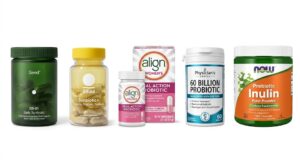
- 🏆 Best overall synbiotic: Seed DS-01 Daily Synbiotic — highest strain diversity, third-party tested
- 💰 Best value synbiotic-style: Physician’s Choice 60 Billion Probiotic + Prebiotics — high CFU count at a lower price per serving
- 🔬 Best strain-backed standalone probiotic: Align Women’s Dual Action Probiotic — B. longum 35624, 20+ years of research
- 🌿 Best for adding fiber to an existing probiotic: NOW Foods Organic Inulin Powder — cheap, flexible dosing
- ⚖️ Best synbiotic + postbiotic combo: Ritual Synbiotic+ — BB-12 plus a tributyrin postbiotic
Probiotics vs Prebiotics vs Synbiotics: What’s the Actual Difference?
Before comparing how well each one works for constipation, it helps to understand what you’re actually taking.
| Term | What it actually is | Examples |
|---|---|---|
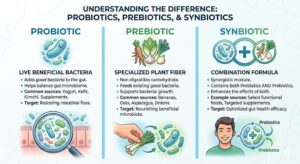
| Probiotic | Live microorganisms that, when consumed in adequate amounts, provide a measurable health benefit | Bifidobacterium, Lactobacillus species |
| Prebiotic | Not a living organism — a non-digestible fiber or compound that feeds the beneficial bacteria already in your gut | Inulin, fructooligosaccharides (FOS), galactooligosaccharides (GOS) |
| Synbiotic | Live bacteria plus the fiber that feeds them, packaged together, with its own evidence of benefit | A combination of the two above |
According to the 2020 consensus statement from the International Scientific Association for Probiotics and Prebiotics (ISAPP), a true synbiotic isn’t just any probiotic-prebiotic combination thrown into one capsule — it’s a formulation with its own evidence of conferring a health benefit on the host. ISAPP splits synbiotics into two types:
- Complementary synbiotic: the probiotic and prebiotic are each independently effective and simply combined in one product — like a yogurt with live cultures served alongside a whole-grain cereal.
- Synergistic synbiotic: the prebiotic is specifically chosen because it’s the preferred fuel source for that particular probiotic strain, so the two ingredients work as a team rather than independently.
This distinction is important because it affects how the two ingredients interact in the gut. A synergistic synbiotic theoretically gives the probiotic strain a survival and colonization advantage it wouldn’t have alone — which is the entire selling point of choosing a synbiotic over a plain probiotic supplement in the first place.
Why Women’s Constipation Deserves Its Own Conversation
Constipation isn’t gender-neutral. Multiple population studies have found that chronic constipation is consistently more common in women than in men, and the mechanisms behind that gap go beyond “women just report it more.”
Hormones Change Gut Motility Throughout the Month and Across Life Stages
Estrogen and progesterone both directly influence the smooth muscle contractions that move stool through the colon. Elevated progesterone slows gut motility — part of why constipation is so common in the luteal phase of the menstrual cycle, during pregnancy (when progesterone rises substantially), and after menopause, when declining estrogen and progesterone are associated with slower gut transit and a higher likelihood of constipation and bloating.
The gut microbiome itself shifts in step with these hormonal changes. After menopause, a woman’s gut microbial profile tends to shift toward a composition that more closely resembles the male microbiome — researchers describe this as a loss of the female-specific microbial diversity that estrogen previously helped maintain. For a closer look at this transition specifically, see constipation and bloating: what’s actually happening.
The Gut Bacteria Differences Are Measurable, Not Just Theoretical
A 2021 study published in Frontiers in Cellular and Infection Microbiology specifically examined gut bacteria in women of reproductive age — deliberately excluding men, children, and postmenopausal women so age and hormonal status wouldn’t muddy the results. Researchers compared stool samples from 29 constipated women against 30 healthy women, matched for age and BMI.
| Marker | Constipated women | Healthy women |
|---|---|---|
| Bacteroides abundance | Significantly higher | Lower |
| Proteobacteria abundance | Significantly lower | Higher |
| Firmicutes-to-Bacteroidetes ratio (a general gut-balance marker) | 1.52 | 2.21 |
| Roseburia and Fusicatenibacter (butyrate-producing bacteria) | Significantly lower | Higher |
Roseburia and Fusicatenibacter produce butyrate, a short-chain fatty acid that stimulates colonic motility and helps regulate the release of serotonin in the gut, which in turn influences how quickly the bowel moves. This matters directly for the synbiotics-vs-probiotics question: if a deficit of butyrate-producing bacteria is part of the puzzle in women’s constipation, supplementation strategies that specifically feed those bacteria — exactly what a well-matched synbiotic prebiotic fiber is designed to do — have a clear mechanistic rationale, not just a marketing one. This deficit also helps explain why fiber alone sometimes isn’t enough; for more on that, see our guide on why fiber isn’t working for your constipation.
Synbiotics vs Probiotics for Women’s Constipation: Clinical Trial Results Compared
Claims about gut bacteria only matter if they translate into real bowel movements. Several randomized controlled trials have tested probiotics and synbiotics directly against each other (and against placebo), and a few are specifically informative for women.
The Spanish Four-Arm Trial (Probiotic vs Prebiotic vs Synbiotic vs Placebo)
A 2024 randomized, double-blind, placebo-controlled pilot trial published in Gastroenterology Report (NCT06381193) split 74 adults with chronic functional constipation into four groups. The study population was overwhelmingly female — 71 of 74 completing participants were women, mean age about 45.
Quick legend: ↑ Weekly bowel movements = better · ↓ GSRS Symptom Score = better
| Group | Weekly bowel movements ↑ | GSRS Symptom Score¹ ↓ |
|---|---|---|
| Placebo | Increased, but not significantly | No significant improvement |
| Probiotic (4 Bifidobacterium strains) | Increased² | 14.6 → 11.2 |
| Prebiotic (oat fiber, inulin, FOS, marshmallow extract) | Increased² | 14.8 → 12.0 |
| Synbiotic | 2.8 → 5.9 (more than doubled) | 13.0 → 8.7 (largest improvement) |
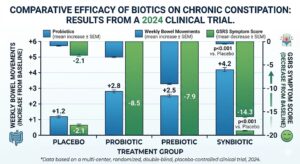
¹GSRS = Gastrointestinal Symptom Rating Scale, a validated questionnaire score where a lower number means fewer/milder symptoms. Every figure in this column — 14.6 → 11.2, 14.8 → 12.0, and 13.0 → 8.7 — is a GSRS score, not a bowel-movement count. Both columns reflect genuine improvement; they’re just two different scales (see legend above) measuring two different things.
²The published trial summary specified exact baseline-to-week-8 bowel movement numbers only for the synbiotic group; the probiotic, prebiotic, and placebo groups were reported only as “increased” without exact figures broken out by group.
Stool frequency increased in all four groups, including placebo — a reminder of how strong the placebo effect can be when people start tracking their bowel habits closely. But the synbiotic group’s jump was the largest by a wide margin, and on the validated symptom scale (GSRS), the synbiotic group was the only one to clearly separate from a placebo group that showed no significant improvement at all.
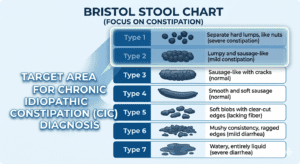
Stool consistency (measured with the Bristol Stool Scale) also improved significantly in the probiotic, prebiotic, and synbiotic groups but not in placebo. If you’ve never seen this scale, our Bristol Stool Chart guide explains what each stool type means.
The Slow Transit Constipation Trial
A separate randomized, placebo-controlled trial enrolled 100 patients with slow transit constipation — a subtype where the colon’s muscular contractions are too weak or infrequent to move stool along efficiently, a pattern research notes is more prevalent in women. Participants took a synbiotic or placebo twice daily for 12 weeks.
| Outcome at week 12 | Synbiotic group | Placebo group |
|---|---|---|
| Clinical remission | 45.8% | 16.7% |
| Overall clinical improvement | 64.6% | 29.2% |
| Colonic transit time (imaging) | Faster | Unchanged |
An Important Caveat: Not Every Probiotic Trial Shows a Benefit
Bifidobacterium lactis HN019 is one of the most frequently recommended single probiotic strains for constipation, and earlier dose-ranging studies found it improved colonic transit time. But a large, more recent triple-blind randomized clinical trial — 229 participants across five hospitals in China, 84.7% of them women, mean age about 45 — found that 8 weeks of HN019 supplementation did not outperform placebo on the primary outcome of complete spontaneous bowel movements per week. Both groups improved by a similar amount.
This doesn’t mean HN019 is worthless, and it doesn’t overturn the synbiotic findings above, since that trial tested a single strain alone rather than a synbiotic combination. It’s a useful reality check, though: single-strain probiotics, taken in isolation, don’t always clear the placebo bar in rigorous trials.
What Do Broader Meta-Analyses Say?
The individual trials above look favorable for synbiotics, but it’s worth being honest about how thin that evidence base still is once you zoom out. A 2022 systematic review and meta-analysis in Clinical Nutrition pooled the available randomized trials and found a striking imbalance: 30 RCTs (2,804 participants) had tested probiotics for chronic constipation, but only 4 RCTs (275 participants) had tested synbiotics.
Pooling that small synbiotic dataset, the reviewers found no significant effect on stool output or symptom scores compared to control, and concluded there was currently insufficient evidence to recommend synbiotics for constipation management. Probiotics fared better in the same review — particularly Bifidobacterium lactis — with a significant improvement in stool frequency and integrative symptom scores.
A more recent 2024 network meta-analysis in the European Journal of Nutrition, which pooled 37 RCTs (3,903 patients) across probiotics, prebiotics, and synbiotics, came to a more favorable conclusion for synbiotics — finding they did significantly increase weekly stool frequency, alongside prebiotics and lactulose.
However, the certainty of evidence behind this finding ranges from moderate to very low depending on the specific comparison being made. That means even this more favorable analysis isn’t built on high-confidence data, and future, better-designed trials could still shift the picture.
In short: the two most recent large individual trials (the 2024 Spanish trial and the slow-transit trial) favor synbiotics fairly clearly, but the pooled literature is mixed, and the synbiotic evidence base is considerably smaller than the probiotic one. That’s a meaningful caveat, not just a footnote — it’s the reason this article frames synbiotics as having a modest, trial-dependent edge rather than a settled win over probiotics.
Best Probiotic Strains for Women’s Constipation (Evidence-Based)
Label specificity matters enormously here. A product that simply lists “Bifidobacterium species” or “Lactobacillus blend” without naming the actual strain gives you no real assurance you’re getting something studied in a clinical trial — and as the HN019 example above shows, even a well-studied strain can underperform when tested rigorously on its own.
| Strain | Best evidence for | Notes |
|---|---|---|
| Bifidobacterium lactis (HN019 or BB-12) | Stool frequency, colonic transit time | Broadest evidence base across meta-analyses, with the HN019 single-strain caveat above |
| Lactobacillus reuteri DSM 17938 | First-time users, mild constipation | Demonstrated increases in bowel movement frequency; gentle side-effect profile |
| Bifidobacterium longum | Chronic constipation persisting for years | Shown to reduce colonic transit time specifically |
For a more detailed strain-by-strain breakdown of dosing and time-to-effect, see our dedicated guide to best probiotic strains for constipation and bloating. If abdominal pain or bloating sits alongside your constipation — which often points toward IBS-C rather than plain functional constipation — see best probiotics for IBS-C and constipation, since the evidence for pain-and-bloating relief doesn’t always track with the evidence for stool frequency.
5 Research-Informed Product Picks: Probiotics and Synbiotics for Women’s Constipation
Note: these products were selected based on ingredient quality, the presence of clinically studied strains, formulation transparency, and publicly available evidence — not sponsorship or affiliate partnerships. Unless stated otherwise, the branded formulas below have not themselves been tested as a complete product in the specific trials discussed earlier in this article; the trial evidence applies to the individual strain(s) they contain (e.g., BB-12, B. longum 35624), not necessarily the full multi-ingredient formula. As always, check with your healthcare provider before starting anything new, especially if you’re pregnant, breastfeeding, or managing another health condition.
| Product | Category | Pros | Cons |
|---|---|---|---|
| Seed DS-01 Daily Synbiotic | Full synbiotic (24 strains + prebiotic) | Highest strain diversity here; third-party tested; non-fermenting prebiotic is gentler on sensitive stomachs | No dedicated published RCT on this exact formula; most expensive option; subscription-based |
| Ritual Synbiotic+ | Synbiotic + postbiotic | Contains BB-12 (strain-level trial support); includes a tributyrin postbiotic; available without subscription | The combined formula itself isn’t separately trial-tested; ~$1.80/serving; mild gas reported in first 1–2 weeks |
| Align Women’s Dual Action Probiotic | Standalone probiotic | Core strain (B. longum 35624) has 20+ years of strain-level research behind it; shelf-stable | No prebiotic fiber included; contains dairy-derived ingredients |
| Physician’s Choice 60 Billion Probiotic + Prebiotics | Budget synbiotic-style | Cheaper per serving; allergen-free; high CFU count | This exact blend has no dedicated clinical trial; 10 strains can cause more initial gas |
| NOW Foods Organic Inulin Powder | Standalone prebiotic | Very cheap; flexible dosing; certified organic | No probiotic strains of its own; can cause gas if dosed too quickly |
For a wider product-by-product comparison, including CFU counts and additional synbiotic options, see our full guide to the 9 Best Probiotic Supplements of 2026.
Are Synbiotics and Probiotics Safe for Women at Every Life Stage?
One practical advantage of probiotics and synbiotics over stimulant laxatives is a generally favorable safety profile across a woman’s reproductive lifespan — though the evidence base is stronger for probiotics alone than for synbiotic combinations specifically.
Pregnancy and postpartum: A 2021 systematic review and meta-analysis evaluating probiotic, prebiotic, and synbiotic supplementation during pregnancy and lactation found no clear evidence of increased adverse outcomes with maternal use. However, the review’s authors specifically flagged a research gap: of the eligible studies, very few had tested true synbiotic combinations during pregnancy, meaning synbiotic-specific safety data (as opposed to probiotics alone) is thinner. Probiotics alone may be the better-studied starting point if you’re pregnant — talk to your OB-GYN first. See our guides on safe probiotics for pregnancy-related constipation and natural high-fiber foods for pregnancy constipation relief.
Perimenopause and menopause: Because declining estrogen and progesterone are linked to slower gut motility and a shift toward a less diverse, more male-pattern microbiome, this life stage is where the rationale for synbiotic supplementation is strongest on a mechanistic level — even though large-scale clinical trials specifically in menopausal women remain limited.
Choosing Between Synbiotics and Probiotics: A Practical Framework
| Your situation | What the evidence suggests |
|---|---|
| Mild, occasional constipation; first time trying a probiotic | Start with a single well-studied strain like Lactobacillus reuteri DSM 17938 |
| Chronic constipation tied to hormonal patterns (luteal phase, pregnancy, perimenopause) | A synbiotic may be worth trying first, given the two newer large trials above — but expect a modest, not guaranteed, advantage |
| Already tried a standalone probiotic for 4–6 weeks without improvement | Add a prebiotic fiber source, or switch to a synbiotic formula |
See a doctor promptly if constipation is accompanied by rectal bleeding, unexplained weight loss, severe abdominal pain, or persists for several weeks despite treatment — these are signs that warrant medical evaluation rather than further supplement trial-and-error.
Keep in mind that individual response varies a lot from person to person. Your current diet, recent antibiotic use, baseline gut bacteria composition, stress levels, and even hydration and activity level can all influence how well any single strain or formula works for you — which is part of why the trial results above show real but imperfect, inconsistent effects rather than a universal fix.
Across every group in the Spanish trial, results took roughly 8 weeks to fully materialize, and the slow transit constipation trial showed continued improvement between week 4 and week 12. So give any strain or formula at least a month, ideally two, before deciding it isn’t working.
If you’ve recently finished a course of antibiotics or a colon cleanse and want to rebuild your gut bacteria afterward, our Mag O7 review for constipation discusses why pairing a cleanse with a probiotic or synbiotic afterward is good practice. Our broader guide to fiber foods and fiber therapy for gut health also covers how dietary fiber and supplemental prebiotics work together as a foundation underneath any probiotic or synbiotic routine.
Frequently Asked Questions
Are synbiotics better than probiotics for constipation in women?
In the newest, largest individual trials, yes — synbiotics produced bigger improvements in both stool frequency and constipation symptom scores than standalone probiotics, particularly in studies where the participant pool was predominantly female. But a 2022 meta-analysis pooling the smaller, older synbiotic trial base found no significant effect compared to control, while probiotics had a larger and more consistent trial record. The honest summary: synbiotics show real promise in some recent trials, but the evidence isn’t yet as settled as the marketing for synbiotic products often implies — and a recent large trial found one popular single-strain probiotic (HN019, tested alone) didn’t outperform placebo at all.
How long do synbiotics take to work for constipation?
In the clinical trials reviewed here, meaningful improvement in stool frequency and constipation symptoms was measured at 8 weeks, with one slow-transit constipation trial showing continued improvement between weeks 4 and 12. Give a synbiotic supplement at least 4 weeks, and ideally a full 8 weeks, before judging whether it’s working.
What is the best synbiotic for women’s constipation?
Look for a formula pairing a clinically studied probiotic strain — Bifidobacterium lactis (HN019 or BB-12) and Lactobacillus reuteri DSM 17938 have the strongest individual evidence — with a prebiotic fiber source like inulin, FOS, or GOS. Avoid products that list only genus-level ingredients (e.g., “Lactobacillus blend”) without specific strain identifiers, since strain-specific effects don’t generalize across an entire bacterial species.
Can probiotics make women’s constipation worse before it gets better?
Some women experience temporary bloating or gas during the first one to two weeks of probiotic or synbiotic use as the gut microbiome adjusts. This usually resolves within 1–2 weeks and doesn’t necessarily mean the supplement is ineffective. If symptoms are severe or persist beyond two weeks, it’s worth discussing with a healthcare provider, since this can occasionally point to an underlying issue (such as small intestinal bacterial overgrowth, or SIBO) that needs different management.
Do synbiotics help with hormone-related constipation during perimenopause?
There isn’t yet a large randomized trial testing synbiotics specifically in perimenopausal or menopausal women, but the mechanistic rationale is solid: declining estrogen and progesterone are linked to reduced gut microbial diversity and slower motility, and synbiotics are designed to support the bacterial diversity and short-chain fatty acid production that tend to decline during this transition. Many women find synbiotics worth trying during this life stage, though it should be framed as a reasonable evidence-informed option rather than a guaranteed solution backed by menopause-specific trial data.
What if my constipation comes with abdominal pain and bloating, not just infrequent stools?
That combination points more toward IBS-C than plain functional constipation, and the strain evidence shifts accordingly — strains like Bifidobacterium infantis 35624 have dedicated large-scale trial data for pain and bloating specifically, which is different from the stool-frequency evidence behind BB-12 or HN019. Our guide to the best probiotics for IBS-C and constipation covers this distinction in more detail.
Medical Disclaimer: The information in this article is for general educational purposes only and is not a substitute for professional medical advice, diagnosis, or treatment. Always consult your physician, gynecologist, or gastroenterologist before starting any new supplement, particularly if you are pregnant, breastfeeding, or have an underlying health condition. This article was medically fact-checked by Dr. ABM Sadikullah, FCPS (Medicine).
Affiliate Disclosure: This article contains affiliate links to products on Amazon. If you click a link and make a purchase, ConstipationRelief.net may earn a small commission at no additional cost to you. We only recommend products we have independently researched and believe offer genuine value to our readers.
References
- Swanson KS, Gibson GR, Hutkins R, et al. The International Scientific Association for Probiotics and Prebiotics (ISAPP) consensus statement on the definition and scope of synbiotics. Nature Reviews Gastroenterology & Hepatology. 2020;17(11):687-701. DOI: 10.1038/s41575-020-0344-2
- Li H, Chen J, Ren X, et al. Gut Microbiota Composition Changes in Constipated Women of Reproductive Age. Frontiers in Cellular and Infection Microbiology. 2021;10:557515. DOI: 10.3389/fcimb.2020.557515 · PMID: 33552996
- Terrén Lora A, Penadés BF, López Oliva S, et al. Supplementation with probiotics, prebiotics, and synbiotics in patients with chronic functional constipation: a randomized, double-blind, placebo-controlled pilot clinical trial. Gastroenterology Report. 2024;12:goae101. DOI: 10.1093/gastro/goae101 · ClinicalTrials.gov: NCT06381193
- Ding C, Ge X, Zhang X, et al. Efficacy of Synbiotics in Patients with Slow Transit Constipation: A Prospective Randomized Trial. Nutrients. 2016;8(10):605. DOI: 10.3390/nu8100605 · PMID: 27690093
- Eight-Week Supplementation With Bifidobacterium lactis HN019 and Functional Constipation: A Randomized Clinical Trial. JAMA Network Open. 2024;7(10):e2436888. DOI: 10.1001/jamanetworkopen.2024.36888 · ChiCTR2000029215
- Sheyholislami H, Connor KL. Are Probiotics and Prebiotics Safe for Use during Pregnancy and Lactation? A Systematic Review and Meta-Analysis. Nutrients. 2021;13(7):2382. DOI: 10.3390/nu13072382
- van der Schoot A, Helander C, Whelan K, Dimidi E. Probiotics and synbiotics in chronic constipation in adults: a systematic review and meta-analysis of randomized controlled trials. Clinical Nutrition. 2022;41(12):2759-2777. DOI: 10.1016/j.clnu.2022.10.015
- Deng X, Liang C, Zhou L, et al. Network meta-analysis of probiotics, prebiotics, and synbiotics for the treatment of chronic constipation in adults. European Journal of Nutrition. 2024;63(6):1999-2010. DOI: 10.1007/s00394-024-03410-1 · PMID: 38693449