

📋 Table of Contents
- Emma’s Story: Two ER Visits and One Simple Solution
- The Science: Why Coconut Water Helps Constipation
- Coconut Water’s Nutritional Profile
- Why Dehydration-Driven Constipation Is Especially Dangerous in the Elderly
- How to Use Coconut Water for Constipation Relief
- Recommended Products
- Limitations and When It May Not Be Enough
- FAQ
- Research References
🧡 Emma’s Story: Two ER Visits and One Simple Solution
Background: Severe Constipation and Fecal Impaction
Emma Marilyn Gonzales Pineda shared her painful experience caring for her 96-year-old mother, who developed severe constipation caused by fecal impaction — a condition where hardened stool becomes lodged in the colon or rectum and cannot be passed naturally.
Within one month, her mother had to be taken to the emergency room twice. She complained of intense pain in her lower body and abdomen. Doctors had to manually remove the impacted stool on both occasions — a deeply distressing experience for both mother and daughter.
All Standard Remedies Had Failed
Before turning to coconut water, Emma had tried every commonly recommended approach:
| Remedy Tried | Result |
|---|---|
| Prune juice | No lasting relief; taste too sour for her mother to drink consistently |
| Papaya | Minimal effect |
| Abdominal massage | Temporary comfort only |
| Warm compress | Comfort only, no bowel movement |
| Docusate (stool softener) | Clinically limited effect — consistent with research showing poor efficacy[1] |
| Senna (stimulant laxative) | Insufficient response; her mother’s immobility and dehydration were overriding the effect |
| Enemas & suppositories | Temporary partial relief but no sustained bowel regularity |
Her mother was bedridden, could not sit up without dizziness, and had to be spoon-fed daily. Doctors later confirmed through clinical assessment that severe dehydration was a primary contributing factor — and administered IV fluids during both ER visits.
The Turning Point: Focusing on Hydration
After the second ER visit, Emma shifted her focus from laxatives to hydration. She was looking for something that was:
- Easy to swallow for an elderly, bedridden patient
- Naturally sweet (to encourage consistent intake)
- Gentle on a sensitive, elderly stomach
- Rich in electrolytes to address the confirmed dehydration
That is when she chose coconut water — available in every supermarket, naturally sweet, and known for its electrolyte content.
The Routine That Worked
Emma began giving her mother warm coconut water twice daily:
- One cup (approximately 240 ml) at 10 a.m.
- One cup at 3 p.m.
Her full daily routine:
| Time | Food/Drink | Purpose |
|---|---|---|
| Breakfast & Dinner | Ensure (liquid nutrition supplement) | Caloric and protein support for a bedridden patient |
| Lunch | Prune juice diluted with a little water | Sorbitol + natural laxative compounds |
| 10 a.m. Snack | Warm coconut water (1 cup) | Electrolyte hydration + bowel stimulation |
| 3 p.m. Snack | Warm coconut water (1 cup) | Electrolyte hydration + bowel stimulation |
The Results
Within days of starting this routine, Emma noticed a dramatic change:
- ✅ Her mother began passing stool almost every day
- ✅ Stool was consistently soft and painless
- ✅ Complaints of rectal pain stopped completely
- ✅ No further emergency room visits
The improvement was sustained for more than two weeks of follow-up.
💬 A Second Community Experience
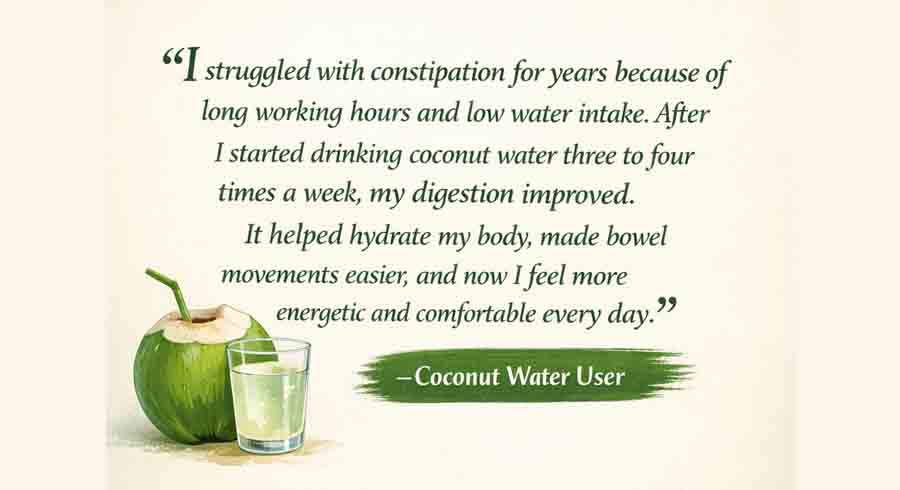
“Coconut water is the only thing that works for me. I drink it with chia seeds every night before bed and again in the morning. I go without strain or pain. I’ve had constipation issues since youth, and coconut water is the only thing that truly helps.”
This experience mirrors the clinical logic: combining coconut water’s electrolyte hydration with chia seeds’ soluble fiber creates a powerful synergistic effect — one that research on fiber and constipation strongly supports.
🔬 The Science: Why Coconut Water Helps Constipation
The original article stated that coconut water “may help constipation” with five brief bullet points but cited no research. Below is the evidence that explains exactly what happened in Emma’s mother’s case.
Mechanism 1 — Rehydration of the Colon
The most fundamental mechanism is the simplest. When the body is dehydrated, the colon compensates by absorbing excess water from stool, producing the hard, dry, difficult-to-pass stools characteristic of constipation. This effect is severely amplified in elderly individuals.
A clinical study published in PubMed found that fresh young coconut water is effective for whole-body rehydration and comparable to commercial carbohydrate-electrolyte beverages for restoring fluid balance.[3] Crucially, coconut water was reported to cause significantly less nausea, fullness, and stomach upset compared to sports drinks — making it ideal for elderly patients who are prone to GI sensitivity.
Mechanism 2 — Potassium Supports Intestinal Smooth Muscle
One cup (240 ml) of coconut water contains approximately 500–600 mg of potassium — roughly 15% of the daily recommended value. Potassium is an essential electrolyte for the function of smooth muscle throughout the body, including the intestinal wall.
Intestinal peristalsis — the rhythmic muscle contractions that move stool through the colon — depends on adequate potassium for proper smooth muscle function. Low potassium (hypokalemia), which is common in dehydrated elderly patients, can directly cause reduced intestinal motility and contribute to constipation and fecal impaction.
A 2024 double-blind randomized controlled trial published in Clinical Gastroenterology and Hepatology found that 400 ml of coconut water daily for 8 weeks significantly improved gut microbiome composition and reduced gut inflammation in patients with ulcerative colitis, with potassium-driven modulation identified as a key mechanism.[4]
Mechanism 3 — Magnesium’s Natural Osmotic Laxative Effect
One cup of coconut water contains approximately 15–16 mg of magnesium. While this is lower than therapeutic magnesium supplement doses, magnesium’s osmotic mechanism — drawing water into the intestinal lumen and softening stool — is active even at lower doses when combined with the rehydration effect of regular coconut water intake.
Research on magnesium and bowel function confirms that even dietary-level magnesium intake from food and beverages contributes meaningfully to stool softness and transit regularity, particularly in individuals who were previously deficient or dehydrated.[5] See our full review: 5 Best Magnesium Supplements for Constipation.
Mechanism 4 — Warm Temperature Activates the Gastrocolic Reflex
Emma specifically gave her mother warm coconut water. This was not just for comfort — it was physiologically meaningful. Warm liquids (especially in the morning and between meals) stimulate the gastrocolic reflex, the natural neurological response that increases colon motility approximately 20–30 minutes after eating or drinking warm fluids.
This reflex is one of the body’s primary mechanisms for initiating bowel movements — and it tends to be weakened in elderly and bedridden individuals. Warm coconut water at 10 a.m. and 3 p.m. would consistently activate this reflex twice between meals.
Mechanism 5 — Bioactive Compounds and Anti-Inflammatory Properties
Coconut water contains several bioactive compounds beyond its basic electrolyte profile, including cytokinins (plant hormones with anti-inflammatory properties), flavonoids, phenolic acids, and natural enzymes that support digestion. According to the World Gastroenterology Organisation, coconut water’s cytokinin content may help reduce gut inflammation and promote mucosal healing.[6]
🥥 Coconut Water’s Nutritional Profile (Per 240 ml / 1 Cup)
| Nutrient | Amount per Cup | % Daily Value | Role in Constipation Relief |
|---|---|---|---|
| Water | ~227 ml (95%) | — | Primary hydration — softens stool directly |
| Potassium | ~500–600 mg | ~15% DV | Supports intestinal smooth muscle contraction (peristalsis) |
| Magnesium | ~15–16 mg | ~4% DV | Mild osmotic laxative effect; draws water into intestinal lumen |
| Sodium | ~50–60 mg | ~2% DV | Maintains plasma osmolality; prevents excessive urinary excretion of water |
| Natural sugars | ~9–11 g | — | Provides mild osmotic effect; encourages fluid retention in gut |
| Dietary fiber | ~2–3 g | ~7–11% DV | Small but meaningful bulk-forming contribution |
| Vitamin C | ~10 mg | ~11% DV | Antioxidant; supports gut mucosal integrity |
| Calories | ~45–60 kcal | — | Low-calorie; appropriate for elderly patients with limited appetite |
Sources: USDA FoodData Central; WebMD Coconut Water Nutrition Profile; Kedia et al. 2024 RCT nutritional analysis.
👵 Why Dehydration-Driven Constipation Is Especially Dangerous in the Elderly
Emma’s mother’s case — 96 years old, bedridden, severely dehydrated, with recurrent fecal impaction requiring ER visits — is not unusual. It is, in fact, a well-documented and tragically common clinical pattern.
The Clinical Evidence
- Research published in BMC Geriatrics found that fecal impaction affects up to 42% of patients in geriatric wards, and 43.5% of all published cases occur in people over 65.[2]
- A landmark paper in PubMed specifically identifies immobility, dehydration, and low dietary fiber as the three primary drivers of constipation and fecal impaction in elderly populations.[7]
- StatPearls (NCBI) reports that severe constipation affects up to 70% of elderly people in nursing home or care settings.[8]
- Fecal impaction in elderly patients can cause — and is regularly misdiagnosed for — acute confusion, cardiac symptoms, respiratory distress, and overflow incontinence (often mistaken for diarrhea).[9]
Why Elderly Patients Are Especially Vulnerable
| Risk Factor | Why It Causes Constipation in the Elderly |
|---|---|
| Reduced thirst sensation | The elderly often don’t feel thirsty even when significantly dehydrated — leading to chronic under-hydration |
| Immobility | Physical inactivity dramatically slows intestinal transit time |
| Polypharmacy | Many common medications (opioids, antihistamines, calcium channel blockers, antidepressants) slow colon motility |
| Reduced colonic motility with age | Normal physiological aging slows gut transit; the gastrocolic reflex weakens |
| Swallowing difficulties | Many elderly patients struggle to drink adequate amounts of plain water |
| Reduced fiber intake | Dental issues and poor appetite lead to soft, low-fiber diets |
This is exactly why coconut water was so effective in Emma’s case: its mild sweetness made it easy to drink, overcoming the palatability barrier that plain water (and prune juice) had failed to clear. Consistent intake of two cups daily substantially corrected her mother’s chronic dehydration.
📋 How to Use Coconut Water for Constipation Relief
Dosage Guidance (Based on Clinical Evidence)
| Situation | Recommended Amount | Timing |
|---|---|---|
| General mild constipation (adults) | 240–480 ml (1–2 cups) daily | Morning (fasting or with breakfast) preferred; activates gastrocolic reflex |
| Elderly bedridden patients (like Emma’s mother) | 240 ml × 2 daily (as Emma used) | Mid-morning (10 a.m.) and mid-afternoon (3 p.m.) |
| Combined with chia seeds (community member approach) | 240 ml coconut water + 1 tbsp chia seeds | Evening before bed + morning upon waking |
| Ulcerative colitis patients (RCT dosage) | 400 ml daily | Daily for 8 weeks under medical supervision[4] |
Practical Tips
- Warm is better — slightly warmed coconut water activates the gastrocolic reflex more effectively than cold
- Choose fresh or minimally processed — fresh young coconut water contains more bioactive enzymes and cytokinins than heavily processed shelf-stable versions
- No added sugar — look for 100% pure coconut water with no additives; added sugar reduces the health benefit
- Combine with fiber — coconut water hydrates, but fiber adds bulk; using both together (as the community member did with chia seeds) maximizes effect
- Be consistent — two weeks of daily use showed clear results in Emma’s case; sporadic use is less effective
- Not a standalone solution for severe impaction — if a patient already has significant fecal impaction, medical disimpaction must come first
Recommended Products
Coconut Water — Pure & Unsweetened
| Product Type | Best For | Amazon Link |
|---|---|---|
| Vita Coco Pure Coconut Water | Best-selling, no additives, widely available, consistent potassium content | 🛒 View on Amazon |
| Harmless Harvest Coconut Water | Raw, unpasteurized, highest bioactive compound content — closest to fresh coconut | 🛒 View on Amazon |
| Zico Natural Coconut Water | Good value, consistent taste, widely tolerated by elderly patients | 🛒 View on Amazon |
Companion Products (Used in the Success Stories)
Chia Seeds — for the Coconut Water + Chia Combination
The community member who drinks coconut water with chia seeds uses them for good reason: chia seeds are one of the highest-fiber foods available (10g per 2 tbsp), and their soluble fiber forms a gel in liquid that adds significant bulk and softness to stool. See our fiber guide: Best Fiber Foods for Gut Health.
🛒 Organic Chia Seeds on Amazon
Prune Juice — Used Alongside Coconut Water in Emma’s Routine
Emma combined coconut water with prune juice at lunch, which adds sorbitol and dihydroxyphenyl isatin — compounds with direct osmotic and stimulant laxative effects. See: How Long Does Prune Juice Take to Work?
Psyllium Husk — for Adding Extra Fiber Alongside Coconut Water
For people who need more than hydration alone, combining coconut water with a psyllium supplement provides the full spectrum: hydration + electrolytes + soluble bulk-forming fiber. See: Psyllium Husk vs Wheat Bran: Which Is Better?
Magnesium Glycinate — Enhancing the Magnesium Effect
For elderly patients or those with more stubborn constipation, supplementing with magnesium glycinate (the gentlest, most bioavailable form) alongside coconut water magnifies the osmotic stool-softening effect. See: 5 Best Magnesium Supplements for Constipation.
🛒 Magnesium Glycinate on Amazon
⚠️ Important Limitations: When Coconut Water May Not Be Enough
Emma herself acknowledged that coconut water did not work for everyone — someone in her community later told her it had not worked for them. This is clinically consistent: coconut water’s primary mechanism is hydration-based, which means it works best when dehydration is a significant contributing factor.
| Situation | Expected Effectiveness | What to Add |
|---|---|---|
| Mild constipation primarily from dehydration (especially elderly) | ✅ Likely effective | Maintain consistent daily intake |
| Mild constipation with low fiber diet | ⚠️ Partial — hydration helps but fiber is needed | Add chia seeds, psyllium, or high-fiber foods |
| Established fecal impaction (like Emma’s mother initially had) | ❌ Not sufficient alone — medical disimpaction needed first | Medical care first; coconut water for prevention after |
| Slow-transit constipation (neurological cause) | ⚠️ Limited — underlying motility problem requires treatment | Specialist evaluation; osmotic laxatives |
| Constipation caused by medications (opioids, iron) | ⚠️ Helpful but limited | Address the medication cause; consider osmotic laxatives |
- An elderly patient has not passed stool in more than 4 days
- There is blood in the stool
- Severe abdominal pain, bloating, or distension is present
- There are signs of overflow incontinence (liquid stool leaking despite apparent constipation) — this may indicate impaction
- Confusion, agitation, or sudden decline in function occurs alongside constipation in an elderly patient
For comprehensive treatment options, see: Best OTC Laxatives for Constipation — Evidence-Rated Guide
🌿 Key Takeaways
- Coconut water relieved Emma’s 96-year-old mother’s severe constipation when all other remedies failed — the primary reason was correcting chronic dehydration
- The science confirms: coconut water rehydrates the colon, potassium supports smooth muscle, magnesium provides mild osmotic laxative effect, and warm temperature activates the gastrocolic reflex
- Effective dose: 240–480 ml (1–2 cups) of unsweetened coconut water daily, ideally warm, in the morning and/or mid-day
- Results are enhanced by combining with chia seeds (fiber) or prune juice (osmotic laxative)
- Not suitable as a standalone treatment for established fecal impaction or medication-induced constipation
- People with kidney disease must consult their doctor before regular intake due to high potassium content
Frequently Asked Questions
Q: How quickly does coconut water relieve constipation?
Results vary by cause and severity. For dehydration-driven constipation like Emma’s mother experienced, noticeable improvement in stool softness can appear within 1–3 days of consistent daily intake. For milder constipation, some people notice effects within 4–8 hours of drinking warm coconut water on an empty stomach (via gastrocolic reflex activation). For chronic or structural constipation, 2–4 weeks of daily use may be needed.
Q: How much coconut water should I drink for constipation?
Based on Emma’s successful routine and available evidence, 240–480 ml (1–2 cups) daily is a practical starting dose. The 2024 clinical trial used 400 ml daily for 8 weeks with excellent safety and efficacy. Do not exceed 2–3 cups per day, particularly if you have kidney problems.
Q: Is coconut water safe for elderly patients with constipation?
Generally yes — it is gentle, palatable, and low in calories. However, elderly patients on medications affecting potassium levels (such as ACE inhibitors, potassium-sparing diuretics, or NSAIDs) or those with kidney disease must consult their doctor first. The potassium content (~600 mg/cup) can accumulate to problematic levels in patients with impaired renal function.
Q: What is the difference between coconut water and coconut milk for constipation?
They are entirely different products. Coconut water is the clear liquid inside young green coconuts — it is low in fat, low in calories, and rich in electrolytes. Coconut milk is made from grating mature coconut flesh and mixing it with water — it is very high in fat and calories. For constipation and hydration, coconut water is the appropriate choice.
Q: Can I combine coconut water with prune juice for constipation?
Yes — and as Emma’s routine shows, this combination works well. Prune juice provides sorbitol and dihydroxyphenyl isatin (osmotic + stimulant laxative compounds), while coconut water provides electrolytes and hydration. Together they address constipation from multiple mechanisms simultaneously. See: How Long Does It Take for Prune Juice to Work?
Research References
- Pare P, Fedorak RN. (2014). Systematic review of stimulant and nonstimulant laxatives for the treatment of functional constipation. Canadian Journal of Gastroenterology & Hepatology. PMID: 25415264 — confirms poor efficacy of docusate (stool softeners)
- Serrano Falcón B, et al. (2016). Fecal impaction: a systematic review of its medical complications. BMC Geriatrics. doi:10.1186/s12877-015-0162-5 — 43.5% of fecal impaction cases are in adults over 65
- Saat M, et al. (2002). Rehydration after exercise with fresh young coconut water. Journal of Physiological Anthropology. PMID: 12056182 — coconut water comparable to sports drinks for rehydration; causes less nausea
- Kedia S, et al. (2024). Coconut Water Induces Clinical Remission in Mild to Moderate Ulcerative Colitis: Double-blind Placebo-controlled Trial. Clinical Gastroenterology and Hepatology. PMID: 38278200 — 400 ml coconut water daily for 8 weeks improved gut microbiome and reduced gut inflammation
- Bothe G, et al. (2017). Efficacy and safety of magnesium and sulfate-rich natural mineral water for constipation. European Journal of Nutrition. PMID: 26404361 — magnesium’s osmotic laxative mechanism
- World Gastroenterology Organisation. Coconut Water and IBD: A Refreshing Approach to Gut Health. worldgastroenterology.org
- Barrett JA, et al. (1990). Constipation and incontinence in the elderly. Journal of Gastroenterology. PMID: 7884183 — dehydration, immobility, and fiber as primary drivers of elderly constipation
- Zaman MK, et al. (2014). Fecal Impaction. StatPearls, NCBI Bookshelf. NBK448094 — affects up to 70% of elderly people in care settings
- Schrock TR. (1986). The geriatric implications of fecal impaction. Drug Intelligence and Clinical Pharmacy. PMID: 3785769 — fecal impaction may present with cardiac and respiratory symptoms in elderly
- Adams W, Bratt DE. (1992). Young coconut water for home rehydration in children with mild gastroenteritis. Trop Geogr Med. PMID: 1496708
- Mayo Clinic. Constipation — Symptoms and Causes. mayoclinic.org
- WebMD. Constipation Relief Tips. webmd.com
Related Reading on constipationrelief.net
- 🔗 12 Fast Constipation Relief Remedies — Research-Backed
- 🔗 Causes of Constipation: A Complete Guide
- 🔗 Best Fiber Foods and Fiber Therapy for Gut Health
- 🔗 Best OTC Laxatives for Constipation in the US
- 🔗 5 Best Magnesium Supplements for Constipation
- 🔗 How Long Does It Take for Prune Juice to Work?
- 🔗 Natural Remedies for Constipation: Safe Long-Term Solutions
- 🔗 9 Best Probiotic Supplements 2026
- 🔗 Chronic Constipation Treatment: Science-Backed Strategies
Testimonial Author: Emma Marilyn Gonzales Pineda






[…] Also read: Coconut Water for Constipation: Real Success Story of Relief […]
I also have problems with the vegal nerve when i have fecal….ER treat me firdehydration…this is excellent advice on my problem. Thank uou. Will definately follow Emma’s directions…
Taking movicol evenings at the moment helps a bit…
You’re very welcome! It’s really tough when constipation starts affecting the vagus nerve and causing dehydration—that can feel very overwhelming.
We’re so glad Emma’s story could offer some practical guidance for you. While Movicol helps in the short term, incorporating natural options like coconut water can be a game-changer for hydration and gentle relief.
Please take it slow, stay hydrated, and we truly hope you find lasting comfort soon. Keep us updated on your progress!
[…] fluid from food sources). Plain water should be the primary source. Warm water with lemon juice or coconut water in the morning are particularly effective for activating the gastrocolic […]