

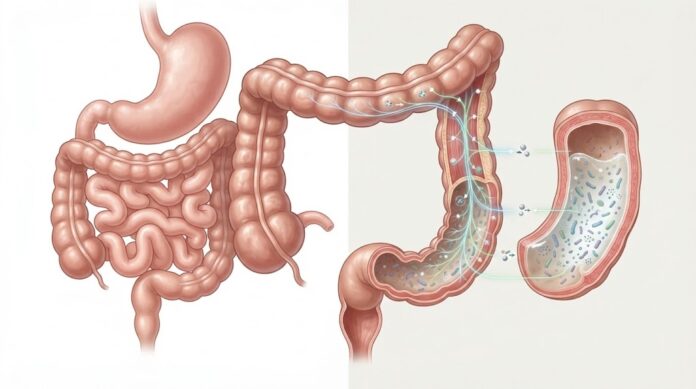
Your gut microbiome, which includes a large share of the microbes living in your body, is busy long before anything reaches the toilet. These microbes ferment leftover fiber, reshape bile acids, and send chemical signals to the nerves and muscles of the colon. So it is a fair question whether the gut microbiome could be part of the reason stool moves slowly in constipation.
The short answer is a careful maybe, leaning toward yes. Gut bacteria can influence how the colon moves, but researchers are still working out how much that matters for everyday constipation, and even which direction the cause runs. This guide walks through what studies have actually found, where the evidence is thin, and what you can reasonably do with that information.
Quick answer: Research suggests gut bacteria can influence how fast stool moves through the colon, mainly through short chain fatty acids, serotonin signaling, and bile acids. Some people with chronic constipation do show differences in their gut microbiota, but the findings are inconsistent, and it is not yet clear whether those differences cause constipation or result from it. Certain probiotics may modestly improve stool frequency, but the effect depends on the strain, and synbiotics have not shown a clear benefit.
What Is the Gut Microbiome, and Why Does It Matter for Bowel Movements?
The gut microbiota is the community of microorganisms living in your digestive tract. These microbes help break down food, stimulate the immune system, keep harmful bacteria in check, and produce many biologically active compounds.2 That last job matters most for constipation: gut movement is regulated by the enteric nervous system, the immune system, gut hormones, and the gut microbiota working together,5 so if microbes change the chemical signals those systems receive, the pace of stool through the colon can change too.
Not All Constipation Is the Same
Functional constipation is commonly described in three broad patterns: normal-transit constipation, slow-transit constipation, and defecatory disorders, where the problem is coordinating the pelvic floor and rectum rather than moving stool along.5 Constipation predominant irritable bowel syndrome (IBS C) is a related condition that also involves abdominal pain, and many microbiome studies include these patients.1
Gut bacteria research is mostly about how stool travels through the colon, so it is much less likely to explain an evacuation disorder. If straining, a blocked feeling, or incomplete emptying are your main problems, bacteria may be the smaller part of the picture.
Do People With Constipation Have Different Gut Bacteria?
Several studies comparing constipated people with healthy controls have found differences in the makeup of the intestinal microbiota.2 It is not quite a clear answer, though. A review of the published research described the findings as inconsistent, with no consensus on what a “constipation microbiome” looks like, yet it still concluded that an imbalance in gut bacteria, often called dysbiosis, may contribute to functional constipation and to IBS C.1
One study of women with chronic constipation sampled both stool and the lining of the colon. The microbes on the colon lining could tell constipated patients apart from healthy people, while the microbes in stool were linked to how fast the colon moved and to breath methane, but not to constipation itself. The authors described these as associations, not proof of cause.3 Where you sample from changes what you see, which is one reason results differ between studies.
Which Comes First: Slow Stool or a Different Microbiome?
This is the chicken and egg problem of gut research. If constipation changes the bacteria, then finding unusual bacteria in constipated people tells us little about the original cause.
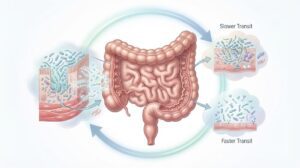
A study of 53 healthy women pointed in exactly that direction. Stool consistency, measured with the Bristol Stool Scale, was strongly tied to microbial richness and community makeup, even in people with no digestive disease. The authors suggested that transit speed itself may help shape the colon’s microbial ecosystem.4
In other words, slower transit may create conditions that favor a different microbial community. (If you are not sure where your own stool falls on the scale, our Bristol Stool Chart guide explains the seven types.)
Animal studies suggest the influence also runs the other way. Mice raised without gut bacteria, or whose bacteria were reduced with antibiotics, show slower gut transit and fewer bowel movements, colonizing them with certain bacteria partly reverses this, and stool bacteria transplanted from constipated donors have slowed transit in mice.5
These findings show that bacteria can change motility, not that they are the cause in any one person. The most realistic picture is a two way relationship: bacteria influence movement, and movement influences bacteria.
How Gut Bacteria May Influence Bowel Movements
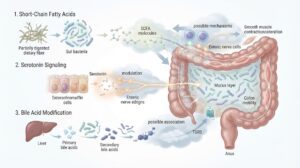
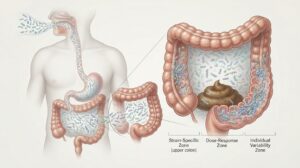
Scientists have identified several routes by which gut microbes can talk to the colon. Most of this knowledge comes from lab and animal experiments, so it works best as a map of possibilities rather than settled proof for humans.5
Short Chain Fatty Acids From Fiber
When bacteria ferment fiber your body cannot digest, they produce short chain fatty acids such as acetate, propionate, and butyrate, and butyrate is also a main energy source for the cells lining the colon.5 These compounds can nudge the gut in both directions: they can prompt the colon wall to release serotonin, which promotes movement, and they can trigger hormones such as GLP-1 and PYY, which slow it down. The net effect seems to depend on which fatty acids are produced and in what balance.5 Evidence is mixed and mostly from animal and lab work.
Serotonin Signaling
The gut holds much of the body’s serotonin, which helps trigger the colon’s squeezing reflexes. Certain spore forming bacteria found in mouse and human gut microbiota increased serotonin production in the colon, with an effect on gut motility shown in mice.6 This is early, mostly animal based science, but it offers a concrete reason why your gut bacteria could matter for regularity.
Bile Acids
Gut bacteria convert some of the bile acids made by your liver into secondary forms. In animal studies, one of these stimulates a receptor called TGR5 in the colon, which promotes movement, and mice lacking TGR5 had slower transit and less frequent defecation.5 Human evidence is limited.
What Research Says About Changing Your Gut Bacteria
Probiotics
Probiotics are the most studied option. A 2014 meta analysis of 14 randomized trials found that, on average, probiotics shortened whole gut transit time by about 12 hours and added about 1.3 bowel movements per week. The effects were strain specific: Bifidobacterium lactis had a significant effect on stool frequency, while Lactobacillus casei Shirota did not.7
The trials were short (2 to 8 weeks), with doses from about 100 million to 30 billion colony forming units (CFU, a count of live bacteria) a day, and later reviewers noted high heterogeneity and a risk of bias.9
Newer evidence is more cautious. A 2024 trial of 229 adults with functional constipation found that weekly complete spontaneous bowel movements (movements after which you feel fully emptied) rose by about 0.80 with the B. lactis strain HN019 and about 0.66 with placebo, and the authors concluded that HN019 did not outperform placebo over 8 weeks.13
A 2020 review described a meta analysis of 21 trials in which the average gain in stool frequency shrank from about 0.8 to about 0.3 extra bowel movements per week after adjusting for publication bias (the tendency for positive studies to get published more often), and was no longer statistically significant.9
A 2022 meta analysis of 30 randomized trials in adults with chronic constipation concluded that certain probiotics may improve stool frequency and overall symptoms, which the authors called cautious optimism, but warned about high heterogeneity and risk of bias. B. lactis had an effect on stool frequency in their subgroup results, while mixtures of probiotics and some other products, including L. casei Shirota, did not.10
The practical takeaway is that “probiotic” is not one thing. Some B. lactis strains have shown benefits in pooled analyses, but the HN019 strain has not consistently outperformed placebo. Any benefit appears to be modest and varies substantially by strain, dose, and study. To compare specific strains, see our breakdown of the best probiotic strains for constipation and bloating, or our broader guide to the best probiotics for constipation and bloating.
Prebiotic Fibers
Prebiotics are fibers that feed beneficial bacteria. (Our explainer on prebiotic vs probiotic for gut health breaks down the difference.) One example that has been studied is partially hydrolyzed guar gum. In a small placebo controlled trial, 60 healthy adults aged 30 to 50 were recruited and assigned to 3 or 5 grams of PHGG, or placebo, daily for eight weeks; 51 participants were included in the final validity analysis.
PHGG changed the gut bacteria, including a reduction in certain mucus degrading species, and the authors linked this to improvements in constipation related symptoms. Stool frequency improved significantly compared with placebo in the 5 gram group.11
However, the study was small, it involved healthy volunteers rather than people with diagnosed chronic constipation, and the study included several authors employed by Taiyo Kagaku Co., Ltd., the company associated with the PHGG product used in the study, so the findings are encouraging but far from conclusive.
Synbiotics
Synbiotics combine a probiotic with a prebiotic. In the 2022 meta analysis, they did not significantly change stool output or symptom scores, and the authors concluded there was insufficient evidence to recommend them, although only four trials were available to pool.10
Can You Test Your Microbiome to Find the Cause?
Not as a standard clinical test for diagnosing the cause of constipation. Chronic constipation is defined by symptoms,2 and given how much the microbiota differs between people and shifts with transit time,4 a single stool snapshot is hard to interpret. More useful starting points are your medications, diet, routine, and a conversation with a doctor. Our guide on what causes constipation covers the usual suspects.
Practical Ways to Support Your Gut Bacteria
Nothing here is a cure, but these habits line up with how the research says gut bacteria work.
- Eat a variety of plant foods. Bacteria make short chain fatty acids by fermenting fiber, so a varied intake gives them more to work with.5 Our list of the best fruits for chronic constipation is a good place to start.
- Add fiber gradually. A sudden jump can cause gas and bloating.17 If more fiber seems to make things worse, read why fiber is not working for your constipation before giving up.
- Treat supplements as a trial, not a promise. If you try a probiotic, choose a product that identifies the strain, and track your symptoms over the period recommended on the product label or by your clinician.
Sometimes bacteria are not the main story, and a short term laxative or magnesium is what the situation calls for. Our guides to the best OTC laxatives for constipation and the best magnesium supplements for constipation walk through the options, and a pharmacist or doctor can help match one to your situation. Supplements are not a substitute for addressing diet, fluid intake, physical activity, medications, or other causes of constipation.
Dosage and Side Effects: What to Know Before Trying Probiotics or Fiber Supplements
There is no proven standard dose for using gut bacteria products against constipation. The table shows amounts used in research and printed on product labels, which are not personal medical advice. If a doctor or pharmacist gives you different directions, follow theirs, and always read the label of the exact product you buy, because directions differ between brands and versions.
| Product type | Amounts used in studies or on labels | Side effects and cautions |
|---|---|---|
| Probiotics | Trials in the 2014 meta analysis used about 100 million to 30 billion CFU a day for 2 to 8 weeks.9
HN019 trials used different doses and durations (for example 1 to 17.2 billion CFU a day for 2 to 8 weeks), so there is no single established dose.8,13,14 Follow the product label or your clinician’s advice. |
Probiotics have a long record of apparent safety in healthy people, but few studies have examined safety in detail, so the frequency and severity of side effects are not well known.
The risk of harm is greater in people with severe illness or a weakened immune system. Possible harms include infections, and some products have been found to contain organisms not listed on the label.16 |
| Partially hydrolyzed guar gum (such as Sunfiber*) | 3 or 5 grams a day for 8 weeks in a trial of 60 healthy volunteers, with significant stool frequency improvement at 5 grams.11
Serving sizes differ between products, so follow the label. |
A 12 week placebo controlled trial in people with IBS reported no significant side effects.15
Add it gradually, because gas or bloating can occur while your body adjusts, and ask a pharmacist how to space it from your medicines. |
| Psyllium husk (such as Metamucil*) | Directions vary by psyllium product and formulation. For example, the Metamucil Therapy for Regularity Drug Facts label instructs adults 12 and older to mix one dose with at least 8 ounces of liquid, and it can be taken up to 3 times daily.
New users are told to start with one serving a day and increase gradually. Follow the Drug Facts label for the exact product you use.17 |
Labels mention minor bloating and changes in bowel habits as your body adjusts. Mix each dose with at least 8 ounces (a full glass) of liquid, because psyllium can swell and block the throat or food pipe and cause choking.
Do not use it if you have trouble swallowing, and seek immediate medical attention for chest pain, vomiting, or difficulty swallowing or breathing after taking it. Take it at least 2 hours before or after other medicines, and note the allergy alert for people sensitive to psyllium.17 |
* Affiliate link (paid link). As an Amazon Associate I earn from qualifying purchases.
When to See a Doctor
Gut bacteria are an interesting piece of the puzzle, but they should never delay a medical check when something seems off. See a doctor if your symptoms do not improve with self care or if colon or rectal cancer runs in your family. Get care right away if constipation comes with rectal bleeding, blood in your stool, constant abdominal pain, inability to pass gas, vomiting, fever, lower back pain, or weight loss you cannot explain.12
Some medicines and supplements can also make constipation worse, so review yours with a pharmacist or doctor. If you have a weakened immune system or a serious health condition, talk to your doctor before using any probiotic.16
Key Takeaways
- Gut bacteria can influence colon movement through short chain fatty acids, serotonin, and bile acids, but most of the mechanism research is in animals.
- Studies of gut bacteria in constipated people are inconsistent, and slow transit can itself change the microbiome.
- Some Bifidobacterium lactis strains have shown benefits in pooled analyses, but results vary by strain, dose, and study, and HN019 has not consistently outperformed placebo, including in a 2024 trial.
- Prebiotic fibers are promising but not yet well proven for constipation, and a microbiome test is not a standard way to diagnose or explain it.
- Follow product labels, increase fiber gradually, take psyllium with a full glass of liquid, and ask a doctor first if you have a weakened immune system.
Frequently Asked Questions
Can gut bacteria cause constipation?
Gut bacteria may contribute, but they are unlikely to be the whole story. Studies find differences in the gut microbiota of some people with chronic constipation, yet the results are inconsistent, and slow movement of stool can also change which bacteria thrive. Constipation usually has more than one cause.
What is the best probiotic for constipation?
Some Bifidobacterium lactis strains have shown benefits in pooled analyses, but results vary by strain, and no single probiotic has been proven best for everyone with constipation. Choosing a product that lists specific strains and checking with a healthcare professional is a sensible approach.
Does fiber help gut bacteria?
Yes, in general. Gut bacteria ferment certain fibers into short chain fatty acids, which can affect gut signaling and provide an important energy source for cells lining the colon. Adding fiber too quickly can cause gas and bloating for some people, so a gradual increase is usually recommended.
How much probiotic or fiber should I take for constipation?
There is no proven standard dose. Studies of probiotics for constipation have used about 100 million to 30 billion CFU a day for 2 to 8 weeks, and fiber products have label directions that differ by brand and version. For fiber supplements, increase gradually. For probiotics, follow the product label or your clinician’s advice.
What are the side effects of probiotics and fiber supplements?
Fiber supplements can cause gas, bloating, and cramps, especially when started too quickly, and psyllium must be taken with a full glass of liquid to avoid choking.17 Probiotics have a long record of apparent safety in healthy people, but the risk of harm is higher in people who are very ill or have a weakened immune system, so ask a doctor first if that applies to you.16
Do I need a microbiome test?
Not usually. Constipation is diagnosed from symptoms and a medical assessment, and stool microbiome testing is not a standard part of that process. A doctor can tell you whether any testing makes sense for your situation.
This article is for educational purposes only and is not medical advice. It does not replace an evaluation by a qualified healthcare professional.
References
-
- Ohkusa T, Koido S, Nishikawa Y, Sato N. Gut microbiota and chronic constipation: a review and update. Front Med (Lausanne). 2019;6:19. doi:10.3389/fmed.2019.00019. PubMed
- Zhao Y, Yu YB. Intestinal microbiota and chronic constipation. Springerplus. 2016;5(1):1130. doi:10.1186/s40064-016-2821-1. PubMed
- Parthasarathy G, Chen J, Chen X, Chia N, O’Connor HM, Wolf PG, et al. Relationship between microbiota of the colonic mucosa vs feces and symptoms, colonic transit, and methane production in female patients with chronic constipation. Gastroenterology. 2016;150(2):367-379. doi:10.1053/j.gastro.2015.10.005. PubMed Central
- Vandeputte D, Falony G, Vieira-Silva S, et al. Stool consistency is strongly associated with gut microbiota richness and composition, enterotypes and bacterial growth rates. Gut. 2016;65(1). doi:10.1136/gutjnl-2015-309618. Gut
- Zheng Z, Tang J, Hu Y, Zhang W. Role of gut microbiota-derived signals in the regulation of gastrointestinal motility. Front Med (Lausanne). 2022;9:961703. doi:10.3389/fmed.2022.961703. PubMed Central
- Yano JM, Yu K, Donaldson GP, Shastri GG, Ann P, Ma L, et al. Indigenous bacteria from the gut microbiota regulate host serotonin biosynthesis. Cell. 2015;161(2). doi:10.1016/j.cell.2015.02.047. PubMed
- Dimidi E, Christodoulides S, Fragkos KC, Scott SM, Whelan K. The effect of probiotics on functional constipation in adults: a systematic review and meta-analysis of randomized controlled trials. Am J Clin Nutr. 2014;100(4):1075-1084. doi:10.3945/ajcn.114.089151. PubMed
- Ibarra A, Latreille-Barbier M, Donazzolo Y, et al. Effects of 28-day Bifidobacterium animalis subsp. lactis HN019 supplementation on colonic transit time and gastrointestinal symptoms in adults with functional constipation: a double-blind, randomized, placebo-controlled, and dose-ranging trial. Gut Microbes. 2018;9:236-251. doi:10.1080/19490976.2017.1412908. PubMed Central
- Dimidi E, Scott SM, Whelan K. Probiotics and constipation: mechanisms of action, evidence for effectiveness and utilisation by patients and healthcare professionals. Proc Nutr Soc. 2020;79(1):147-157. doi:10.1017/S0029665119000934. Cambridge Core
- van der Schoot A, Helander C, Whelan K, Dimidi E. Probiotics and synbiotics in chronic constipation in adults: a systematic review and meta-analysis of randomized controlled trials. Clin Nutr. 2022;41(12):2759-2777. doi:10.1016/j.clnu.2022.10.015. PubMed
- Abe A, Morishima S, Kapoor MP, Inoue R, Tsukahara T, Naito Y, Ozeki M. Partially hydrolyzed guar gum is associated with improvement in gut health, sleep, and motivation among healthy subjects. J Clin Biochem Nutr. 2023;72(2):189-197. PubMed Central
- National Institute of Diabetes and Digestive and Kidney Diseases. Symptoms and causes of constipation. NIDDK
- Cheng J, et al. Eight-week supplementation with Bifidobacterium lactis HN019 and functional constipation: a randomized clinical trial. JAMA Netw Open. 2024;7(10):e2436888. doi:10.1001/jamanetworkopen.2024.36888. PubMed
- Waller PA, Gopal PK, Leyer GJ, et al. Dose-response effect of Bifidobacterium lactis HN019 on whole gut transit time and functional gastrointestinal symptoms in adults. Scand J Gastroenterol. 2011;46:1057-1064. doi:10.3109/00365521.2011.584895. PubMed Central
- Niv E, Halak A, Tiommny E, et al. Randomized clinical study: partially hydrolyzed guar gum (PHGG) versus placebo in the treatment of patients with irritable bowel syndrome. Nutr Metab (Lond). 2016;13:10. doi:10.1186/s12986-016-0070-5. PubMed Central
- National Center for Complementary and Integrative Health. Probiotics: usefulness and safety. Last updated August 2019. NCCIH
- The Procter & Gamble Manufacturing Company. Metamucil Therapy for Regularity (psyllium husk powder), Drug Facts label (choking, allergy, directions, and medicine spacing warnings). DailyMed, U.S. National Library of Medicine; label updated October 11, 2024. Label directions vary by product, so check the current label for the exact formulation. DailyMed




[…] These ideas come mostly from laboratory and supplement studies, and it is still an open question whether typical food portions deliver enough of the right microbes to matter. See our guide to the gut microbiome and constipation. […]