

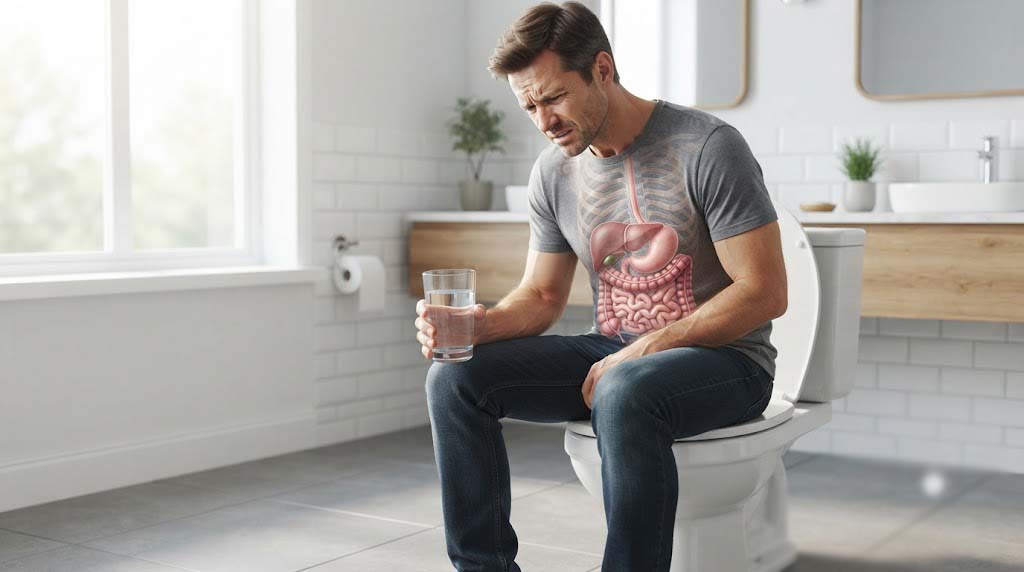
Why am I constipated even though I drink water? It’s one of the most frustrating experiences in digestive health. Water is the advice everyone hears first, so when it doesn’t work, there’s rarely an obvious next step. The truth is that once your fluid intake is genuinely adequate, drinking more water has a small and inconsistent effect on bowel movements.[1] So if you’re still backed up despite chugging bottle after bottle, the real cause is probably something water alone was never going to fix.
This article picks up where hydration advice usually stops. If you haven’t yet confirmed whether dehydration is actually part of your problem, our companion guide, Does Dehydration Cause Constipation? The Science-Backed Link, walks through how much water your body actually needs and how to check. Here, we’re assuming your hydration is already reasonable and digging into the other causes the research points to.
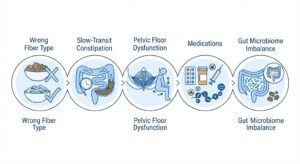
Quick Answer: Why You’re Constipated Even Though You Drink Water
- Wrong fiber type: Coarse insoluble fiber doesn’t soften stool the way soluble, gel-forming fiber does, no matter how much water you drink with it.
- Slow-transit constipation: The colon’s muscular contractions are weak or infrequent, so stool moves too slowly regardless of hydration.
- Dyssynergic defecation: The pelvic floor muscles fail to coordinate during a bowel movement, a mechanical problem, not a fluid problem.
- Medications and conditions: Opioids, iron, certain antidepressants, and an underactive thyroid can all slow the gut on their own.
- Gut microbiome imbalance: Altered gut bacteria can affect motility even when hydration and fiber both look fine on paper.
Affiliate Disclosure: This article contains Amazon Associates and iHerb affiliate links. If you purchase through these links, ConstipationRelief.net may earn a small commission at no extra cost to you. We only recommend products supported by clinical evidence.
At a Glance: What to Try When Water Alone Isn’t Fixing Your Constipation
Hydration is only one piece of the puzzle — here are the most evidence-aligned options for each cause covered in this guide:
- Best soluble gel-forming fiber (switch from coarse bran): Konsyl Daily Psyllium Fiber Powder (19oz) — 100% pure psyllium husk, forms a water-holding gel that softens stool directly, shown to be significantly more effective than coarse wheat bran — introduce gradually and always take with at least 8oz water
- Best osmotic option (works independently of gut motility): MiraLAX Laxative Powder (45-Dose) — PEG 3350 draws water into the colon through a mechanism that doesn’t depend on gut motility or fiber, the only OTC laxative with a strong 2023 AGA-ACG recommendation for chronic use
- Best magnesium option (osmotic, draws water into colon): Natural Vitality CALM Magnesium Citrate Powder — works in 30 minutes to 6 hours, useful when hard stool persists despite fiber — ⚠️ avoid or use only under medical supervision with kidney disease
- Best probiotic (if gut microbiome imbalance is contributing): Garden of Life Dr. Formulated Probiotics for Constipation (50B CFU) — contains Bifidobacterium lactis and 15 other clinically studied strains, consistent with the article’s recommendation to consider a targeted probiotic when gut bacteria composition may be affecting regularity
Why Am I Constipated Even Though I Drink Water? Common Causes
1. First, Confirm You’re Actually Well-Hydrated
Before chasing other causes, it’s worth ruling hydration out properly instead of just assuming you’re fine. The simplest practical check is urine color: pale, straw-colored urine throughout the day is a reliable sign that your fluid intake is adequate, though it isn’t a perfect measure for everyone, since certain vitamins, medications, and some medical conditions can change urine color independent of hydration.[2]
Interestingly, a large analysis of U.S. adults using NHANES data found that low liquid intake predicted constipation, but dietary fiber intake on its own did not, suggesting the two work together rather than independently.[3]
If your urine has been consistently pale and you’re still constipated, dehydration probably isn’t your main issue. The sections below are more likely to hold your answer.
2. Your Fiber Type May Not Match What Your Gut Needs
Not all fiber behaves the same way in your gut. Soluble fiber, found in psyllium husk, oats, and flaxseed, dissolves in water and forms a gel that traps moisture inside the stool, making it softer and easier to pass. Insoluble fiber, found in wheat bran and many vegetable skins, adds bulk mechanically, but it doesn’t reliably pull water into the stool the same way.[4]
A detailed 2020 review comparing coarse wheat bran and psyllium in people with chronic constipation found psyllium was significantly more effective than coarse wheat bran at increasing stool output. Finely ground wheat bran even decreased stool water content in some patients, the opposite of what you’d want.[4]
So if most of your fiber is coming from bran cereal or coarse wheat products, more water isn’t going to compensate for a fiber type that was never built to soften stool in the first place. Our companion guides on Why Is My Stool Hard Even After Eating Fiber? and Best Fiber Foods and Fiber Therapy for Gut Health go deeper into which foods fall into each camp.
3. Slow-Transit Constipation: A Motility Problem, Not a Hydration Problem
For a meaningful share of people with chronic constipation, the issue has nothing to do with diet or fluid intake. Slow-transit constipation happens when the muscular contractions that push stool through the colon are weak or infrequent, no matter how much water or fiber is on board.[5] In a well-known trial, 149 people with chronic constipation took psyllium fiber for six weeks, and 80 percent of those with slow-transit constipation saw little or no improvement.[6]
Piling on more water or fiber just adds volume to a colon that isn’t contracting efficiently; it doesn’t fix the underlying motility problem. If you’ve given fiber and hydration a genuine four-to-six-week trial and nothing has changed, this is one of the most likely explanations, and it’s worth raising with a gastroenterologist. Our guide on Why Fiber Isn’t Working for Your Constipation covers alternatives that work through different mechanisms.
4. Dyssynergic Defecation (Pelvic Floor Dysfunction)
Dyssynergic defecation is a coordination problem: the pelvic floor muscles tighten instead of relaxing during an attempted bowel movement, physically blocking stool from coming out.[7] Estimates vary, but it’s thought to affect somewhere between roughly a quarter and half of people evaluated for chronic constipation, and it’s the single most common cause among evacuation disorders.[8] Because this is a mechanical, neuromuscular issue rather than a stool-consistency issue, water simply doesn’t change the outcome.
It typically responds best to biofeedback therapy and pelvic floor retraining, not dietary changes.[7] Warning signs to watch for include excessive straining, a persistent sense of incomplete evacuation, and needing to use manual pressure to finish a bowel movement.
5. Irritable Bowel Syndrome with Constipation (IBS-C)
If you have constipation-predominant irritable bowel syndrome, what you eat matters more than how much you drink. Highly fermentable fibers, the kind found in legumes and some fruits, get rapidly broken down by gut bacteria and can increase gas, bloating, and discomfort in people with IBS-C, which can make constipation feel worse even as stool bulk goes up.[9]
Many of these fibers are also high-FODMAP foods, which is why some people with IBS-C find a low-FODMAP approach helps with bloating even before hydration or fiber dose is adjusted. Longer-chain, more slowly fermented soluble fibers like psyllium tend to be better tolerated in this group.[9]
If bloating and hard stool both flare up shortly after high-fiber meals despite plenty of water, IBS-C is worth discussing with a doctor.
6. Medications That Slow the Gut Regardless of Hydration
Several common medication classes reduce colonic motility no matter how much water you drink. Opioid pain relievers slow peristalsis and increase how much fluid gets reabsorbed from the stool, which is why constipation is a near-universal side effect of long-term opioid use.[10] Iron supplements, anticholinergic drugs (including certain antihistamines and bladder medications), tricyclic antidepressants, and calcium channel blockers for blood pressure are all recognized contributors.[10]
If your constipation started around the same time as a new prescription or supplement, that timing is a stronger clue than your water intake, and it’s worth reviewing your full medication list with a pharmacist or doctor. Our full breakdown of constipation causes covers this and the other non-dietary triggers in more depth.
7. Hypothyroidism and Other Underlying Conditions
Thyroid hormones directly influence gut motility, and an underactive thyroid slows the rhythmic contractions that move stool along, giving the colon more time to reabsorb water from the stool and harden it, regardless of how much fluid you’re drinking.[11] Constipation is one of the most consistently reported gastrointestinal symptoms of hypothyroidism.[11]
Diabetes, Parkinson’s disease, and certain neurological conditions can affect motility through similar mechanisms.[12] If constipation shows up alongside fatigue, unexplained weight changes, or feeling cold all the time, it’s reasonable to ask your doctor about thyroid testing.
8. Gut Microbiome Imbalance
Emerging research suggests gut bacteria composition can affect bowel regularity on its own, separate from fiber and water. Shifts in the microbiome have been linked to altered motility and stool consistency, and some clinical studies show modest but consistent improvements in stool frequency with specific probiotic strains.[13] Not every strain works equally well, though; the benefit appears to be strain-specific rather than a general “probiotics help everyone” effect, so results vary by product.
If your hydration and fiber both look adequate and other causes have been ruled out, a targeted probiotic approach may still be worth exploring. See 9 Best Probiotic Supplements 2026 and Gut Microbiome Rebalancing for Constipation for more.
9. Lifestyle Factors That Compete With Hydration
Physical activity directly stimulates intestinal motility, so a sedentary routine can cause constipation even alongside excellent fluid and fiber intake.[12] Regularly ignoring the urge to go, common when you’re busy or away from a familiar bathroom, can also dull the body’s normal signaling over time.[12] Neither of these has anything to do with how much water you drink, which is one reason some well-hydrated, fiber-conscious people still struggle.
Moderate coffee intake is unlikely to have a meaningful effect on hydration in most healthy adults. Excess alcohol, however, can contribute to dehydration and may indirectly worsen constipation.
10. Why Water Alone Isn’t a Cure-All
A widely cited review of constipation myths concluded that increasing fluid intake beyond what a person already needs is unlikely to meaningfully improve constipation, unless they were genuinely under-hydrated to begin with.[1] That lines up with an older clinical trial showing that water supplementation enhances the effect of a high-fiber diet, rather than working as a stand-alone fix.[14]
In practice, this means hydration is best thought of as a baseline requirement that lets fiber and gut motility do their job, not as an unlimited remedy on its own. If you’ve already hit that baseline, more water won’t resolve a fiber mismatch, a motility disorder, a medication side effect, or a thyroid problem.
A Simple Way to Track What’s Actually Happening
Before your next doctor visit, it helps to have more to go on than “I’m still constipated.” For two to three weeks, jot down your daily water intake, what kind of fiber you ate, how much you moved, any new medications or supplements, and your stool’s shape and consistency using the Bristol Stool Chart (types 1–2 indicate hard, constipated stool; types 3–4 are considered ideal).
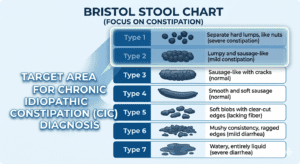
This kind of record turns a vague complaint into a pattern a doctor can actually act on, for example, showing whether symptoms cluster around a specific food, a stressful week, or the start of a new prescription.
What to Do If You’re Drinking Enough Water but Still Constipated
- Confirm hydration objectively using urine color rather than assumption, and compare against the guidance in our dehydration and constipation guide.
- Switch to soluble, gel-forming fiber such as psyllium rather than coarse bran, and introduce it gradually over several weeks.[4]
- Consider an osmotic agent like magnesium if hard stool persists. It draws water into the colon through a mechanism that doesn’t depend on gut motility. See 5 Best Magnesium Supplements for Constipation. Avoid magnesium, or use it only under medical supervision, if you have kidney disease.
- Review your medication list with a pharmacist, particularly opioids, iron, or antidepressants, and see Best OTC Laxatives for Constipation in the US for options that work independently of fiber.
- Ask about biofeedback therapy if pelvic floor dysfunction is suspected. It addresses the coordination problem directly instead of adding more bulk or fluid.[7]
- Track your pattern for two to three weeks using the method above before your next doctor visit.
If you’re drinking enough water and still struggling with constipation, don’t assume you simply need more fluids. Being hydrated but constipated is common, and persistent constipation despite drinking plenty of water usually has an underlying cause (a fiber mismatch, a motility issue, a medication, or something else covered above) that a bit more water was never going to reach. Identifying which one applies to you is the real first step toward lasting relief, not another glass of water.
When to See a Doctor
See a healthcare provider promptly if constipation persists for more than three weeks despite adequate hydration and fiber, or if it comes with rectal bleeding, unintentional weight loss, severe abdominal pain, new-onset constipation after age 50, or a family history of colorectal cancer.[12] These symptoms call for direct medical evaluation, not more dietary tweaking.
Frequently Asked Questions
Can you be constipated even if you drink enough water?
Yes. Once fluid intake is already adequate, extra water has a limited effect on bowel movements. Fiber type, gut motility, pelvic floor coordination, medications, thyroid function, and gut bacteria all influence constipation independently of hydration.[1]
How do I know if my water intake is actually enough?
Pale, straw-colored urine throughout the day is the simplest practical sign of adequate hydration.[2] If your urine is consistently pale but you’re still constipated, dehydration is unlikely to be the main driver.
What is the most common reason fiber and water are not helping?
A mismatch between fiber type and your gut’s needs is one of the most common reasons. Coarse insoluble fiber doesn’t soften stool the way soluble, gel-forming fiber like psyllium does, and slow-transit or pelvic floor problems often don’t respond to fiber or water at all.[4][6]
Could my constipation be caused by a medication I’m already taking?
It’s possible. Opioids, iron supplements, anticholinergic medications, tricyclic antidepressants, and calcium channel blockers are all recognized causes that act independently of fluid intake.[10]
Can drinking too much water make constipation worse?
Plain water alone doesn’t cause constipation, but drinking large volumes on top of an already-adequate intake won’t fix it either, and in extreme cases can dilute electrolytes without addressing the actual cause. If water isn’t helping and you’re already well-hydrated, the more useful next step is figuring out which of the causes above (fiber type, motility, medication, or an underlying condition) applies to you.
When should I see a doctor about constipation despite drinking water?
See a provider if constipation lasts more than three weeks despite adequate hydration and fiber, or if it comes with rectal bleeding, unintentional weight loss, severe abdominal pain, or new onset after age 50.[12]
Key Takeaways
- Once hydration is genuinely adequate, more water has a small and inconsistent effect on constipation.[1]
- Pale urine is a simple, reliable check for hydration status before looking elsewhere.[2]
- Coarse insoluble fiber doesn’t soften stool the way soluble fiber like psyllium does, regardless of water intake.[4]
- Slow-transit constipation and dyssynergic defecation are mechanical or motility problems that water and fiber alone typically can’t fix.[6][7]
- Opioids, iron, certain antidepressants, and hypothyroidism are common medical causes independent of hydration.[10][11]
- Gut microbiome composition can affect regularity separately from fiber and water.[13]
- Persistent constipation despite good hydration and fiber for more than three weeks warrants a medical evaluation.[12]
References
- Müller-Lissner SA, Kamm MA, Scarpignato C, Wald A. Myths and misconceptions about chronic constipation. Am J Gastroenterol. 2005;100(1):232-242. PMID: 15654804
- Institute of Medicine. Dietary Reference Intakes for Water, Potassium, Sodium, Chloride, and Sulfate. Washington, DC: The National Academies Press; 2004. NCBI Bookshelf
- Markland AD, Palsson O, Goode PS, Burgio KL, Busby-Whitehead J, Whitehead WE. Association of low dietary intake of fiber and liquids with constipation: evidence from the National Health and Nutrition Examination Survey. Am J Gastroenterol. 2013;108(5):796-803. PMID: 23567352
- McRorie JW Jr, Fahey GC Jr, Gibb RD, Chey WD. Laxative effects of wheat bran and psyllium: Resolving enduring misconceptions about fiber in treatment guidelines for chronic idiopathic constipation. J Am Assoc Nurse Pract. 2020;32(1):15-23. PMID: 31764399
- Bharucha AE, Lacy BE. Mechanisms, Evaluation, and Management of Chronic Constipation. Gastroenterology. 2020;158(5):1232-1249.e3. PMID: 31945360
- Voderholzer WA, Schatke W, Mühldorfer BE, Klauser AG, Birkner B, Müller-Lissner SA. Clinical response to dietary fiber treatment of chronic constipation. Am J Gastroenterol. 1997;92(1):95-98. PMID: 8995945
- Rao SS. Dyssynergic defecation. Gastroenterol Clin North Am. 2001;30(1):97-114. PMID: 11394039
- Rao SS. Dyssynergic defecation and biofeedback therapy. Gastroenterol Clin North Am. 2008;37(3):569-586. Constipation from dyssynergic defecation is estimated to affect up to half of patients evaluated for chronic constipation, with reported ranges from roughly one-quarter to one-half depending on the diagnostic criteria used. ScienceDirect
- El-Salhy M, Ystad SO, Mazzawi T, Gundersen D. Dietary fiber in irritable bowel syndrome. Int J Mol Med. 2017;40(3):607-613. PMC5548066
- Merck Manual Professional Edition. Constipation. Gastrointestinal Disorders. merckmanuals.com
- Ebert EC. The thyroid and the gut. J Clin Gastroenterol. 2010;44(6):402-406, cited via: Does Hypothyroidism Affect Gastrointestinal Motility? PMC2833301
- Diaz S, Bittar K, Mendez MD. Constipation. In: StatPearls [Internet]. Treasure Island (FL): StatPearls Publishing; 2023. NCBI Bookshelf: NBK513291
- Ding F, Hu M, Ding Y, Meng Y, Zhao Y. Efficacy in bowel movement and change of gut microbiota on adult functional constipation patients treated with probiotics-containing products: a systematic review and meta-analysis. BMJ Open. 2024;14(1):e074557. DOI: 10.1136/bmjopen-2023-074557
- Anti M, Pignataro G, Armuzzi A, et al. Water supplementation enhances the effect of high-fiber diet on stool frequency and laxative consumption in adult patients with functional constipation. Hepatogastroenterology. 1998;45(21):727-732. PMID: 9684123
Medical Disclaimer: This article is for informational purposes only and does not constitute medical advice. Always consult a qualified healthcare provider for diagnosis and treatment of constipation, particularly if you have an underlying health condition or are taking prescription medication. If you experience rectal bleeding, unintentional weight loss, or severe abdominal pain, seek medical attention promptly.






[…] when increasing dietary fiber, so this is a reasonable, low-effort contribution, alongside actually drinking enough water throughout the […]