

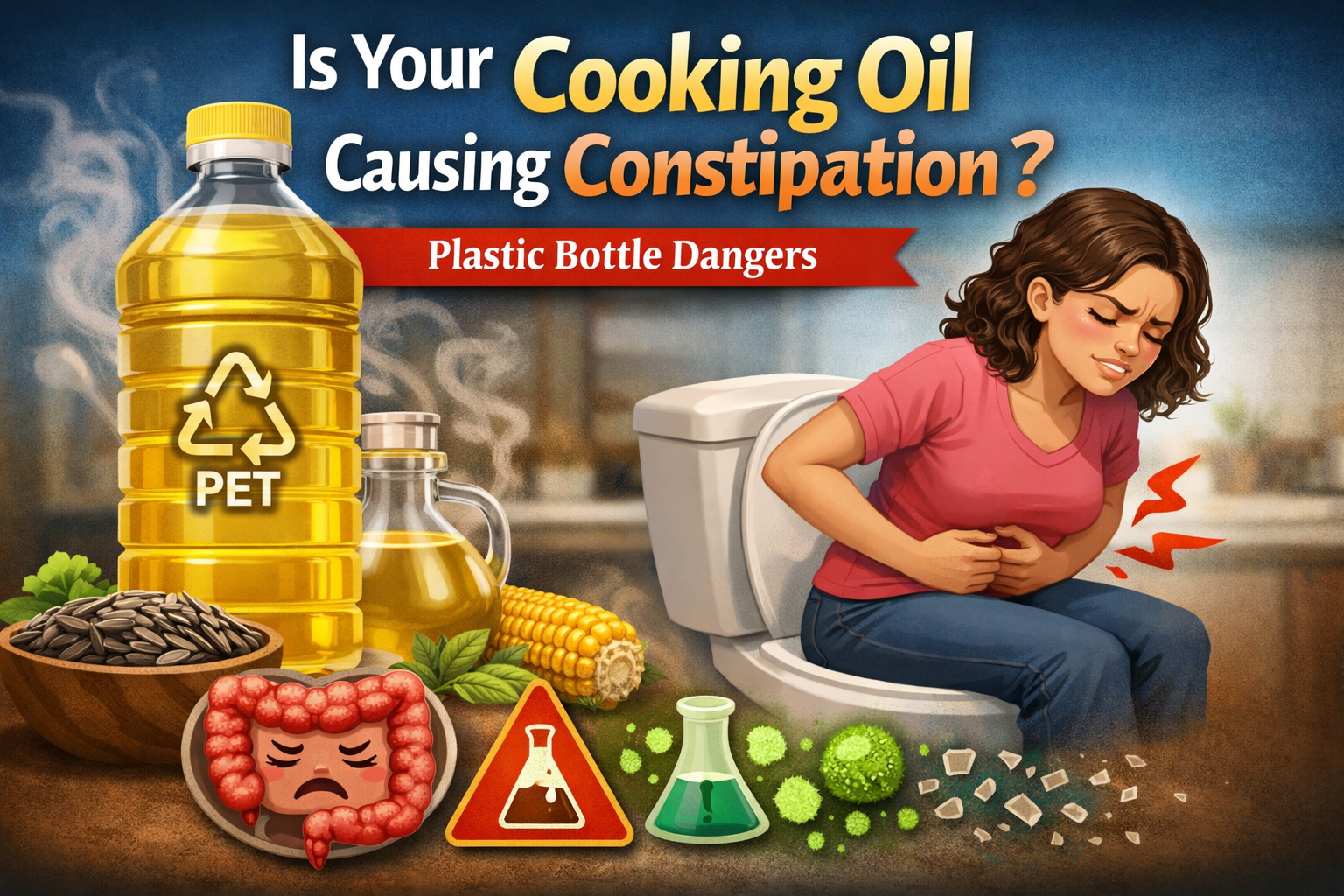
Is your cooking oil causing constipation? For most people the answer isn’t the oil itself, it’s what the plastic bottle around it may be adding to your food. Millions of Americans reach for a plastic bottle of sunflower, canola, or olive oil every day without thinking about the container. A growing body of research suggests that container may be quietly affecting gut health.
Quick answer: No single study proves that cooking oil in a plastic bottle directly causes constipation. But plastic bottles can add microplastics and hormone-disrupting chemicals like BPA and phthalates to the oil inside, and both have been linked to gut inflammation and slower gut motility, key drivers of constipation. Switching to extra virgin olive oil in dark glass, taken daily, has real clinical support for constipation relief.
We’ve previously covered how cookware chemicals can affect your gut. The oil inside your pan matters too, and so does what it’s stored in.
Is Your Cooking Oil Causing Constipation?
Not directly on its own, but yes, it can be a contributing factor. Cooking oil sold in plastic bottles can pick up microplastics and endocrine-disrupting chemicals such as BPA and phthalates. Both have been linked in research to gut inflammation and slower gut motility, which are directly tied to constipation. The oil itself isn’t the problem so much as what its plastic container may be adding to it over time.
1. The Cooking Oil Problem Nobody Talks About
Constipation affects an estimated 35% of Americans at any given time. It’s one of the most underreported and undertreated digestive conditions in the country. Billions are spent annually on laxatives, fiber supplements, and probiotics, yet the problem persists for millions of people.
The conversation almost always focuses on fiber, hydration, and physical activity. These matter, but the fat source at the center of your daily cooking, and the chemicals that can migrate into it from plastic packaging, is an angle worth understanding too.
If you’ve already tried natural fiber supplements, magnesium, or OTC laxatives without lasting relief, this article looks at a different piece of the puzzle, one that starts in the kitchen cabinet rather than the pharmacy.
This guide covers four connected topics: microplastics in vegetable oil, leaching chemicals from plastic bottles, the best oil for chronic constipation relief, and how extra virgin olive oil compares to seed oils for gut health.
2. Microplastics in Vegetable Oil: What the Research Shows
Researchers from the University of Bologna and FISABIO Public Health tested commercial vegetable oils, including extra virgin olive oil, regular olive oil, sunflower oil, and mixed seed oils, in both plastic and glass bottles. Their 2024 study in Food Chemistry found microplastics in every sample, regardless of packaging type. Most particles were smaller than 100 microns and were made mostly of polyethylene (50.3%) and polypropylene (28.7%).
The average was about 1,140 microplastic particles per liter, with meaningful variation between samples. The researchers found no real difference between oil types or between plastic and glass packaging. That suggests contamination may happen during production or bottling, not just from the retail container [1].
A separate 2023 study from the University of Massachusetts Amherst analyzed four commercially bottled oils (olive, canola, sunflower, and coconut). It found between 134,000 and 580,000 microplastic particles per liter, with more than 80% of the detected particles smaller than 10 microns [2]. Particles at that scale can potentially cross the intestinal lining and enter the bloodstream.
There’s also evidence that olive oil itself can degrade plastic over time, meaning oil stored in a plastic bottle may gradually cause the container to break down and release additional particles, particularly with exposure to heat and light [3].
What This Might Mean for Your Gut
Research on ingested microplastics is still emerging, but early findings suggest they can accumulate in the intestinal lining, contribute to low-grade inflammation, and disrupt gut bacteria. They may also act as carriers for heavy metals and other pollutants, potentially delivering them directly to the gut wall.
When the intestinal lining is inflamed, normal gut motility (the muscle contractions that move food and waste through the digestive tract) can be impaired, which may contribute to constipation. This is one reason approaches that support the gut microbiome, such as probiotic therapy, are worth considering alongside reducing plastic exposure from food.
3. Leaching Chemicals from Plastic Bottles: What’s Actually Getting Into Your Food
Beyond microplastics, chemical migration from plastic packaging is a separate and longer-studied concern. Plastic oil bottles are commonly made from HDPE, PET, or polypropylene, materials that can contain additives such as BPA, BPS, and phthalates. These additives can migrate into oil over time, especially with heat, UV exposure, or long storage.
Consumer Reports’ investigation into plastic chemicals in food found phthalates in nearly every food tested, sometimes at high levels, and noted these chemicals enter the body at close to the same rate they’re eliminated, so ongoing exposure keeps levels chronically elevated [4].
Phthalates can also enter food through processing equipment such as tubing, conveyor belts, and gloves, not just packaging. In 2023, the FDA rejected a petition calling for a ban on phthalates in food packaging and processing [5].
BPA and Phthalates as Endocrine Disruptors
BPA and phthalates are classified as endocrine disruptors, meaning they interfere with hormone signaling. When plastic is exposed to heat or certain solvents, its chemical structure can change and BPA can migrate into food, an effect linked in research to reproductive problems, cardiovascular disease, type 2 diabetes, and effects on fetal brain development [6].
Gut motility is partly regulated by hormonal signals, so disruption from these chemicals is a plausible mechanism by which plastic exposure could slow gut transit, a hallmark of constipation.
Research on plasticizer contamination in olive oil production found that plasticizer concentrations tended to increase at each stage of production, with higher concentrations in plastic-packaged samples after 18 months of storage, leading researchers to recommend against prolonged storage in plastic [7].
The Oxidation Problem
Plastic is permeable to oxygen, which accelerates oil oxidation. Oxidized oil contains compounds such as lipid peroxides, aldehydes, and acrolein that can irritate the gut lining and contribute to inflammation. Cooking with older, plastic-stored vegetable oil can mean exposure to microplastics, endocrine-disrupting chemicals, and oxidation byproducts at the same time.
4. The Gut Plastic Connection: How Plastic May Affect Digestion
Here’s the proposed chain of events in plain terms. Oil gets bottled in plastic. Microplastics and chemical additives build up in it during manufacturing and storage. Each meal cooked with that oil introduces a small dose of these substances.
Over time, this may contribute to low-grade intestinal inflammation, disrupted gut bacteria, and altered motility signaling. That combination can show up as harder stools, reduced frequency, and general constipation.
As we’ve covered in our article on chronic constipation and probiotic relief, rebuilding gut bacteria matters, but that effort is undermined if the dietary inputs keep working against the microbiome.
To be clear, plastic-bottled oil is not the sole cause of constipation. Diet, hydration, fiber, activity, stress, and medications all play a role. But for people who’ve tried prune juice, fiber, and probiotics without lasting relief, it may be worth a look.
5. Best Oil for Chronic Constipation Relief: What Science Says
Not all oils affect constipation the same way. Among the options studied, extra virgin olive oil (EVOO) has the most direct clinical support.
The Clinical Evidence
A 2025 double-blind randomized clinical trial in the Caspian Journal of Internal Medicine compared EVOO against refined olive oil in 140 patients with chronic constipation. After four weeks, the EVOO group showed a substantially larger drop in constipation scores than the refined olive oil group, along with earlier improvement in stool consistency on the Bristol Stool Form Scale [8].
EVOO is thought to work as a natural gut lubricant that coats intestinal walls and softens stool. It also stimulates bile acid production, and bile acids act as natural laxatives. Its polyphenols appear to stimulate contractions in the large intestine and increase water and electrolyte secretion into the gut, both of which support easier bowel movements.
Some smaller studies suggest even a modest daily dose, around a teaspoon, may help with constipation without the dependency or rebound effect seen with some pharmaceutical laxatives.
The Polyphenol Difference
Regular consumption of phenolic-rich EVOO appears to support Bifidobacteria, the same beneficial bacteria targeted by many probiotic supplements. EVOO also contains oleocanthal, a polyphenol with anti-inflammatory effects that some research compares to a low dose of ibuprofen.
A Simple Daily Approach
- Morning dose: 1 to 2 tablespoons of high-quality EVOO on an empty stomach
- Polyphenol content: look for oils listing more than 400 mg/kg
- Packaging: choose dark glass bottles or metal tins
- Timeline: many people notice digestive improvement within 3 to 7 days, with fuller microbiome benefits over 3 to 12 weeks
6. Extra Virgin Olive Oil vs Seed Oils for Gut Health
Americans consume large quantities of seed oils (canola, soybean, sunflower, corn) because they’re inexpensive and widely marketed as heart-healthy. For gut health specifically, the evidence points to real differences between the two categories.
What Seed Oils Do to Your Gut
Seed oils are rich in omega-6 fatty acids. These are essential in moderate amounts, but the modern American diet skews the omega-6 to omega-3 ratio as high as 20:1 in some people, which creates a persistently pro-inflammatory environment.
Research from the University of California, Riverside is often cited as showing that a high-soybean-oil diet reduces beneficial gut bacteria, increases harmful E. coli populations, and produces gut wall changes consistent with inflammatory bowel disease.
Seed oils are also almost always sold in plastic bottles, so the omega-6 load and the plastic exposure often come together.
What EVOO Does Instead
EVOO is predominantly monounsaturated fat, which is more stable and less prone to oxidation than the polyunsaturated fats in seed oils. It also contains polyphenols, hydroxytyrosol, oleuropein, squalene, and fat-soluble vitamins that refined seed oils largely lack.
A 2020 crossover trial published in the European Journal of Clinical Nutrition compared EVOO with canola oil in 32 patients with ulcerative colitis. After 20 days on EVOO, patients showed significant reductions in inflammatory markers and significant improvement in bloating, constipation, fecal urgency, and incomplete defecation [9].
Head to Head Comparison
| Factor | Extra Virgin Olive Oil | Common Seed Oils |
|---|---|---|
| Primary fat type | Monounsaturated (oleic acid) | Polyunsaturated (omega-6) |
| Oxidation stability | High | Low |
| Polyphenol content | High (if cold-pressed) | Negligible (refined) |
| Inflammatory effect | Anti-inflammatory | Pro-inflammatory in excess |
| Constipation relief | Clinical evidence supports it | May worsen symptoms |
| Typical packaging | Available in dark glass | Almost always plastic |
To be fair, seed oils in moderate amounts as part of a whole-foods diet are not inherently harmful. The practical issue is how they’re typically consumed: in heavily processed foods, stored in oxidation-prone plastic, and out of balance with omega-3 intake. For someone dealing with chronic constipation, EVOO in glass is the more evidence-backed choice.
7. Top 5 EVOO Picks on Amazon (Glass Bottle Only)
Editor’s note: the ratings, polyphenol figures, and ASINs below should be verified against current Amazon listings before this section is published, since these details change over time.
#1: P.J. KABOS Fresh Harvest Organic Greek EVOO, Phenolic Shot
A high-polyphenol Greek EVOO, USDA Organic and cold-extracted, packaged in glass and designed for a daily morning dose. Search “PJ KABOS Phenolic Shot olive oil” on Amazon
#2: Terra Delyssa Organic EVOO
Tunisian, cold-pressed, USDA Organic, non-GMO, in a dark glass bottle that blocks UV degradation.View on Amazon
#3: Colavita Premium Italian EVOO
CERMET certified as 100% Italian, in a 25.5 oz glass bottle. View on Amazon
#4: Atlas Organic EVOO
Grown in Morocco’s Atlas Mountains, USDA Organic, available in glass or metal tin. Search “Atlas Organic olive oil glass” on Amazon
#5: Atsas Gold Limited Edition Greek EVOO
A high polyphenol, small batch Greek EVOO in UV blocking black glass. View on Amazon
8. Practical Action Plan
Switch the container: if your cooking oil is in a plastic bottle, replace it with the same oil in dark glass or a metal tin at your next shopping trip.
Start a morning routine: take 1 tablespoon of high-quality EVOO on an empty stomach each morning, plain or mixed into warm water with lemon.
Replace everyday cooking oil where practical: swap plastic-bottled seed oils for EVOO in glass. For high-heat cooking above 375°F, refined avocado oil in glass is a reasonable alternative.
Store oil properly: keep it away from the stove, use dark glass, buy smaller quantities more often, and check for a harvest date since polyphenol content declines over time.
Give it time: microbiome changes from EVOO take 3 to 12 weeks, though symptom relief often shows up within the first week or two.
Combining this with our fiber foods guide and probiotic supplement list gives a more complete approach to gut health.
9. Frequently Asked Questions
Does cooking oil in plastic bottles actually cause constipation?
Not on its own, but the chemicals and microplastics linked to plastic packaging may contribute to inflammation and disrupted motility that make constipation more likely [1,6].
Is glass-bottled olive oil free from microplastics?
Not entirely. Research has found no significant difference in microplastic levels between glass and plastic packaging, suggesting contamination may occur earlier in production. Glass does still help prevent additional chemical leaching and oxidation during storage [1].
Are BPA-free plastics actually safer?
Not reliably. Some BPA substitutes have been shown in independent research to affect reproduction and hormone function in similar ways to BPA itself. Dark glass or stainless steel remain the safer long-term choice [10].
How quickly does olive oil help with constipation?
Many people notice improvement in frequency and stool consistency within 3 to 7 days of a daily morning dose, with fuller benefits over several weeks [8].
What else helps alongside EVOO?
Adequate fiber, hydration, movement, and where appropriate, magnesium and probiotics, work well together with better oil choices rather than replacing them.
Final Thoughts
The research on microplastics in vegetable oil is real and has been replicated across multiple studies. The evidence on chemical leaching from plastic packaging has built up over decades. And the clinical data on EVOO for constipation relief is genuinely encouraging. Together, they make a reasonable case for a simple change: buy oil in glass, take a tablespoon each morning, and give it a few months.
References
- Battaglini E, Miralles P, Lotti N, Soccio M, Fiorini M, Coscollà C. Analysis of microplastics in commercial vegetable edible oils from Italy and Spain. Food Chemistry. 2024;443:138567. https://pubmed.ncbi.nlm.nih.gov/38295567/
- Guo X, Dai H, Gukowsky J, Tan X, He L. Detection and quantification of microplastics in commercially bottled edible oil. Food Packaging and Shelf Life. 2023. https://www.sciencedirect.com/science/article/abs/pii/S2214289423000996
- Oleaphen. Are There Microplastics in Your Olive Oil? 2025. https://www.highphenolic.com/post/are-there-microplastics-in-your-olive-oil
- Consumer Reports. The Plastic Chemicals Hiding in Your Food. 2024. https://www.consumerreports.org/health/food-contaminants/the-plastic-chemicals-hiding-in-your-food-a7358224781/
- CBS News. BPA, Phthalates “Widespread” in Supermarket Foods. 2024. https://www.cbsnews.com/news/bpa-phthalates-plastic-chemicals-consumer-reports-fda/
- BPA Leaching from Polycarbonate Baby Bottles. PMC/NIH. 2022. https://pmc.ncbi.nlm.nih.gov/articles/PMC9441614/
- Analysis of Plasticizer Contamination Throughout Olive Oil Production. PMC/NIH. 2024. https://pmc.ncbi.nlm.nih.gov/articles/PMC11678070/
- Joukar F, Mozaffari Chenijani SN, Maroufizadeh S, Zeinali T, Faraji N, Eslami N, Mansour Ghanaei F. Comparative efficacy of extra virgin olive oil versus refined olive oil in the treatment of individuals suffering from constipation: a double-blind randomized clinical trial study. Caspian Journal of Internal Medicine. 2025;16(4):674-685. http://caspjim.com/article-1-4281-en.html
- Morvaridi M, Jafarirad S, Seyedian SS, Alavinejad P, Cheraghian B. The effects of extra virgin olive oil and canola oil on inflammatory markers and gastrointestinal symptoms in patients with ulcerative colitis. European Journal of Clinical Nutrition. 2020;74(6):891-899. https://pubmed.ncbi.nlm.nih.gov/31901082/
- National Geographic. Is BPA-Free Plastic Safe? 2022. https://www.nationalgeographic.com/science/article/news-BPA-free-plastic-safety-chemicals-health
Medical Disclaimer: This article is for informational and educational purposes only and does not constitute medical advice, diagnosis, or treatment. Consult a licensed healthcare provider before making significant dietary changes. This site participates in the Amazon Associates Program; product links may generate a small commission at no additional cost to you.
Affiliate disclosure: ConstipationRelief.net is reader-supported. As an Amazon Associate and iHerb affiliate, we may earn a commission from qualifying purchases made through links on this page, at no extra cost to you.




[…] Related on Is Your Cooking Oil Causing Constipation? Plastic Bottle Dangers Symptoms: How to Recognize […]