
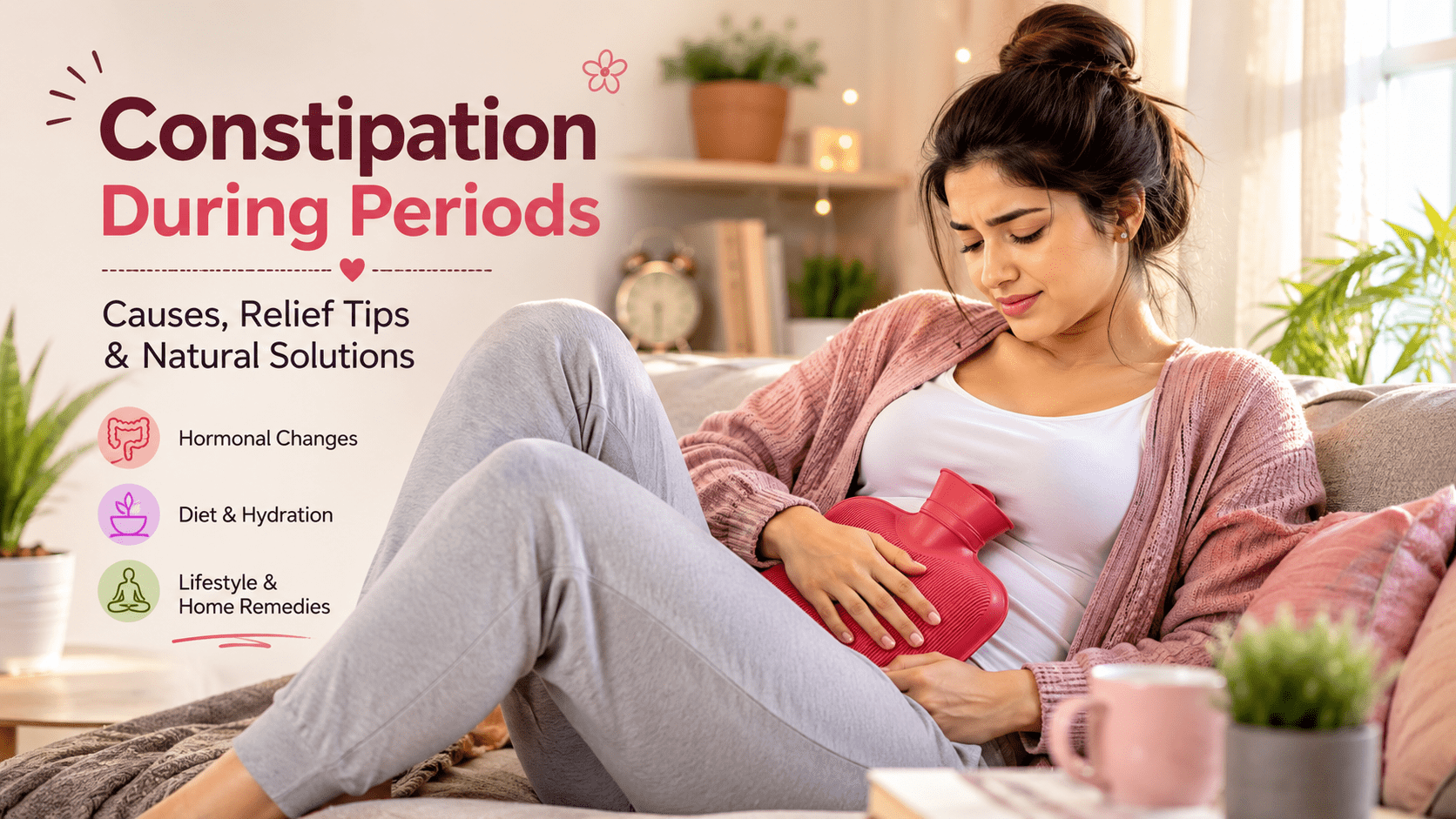
Constipation during your period is one of the most common yet least talked-about menstrual symptoms. A 2014 study published in BMC Women’s Health found that 73% of healthy women experience at least one gastrointestinal symptom, including constipation, bloating, or abdominal pain, before or during menstruation, and for many, a backed-up, bloated feeling arrives like clockwork every single cycle.[1]
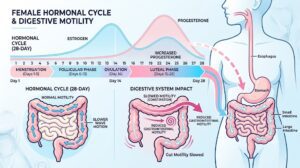
The cause is hormonal. In the days before and during your period, progesterone and estrogen shift dramatically, and these same hormones that govern your uterus also control how fast food moves through your gut. When progesterone rises during the luteal phase, your digestive system slows to a crawl, leaving you with hard stools, uncomfortable bloating, and that frustrating inability to go.
The good news: constipation during your period is predictable, temporary, and manageable. In this guide you will find clear explanations of why it happens, fast-acting relief you can try today, evidence-based natural remedies, a curated supplement list with product picks, and specific red flags that mean it is time to see a doctor.
Why Does Constipation Happen During Your Period?
Period constipation follows a predictable biological pattern. It is driven by hormonal changes that affect your digestive tract in parallel with your uterus. Here is what is actually happening.
Progesterone Slows Your Gut
The dominant driver of period constipation is progesterone. During the luteal phase (the two-week window between ovulation and the first day of your period), progesterone rises sharply. A 2022 literature review in Climacteric examined progesterone’s effects on the digestive tract and concluded that it relaxes smooth muscle throughout the gut, including the colon, and slows gastrointestinal motility in a dose-dependent way.[2] In plain terms: the higher progesterone climbs, the weaker the rhythmic contractions (peristalsis) that normally push stool forward, so transit time stretches out and stool sits longer, drying and hardening as it goes.
Dr. Sara Twogood, OB-GYN at Cedars-Sinai Medical Group, sums up the effect simply: progesterone slows the gastrointestinal tract, leading to constipation.[3] She notes this is most noticeable in the luteal phase, exactly when progesterone peaks.
Estrogen’s Role in Gut Motility
Estrogen also influences digestion, though its role is more nuanced. Some research suggests that elevated estrogen may reduce bowel motility and contribute to constipation-like symptoms.[4] Because estrogen peaks then falls sharply just before menstruation, both hormones can contribute to digestive slowdown in the days leading up to your period.
Water Retention Reduces Colon Hydration
PMS-related water retention means your body is holding fluid in peripheral tissue rather than circulating it through your digestive system. The colon needs water to keep stool soft. When less fluid reaches it, stool dries out and becomes harder to pass, even if you are not technically dehydrated.
Diet Changes During Menstruation
Period cravings typically favor comfort foods (chocolate, salty snacks, fried food) that are low in fiber and high in fat. High-fat foods slow gastric emptying on their own. When fiber intake drops precisely at the moment your gut is already hormonally slowed, constipation becomes nearly inevitable.
Stress and the Gut-Brain Axis
Premenstrual mood changes, including anxiety, irritability, and low mood, raise cortisol levels. A landmark review by Mayer EA published in Gut established that psychological stress disrupts gut motility and alters normal digestive rhythms through the gut-brain axis, with cortisol acting on receptors in smooth muscle cells to affect gut contractions and transit time.[5] This is why emotional stress before your period can worsen the physical constipation: they reinforce each other through shared neurological pathways.
Common Symptoms of Period Constipation
Period constipation has a recognizable symptom profile. Knowing what to look for helps you respond quickly and choose the right approach.
Hard or Infrequent Stool
Fewer bowel movements than your personal baseline, or stools that feel hard, lumpy, and require straining, are the clearest signs. Medically, constipation is defined as fewer than three bowel movements per week, or persistent difficulty passing stool.[6] If your normal is once daily and you go two to three days without going just before your period, hormonal constipation is the most likely cause.
Bloating and Abdominal Discomfort
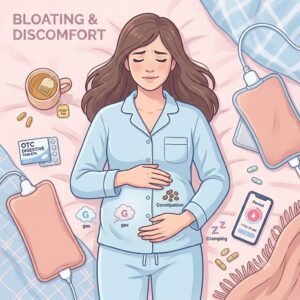
Bloating and constipation during your period often occur together. When stool sits in the colon longer than it should, gas accumulates and the abdomen swells and feels tender. This combination of hormonal water retention and digestive slowdown happening simultaneously is sometimes called “PMS belly.”[7]
Gas and Cramping
Backed-up stool generates gas. In an abdomen already cramping from prostaglandin activity in the uterus, trapped gas significantly amplifies discomfort. Many women cannot easily distinguish menstrual cramps from digestive cramping, because in the premenstrual phase, both are happening at the same time.
Feeling of Incomplete Emptying
The sensation of needing to go but being unable to fully empty the bowel (called incomplete evacuation) is a hallmark of slow-transit constipation. It is exactly what hormonal suppression of gut motility produces during the luteal phase.
How to Relieve Constipation During Period Fast
These four strategies can produce results within hours by directly stimulating gut movement or softening stool already in the colon.
1. Warm Water First Thing in the Morning
A large glass of warm water on an empty stomach triggers the gastrocolic reflex, the natural signal that causes the colon to contract after waking and eating. Adding a squeeze of fresh lemon enhances the effect. This is one of the simplest, fastest ways to stimulate a bowel movement without any supplement.
2. Prune Juice (120-240 ml on an Empty Stomach)
Prune juice contains sorbitol, a natural osmotic agent that draws water into the colon, combined with polyphenols that stimulate gut contractions. A randomized placebo-controlled trial published in the American Journal of Gastroenterology found that regular prune juice intake significantly improved stool softness and frequency in adults with chronic constipation.[8] This is one of the most evidence-backed whole-food options for period constipation. For a complete guide, see: prune juice for constipation relief.
3. Light Movement: Walking or Yoga
Even 20 minutes of walking stimulates intestinal peristalsis and helps move stool forward. Yoga poses involving abdominal compression, such as knees-to-chest pose (Apanasana), seated spinal twist, or wind-relieving pose, can be particularly effective during your period. Movement does not need to be vigorous; gentle consistent activity is enough. For a complete guide, see: Yoga for Constipation Relief
4. Ginger Tea
Ginger has been shown in clinical research to accelerate gastric emptying and reduce gut inflammation.[9] A cup of warm ginger tea after meals during the premenstrual week is a simple, evidence-backed habit with real digestive benefit. Peppermint tea is a useful alternative, as it relaxes intestinal smooth muscle and can relieve gas and cramping.
Natural Remedies for Period Constipation
These longer-acting remedies work best when added consistently in the days before and during your period. They address the root causes (stool hardness, slow transit, and microbiome disruption) rather than just providing temporary relief.
Prunes and Dried Figs
You already know prune juice works (see above), but the whole fruit earns a daily spot in its own right, not just as an emergency fix. Whole prunes deliver the same sorbitol-driven softening effect plus the soluble fiber bulk that juice strips away. That combination is likely why a randomized trial in Alimentary Pharmacology & Therapeutics found prunes actually outperformed psyllium husk (itself a leading fiber supplement) for improving stool frequency and consistency in adults with constipation.[10] Eating 5-8 prunes a day is the clinically studied whole-food dose.
Dried figs work through a similar fiber-and-sorbitol mechanism and make a good rotation option if you want variety. For more, see: dried figs for constipation: the science and best products.
Flaxseed and Chia Seeds
Both form a soft gel when mixed with water, adding bulk to stool and lubricating the intestinal wall. One to two tablespoons of ground flaxseed per day (whole flaxseed passes undigested) can be added to oatmeal, yogurt, or smoothies. Chia seeds can be stirred directly into water or food. These are ideal additions to your premenstrual diet because they also provide omega-3 fatty acids that help modulate the prostaglandin activity responsible for menstrual cramping.
Probiotic Foods: Plain Yogurt and Kefir
Hormonal changes during the menstrual cycle can disrupt your gut microbiome. Fermented foods with live cultures, such as plain yogurt, kefir, and to a lesser extent miso and kimchi, help maintain microbiome balance and support gut motility. Look for products labeled “live and active cultures” with a specific strain list on the label.
For strain-specific probiotic guidance, see: probiotics for constipation: what research actually says.
Magnesium-Rich Foods
Magnesium relaxes the smooth muscle of the colon and draws water into the intestine, softening stool. The richest dietary sources include pumpkin seeds (~156 mg per oz), dark chocolate (~64 mg per oz), spinach (~78 mg per half cup cooked), almonds (~77 mg per oz), and avocado (~58 mg per fruit).[11] Increasing magnesium intake through whole foods in the week before your period is a simple, evidence-supported preventive strategy.
Do’s and Don’ts: Quick Reference for Period Constipation
| DO (Helps Relieve Constipation) | AVOID (Makes It Worse) |
|---|---|
| Drink 8-10 glasses of water daily | Excess caffeine (more than 2 cups/day) |
| Warm water with lemon first thing in the morning | Processed and packaged snack foods |
| Eat 5-8 prunes or drink 120-240 ml prune juice daily | Fried and fast food |
| Add 1-2 tbsp ground flaxseed to meals | Large amounts of cheese and ice cream |
| Eat plain yogurt or kefir daily | Low-fiber white bread, white rice, white pasta |
| Walk 20-30 minutes or do gentle yoga | Sitting for prolonged periods |
| Drink ginger or peppermint tea | Skipping meals or eating very late at night |
| Increase fiber intake 5-7 days before your period | High-fat comfort foods that slow gastric emptying |
When to Worry: Warning Signs That Need Medical Attention
Period constipation is usually harmless and self-resolving. But a few symptoms cross the line from “uncomfortable” to “needs a doctor.” Here is how to tell the difference.
Get medical care the same day if you have:
- No bowel movement for 3 or more days along with significant abdominal pain, vomiting, or visible abdominal swelling
- Inability to pass stool or gas at all. This combination can signal a bowel obstruction and should not wait.
- Blood in your stool: bright red on toilet paper, in the bowl, or dark/tarry-looking stool (distinct from menstrual blood)
- Fever combined with abdominal pain and constipation
- Severe abdominal pain that feels different from, or clearly worse than, your usual period cramps
See your doctor soon (not an emergency, but worth a visit) if you have:
- Severe constipation every single cycle that does not improve with home remedies
- Unexplained weight loss alongside digestive changes
- Ribbon-like or pencil-thin stools, which can indicate structural changes worth evaluating
- Deep pelvic pain, especially pain during sex or bowel movements. Ask about endometriosis, since lesions can form on or near the bowel and cause cycle-dependent constipation that mimics the hormonal kind.[12]
- Persistent bloating with alternating constipation and diarrhea, plus mucus in stool outside your period. This pattern is worth an IBS evaluation, since research consistently shows that women with IBS report significantly worse gastrointestinal symptoms during and around menstruation.[13]
For more on when home constipation relief is enough and when it is not, see: constipation relief at home, including when to seek medical help.
Best Supplements and Probiotics for Period Constipation
When dietary changes alone are not enough, these supplements have the strongest clinical research support. Products listed are available on Amazon and selected based on strain specificity, evidence, and verified user outcomes.
Probiotics: The Right Strains Matter
Not all probiotics are equal for constipation. A 2014 systematic review and meta-analysis of randomized controlled trials in the American Journal of Clinical Nutrition (PMID: 25099542) found that probiotics increased bowel movement frequency by an average of 1.3 times per week, with the strongest effect from Bifidobacterium strains.[14]
Strains with the Best Evidence for Constipation:
- Bifidobacterium lactis HN019: improves gut transit time; studied in multiple RCTs
- Bifidobacterium lactis BB-12: improves stool frequency and consistency
- Lactobacillus acidophilus NCFM: supports motility and microbiome balance
- Lactobacillus reuteri DSM 17938: improved stool frequency versus placebo in a randomized trial of adults with chronic functional constipation.[15] A separate trial in children found it performed comparably to magnesium oxide,[20] but that head-to-head comparison is pediatric data and has not been replicated in adult women specifically, which is worth knowing as you weigh your options.
Tip: Take your probiotic consistently for at least 2-4 weeks before expecting measurable improvement. Starting 5-7 days before your expected period each cycle can help establish coverage before hormonal changes kick in.
Contains L. acidophilus, B. lactis, and L. reuteri among its strains. Verify the current label before purchasing, as manufacturers occasionally reformulate probiotic blends. Check current price on Amazon
2. Culturelle Digestive Daily Probiotic: Best Budget Pick
Lactobacillus rhamnosus GG, one of the most studied probiotic strains globally, in a well-tolerated, affordable daily capsule. Check current price on Amazon
Magnesium Supplements
Magnesium is one of the most clinically validated natural constipation remedies. Magnesium citrate and magnesium oxide work as osmotic agents, drawing water into the colon, softening stool, and stimulating contractions. According to MedlinePlus drug information, magnesium citrate typically causes a bowel movement within 30 minutes to 6 hours after taking it.[16] The 2023 joint AGA-ACG Clinical Practice Guideline endorsed magnesium oxide as an evidence-based treatment for chronic idiopathic constipation.[17]
Not all magnesium forms behave the same way, which matters when you are choosing one for period-related constipation specifically. Magnesium citrate is the fastest-acting and the usual first choice for occasional constipation. Magnesium oxide works more slowly but has the strongest guideline-level evidence behind it for chronic constipation. Magnesium glycinate is chelated to an amino acid, which makes it noticeably gentler on the gut and is a reasonable option if citrate or oxide cause cramping, though its laxative effect is comparatively mild. Magnesium hydroxide (milk of magnesia) sits between citrate and oxide in onset, typically working overnight.
Because period constipation is short-lived and predictable, magnesium is generally best used as a targeted, few-day tool around the days you expect symptoms, rather than an everyday supplement, unless your doctor has specifically recommended ongoing use.
Starting dose: 200-400 mg at bedtime. Always consult your healthcare provider first, especially if you have kidney disease, as magnesium is contraindicated in renal insufficiency.
Recommended Magnesium Products
1. Natural Vitality Calm Magnesium Citrate Powder: Editor’s pick. Fizzy citrate powder; non-GMO, vegan. Check current price on Amazon
2. Doctor’s Best High Absorption Magnesium Glycinate: Best for sensitive stomachs. Chelated form that is gentler and produces less cramping than citrate.Check current price on Amazon
For detailed comparison of all magnesium forms and dosages: 5 best magnesium supplements for constipation (2026 review).
Psyllium Husk (Fiber Supplement)
Psyllium husk is the most evidence-backed fiber supplement for constipation. It absorbs water and forms a soft gel that softens stool and makes it easier to pass. Evidence-based dietary guidelines developed by researchers at King’s College London, co-published in the Journal of Human Nutrition & Dietetics and Neurogastroenterology & Motility and endorsed by the British Dietetic Association, confirmed psyllium produces meaningful benefit for chronic constipation.[18] The same guidelines, notably, found weaker evidence for general “increase your fiber” advice without specifying a source, so a measured psyllium dose may help more than just eating more fiber in general.
Critical rule: always take psyllium with a full glass of water (8-12 oz minimum) and drink fluids throughout the day. Psyllium without adequate water can worsen constipation.
The most widely recommended psyllium product globally, with 2.4g soluble fiber per serving. Onset: 12-72 hours for consistent daily use.Check current price on Amazon
Non-GMO capsule format, frequently recommended by gastroenterologists for those who dislike powder texture. Check current price on Amazon
For a full fiber supplement comparison: Benefiber vs Metamucil: which fiber supplement works better?
Important Safety Note: The 2023 AGA-ACG Clinical Practice Guideline explicitly advises against magnesium-based laxatives in patients with renal insufficiency due to risk of hypermagnesemia. Always consult your healthcare provider before starting any supplement, particularly if you have kidney disease, are pregnant, or are taking prescription medications.
Prevention Tips for Future Period Constipation
The most effective strategy is getting ahead of period constipation before hormonal changes begin. A few consistent habits in the luteal phase can significantly reduce or eliminate symptoms.
Start Fiber Intake 5-7 Days Before Your Period
Begin increasing dietary fiber about one week before your period is due, right as the luteal phase begins and progesterone starts rising. Focus on whole foods: prunes, oats, flaxseed, pears, lentils, and dark leafy greens. This builds a fiber reserve before the hormonal slowdown begins, making it much easier to maintain transit through your period. For specific food recommendations: best fiber foods for gut health.
Hydrate Consistently Across Your Entire Cycle
Consistent daily hydration is more effective than drinking a lot of water after constipation has already set in. Aim for 8-10 glasses per day throughout your cycle, with extra attention in the week before your period. Magnesium-rich mineral water is a useful upgrade, as it provides both hydration and a gentle osmotic benefit.
Exercise Regularly
A 2019 meta-analysis of randomized controlled trials confirmed that regular physical activity significantly reduces constipation risk and improves bowel frequency in adults.[19] Aim for at least 30 minutes of moderate movement most days. Walking, swimming, cycling, or yoga are all appropriate during your period. Consistency across the cycle matters more than intensity.
Track Your Cycle to Anticipate Symptoms
A period tracking app that lets you log symptoms helps identify exactly when your constipation typically starts. If you know it reliably begins on day 24 of your cycle, you can start your fiber-and-hydration push on day 18. This turns a reactive problem into a preventable one, and that shift in timing makes more difference than most women expect.
Frequently Asked Questions About Period Constipation
Why do I get constipated before my period?
The primary cause is rising progesterone during the luteal phase, which relaxes smooth muscle throughout the gut and slows the contractions that drive bowel movements. Estrogen fluctuations, PMS-related water retention, stress, and dietary changes compound the effect. Most women experience this in the 3-7 days before menstruation begins.
How long does period constipation last?
Typically 5-7 days total. It starts in the pre-period window and begins resolving within 1-2 days of menstruation starting, because progesterone drops sharply when your period begins, allowing gut motility to return to normal. If constipation persists beyond your period or is getting progressively worse each cycle, discuss it with your doctor.
Can probiotics help period constipation?
Yes, particularly strains of Bifidobacterium lactis (HN019, BB-12) and Lactobacillus acidophilus NCFM. These strains support gut motility and stool consistency through microbiome-driven mechanisms that are independent of hormonal fluctuations, meaning they can help offset the hormonal slowdown your cycle creates. Daily consistent use for at least 2-4 weeks produces the best outcomes. For strain-specific guidance: probiotics for constipation relief.
Is constipation normal during menstruation?
Yes. A 2014 study published in BMC Women’s Health (PMID: 24450290) found that 73% of healthy premenopausal women experienced at least one GI symptom, including constipation, before or during their period.[1] It is caused by the same hormonal shifts that produce other menstrual symptoms and is not a sign of disease in most women. However, it does not need to be simply endured, as the strategies in this guide are effective and safe.
How to relieve constipation during period naturally?
The most effective natural approach combines several strategies simultaneously: drink warm water with lemon first thing in the morning, eat 5-8 prunes or drink prune juice daily, add ground flaxseed to meals, drink ginger tea, walk for 20-30 minutes, and eat plain yogurt or kefir for probiotic support. Starting these habits 5-7 days before your period gives them time to work before the hormonal slowdown peaks.
Final Thoughts
Constipation during your period is uncomfortable, but it follows a predictable hormonal pattern, which means it can be anticipated and prevented. The core cause is progesterone-driven relaxation of gut muscle during the luteal phase, compounded by water retention, dietary changes, and premenstrual stress. None of these are things you can completely stop, but all of them are things you can prepare for.
The most effective strategy is consistent prevention: increase fiber and hydration in the week before your period, add prunes or prune juice daily, take a daily multi-strain probiotic suited for women’s digestive health, and keep moving. If symptoms are severe, a short course of magnesium citrate or psyllium husk can provide faster relief.
If severe constipation disrupts your life every cycle, blood appears in your stool, or you go more than three days without a bowel movement despite trying these strategies, see your doctor. Some conditions that mimic period constipation, including endometriosis and IBS, require specific medical management.
You do not have to wait for next cycle to feel better. Start here:
- Compare the top probiotic strains for constipation: Probiotics for constipation relief
- Find the right magnesium form for your needs: 5 best magnesium supplements (2026 review)
- Discover 12 home remedies with dosage details: Fast constipation relief at home
- See the full evidence on fiber foods: Best fiber foods for gut health
- Compare psyllium products head to head: Benefiber vs Metamucil: which works better?
- Understand all OTC laxative options: Best OTC laxatives for constipation in the US
- Read the prune juice evidence guide: Prune juice for constipation relief
- Explore dried figs as a natural remedy: Dried figs for constipation: science and products
References
Every claim above links to a numbered source below. Expand to see full citations.
View All 20 References
- Bernstein MT, Graff LA, Avery L, et al. Gastrointestinal symptoms before and during menses in healthy women. BMC Women’s Health. 2014;14:14. PMID: 24450290. pmc.ncbi.nlm.nih.gov/articles/PMC3901893/
- Coquoz A, Regli D, Stute P. Impact of progesterone on the gastrointestinal tract: a comprehensive literature review. Climacteric. 2022;25(4):337-361. doi.org/10.1080/13697137.2022.2033203
- Flo Health. Constipation during ovulation: Is it a thing? January 2025. Summarizes commentary from Dr. Sara Twogood, OB-GYN, Cedars-Sinai Medical Group. flo.health
- Khalif IL, Quigley EM, Konovitch EA, Maximova ID. Alterations in the colonic flora and intestinal permeability and evidence of immune activation in chronic constipation. Dig Liver Dis. 2005;37(11):838-849. PMID: 16169298. Note: The role of estrogen in gut motility remains an active area of research. Animal studies have suggested elevated estrogen may slow intestinal transit; human data are more limited. The claim in this article is stated accordingly as “some research suggests.”
- Mayer EA. The neurobiology of stress and gastrointestinal disease. Gut. 2000;47(6):861-869. PMID: 11115828. pubmed.ncbi.nlm.nih.gov/11115828/
- Mayo Clinic Staff. Constipation: Symptoms and Causes. Updated January 2024. mayoclinic.org
- National Institute of Diabetes and Digestive and Kidney Diseases (NIDDK). Symptoms and causes of constipation. Updated May 2018. niddk.nih.gov
- Koyama T, et al. Prune juice containing sorbitol, pectin, and polyphenol ameliorates subjective complaints and hard feces while normalizing stool in chronic constipation: a randomized placebo-controlled trial. Am J Gastroenterol. 2022. PMC: 9531972. pmc.ncbi.nlm.nih.gov/articles/PMC9531972/
- Hu ML, et al. Effect of ginger on gastric motility and symptoms of functional dyspepsia. World J Gastroenterol. 2011;17(1):105-110. PMID: 21218090. pubmed.ncbi.nlm.nih.gov/21218090/
- Attaluri A, Donahoe R, Valestin J, Brown K, Rao SSC. Randomised clinical trial: dried plums (prunes) vs. psyllium for constipation. Aliment Pharmacol Ther. 2011;33(7):822-828. PMID: 21323688. pubmed.ncbi.nlm.nih.gov/21323688/
- NIH Office of Dietary Supplements. Magnesium: Fact Sheet for Health Professionals. Updated June 2022. ods.od.nih.gov
- Luscombe GM, Markham R, Judio M, Grigoriu A, Fraser IS. Abdominal bloating: an under-recognized endometriosis symptom. J Obstet Gynaecol Can. 2009;31(12):1159-1171. PMID: 20085681. pubmed.ncbi.nlm.nih.gov/20085681/
- Kane SV, Sable K, Hanauer SB. The menstrual cycle and its effect on inflammatory bowel disease and irritable bowel syndrome: a prevalence study. Am J Gastroenterol. 1998;93(10):1867-1872. PMID: 9772046. pubmed.ncbi.nlm.nih.gov/9772046/
- Dimidi E, Christodoulides S, Fragkos KC, Scott SM, Whelan K. The effect of probiotics on functional constipation in adults: a systematic review and meta-analysis of randomized controlled trials. Am J Clin Nutr. 2014;100(4):1075-1084. PMID: 25099542. pubmed.ncbi.nlm.nih.gov/25099542/
- Ojetti V, Ianiro G, Tortora A, D’Angelo G, Di Rienzo TA, Bibbò S, Migneco A, Gasbarrini A. The effect of Lactobacillus reuteri supplementation in adults with chronic functional constipation: a randomized, double-blind, placebo-controlled trial. J Gastrointestin Liver Dis. 2014;23(4):387-391. PMID: 25531996. pubmed.ncbi.nlm.nih.gov/25531996/
- MedlinePlus. Magnesium Citrate: Drug Information. U.S. National Library of Medicine. medlineplus.gov/druginfo/meds/a619019.html
- American College of Gastroenterology (ACG) / American Gastroenterological Association (AGA). Joint Clinical Practice Guideline on Chronic Idiopathic Constipation. Gastroenterology. 2023. gastrojournal.org
- Dimidi E, van der Schoot A, Barrett K, Farmer AD, Lomer MC, Scott SM, Whelan K. British Dietetic Association Guidelines for the Dietary Management of Chronic Constipation in Adults. J Hum Nutr Diet. 2025;38(5):e70133. Simultaneously co-published in Neurogastroenterol Motil. 2025;37(12):e70173. doi.org/10.1111/jhn.70133 | Summary: sciencedaily.com
- Gao R, Tao Y, Zhou C, et al. Exercise therapy in patients with constipation: a systematic review and meta-analysis of randomized controlled trials. Scand J Gastroenterol. 2019;54(2):169-177. PMID: 30843436. pubmed.ncbi.nlm.nih.gov/30843436/
- Kubota M, Ito K, Tomimoto K, Kanazaki M, Tsukiyama K, Kubota A, Kuroki H, Fujita M, Vandenplas Y. Lactobacillus reuteri DSM 17938 and magnesium oxide in children with functional chronic constipation: a double-blind and randomized clinical trial. Nutrients. 2020;12(1):225. PMID: 31952280. pubmed.ncbi.nlm.nih.gov/31952280/ (Pediatric trial, ages 6 months to 6 years; cited as supporting context for the magnesium-oxide comparison, not as direct evidence in adult women.)
Medical Disclaimer: The information on ConstipationRelief.net is for general educational purposes only and does not replace professional medical advice. Always consult your physician or gastroenterologist before making significant dietary or supplement changes, particularly if you have a diagnosed condition, are pregnant, or have kidney disease. This article is pending expert medical review.