

This article contains affiliate links. If you purchase through our links, we may earn a commission at no extra cost to you. This does not influence our recommendations or analysis.
📋 Table of Contents
If you have tried regular probiotics and still struggle with bloating, constipation, or an unsettled gut, you are not alone. Many conventional Lactobacillus and Bifidobacterium probiotics have limited survival through stomach acid, which may reduce how many live bacteria actually reach the intestines.
That is one reason spore-based probiotics have gained significant attention in recent years. Unlike many traditional probiotic strains, spore-forming Bacillus bacteria are naturally designed to survive harsh environments — including stomach acid — allowing more bacteria to remain viable through digestion and reach the intestines in active form.
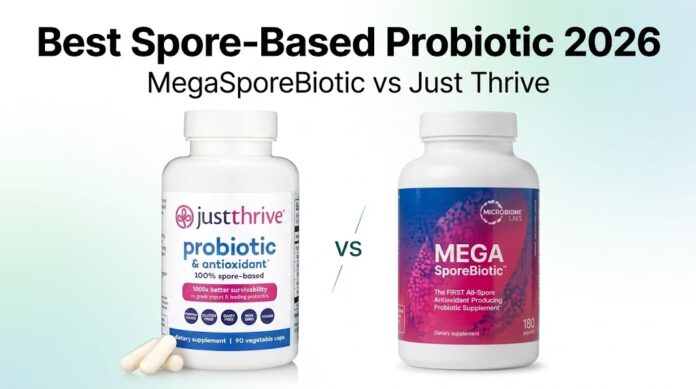
If you are searching for the best spore-based probiotic in 2026, two products dominate most discussions: MegaSporeBiotic (by Microbiome Labs) and Just Thrive Probiotic. Both use Bacillus spore strains, both are widely used in the functional medicine space, and both have research supporting their formulations.
However, they are not exactly the same. This guide breaks down their strain profiles, research, formulation differences, and ideal use cases — so you can better decide which spore-based probiotic may fit your gut health goals in 2026.
⚡ Quick Summary — MegaSporeBiotic vs Just Thrive (2026)
| Feature | MegaSporeBiotic | Just Thrive |
|---|---|---|
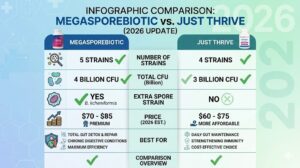
| Number of strains | ✅ 5 strains | ✅ 4 core strains (same as MSB) |
| CFU per dose | ✅ 4 billion CFU | ✅ 3 billion CFU |
| Clinical trial formula | ✅ Exact formula from 2017 clinical trial | — |
| Unique strain advantage | ✅ Includes B. licheniformis SL-307 | ✅ Unique antioxidant-producing HU36 strain |
| Shelf stability | ✅ Shelf-stable · No refrigeration | ✅ Shelf-stable · No refrigeration |
| Availability | ⚠️ Primarily practitioner-distributed | ✅ Widely available on Amazon & retail |
| Price | ⚠️ Higher price (~$50–65/month) | ✅ Lower price (~$45–55/month) |
| Ease of use | Requires standard capsule dosing | ✅ Can be opened and mixed into food |
| Best suited for | ⭐ May suit complex or long-standing gut symptoms | ⭐ Good starting point for first-time users |
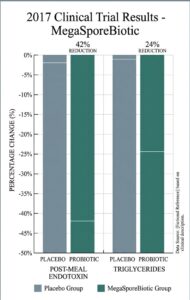
A 2017 published clinical trial using the MegaSporeBiotic formula observed a 42% reduction in a post-meal gut permeability marker at 30 days — though the study was small and industry-funded. Neither product should replace medical advice for persistent health conditions.
MegaSporeBiotic vs Just Thrive: Side-by-Side Comparison (2026)
| Feature | MegaSporeBiotic | Just Thrive | Edge |
|---|---|---|---|
| Made by | Microbiome Labs | Just Thrive Health | — |
| Key scientist behind it | Kiran Krishnan (co-founder) | Kiran Krishnan (consultant) | — |
| Number of bacterial strains | 5 strains | 4 strains | MSB |
| Strains included | B. indicus HU36 B. subtilis HU58 B. coagulans SC-208 B. licheniformis SL-307 B. clausii SC-109 |
B. indicus HU36 B. subtilis HU58 B. coagulans SC-208 B. clausii SC-109 (no B. licheniformis) |
MSB |
| Live cultures per dose | 4 billion (2 capsules) | 3 billion (1 capsule) | MSB |
| Special advantage | Extra strain for gut barrier repair, enzyme production, full B-vitamin synthesis | HU36 strain produces antioxidants (lycopene, vitamin K2) directly inside the gut | Different strengths |
| Clinical trial support | 2017 published RCT tested this exact 5-strain formula — observed 42% reduction in a post-meal gut permeability marker at 30 days (small, industry-funded study) | References the same 2017 trial; 4-strain formula not independently tested in a published RCT | MSB |
| Needs refrigeration? | No — 5-year shelf life | No — fully shelf-stable | Tie |
| Safe during antibiotic use? | Yes — B. clausii SC-109 survives antibiotics | Yes — B. clausii SC-109 survives antibiotics | Tie |
| Where to buy | Health practitioners; also Amazon | Amazon, retail stores, brand website | JT |
| Approximate price (30 days) | ~$50–$65 | ~$45–$55 | JT |
| Best for | Leaky gut, IBS, SIBO, chronic constipation | General gut health, mild issues, first-time spore probiotic users | — |
Prices vary by retailer and subscription. Check current pricing before purchasing.
Why Spore-Based Probiotics Are Different From Standard Probiotics
Your stomach produces strong acid — and a significant portion of some traditional Lactobacillus probiotic strains may not survive long enough to reach the intestines where they are meant to work. This is a known limitation of many conventional probiotic formulations.
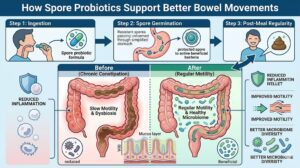
Spore-based probiotics are formulated differently. Bacillus bacteria — the type used in both these products — can form a tough, dormant shell called an endospore, similar to a seed pod. This structure is designed to survive stomach acid far more effectively than many standard strains, helping bacteria survive digestion more effectively and arrive at the intestines ready to work. Once there, the spores germinate into their active form and begin interacting with the gut environment.
Beyond survival, spore probiotics may offer a broader range of gut effects compared to conventional strains. Rather than simply adding bacteria, they appear to support gut microbial diversity, help reduce populations of harmful bacteria, and create conditions that may allow the gut’s own native beneficial bacteria to thrive.
The Surprising Connection Between These Two Products
Here is something most comparison articles leave out: these two products share the same scientific origin.
A microbiologist named Kiran Krishnan co-founded Microbiome Labs — the company that makes MegaSporeBiotic — and was also involved in creating Just Thrive. The four Bacillus strains in Just Thrive are the same four strains in MegaSporeBiotic, in the same amounts. This is not a coincidence.
The key differences come down to one extra strain and where you buy it:
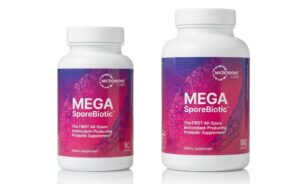
- MegaSporeBiotic includes a fifth strain (Bacillus licheniformis SL-307) and is distributed primarily through licensed health practitioners rather than general retail.
- Just Thrive is the consumer-friendly version — available on Amazon and in stores, no doctor required, and without that fifth strain.
Simple way to think about it: MegaSporeBiotic is commonly used within functional and integrative medicine practices, where a practitioner is guiding your protocol. If you are managing your own gut health independently, Just Thrive provides the same four core strains — a solid foundation, slightly simpler formula, and easier to purchase.
What Each Strain Does — In Plain Language
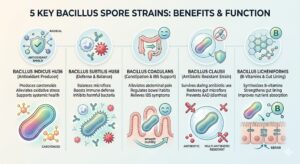
🔬 Bacillus indicus HU36 — The Antioxidant Maker (In Both Products)
This is the star strain of Just Thrive — and also found in MegaSporeBiotic. What makes it notable: research suggests it may produce antioxidants directly inside the gut environment, including lycopene, lutein, zeaxanthin, beta-carotene, and vitamin K2. These are produced right at the point where your body absorbs them best.
Why does that matter? Inflammation in your gut lining is one of the main contributors to leaky gut and slow digestion. Antioxidants produced at the gut wall may help counter that inflammation more directly than antioxidants consumed in standard supplement form.
Note: The antioxidant-producing ability of HU36 is documented in lab studies. Large human clinical trials specifically measuring this effect are still limited.
🔬 Bacillus subtilis HU58 — Your Gut’s Security Guard (In Both Products)
HU58 produces up to 12 natural antimicrobial compounds that actively fight harmful bacteria — including C. difficile and H. pylori. It also makes an enzyme called nattokinase, linked to healthy blood pressure and circulation. Think of HU58 as round-the-clock defense against harmful bacteria trying to take hold in your gut.
🔬 Bacillus coagulans SC-208 — The Constipation and IBS Strain (In Both Products)
If you are using either product for constipation or IBS, this is the strain doing the most direct work. A 90-day clinical trial found that Bacillus coagulans significantly reduced diarrhea, bloating, abdominal pain, and irregular bowel movements. It works by improving gut motility — how efficiently your digestive system moves food and waste through your body.
🔬 Bacillus clausii SC-109 — The Antibiotic-Resilient Strain (In Both Products)
This is one of the most widely used Bacillus probiotic strains worldwide — sold as a prescription medicine in many countries. Its standout feature: it has documented resistance to a wide range of common antibiotics, allowing it to remain viable even during antibiotic treatment. If you have taken multiple rounds of antibiotics and your gut has never felt right since, this strain is particularly relevant. This is a notable advantage compared with many conventional Lactobacillus-based probiotics.
🔬 Bacillus licheniformis SL-307 — MegaSporeBiotic ONLY ⭐
This is the strain that sets the two products apart. Kiran Krishnan has noted this strain is potent enough that he chose to sell it primarily through health practitioners rather than open retail.
What it adds:
- May produce compounds with antimicrobial activity — including bacitracin-like substances observed in lab settings — that target a wide range of harmful gut bacteria
- Makes digestive enzymes (proteases) to help break down proteins in food
- Synthesizes the full B-vitamin complex — including folate and biotin — directly in your gut
- May help support the gut lining, potentially reducing permeability associated with leaky gut
Microbiome Labs distributes this strain primarily through practitioner channels, which may reflect differences in positioning and intended use context.
🔍 How We Evaluated These Products
- Strain-level research: We reviewed published studies on each individual Bacillus strain — not just brand marketing claims.
- Clinical trial quality: We assessed the 2017 RCT (PMID: 28868181) for sample size, funding source, methodology, and limitations.
- Formulation transparency: We verified strain names, CFU counts, and third-party testing claims using publicly available product documentation.
- Use-case fit: We matched each product’s strengths to specific digestive concerns — constipation, leaky gut, IBS, antibiotic recovery.
- Pricing and accessibility: We compared real-world purchase options, subscription pricing, and availability through practitioner vs. retail channels.
- Safety profile: We reviewed adverse event reports and contraindication data for all included strains.
Neither Microbiome Labs nor Just Thrive Health had any editorial input into this article.
What the Research Actually Shows
The 2017 Clinical Trial — The Study Both Products Reference
In 2017, researchers at the University of North Texas published a double-blind, placebo-controlled clinical trial in the World Journal of Gastrointestinal Pathophysiology. (McFarlin BK, et al. PMID: 28868181 · PMC: PMC5561432)
The researchers tested for increased intestinal permeability — commonly called “leaky gut”, a pattern where the gut lining becomes more porous and allows toxins to enter the bloodstream after meals. Out of 75 people screened, 28 showed this pattern and were enrolled in the study.
For 30 days, half took the 5-strain MegaSporeBiotic formula. The other half took a placebo (rice flour). No other changes were required.
What happened after 30 days:
- Probiotic group: 42% drop in post-meal blood toxins (a key leaky gut marker)
- Placebo group: toxin levels actually went up 36% over the same period
- Net difference vs. placebo: 78% improvement in the leaky gut marker (calculated from the difference between the probiotic group’s 42% reduction and the placebo group’s 36% increase — not a standalone measurement)
- Triglycerides (blood fats): 24% reduction in the probiotic group
- Inflammatory markers (IL-12 and IL-1β): significantly reduced
- Hunger hormone (ghrelin): improved in the probiotic group
Be aware of these study limitations:
- Industry-funded: Microbiome Labs funded this study. Independent replication would make the evidence stronger.
- Small sample: Only 28 people completed the trial — promising results, but not a large-scale study.
- Not a perfect match for Just Thrive: The study tested the 5-strain MegaSporeBiotic formula. Just Thrive shares 4 of those 5 strains — so the evidence largely applies, but is not a perfect match.
Other Supporting Research
- Bacillus coagulans SC-208: A separate 90-day randomized trial showed significant improvements in IBS symptoms — less diarrhea, less bloating, less abdominal pain, and more regular bowel movements.
- Bacillus subtilis HU58: A 2020 pilot study in Evidence-Based Complementary and Alternative Medicine showed this strain was safe and well-tolerated even in patients with serious liver conditions.
- 5-strain formula gut diversity study: A 2021 study in Food Research International (Marzorati et al.) found the 5-strain Bacillus formula significantly increased gut microbial diversity and healthy metabolite production in a validated lab model of the human gut.
- Bacillus clausii: Decades of prescription-level clinical data from European pharmaceutical markets make it one of the most extensively studied Bacillus probiotic strains available.
How Spore Probiotics May Help With Constipation — 4 Possible Mechanisms
Constipation is rarely just one thing. It can involve slow gut movement, an imbalanced gut microbiome, gut wall inflammation, or poor gut-nerve signaling. Spore probiotics may address several of these at once.
1. Speed Up Gut Movement
Bacillus coagulans SC-208 has clinical evidence for improving intestinal transit time — how quickly food and waste move through your digestive tract. Faster movement generally means softer, easier-to-pass stools and less constipation.
2. Reduce Gut Inflammation
The 2017 trial showed significant drops in inflammatory markers at 30 days. Chronic low-grade gut inflammation can interfere with the nerve network that controls intestinal contractions. Reducing inflammation may allow those contractions to improve over time.
3. Restore Gut Bacteria Diversity
Antibiotics, poor diet, stress, and illness all reduce the variety of bacteria in your gut. A less diverse gut microbiome is consistently linked to slower digestion and more constipation. The 2021 SHIME study showed the 5-strain formula significantly improved gut diversity and healthy fermentation activity.
4. Support the Gut Lining
Supporting gut barrier integrity — one of the main findings associated with the 2017 trial — may help restore normal bowel function. When the gut wall is compromised, body-wide inflammation can impair normal digestive nerve signaling. Improving gut wall integrity may, over time, help normalize bowel contractions and movement.
MegaSporeBiotic may be a better fit if you:
- Have experienced constipation for months or years and have not found a solution that works for you
- Have symptoms commonly associated with increased intestinal permeability — sometimes referred to as “leaky gut”, IBS, or SIBO
- Have had multiple antibiotic courses and your digestion has not fully recovered
- Are already working with a functional medicine doctor, naturopath, or integrative health practitioner
- Want the exact 5-strain formula used in the 2017 clinical trial
- Are willing to pay a little more for the more complete strain profile
Just Thrive may be a better fit if you:
- Are new to spore probiotics and want a trusted, science-backed starting point
- Have mild to moderate digestive issues — occasional bloating, irregular bowel movements, gas
- Want gut health support plus potential natural antioxidant production through the unique HU36 strain
- Are managing your own gut health without a practitioner and want a retail option
- Want something safe for the whole family — capsules can be opened and mixed into food or drinks
- Prefer a slightly lower price point

Pros & Cons at a Glance
MegaSporeBiotic
✅ Pros
- One of the more comprehensive spore-based formulas currently available
- 4 billion CFU per dose
- Exact formula used in the 2017 published RCT
- Includes B. licheniformis SL-307 for B-vitamins, enzymes & gut lining support
- 5-year shelf life; no refrigeration needed
- Practitioner-grade positioning with medical guidance available
❌ Cons
- Slightly higher price (~$50–65/month)
- Requires 2 capsules per dose
- Primarily practitioner-distributed (though available on Amazon)
- Funding source of key study (industry-funded) limits independence
Just Thrive
✅ Pros
- Same 4 core strains as MegaSporeBiotic
- Widely available — Amazon, retail, direct
- 1 capsule per dose (simpler)
- Lower price point (~$45–55/month)
- Can be opened and mixed into food/drinks
- Good for whole-family use (children over 3)
❌ Cons
- Missing B. licheniformis SL-307
- 3 billion CFU — lower total live culture count than MegaSporeBiotic
- No independent published RCT for the exact 4-strain formula
- May not be sufficient for severe or chronic gut conditions
⚠️ Who Should Avoid or Use Caution With These Probiotics?
- Immunocompromised individuals — including those on chemotherapy, organ transplant recipients, or people with serious autoimmune conditions. Always consult your physician before starting any probiotic.
- People with Small Intestinal Bacterial Overgrowth (SIBO) — though spore probiotics are often better tolerated than Lactobacillus-based products in SIBO, some practitioners prefer to address overgrowth before introducing probiotics. Discuss with your provider. See also: which probiotic strains are studied for IBS and SIBO.
- Pregnant or breastfeeding women — generally considered low risk, but always check with your OB-GYN before starting anything new.
- Children under 3 — both companies offer dosing guidance for children over age 3, but talk to your pediatrician for younger children.
- Anyone with a known Bacillus sensitivity or allergy — rare, but if you have had a prior reaction to Bacillus-based products, avoid these.
- People taking immunosuppressant drugs — consult your prescribing physician.
If symptoms significantly worsen after starting either product, stop use and consult a healthcare provider.
How to Use Spore Probiotics for Best Results
Start at Half Dose — This Step Is Important
When starting a spore-based probiotic, some people experience temporary digestive changes in the first week or two — such as mild bloating, gas, loose stools, or brief fatigue. Some people describe this temporary adjustment phase as a “die-off effect,” although this term is not universally defined in clinical medicine and individual responses can vary considerably. Starting at a lower dose and gradually increasing may help minimize initial discomfort.
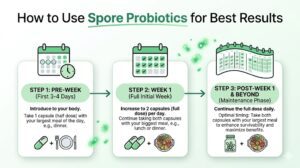
- MegaSporeBiotic: Begin with ½ capsule every other day for Week 1. Then ½ capsule daily for Week 2. Then work up to the full 2-capsule dose over 3–4 weeks.
- Just Thrive: Open ½ capsule and mix into food or a drink for the first week. Then move to 1 full capsule daily.
Temporary symptoms should clear up within 2–3 days. If they last more than a week, reduce your dose and increase more slowly.
Take With Your Biggest Meal of the Day
Both products are designed to be taken with food. Eating activates the digestive environment the spores need to germinate and begin working. Both companies recommend pairing with your largest meal.
Add a Prebiotic — It Can Make a Real Difference
A probiotic adds beneficial bacteria to your gut. A prebiotic feeds those bacteria so they can multiply and stay strong. Some research suggests combining probiotics with prebiotics may significantly improve beneficial bacterial growth compared to using a probiotic alone.
- For MegaSporeBiotic: MegaPre (by Microbiome Labs) contains specific fibers designed to feed the strains in MegaSporeBiotic.
- For Just Thrive: Just Thrive also offers a companion prebiotic — or simply eat more prebiotic-rich foods: garlic, onions, leeks, oats, asparagus, green bananas.
See: Best Fiber Foods for Gut Health · Natural Fiber Supplements for Chronic Constipation
Give It 60–90 Days Minimum
The 2017 trial showed measurable changes at just 30 days — but rebuilding a healthy gut microbiome takes time. For lasting relief from chronic constipation or IBS, most experts and both companies recommend at least 60–90 days of daily use before evaluating the full results.
Combine With a Broader Strategy
- Hydration: Dehydration is one of the biggest causes of constipation. See: Does Dehydration Cause Constipation?
- Magnesium: Works alongside probiotics for constipation relief. See: Best Magnesium Supplements for Constipation
- Psyllium fiber: Gold-standard fiber for constipation. See: Psyllium Husk vs Wheat Bran for Constipation
- Movement and yoga: Gentle exercise directly stimulates gut movement. See: Yoga for Constipation Relief
- Plant-based diet: See: Plant-Based Diet for Constipation Relief
Side Effects and Who Should Be Careful
Bacillus spore probiotics have a 50+ year safety track record in Europe and Asia and are considered safe for most healthy adults. A few things to know:
- First 1–2 weeks: Temporary bloating, gas, or loose stools are normal during the adjustment period. Starting at half dose helps minimize this.
- Histamine sensitivity: Unlike many Lactobacillus strains, Bacillus spores do not produce histamine — making them generally better tolerated by people sensitive to histamine. Individual responses vary.
- During pregnancy: Both products are generally considered low risk, but always check with your OB-GYN before starting anything new. See: Safe Probiotics for Pregnancy-Related Constipation
- Children under 3: Talk to your pediatrician first. Both companies offer dosing guidance for children over age 3.
If symptoms significantly worsen or persist beyond 3–4 weeks, stop use and consult a healthcare provider.
🏆 Final Verdict: Best Spore-Based Probiotic 2026 — Which One Is Right for You?
For people with more persistent digestive symptoms — long-term constipation, suspected leaky gut, IBS, or SIBO: MegaSporeBiotic may be better suited. It is the only product that uses the exact 5-strain formula from the published 2017 clinical trial, includes Bacillus licheniformis SL-307, and delivers 4 billion live cultures per serving. If you are working with a functional medicine or integrative practitioner, this is the more complete formula to discuss with them.
For general gut maintenance, first-time users, or mild digestive concerns: Just Thrive is a well-validated option. It shares the same scientific origin and four identical core strains, offers a unique antioxidant-producing strain (HU36), and is more accessible for self-directed use. For many people it may be entirely sufficient.
The balanced bottom line: Both products offer meaningful advantages over many standard Lactobacillus probiotics in terms of gut survivability and strain profile. The choice comes down to the nature of your digestive symptoms, whether you have practitioner access, and your budget. Neither should replace medical advice for persistent health conditions.
Frequently Asked Questions
Is MegaSporeBiotic better than Just Thrive?
MegaSporeBiotic contains five Bacillus strains (including the exclusive B. licheniformis SL-307), delivers 4 billion CFU per dose, and is the exact product tested in the 2017 published clinical trial. Just Thrive shares the same four core strains at 3 billion CFU and is more accessible for self-directed use. For persistent or complex digestive issues, MegaSporeBiotic’s additional strain and higher CFU count may offer more support. For general gut maintenance or first-time use, Just Thrive is a well-validated starting point. See the Final Verdict for a full side-by-side recommendation.
Are MegaSporeBiotic and Just Thrive the same product?
They share the same scientist (Kiran Krishnan) and the same four core Bacillus strains in the same amounts. Key differences: MegaSporeBiotic has a fifth strain (B. licheniformis SL-307), 4 billion vs. 3 billion live cultures, and is sold primarily through licensed practitioners rather than general retail.
What exactly is a spore-based probiotic?
It uses Bacillus bacteria that form a protective shell — called an endospore — that is designed to survive stomach acid far more effectively than many standard probiotic strains, helping viable bacteria arrive and activate in the intestines. Most standard Lactobacillus probiotics lack this protection and may be largely destroyed before they reach the gut.
Can spore probiotics actually help with constipation?
Evidence suggests they may help. Bacillus coagulans SC-208 in both products has been studied for bowel regularity and gut motility improvements. Spore probiotics may also support microbiome rebalancing and help reduce gut inflammation — both of which can influence bowel movement frequency and stool consistency. Individual results will vary. See our full guide: MegaSporeBiotic for Constipation.
How long before I notice results?
Most people notice digestive changes within 2–4 weeks. The 2017 trial showed measurable gut barrier improvement at 30 days. For chronic constipation and full microbiome rebuilding, expect 60–90 days of consistent use for best results.
Can I take these while on antibiotics?
Yes. Bacillus clausii SC-109 in both products has documented resistance to a wide range of common antibiotics — so it remains effective even during antibiotic treatment. This may offer a practical advantage compared with many conventional Lactobacillus-based probiotics.
Do I need to keep these in the fridge?
No. Both are shelf-stable. The endospore shell protects the bacteria from heat and moisture. MegaSporeBiotic has a stated 5-year shelf life. The spores can even be mixed into warm food or drinks without losing potency.
Should I take a prebiotic at the same time?
Yes — for best results. A prebiotic provides the fiber these bacteria need to thrive and multiply in your gut. Some research suggests combining a spore probiotic with a prebiotic may significantly improve beneficial bacterial growth. Both Microbiome Labs and Just Thrive offer companion prebiotic products. See also: Best Probiotic Strains for Constipation and Bloating.
What is the best spore-based probiotic in 2026?
MegaSporeBiotic and Just Thrive are among the most researched and widely discussed spore-based probiotics in 2026. MegaSporeBiotic may be better for complex digestive symptoms, while Just Thrive is often preferred for general gut health support and first-time users.
References
- McFarlin BK, et al. “Oral spore-based probiotic supplementation was associated with reduced incidence of post-prandial dietary endotoxin, triglycerides, and disease risk biomarkers.” World Journal of Gastrointestinal Pathophysiology. 2017;8(3):117–126. PMID: 28868181 · PMC: PMC5561432
- Marzorati M, Van den Abbeele P, Bubeck S, Bayne T, Krishnan K, Young A. “Treatment with a spore-based probiotic containing five strains of Bacillus induced changes in the metabolic activity and community composition of the gut microbiota in a SHIME® model.” Food Research International. 2021;149:110676.
- Yossef S, Clark F, Bubeck SS, et al. “An Oral Formulation of the Probiotic, Bacillus subtilis HU58, Was Safe and Well Tolerated in a Pilot Study of Patients with Hepatic Encephalopathy.” Evidence-Based Complementary and Alternative Medicine. 2020;2020:1463108.
- Ford AC, et al. “Efficacy of prebiotics, probiotics, and synbiotics in irritable bowel syndrome and chronic idiopathic constipation: systematic review and meta-analysis.” American Journal of Gastroenterology. 2014;109(10):1547–1561. PMID: 25070051
- Cutting SM. “Bacillus Probiotics.” Food Microbiology. 2011;28(2):214–220.
- Payne J, et al. “The Potential of Bacillus Species as Probiotics in the Food Industry: A Review.” Foods. 2024;13(15):2444.





[…] you are interested in adding probiotic support alongside dietary changes, our 2026 guide to the best spore-based probiotics is a useful next read — particularly for people who have tried standard probiotic supplements […]
[…] a supplement alongside dietary changes, see our review of the 9 best probiotic supplements and the best spore-based probiotics for […]
[…] Best Spore-Based Probiotic 2026: MegaSporeBiotic vs Just Thrive […]