

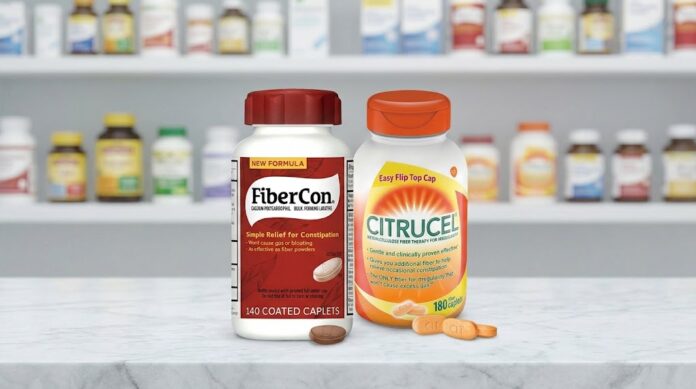
FiberCon vs Citrucel is a choice many people face in the laxative aisle. Both come as caplets, both promise gentle, non-stimulant relief, and both tell you to drink a full glass of water with every dose. When two boxes look this similar, what actually separates them?
This guide compares what is printed on the labels, what the research really covers, and where the practical differences show up, from calcium content to dosing steps to who each product is written for. We also say plainly where the evidence runs out, because for these two products it runs out sooner than most people expect.
Quick answer: FiberCon (calcium polycarbophil) and Citrucel (methylcellulose) are both bulk-forming laxatives that resist fermentation by gut bacteria, and both labels say a bowel movement usually follows in 12 to 72 hours.[1,2,5] We did not find a trial that compares the two for constipation, so the choice mostly comes down to practical details. Citrucel is also sold as a powder and has a label dose for children 6 to 11, while each FiberCon caplet adds 140 mg of calcium.[1,2] If you want the fiber with the strongest research behind it, that is psyllium, not either of these.[3,4,11]
FiberCon vs Citrucel: Quick Comparison
| Feature | FiberCon | Citrucel |
|---|---|---|
| Active ingredient per caplet | Calcium polycarbophil 625 mg (equal to 500 mg polycarbophil)[1] | Methylcellulose 500 mg[2] |
| How the label sets the dose | 2 caplets per dose[1] | Start with 2 caplets, increase as needed up to 6 times per day[2] |
| Label maximum per day | 8 caplets[1] | 12 caplets[2] |
| Ages on the label | 12 and older; under 12, ask a doctor[1] | 12 and older; ages 6 to 11 start with 1 caplet (maximum 6 caplets per day); under 6, consult a physician[2] |
| Usual time to a bowel movement | 12 to 72 hours[1] | 12 to 72 hours[2] |
| Calcium per caplet | 140 mg (plus 10 mg magnesium)[1] | 10 mg[2] |
| Label wording on duration | Do not use for more than 7 days unless directed by a doctor[1] | Stop use and ask a doctor if constipation lasts more than 7 days[2] |
| Spacing from other drugs | Take 2 or more hours before or after other drugs[1] | No such line on the caplet label we reviewed[2] |
| Claims on the package | “Won’t cause gas or bloating” and “As effective as fiber powders”[1] | “Won’t cause excess gas” (based on laboratory testing; individual results may vary) and “Gentle and clinically proven effective” (when used as directed)[2] |
| Forms sold | Caplets | Caplets and powder (the powder, including a sugar-free version, has its own label and dosing) |
Labels can change, so check the box in your hand. Calcium amounts can differ between product labels and label versions, so check the Drug Facts panel on your box. The figures above come from the FiberCon label updated in March 2026 and the Citrucel caplet label updated in December 2024.[1,2] The package claims are marketing statements, not trial results. Milligrams of different polymers are not directly comparable, so do not read the 500 mg figures as equal strength.
Disclosure: This post contains affiliate links. As an Amazon Associate, ConstipationRelief.net earns from qualifying purchases, at no extra cost to you.
What Is FiberCon?
FiberCon’s active ingredient is calcium polycarbophil, a synthetic polymer. Each caplet contains 625 mg of it, equal to 500 mg of polycarbophil, and the label is written for occasional constipation in adults and children 12 and older.[1] For the full story on dosing, side effects, and the older studies behind it, see our guide to FiberCon for constipation.

What Is Citrucel?
Each Citrucel caplet contains 500 mg of methylcellulose, a cellulose derivative, and the label calls it a bulk-forming fiber laxative.[2,5] The same ingredient is also sold as a powder. Our separate Citrucel for constipation review goes deeper on how it compares with psyllium and who should be careful with it.

How FiberCon and Citrucel Work
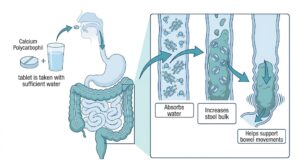
Despite the different names, the mechanism is shared. A clinical review groups methylcellulose, calcium polycarbophil, and psyllium together as bulk-forming agents that absorb water into the colon and increase stool mass, which in turn stimulates movement through the gut.[5] The same review describes methylcellulose and calcium polycarbophil as synthetic fiber polymers that are metabolically inert and resistant to bacterial fermentation.[5]
An older pharmacology review notes that calcium polycarbophil can hold 60 to 100 times its weight in water in dilute alkali, which is the basis for its use.[6] That is a laboratory figure, not a measurement from inside the intestine. The practical point is simple: both products depend on water. Without enough fluid they cannot do their job, and they can swell where you do not want them to, which is why both labels carry a choking warning.[1,2] If you tend to run low on fluids, our article on dehydration and constipation explains why that matters.
Gas and Bloating: What the Boxes Say and What We Know
Gas is the reason many people look for an alternative to a psyllium drink, so it deserves a careful look. The FiberCon panel says it will not cause gas or bloating.[1] The Citrucel panel uses softer wording, saying it will not cause excess gas, with a note that the claim is based on laboratory testing and that individual results may vary.[2]
The science behind both claims is the same: neither polymer is fermented by gut bacteria, and fermentation is the usual source of gas from fiber.[5] That is a reasonable argument, but it is not the same as a trial showing less gas in people. We did not find a study that compares gas or bloating between FiberCon and Citrucel.
The evidence that does exist is mixed. The older calcium polycarbophil review lists epigastric fullness, abdominal distention, bloating, and flatulence among its reported adverse effects, while calling them minimal.[6] In the small IBS trial described below, 13 of the 15 participants with bloating as a symptom preferred polycarbophil over placebo.[9] Meanwhile, the 2022 fiber meta-analysis notes that an earlier meta-analysis linked fiber supplements in general to side effects such as flatulence.[4] So “gentler on gas” is a fair expectation, not a guarantee. A review of constipation treatment adds that bloating from fiber can often be reduced by starting with a low dose and increasing it gradually.[5]
What Does the Research Say?
Citrucel (methylcellulose)
One study followed 59 adults with chronic constipation who took 1, 2, or 4 g of methylcellulose daily, or 3.4 g of psyllium. Every dose increased stool frequency, stool water content, and fecal solids, and the authors concluded that even 1 g a day was an effective laxative.[7] By our arithmetic, 1 g is 2 Citrucel caplets (the label’s starting dose) and 4 g is 8 caplets. The abstract does not mention a placebo group, so the study shows that methylcellulose does something, rather than how much better it is than placebo.
A 1989 report on 538 patients with fewer than three stools per week found that stool frequency, consistency, and ease of passage returned to normal with one to three tablespoonfuls of methylcellulose a day, and 61% were judged to have less constipation.[8] That abstract also does not describe a control group, and the dosing was in tablespoons rather than caplets. Both studies tested methylcellulose laxatives in general, so results for a specific branded caplet may differ.
FiberCon (calcium polycarbophil)
The research on calcium polycarbophil is smaller and older. A 1982 review described the clinical studies as relatively few, ranging from uncontrolled, unblinded evaluations to double-blind crossover trials, and asked for better controlled work.[6]
The best-known placebo-controlled trial was a six month crossover study of 23 people with irritable bowel syndrome (IBS) who took 6 g a day, given as twelve 0.5 g tablets.[9] Of the 21 who expressed a preference, 15 chose polycarbophil over placebo. Among the 19 with constipation, 15 (79%) preferred it, as did all six people with alternating diarrhea and constipation.[9] This is a small, dated trial in IBS rather than everyday constipation, and its daily dose was higher than the 8 caplets the FiberCon label allows. Treat it as a hint, not proof.
Is there a head-to-head trial?
We did not find one for constipation. The only controlled study we found that put both products in the same trial looked at cholesterol instead. In that placebo-controlled study of people with mild to moderate high cholesterol, the LDL cholesterol difference versus placebo was −8.8% with psyllium, −3.2% with methylcellulose (not statistically significant), and +8.7% with calcium polycarbophil. The authors concluded that methylcellulose and calcium polycarbophil provided little or no additional benefit.[10] It is a 1991 study and it measured cholesterol, not constipation relief, so it cannot show which product works better for constipation. It is still a useful reminder that neither product carries the cholesterol benefit that psyllium has.
What the guidelines say
The 2023 AGA and ACG guideline on chronic idiopathic constipation conditionally suggests fiber supplementation for chronic idiopathic constipation, based on low certainty evidence. Among the fiber supplements evaluated, psyllium has the clearest evidence of benefit, while the evidence for bran and inulin is limited and uncertain.[3] The guideline did not identify eligible studies of methylcellulose, and it does not specifically recommend calcium polycarbophil. It gave polyethylene glycol (the ingredient in MiraLAX) a strong recommendation based on moderate certainty evidence.[3]
A 2021 systematic review of over-the-counter therapies, which included only randomized trials of at least 4 weeks published between 2004 and 2020, graded the evidence as good for polyethylene glycol and senna and moderate for psyllium, among others. Its abstract names no grade for methylcellulose or calcium polycarbophil.[11] That does not prove they fail; it means trials of that type were not found for them in that period.
A 2022 meta-analysis of 16 randomized trials with 1,251 adults found that, among the trials reporting treatment response (802 participants), 66% of people taking fiber responded compared with 41% on control. Psyllium and pectin showed significant effects, and gains in stool frequency appeared mainly with higher doses and treatment lasting 4 weeks or more.[4] In plain terms, fiber in general helps, psyllium has the clearest proof, and FiberCon and Citrucel are reasonable but less studied options.
The Calcium Difference Worth Knowing About
This is the detail most comparison pages skip. Each FiberCon caplet on the label we reviewed contains 140 mg of calcium and 10 mg of magnesium, while a Citrucel caplet contains 10 mg of calcium.[1,2] A standard 2-caplet FiberCon dose therefore supplies 280 mg of calcium, and the 8-caplet daily maximum supplies about 1,120 mg (our arithmetic from the label). These are the amounts on the label, not the amount your body absorbs. Other calcium polycarbophil products, and other label versions, may list a different amount, so check the Drug Facts panel on the box you buy.
For context, the NIH lists a recommended intake of 1,000 mg a day for most adults 19 to 50 and 1,200 mg for women 51 and older and everyone 71 and older. The daily upper limit, counting food, drinks, and supplements together, is 2,500 mg for adults 19 to 50 and 2,000 mg for adults 51 and older.[12] So the FiberCon maximum alone is close to a full day’s recommended intake, before any calcium from food. The label does not say how much of the calcium is absorbed.
For many people occasional use will not matter. It is worth a quick conversation with a pharmacist or doctor if you already take calcium supplements or calcium-containing antacids, have kidney disease or a history of kidney stones, have been told to limit calcium, or take medicines that need spacing from calcium-containing products.
How to Take Either One Safely
- Use a full glass of water. Both labels call for at least 8 ounces of water or other fluid with each dose.[1,2]
- Follow the label dose. For FiberCon that is 2 caplets per dose, no more than 8 caplets in 24 hours. For Citrucel, start with 2 caplets and increase as needed, up to 6 times a day and no more than 12 caplets daily.[1,2]
- Give it time. The FiberCon label says one to three days of use is normally needed for full benefit, and that the right dose may vary with diet, exercise, previous laxative use, or severity of constipation.[1]
- Space it from other medicines. The FiberCon label says to take it 2 or more hours before or after other drugs, because all laxatives may affect how other drugs work.[1] The Citrucel caplet label does not carry that exact line, but the same precaution is sensible. Ask a pharmacist if you take prescription medicines regularly.
- Skip it if swallowing is difficult or the gut may be narrowed. Both labels warn against use if you have difficulty swallowing, and say to seek immediate medical attention for chest pain, vomiting, or trouble swallowing or breathing after a dose.[1,2] The older polycarbophil review also advises against bulk-forming agents for people with narrowing (stenotic lesions) of the gastrointestinal tract.[6]
- Know when to stop. Rectal bleeding is a reason to stop and call a doctor on both labels. The FiberCon label adds failing to have a bowel movement after using a laxative, and the Citrucel label adds constipation lasting more than 7 days.[1,2]
FiberCon or Citrucel: Who Might Prefer Which?
Because the evidence does not separate them, this comes down to fit. Think of it as a short checklist rather than a verdict.
Citrucel may suit you if:
- you would like a powder option, including a sugar-free one, as well as caplets
- you want a product with a label dose for children 6 to 11 (ask the child’s doctor first)
- you would rather not add calcium, since Citrucel caplets contain 10 mg versus 140 mg in FiberCon[1,2]
- you like starting low and adjusting the dose within the label limits
FiberCon may suit you if:
- you want a simple caplet routine with a fixed 2 caplet dose
- you do not have a reason to limit calcium
- your constipation sometimes alternates with loose stools. All six such participants in the small IBS trial preferred polycarbophil,[9] and the older review describes it being used for both constipation and diarrhea.[6] That is thin evidence, so discuss it with a doctor rather than treating it as a recommendation.
Neither may be the right first step if:
- you want the fiber with the strongest research, in which case psyllium is the better-supported choice (see our guide to psyllium fiber capsules and our broader look at psyllium vs methylcellulose vs FiberCon capsules)
- you need something stronger or faster, where our comparison of MiraLAX vs Metamucil and our guide to OTC laxatives explain the osmotic options
- you have trouble swallowing, a known bowel obstruction, or any warning sign such as blood in the stool
Pregnancy, Children, and Older Adults
Pregnancy. A clinical review of constipation treatment lists psyllium, methylcellulose, and polycarbophil among the most physiologic and safest laxative options during pregnancy.[5] That review dates from 2005, and it is general information, so check with your obstetrician or midwife first. Our guide to safe laxatives during pregnancy walks through the other options.
Children. The FiberCon label covers ages 12 and older and tells you to ask a doctor for younger children.[1] The Citrucel caplet label gives ages 6 to 11 a lower starting dose (1 caplet, up to 6 caplets a day) and tells you to consult a physician for children under 6.[2] Either way, a pediatrician should guide the decision.
Older adults. Choking is the main safety issue with swellable caplets, so adequate fluid and an easy swallow matter. Our roundup of sugar-free fiber supplements for seniors covers other formats and dosing considerations for older adults.
When Fiber Alone Is Not Enough
Both labels are written for occasional constipation.[1,2] If you are using a fiber caplet every day and still struggling, the next step is a conversation with your doctor rather than a bigger dose. Ask a doctor sooner for abdominal pain, nausea or vomiting, or a sudden change in bowel habits that lasts two weeks, and stop use for rectal bleeding or no bowel movement after using a laxative.[1,2] Unexplained weight loss is another reason to get checked rather than self-treat.
Products Mentioned in This Guide
If you have decided to try one, these are the versions this guide refers to. Package sizes and prices change, so check the current listing and read the label before you buy.
- For calcium polycarbophil, FiberCon caplets are the standard place to start.
- For methylcellulose in caplet form, Citrucel Fiber Therapy Caplets (180 count) give you the same ingredient without mixing a drink.
- If you would rather mix a drink, the Citrucel Sugar-Free Fiber Powder in orange flavor (16.9 oz) is the powder version. Check the current label for its dosing and sweetener, which matters for anyone with phenylketonuria.
- If you decide you want the fiber with the stronger research, Metamucil is the best-known psyllium brand.
Frequently Asked Questions
Is FiberCon better than Citrucel for constipation?
Neither has been shown to be better. We did not find a trial comparing the two for constipation. Both are bulk-forming laxatives that resist fermentation by gut bacteria, and both labels say a bowel movement usually follows within 12 to 72 hours. The practical differences are the form (Citrucel is also sold as a powder), the calcium content (140 mg per FiberCon caplet on the label we reviewed), and the dosing steps on the label. If you want the fiber with the best evidence, the 2023 AGA and ACG guideline points to psyllium, not either of these.
Can I take FiberCon and Citrucel together?
There is no good evidence that combining two bulk-forming fibers works better than using one consistently. Taking both increases the fluid you need and makes it harder to tell which product is causing a side effect. It is usually simpler to choose one, follow its label, and ask a pharmacist or doctor before combining laxatives.
Which causes less gas, FiberCon or Citrucel?
Both resist fermentation by gut bacteria, which is the usual reason fibers cause gas. FiberCon packaging says it will not cause gas or bloating, while Citrucel packaging says it will not cause excess gas, based on laboratory testing. We did not find a study comparing the two for gas in people, so your own response is the real test. Any bulk-forming product can cause fullness or bloating in some people, especially if the dose is raised too quickly.
How long do FiberCon and Citrucel take to work?
Both labels say they generally produce a bowel movement in 12 to 72 hours. The FiberCon label adds that continued use for one to three days is normally needed for full benefit. Neither is meant for same-day relief.
Can I take FiberCon or Citrucel every day?
The over-the-counter labels are written for occasional constipation. The FiberCon label says not to use it for more than 7 days unless a doctor directs it, and the Citrucel label says to stop use and ask a doctor if constipation lasts more than 7 days. If you need a fiber supplement most days, a doctor can help you plan a longer-term approach.
Does FiberCon contain calcium?
Yes. On the FiberCon label we reviewed, each caplet contains 140 mg of calcium and 10 mg of magnesium, so the standard 2-caplet dose provides 280 mg of calcium and the 8-caplet daily maximum provides about 1,120 mg. These are label amounts, not absorbed amounts, and other products or label versions may differ. A Citrucel caplet contains 10 mg of calcium. This is usually not a concern for occasional use, but ask a pharmacist or doctor if you take calcium supplements, have kidney disease or kidney stones, or have been told to limit calcium.
Can children take FiberCon or Citrucel?
The FiberCon label covers ages 12 and older and says to ask a doctor for younger children. The Citrucel caplet label gives children 6 to 11 a lower dose, starting with 1 caplet and no more than 6 caplets per day, and says to consult a physician for children under 6. A pediatrician should guide the decision either way.
Are FiberCon and Citrucel safe during pregnancy?
A clinical review of constipation treatment lists psyllium, methylcellulose, and polycarbophil among the most physiologic and safest laxative options in pregnancy. That is general information rather than personal advice, so check with your obstetrician or midwife before using either one.
Do FiberCon or Citrucel lower cholesterol like Metamucil?
Not as far as we know. In a 1991 placebo-controlled trial, psyllium lowered LDL cholesterol, methylcellulose did not produce a significant change, and calcium polycarbophil was associated with a rise. Psyllium is the fiber with an established cholesterol benefit. Take these products as labeled, and talk to your doctor about cholesterol treatment.
The Bottom Line
FiberCon and Citrucel are closer cousins than their boxes suggest. Both are bulk-forming caplets that resist fermentation, both work on a similar timeline, and neither has a head-to-head trial or a guideline endorsement that puts it ahead of the other. The real differences are practical: Citrucel also comes as a powder and has a children’s dose on the label, while FiberCon brings 140 mg of calcium in every caplet and a label line about spacing it from other drugs.
Pick the one that fits your routine, take it with a full glass of water, and give it a few days. If it is not enough, psyllium and polyethylene glycol are the options with the stronger evidence, and persistent constipation deserves a conversation with your doctor.
This article is for general information only and is not a substitute for professional medical advice, diagnosis, or treatment. Talk to a doctor or pharmacist before starting any laxative or fiber supplement, especially if you are pregnant, have a chronic condition, or take other medicines. Seek urgent care for severe abdominal pain, vomiting, rectal bleeding, or an inability to pass stool or gas.
References
- DailyMed. FiberCon (calcium polycarbophil) tablet: drug label information. Bethesda (MD): National Library of Medicine (US); label updated 2026 Mar 12. Available from: https://dailymed.nlm.nih.gov/dailymed/drugInfo.cfm?setid=7992a4bb-5535-4a1d-867d-a99f7e0c1be7
- DailyMed. Citrucel (methylcellulose) tablet: drug label information. Bethesda (MD): National Library of Medicine (US); label updated 2024 Dec 5. Available from: https://dailymed.nlm.nih.gov/dailymed/drugInfo.cfm?setid=d27f6742-2dcc-451e-b803-6ffe183038ec
- Chang L, Chey WD, Imdad A, et al. American Gastroenterological Association-American College of Gastroenterology clinical practice guideline: pharmacological management of chronic idiopathic constipation. Am J Gastroenterol. 2023;118(6):936-954. doi:10.14309/ajg.0000000000002227. Summary of recommendations: https://gastro.org/?p=79354
- van der Schoot A, Drysdale C, Whelan K, Dimidi E. The effect of fiber supplementation on chronic constipation in adults: an updated systematic review and meta-analysis of randomized controlled trials. Am J Clin Nutr. 2022;116(4):953-969. doi:10.1093/ajcn/nqac184. PMID: 35816465. Available from: https://pmc.ncbi.nlm.nih.gov/articles/PMC9535527
- Siegel JD, Di Palma JA. Medical treatment of constipation. Clin Colon Rectal Surg. 2005;18(2):76-80. doi:10.1055/s-2005-870887. PMID: 20011345. Available from: https://pmc.ncbi.nlm.nih.gov/articles/PMC2780140/
- Danhof IE. Pharmacology, toxicology, clinical efficacy, and adverse effects of calcium polycarbophil, an enteral hydrosorptive agent. Pharmacotherapy. 1982;2(1):18-28. PMID: 6765389. Available from: https://go.drugbank.com/articles/A18716
- Hamilton JW, Wagner J, Burdick BB, Bass P. Clinical evaluation of methylcellulose as a bulk laxative. Dig Dis Sci. 1988;33(8):993-998. doi:10.1007/BF01535996. PMID: 2839321. Available from: https://pubmed.ncbi.nlm.nih.gov/2839321
- Snape WJ. The effect of methylcellulose on symptoms of constipation. Clin Ther. 1989;11(5):572-579. PMID: 2805023. Available from: https://pubmed.ncbi.nlm.nih.gov/2805023/
- Toskes PP, Connery KL, Ritchey TW. Calcium polycarbophil compared with placebo in irritable bowel syndrome. Aliment Pharmacol Ther. 1993;7(1):87-92. PMID: 8439642. Available from: https://pubmed.ncbi.nlm.nih.gov/8439642
- Anderson JW, Floore TL, Geil PB, O’Neal DS, Balm TK. Hypocholesterolemic effects of different bulk-forming hydrophilic fibers as adjuncts to dietary therapy in mild to moderate hypercholesterolemia. Arch Intern Med. 1991;151(8):1597-1602. doi:10.1001/archinte.1991.00400080089017. PMID: 1872664. Available from: https://pubmed.ncbi.nlm.nih.gov/1872664/
- Rao SSC, Brenner DM. Efficacy and safety of over-the-counter therapies for chronic constipation: an updated systematic review. Am J Gastroenterol. 2021;116(6):1156-1181. doi:10.14309/ajg.0000000000001222. PMID: 33767108. Available from: https://pubmed.ncbi.nlm.nih.gov/33767108/
- National Institutes of Health, Office of Dietary Supplements. Calcium: fact sheet for consumers. Available from: https://ods.od.nih.gov/factsheets/Calcium-Consumer/