

Quick answer: Triphala might help some adults with occasional constipation, but the evidence is weak. The few human studies are small, older, or tested Triphala inside a blend, and the 2023 AGA and ACG constipation guideline did not evaluate it.[1][5][9] No clinically validated dose exists, and product labels vary. Ask a pharmacist or doctor first if you take regular medicines, are pregnant, or have constipation that keeps returning.
Triphala sits between the kitchen cabinet and the supplement shelf. It is an Ayurvedic fruit blend now sold as capsules, tablets, and powders for “colon support,” yet no large modern trial has settled whether it works for constipation. Here is what the research shows, how people take it, what dose ranges look like, and what to watch for.
Is Triphala Good for Constipation?
What Triphala is
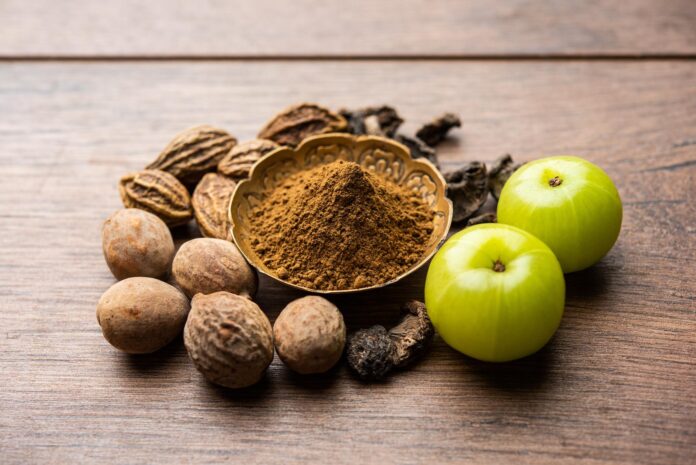
Triphala means “three fruits.” A common preparation is a powdered blend of roughly equal parts amla (Indian gooseberry), bibhitaki, and haritaki, although traditional formulas and products can vary.[2][3] In Ayurveda it is a pillar of digestive care and is described as a tridoshic rasayana, traditionally associated with balance among Vata, Pitta, and Kapha and with rejuvenation.[2]
Reviewers describe it as having mild laxative properties, but how it might move stool along in people has not been established, and its effect may differ with the amount and preparation used.[3] Traditional ideas give useful context, but they are not clinical trial evidence, which is what the rest of this section covers.

What the research shows
The most direct human evidence is a 2006 clinical study from an Indian hospital. It enrolled 160 people in four groups of 40: a comparison group labeled “normal,” and three groups that each received a different Triphala powder (one made in house, two marketed brands) at 2.5 g twice daily. The authors reported better stool amount and consistency in the Triphala groups and no adverse effects.[1]
We would be cautious about leaning on it. The paper does not clearly show participants were constipated at the start, the comparison group was not a typical placebo design, and the abstract and main text disagree on details such as age range and whether treatment lasted 45 days or one month. The tables also show lower daily stool frequency in the Triphala groups than in the comparison group, which is hard to square with the abstract’s claim that frequency improved.[1]
A 2011 open label study of 34 patients with functional constipation had no comparison group and tested a five herb formula that also contained psyllium husk and senna extract, so its result cannot be credited to Triphala.[5] A 2022 Ayurvedic trial used Triphala churna (3 to 6 g at night with lukewarm water) as the comparison arm against a prescribed diet plan. Both had a laxative effect, and the diet group did better on two measures.[4] Memorial Sloan Kettering’s herb summary sums up the field: human studies are limited and more are needed.[6]

So, is it good for constipation?
Possibly, for some people with occasional constipation, but we cannot say it is proven. The small studies reported no adverse effects,[1][5] but studies of this size cannot show how often side effects occur. For comparison, the 2023 AGA and ACG guideline strongly recommends PEG 3350 (the ingredient in MiraLAX) for chronic idiopathic constipation and conditionally suggests fiber supplements, senna, and magnesium oxide, among others.
It did not evaluate Triphala, which is not the same as saying no research exists.[9] Our reviews of Senokot and senna and the best OTC laxatives explain how those options compare.
How to Take Triphala for Constipation
There is no single proven method, so this blends what trials and product labels describe.
- Choose a form you will use. Powder (churna) is the traditional version. Capsules and tablets are easier if you dislike the strong, sour, bitter taste.
- Take it with warm water at bedtime or on waking. For powder, stir the measured amount into a cup of warm or lukewarm water and drink it right away. Capsules and tablets go down with a full glass of water. The 2022 trial gave it at night after a meal,[4] and several labels list bedtime or on waking, some on an empty stomach.[10][11] We found no evidence that warm water or any particular time is best for every type of constipation.
- Add honey only if you like it. Traditional preparations sometimes pair Triphala with honey or ghee, and some people add a little honey for taste. We are not aware of modern studies showing it improves the laxative effect.
- Keep your basics going. Triphala does not replace fiber, fluids, and movement. See our guides to relieving constipation without laxatives and how much flaxseed to use, and use the Bristol Stool Chart to track changes for a week.
- Do not stack laxatives on your own. Adding Triphala to senna, magnesium, or other laxatives can make loose stools and cramping more likely. Check with a pharmacist first, especially if you take regular medicines or already have loose stools.
Triphala Dosage for Constipation
No clinically validated dose of Triphala has been established for constipation. Traditional references, clinical studies, and product labels describe different amounts, but these should not be treated as interchangeable or as proof of an optimal dose. The table shows what sources actually say. It is not a list of traditional Ayurvedic doses, which a practitioner may adjust for the individual and the preparation.
| Form and source | Amount described | Notes |
|---|---|---|
| Powder, 2006 clinical study | 2.5 g twice daily (5 g per day)[1] | Study design has limits, described above. |
| Powder (churna), 2022 Ayurvedic trial | 3 to 6 g at night after a meal with lukewarm water[4] | Used as the comparison group, not a tested “best dose.” |
| Powder, US product label | One quarter to one half teaspoon with warm water, once or twice daily, at bedtime or on waking[10] | The label lists about 1,190 mg per half teaspoon. |
| Tablets, US product label | 1 to 4 tablets at bedtime or on waking[11] | The label lists 2,000 mg per 4 tablets and states it is not intended for chronic constipation. |
| Tablets (250 mg), India product label | 1 to 2 tablets twice daily, or as directed by a physician[12] | Label advises asking a physician first during pregnancy and breastfeeding. |
| Capsules (750 mg each), Canadian product label authorized by Health Canada | 2 capsules twice daily, about 3 g per day[13] | Label says to allow at least 6 to 12 hours for a laxative effect and to consult a practitioner beyond 7 days. |
Some figures are per dose and others per day, and study powders differ from commercial products, so these numbers cannot be compared directly. Follow the directions on your specific product, do not exceed the label amount, and cut back or stop if you get cramping or loose stools.
How long to take it. Long term safety in people has not been well studied. One manufacturer states Triphala is not intended for chronic constipation,[11] and the Canadian label advises consulting a practitioner beyond 7 days.[13] As a general rule of thumb for non prescription laxatives (not a Triphala specific rule), constipation lasting a week or more despite treatment deserves a conversation with a clinician.
Side Effects, Interactions, and Quality Concerns
Digestive effects. Because Triphala has a laxative effect, loose stools and cramping are the things to watch for. Memorial Sloan Kettering describes gastrointestinal side effects as rare in the literature it reviewed.[6]
Who should check first. One Canadian product label authorized by Health Canada says not to use Triphala during pregnancy or breastfeeding, or with narrowing or blockage of the digestive tract, inflammatory bowel disease, abdominal pain of unknown origin, rectal bleeding, severe dehydration, or diarrhea. It also says to check with a practitioner first if you take thiazide diuretics, corticosteroids, licorice root, cardiac glycosides, or antiarrhythmic medicines, or have a kidney disorder.[13]
Many of these cautions relate to fluid and electrolyte balance. This is label guidance rather than trial findings, but it is a good reason to ask a doctor or pharmacist before starting. Dosing for children has not been established, so ask a pediatrician before giving Triphala to a child.
Possible drug interactions. A laboratory study found that Triphala inhibited two liver enzymes, CYP3A4 and CYP2D6, which help process many prescription drugs.[7] Memorial Sloan Kettering lists this as a reason for caution with medicines handled by those enzymes.[6] How much this matters in real life is not clear.
Product quality. A JAMA study of Ayurvedic medicines bought online in 2005 found that about one in five contained detectable lead, mercury, or arsenic, with the highest rates in rasa shastra products, which deliberately include metals.[8] Triphala is a fruit based blend and is not in that category, and the market may have changed, but the finding is a fair argument for choosing brands that publish independent testing, such as certificates of analysis or third party seals like USP or NSF.
When a Different Option May Fit Better
If Triphala has not helped within a reasonable trial, or you want something with a bigger evidence base, see our guides to gentle laxatives for older adults, magnesium supplements, and the best fruits for chronic constipation. See a doctor promptly if constipation comes with blood in the stool, black stools, severe abdominal pain, vomiting, unexplained weight loss, or a sudden change in bowel habits lasting more than a few weeks.
Triphala Supplements You Can Find on Amazon
If you decide to try Triphala, these are three widely listed options. We have not tested them, and we could not confirm independent heavy metal testing from the listings, so check each brand’s website for lab reports. Labels such as organic or non GMO do not mean a product was independently tested for lead, mercury, or arsenic. Availability and pricing change often.
Organic India Triphala Capsules (90 count). The listing describes a USDA Certified Organic, vegan capsule made from amla, bibhitaki, and haritaki. The capsule format avoids the powder’s strong taste.
Himalaya USDA Organic Triphala (688 mg, 60 caplets). Listed as USDA Organic, vegan, and non GMO. The 60 count size suits a short trial before committing to a bigger bottle.
Nutricost Organic Triphala (120 capsules). The listing states 2,000 mg per serving and 30 servings per bottle. Check the label for how many capsules make one serving, and follow the package directions.
For a broader look at products people reach for, see our roundup of the best constipation products on Amazon.
Frequently Asked Questions
How long does Triphala take to work for constipation?
There is no reliable answer from research. One Canadian product label says to allow at least 6 to 12 hours for a laxative effect, and some sellers say a day or so, but these are label and marketing statements rather than trial results. If nothing changes after about a week at a label dose, check in with a pharmacist or doctor instead of increasing the amount.
Should I take Triphala in the morning or at night?
Product labels commonly say bedtime or on waking, and one Ayurvedic trial gave it at night with lukewarm water. We did not find research showing that one time works better than the other, so pick the time you will actually stick with.
Can I take Triphala every day?
Long term safety in people has not been well studied. At least one manufacturer states that Triphala is not intended for chronic constipation. If you find yourself needing it daily for weeks, that is a good reason to talk with a doctor about the cause.
Is Triphala safe during pregnancy or breastfeeding?
Safety in pregnancy and breastfeeding has not been established. One Canadian product label says not to use Triphala while pregnant or breastfeeding, and other labels say to consult a physician first, so speak with your obstetrician or pharmacist before trying it.
This article is for general information and is not medical advice. Supplements are not evaluated by the FDA to diagnose, treat, or cure any condition. Talk with a qualified healthcare professional before starting Triphala, especially if you are pregnant, breastfeeding, taking medication, or managing a health condition.
References
-
- Mukherjee PK, Rai S, Bhattacharyya S, Debnath PK, Biswas TK, Jana U, et al. Clinical study of ‘Triphala’: a well known phytomedicine from India. Iran J Pharmacol Ther. 2006;5(1):51 to 54. Source
- Peterson CT, Denniston K, Chopra D. Therapeutic uses of Triphala in Ayurvedic medicine. J Altern Complement Med. 2017;23(8):607 to 614. PMID: 28696777. Source
- Tarasiuk A, Mosińska P, Fichna J. Triphala: current applications and new perspectives on the treatment of functional gastrointestinal disorders. Chin Med. 2018;13:39. PMID: 30034512. Source
- Saini P, Agrawal SK. A randomized controlled trial to evaluate the laxative effect of prescribed diet compared with Triphala churna in Vibandha with special reference to constipation. J Ayurveda. 2022;16(2):106 to 111. Source
- Munshi R, Bhalerao S, Rathi P, Kuber VV, Nipanikar SU, Kadbhane KP. An open label, prospective clinical study to evaluate the efficacy and safety of TLPL/AY/01/2008 in the management of functional constipation. J Ayurveda Integr Med. 2011;2(3):144 to 152. Source
- Memorial Sloan Kettering Cancer Center. Triphala. In: About Herbs, Botanicals and Other Products. Updated 2022 Jan 5. Source
- Ponnusankar S, Pandit S, Babu R, Bandyopadhyay A, Mukherjee PK. Cytochrome P450 inhibitory potential of Triphala: a Rasayana from Ayurveda. J Ethnopharmacol. 2011;133(1):120 to 125. Source
- Saper RB, Phillips RS, Sehgal A, Khouri N, Davis RB, Paquin J, et al. Lead, mercury, and arsenic in US and Indian manufactured Ayurvedic medicines sold via the Internet. JAMA. 2008;300(8):915 to 923. Source
- Chang L, et al. American Gastroenterological Association and American College of Gastroenterology clinical practice guideline: pharmacological management of chronic idiopathic constipation. Gastroenterology. 2023;164(7):1086 to 1106. Source
- Banyan Botanicals. Triphala powder (454 g) product information and suggested use. Fullscript catalog. Accessed 2026 Oct 16. Source
- Banyan Botanicals. Triphala tablets (90 tablets) product information and suggested use. Fullscript catalog. Accessed 2026 Oct 16. Source
- Himalaya Wellness. Triphala tablets, directions for use and special instructions. Accessed 2026 Oct 16. Source
- AOR. Triphlax-750 (Triphala) product label: suggested use and cautions. Canadian product authorized for sale by Health Canada. Fullscript catalog. Accessed 2026 Oct 16. Source