


Quick answer: No head to head trial comparing magnesium oxide with magnesium citrate in chronic constipation was identified in the evidence reviewed for this article, so neither can be called universally better. Magnesium oxide has randomized trial data and a conditional 2023 AGA/ACG guideline recommendation, based on very low certainty evidence [1]. Magnesium citrate oral solution is labeled for occasional constipation and generally produces a bowel movement within 30 minutes to 6 hours [2]. If you have significant kidney impairment or take regular medication, check with a doctor or pharmacist before using either one.
When comparing magnesium oxide vs magnesium citrate for constipation, it is important to look beyond the name on the bottle. Both contain magnesium, but they differ in absorption, available evidence, typical use, onset, and safety considerations. This guide compares them using clinical research and official drug labels to explain how each works, what the evidence can and cannot tell us, where the safety limits sit, and how to choose between them.
How Magnesium Relieves Constipation
Magnesium laxatives work mainly through osmosis. Magnesium that is not absorbed stays in the gut and holds water there, which softens the stool and makes it easier to pass. The NIH Office of Dietary Supplements attributes the laxative effect of magnesium salts to the osmotic activity of unabsorbed magnesium in the intestine and colon, along with some stimulation of gastric motility [3]. Magnesium oxide reacts with gastric acid, forming magnesium salts that contribute to the osmotic effect in the gastrointestinal tract [4].
For a look at where osmotic laxatives sit next to fiber and stimulants, see our guide to the best OTC laxatives for constipation.

Magnesium Oxide for Constipation
Magnesium oxide has been used as a laxative in East Asia for many years [4]. It is inexpensive, and it is the magnesium form that the 2023 guideline panel evaluated in randomized trials. Magnesium oxide is about 60 percent elemental magnesium by weight. Magnesium citrate contains less elemental magnesium by compound weight, and the exact amount depends on the specific citrate formulation.
One randomized trial in adults with chronic idiopathic constipation compared magnesium oxide with senna and placebo over 28 days. Participants took 1.5 g of magnesium oxide daily, 1 g of senna daily, or placebo. Overall improvement was reported by about 68 percent of the magnesium oxide group, about 69 percent of the senna group, and about 12 percent of the placebo group, while bowel movement frequency and constipation related quality of life improved significantly more than with placebo [4][5].
A second 28 day placebo controlled trial gave 0.5 g of magnesium oxide three times daily and found overall improvement in about 71 percent of the oxide group versus 25 percent on placebo [4].
Magnesium oxide does not have the same short onset window established by the magnesium citrate oral solution label. In one 28 day trial, the reported time to the first spontaneous bowel movement was about 18 hours on magnesium oxide versus about 22 hours on placebo [4].
The 2023 AGA/ACG guideline made a conditional recommendation for magnesium oxide in adults with chronic idiopathic constipation, with the certainty of evidence rated very low [1]. Conditional means it is a reasonable option many people could choose, not a first pick for everyone. Polyethylene glycol, by comparison, received a strong recommendation with moderate certainty [1]. Our comparison of PEG 3350 and Colace explains that option.
The guideline attaches practical notes to the oxide recommendation. It suggests starting at a lower dose and increasing only if needed, advises avoiding oxide in people with renal insufficiency because of the risk of hypermagnesemia (too much magnesium in the blood), and calls for caution in pregnancy [1]. Its dosing table lists a starting dose of 400 to 500 mg daily, says there is no clear maximum, and notes that earlier studies used 1,000 to 1,500 mg daily [1].
These doses refer to magnesium oxide as the compound, not to elemental magnesium, so they should not be compared directly with the elemental magnesium amount listed on a supplement label.
The NIH lists oxide among the magnesium forms most often reported to cause diarrhea, and higher amounts of magnesium in general can bring nausea and abdominal cramping [3]. Hypermagnesemia from laxative doses of oxide is uncommon but does occur. In one Japanese cross sectional study of 193 people taking magnesium oxide daily for functional constipation, 5.2 percent had hypermagnesemia.
This was an observational study, so it should not be read as the risk for all magnesium oxide users. Stage 4 chronic kidney disease and the oxide dose were associated with it, while age was not [8]. People with reduced kidney function, particularly older adults who may have reduced renal function or take several medications, need particular care [4]. We go deeper on this form in our full guide to magnesium oxide for constipation.
Magnesium Citrate for Occasional Constipation
Magnesium citrate is magnesium bound to citric acid. Citrate dissolves well in liquid, and small studies reported by the NIH found it is absorbed more completely than oxide [3][6][7].
For constipation, magnesium citrate is commonly sold as an oral solution. The Drug Facts label on a widely sold store brand describes it as a saline laxative for occasional constipation that generally produces a bowel movement in 1/2 to 6 hours, with 290 mg of magnesium per fluid ounce.
It tells readers to drink a full glass of liquid with each dose, to ask a doctor first if they have kidney disease or a magnesium restricted diet, and to ask a doctor if they have already used a laxative for longer than a week [2]. Amounts can differ between brands, so follow the label on the bottle you buy. This timing applies to the oral solution label only, and it should not be assumed for citrate powders or capsules.
The labeled adult dose of some magnesium citrate oral solutions can provide more magnesium than the NIH upper limit for routine supplemental magnesium [2][3]. That upper limit is intended for magnesium from dietary supplements and medications in healthy people and does not serve as the dosing limit for a laxative used under appropriate medical guidance [3]. The same label tells pregnant or breastfeeding adults to ask a health professional before use [2], and children should be assessed by a pediatrician first.
The 2023 AGA/ACG guideline evaluated magnesium oxide, not magnesium citrate, for chronic idiopathic constipation. It therefore does not provide an evidence-based recommendation for citrate as a chronic constipation treatment [1].
For timing details, read our article on how long magnesium citrate takes to work. If you are weighing citrate against a gentler form, our magnesium citrate vs glycinate comparison covers that.
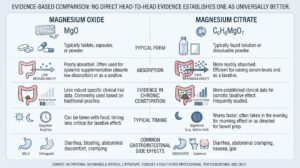
Magnesium Oxide vs Magnesium Citrate: Side by Side
| Feature | Magnesium oxide | Magnesium citrate |
|---|---|---|
| Forms you will usually find | Tablets, capsules, powder | Oral solution (liquid), powder, capsules |
| Elemental magnesium by compound weight | About 60 percent | Lower than oxide; exact amount depends on the specific citrate formulation |
| Absorption | Lower [3] | Higher [3] |
| Evidence in chronic constipation | Two 28 day randomized trials; conditional guideline recommendation, very low certainty [1][4][5] | Not evaluated by the 2023 guideline [1] |
| Timing | In one trial, first bowel movement after about 18 hours (about 22 hours on placebo) [4] | Oral solution label: generally 30 minutes to 6 hours [2] |
| Labeled or studied use | Studied for chronic constipation, ideally with clinician input | Oral solution labeled for occasional constipation |
| Main complaints | Diarrhea, cramping [3] | Loose stools, cramping at higher amounts [3] |
Why Better Absorption Does Not Mean a Better Laxative
It is tempting to read the absorption research and decide citrate wins. For a laxative, that logic is shaky. Magnesium that is absorbed enters the bloodstream and is handled by the kidneys, while the portion that stays in the gut pulls water in [3]. That is why a poorly absorbed form such as oxide can still exert a laxative effect, and why absorption studies matter more when the goal is raising magnesium levels than when the goal is moving a stool.
What the Evidence Can and Cannot Tell Us
These are not interchangeable forms, and the evidence for each answers a different question. Saying neither has been shown to be better does not mean both are equally proven; there is simply not enough direct evidence to rank them. Here is what exists for each:
- Magnesium oxide has randomized trial data in chronic idiopathic constipation, but the evidence base is small. The available trials were conducted in Japan, were relatively small, lasted 28 days, and say little about long term effectiveness and harms. The guideline rates the certainty as very low [1][4].
- Magnesium citrate oral solution has a long history of use and an official label for occasional constipation, but it was not among the agents the guideline evaluated [1][2].
Anyone saying one is clearly stronger than the other is going beyond what the research shows.
Choosing Between Them
- Constipation that keeps coming back over weeks or months. This is a conversation for your doctor. Oxide is the magnesium form with guideline support, but PEG has a stronger guideline recommendation and higher certainty evidence [1].
- Occasional constipation in an otherwise healthy adult. The citrate oral solution is labeled for occasional constipation. Follow the product label, and seek medical advice if symptoms persist or the product does not work as directed.
- A sensitive gut. Either form can cause loose stools or cramping, especially at higher amounts. Follow the specific product directions rather than assuming one form will be gentler.
- Kidney disease, older age, pregnancy, children, or several medications. Speak with a clinician before using either one. Our guides to the best gentle laxatives for older adults and safe laxatives during pregnancy are good places to prepare questions.
It also helps to track what is happening. The Bristol Stool Chart gives you a simple way to tell whether a change is helping or overshooting into loose stool.
Reading Magnesium Labels
The most common mistake is confusing elemental magnesium with compound weight. Supplement Facts panels report elemental magnesium [3], while some trials and guideline tables describe the weight of the compound. Those numbers should not be compared directly.
The NIH upper limit is 350 mg per day for magnesium from supplements and medications in healthy adults, and it does not include magnesium from food. It is lower for young children: 65 mg at ages 1 to 3 and 110 mg at ages 4 to 8 [3]. Laxative products can contain amounts above it, but those amounts should follow the product label or a clinician’s advice.
- Follow the directions on your specific product, and check whether a number refers to elemental magnesium or to the compound.
- If you take more than one magnesium containing product or medication, ask a pharmacist or clinician to review the total magnesium exposure. This includes Milk of Magnesia (magnesium hydroxide), which has its own label amounts.
- Separate magnesium from certain medicines. The NIH advises taking tetracycline and quinolone antibiotics at least 2 hours before or 4 to 6 hours after magnesium, and keeping oral bisphosphonates at least 2 hours apart from it [3]. The citrate label similarly says to take it 2 or more hours before or after other drugs [2].
Magnesium From Food
Supplements are not the only source. According to the NIH, good food sources include roasted pumpkin seeds (156 mg per ounce), chia seeds (111 mg per ounce), almonds (80 mg per ounce), and boiled spinach (78 mg per half cup) [3]. NHANES data from 2013 to 2016, cited by the NIH, suggest that about 48 percent of Americans take in less magnesium from food and drink than their estimated average requirement [3]. We are not aware of evidence that food magnesium alone treats constipation, but these foods support overall intake.
Side Effects and Safety
High amounts of magnesium from supplements or medicines often cause diarrhea, sometimes with nausea and abdominal cramping [3]. For most people this is the main side effect and usually signals that the amount is too high for them.
The more serious concern is magnesium building up in the blood. Severe magnesium toxicity can cause low blood pressure, weakness, breathing difficulty, and abnormal heart rhythm, and the risk is substantially higher when kidney function is impaired [3]. These symptoms need urgent medical attention.
This article contains affiliate links. If you buy through them we may earn a commission at no extra cost to you. It does not change what we say about either form.
Magnesium Products: What to Check on the Label
These examples illustrate the product forms and label information discussed above. They are not recommendations that one product will work better for everyone.
- Magnesium oxide tablets and capsules: look for “as magnesium oxide” on the Supplement Facts panel and read the amount of elemental magnesium per tablet before deciding how many to take.
- NOW Foods Magnesium Oxide Pure Powder: a powder form of oxide. The manufacturer’s page includes directions and cautions for mixing and handling the pure powder, so read the current product label before use [9].
- Natural Vitality CALM powder: the manufacturer describes the product as providing magnesium citrate in ionic form when mixed with water. The current directions start at about 1 g daily and can increase to 4 g per day, so check the current Supplement Facts panel and directions before use [10].
- Store brand magnesium citrate oral solution: look for a Drug Facts label listing magnesium citrate 1.745 g per fluid ounce and follow its directions exactly [2].
Want a wider comparison that includes glycinate and other forms? Our review of the 5 best magnesium supplements for constipation covers more products, and our list of the best constipation products on Amazon looks beyond magnesium.
When to See a Doctor
Magnesium is a short term tool, not a diagnosis. The citrate label advises asking a doctor before use if you have abdominal pain, nausea, or vomiting, a sudden change in bowel habits that lasts 2 weeks, or laxative use for longer than a week. It also says to stop use and ask a doctor if you have rectal bleeding or no bowel movement after use [2].
Other reasons to seek medical evaluation include unexplained weight loss, severe or worsening abdominal pain, repeated vomiting, and black or bloody stools. Constipation that keeps returning deserves a proper workup rather than another bottle.
The Bottom Line
No head to head trial comparing magnesium oxide and magnesium citrate in chronic constipation was identified in the evidence reviewed for this article, so the choice depends on the situation. Oxide has trial data and a conditional guideline recommendation for chronic idiopathic constipation. Citrate oral solution is labeled for occasional constipation and generally works within 30 minutes to 6 hours. Neither should be used as an improvised long term daily treatment without appropriate medical guidance. Follow the label, and bring in a clinician when constipation persists.
Frequently Asked Questions
Is magnesium oxide or magnesium citrate better for constipation?
Neither has been shown to be better in a direct head-to-head trial for chronic constipation, and no such trial was identified in the evidence reviewed for this article. That means there is not enough direct evidence to rank the two forms. Magnesium oxide has randomized trial data and a conditional guideline recommendation for chronic idiopathic constipation, while magnesium citrate oral solution is labeled for occasional constipation.
Can I take magnesium oxide and magnesium citrate together?
It is best not to combine them unless a clinician or pharmacist has reviewed the total magnesium. The amounts add up, which raises the chance of diarrhea and cramping and, in people with reduced kidney function, the risk of magnesium building up in the blood.
How long do magnesium oxide and magnesium citrate take to work?
Magnesium citrate oral solution labels say it generally produces a bowel movement in 30 minutes to 6 hours. That timing is specific to the oral solution. Magnesium oxide is studied over weeks, and in one 28 day trial the first spontaneous bowel movement came after about 18 hours on magnesium oxide versus about 22 hours on placebo.
Is it safe to take magnesium citrate every day?
The magnesium citrate oral solution is labeled for occasional constipation, and its label advises asking a doctor if you have already used a laxative for longer than a week. Daily use of any magnesium product at laxative amounts should be discussed with a clinician, especially if you have kidney disease or take other medicines.
Which is better absorbed, magnesium oxide or magnesium citrate?
Magnesium citrate. The NIH Office of Dietary Supplements notes that small studies found citrate is absorbed more completely than oxide. For constipation, though, the magnesium that stays in the gut is what draws in water, so better absorption does not automatically mean a better laxative.
Who should avoid magnesium oxide for constipation?
People with significant kidney impairment should not use magnesium oxide for constipation unless a clinician specifically recommends it, because the 2023 guideline advises against its use in renal insufficiency due to the risk of hypermagnesemia. The guideline also calls for caution in pregnancy. If you take tetracycline or quinolone antibiotics or oral bisphosphonates, the timing needs to be separated from magnesium.
How much magnesium is too much?
For healthy adults, the NIH upper limit for magnesium from supplements and medications is 350 mg per day, and magnesium from food does not count toward it. Laxative products can contain more than this because they serve a different purpose, but amounts should follow the product label or a clinician’s advice, especially if you have kidney disease.
This article is for general information and is not medical advice. Talk with a doctor or pharmacist before using any magnesium product, especially if you are pregnant or breastfeeding, are older, have kidney disease, or take prescription medicines.
References
-
- Chang L, Chey WD, Imdad A, et al. American Gastroenterological Association and American College of Gastroenterology clinical practice guideline: pharmacological management of chronic idiopathic constipation. Am J Gastroenterol. 2023;118(6):936-54. doi:10.14309/ajg.0000000000002227. Available from: https://pmc.ncbi.nlm.nih.gov/articles/PMC10544839/
- Walgreen Company. Walgreens magnesium citrate oral solution, fruit punch: Drug Facts label [Internet]. DailyMed, National Library of Medicine. Label revised 2026 Jul; effective 2026 Jul 20 [cited 2026 Oct 8]. Available from: https://dailymed.nlm.nih.gov/dailymed/lookup.cfm?setid=4ffe54ae-3126-ba58-e063-6294a90a8877&version=2
- National Institutes of Health, Office of Dietary Supplements. Magnesium: fact sheet for health professionals [Internet]. Updated 2026 Jan 6 [cited 2026 Oct 8]. Available from: https://ods.od.nih.gov/factsheets/Magnesium-HealthProfessional/
- Mori H, Tack J, Suzuki H. Magnesium oxide in constipation. Nutrients. 2021;13(2):421. doi:10.3390/nu13020421. Available from: https://pmc.ncbi.nlm.nih.gov/articles/PMC7911806/
- Morishita D, Tomita T, Mori S, Kimura T, Oshima T, Fukui H, et al. Senna versus magnesium oxide for the treatment of chronic constipation: a randomized, placebo controlled trial. Am J Gastroenterol. 2021;116(1):152-61. Available from: https://pubmed.ncbi.nlm.nih.gov/32969946/
- Lindberg JS, Zobitz MM, Poindexter JR, Pak CY. Magnesium bioavailability from magnesium citrate and magnesium oxide. J Am Coll Nutr. 1990;9:48-55. Available from: https://pubmed.ncbi.nlm.nih.gov/2407766/
- Walker AF, Marakis G, Christie S, Byng M. Mg citrate found more bioavailable than other Mg preparations in a randomised, double blind study. Magnes Res. 2003;16:183-91. Available from: https://pubmed.ncbi.nlm.nih.gov/14596323/
- Mori H, Suzuki H, Hirai Y, et al. Clinical features of hypermagnesemia in patients with functional constipation taking daily magnesium oxide. J Clin Biochem Nutr. 2019. Available from: https://pmc.ncbi.nlm.nih.gov/articles/PMC6667383/
- NOW Foods. Magnesium oxide powder: suggested usage and cautions [Internet]. [cited 2026 Oct 8]. Available from: https://www.nowfoods.com/products/supplements/magnesium-oxide-powder
- Natural Vitality. CALM powder, unflavored, 16 oz: supplement facts and suggested use [Internet]. [cited 2026 Oct 8]. Available from: https://www.naturalvitality.com/products/calm-powder-unflavored-nv545