

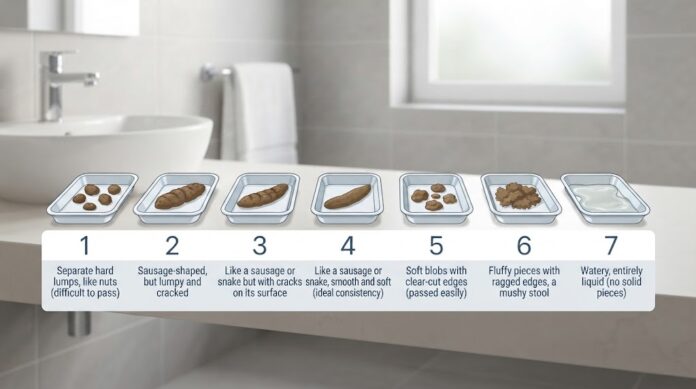
Quick answer: The Bristol Stool Chart (also called the Bristol Stool Form Scale, or BSFS) is a 7 point visual scale doctors use to classify stool by shape and consistency. Type 1 and Type 2 are hard, pellet like stools linked to constipation. Type 3 and Type 4 are generally considered healthy, easy to pass stools. Type 5, 6, and 7 get progressively looser and point toward diarrhea. The scale was created in 1997 by researchers at Bristol Royal Infirmary and is still used today because stool form is generally associated with how long waste has spent in the colon.
What Is the Bristol Stool Chart?
The Bristol Stool Chart is a clinical assessment tool that classifies human stool into seven categories based on shape, texture, and consistency, ranging from hard separate lumps to entirely liquid stool. It was developed in 1997 by Dr. Stephen Lewis and Dr. Kenneth Heaton at Bristol Royal Infirmary in the United Kingdom, which is where the scale gets its name.[1]
Before the chart existed, doctors had no simple, standardized way to ask patients about their bowel movements. Descriptions like “hard” or “loose” meant different things to different people. Lewis and Heaton set out to test whether stool appearance could reliably reflect intestinal transit time, meaning how long stool actually stays inside the gut before being passed. Using radiopaque marker pellets to track transit time directly, they found that stool form correlated with transit time better than either bowel frequency or stool weight did.[1] That finding is the reason the chart is still considered clinically useful nearly three decades later.
Today, the Bristol Stool Chart is used by clinicians and researchers as a quick, noninvasive way to characterize stool form and bowel patterns, including in the context of constipation, diarrhea, and conditions like irritable bowel syndrome (IBS).
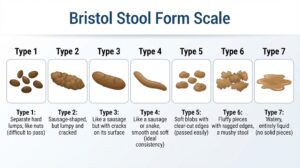
The 7 Types of the Bristol Stool Chart
Stool form is generally associated with intestinal transit time. Harder stools tend to be associated with slower transit through the colon, which allows more time for water to be reabsorbed, while looser stools tend to be associated with faster transit and less water reabsorption.[1]
| Type | Appearance | What It Generally Means |
|---|---|---|
| Type 1 | Separate hard lumps, like small nuts, hard to pass | Constipation; associated with slower transit |
| Type 2 | Sausage shaped but lumpy | Constipation; associated with slower transit |
| Type 3 | Sausage shaped with cracks on the surface | Generally well formed stool |
| Type 4 | Smooth, soft sausage or snake shape | Generally well formed stool |
| Type 5 | Soft blobs with clear cut edges | Soft stool that may still be within the normal range |
| Type 6 | Fluffy, mushy pieces with ragged edges | Loose stool; associated with faster transit |
| Type 7 | Entirely liquid, no solid pieces | Watery diarrhea |
Clinically, the scale is often grouped into rough bands: Types 1 and 2 are associated with constipation, Types 3 and 4 are generally considered well formed stool patterns, and Types 6 and 7 indicate increasingly loose or watery stool. Type 5 is softer than Type 3 or 4 and may still occur within the normal range, particularly when it happens occasionally rather than as a persistent pattern.[1]
What Does a “Healthy” Stool Actually Look Like?
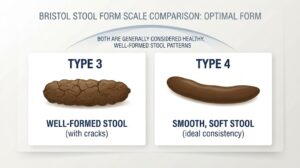
Type 3 and Type 4 are generally considered well formed, healthy stool patterns and are often used as a practical target range. They are soft enough to pass without straining, but formed enough to hold together, which is generally consistent with a balanced stool water content. Type 4 in particular is often described as an ideal stool form.
A healthy bowel movement usually happens somewhere between three times a day and three times a week, though normal frequency varies a lot between individuals.[2] Stool form matters more than frequency alone. Someone can have a daily bowel movement that is still Type 1 or Type 2, and that still counts as constipation.
What Type 1 and Type 2 Stool Means
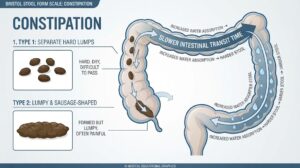
Type 1 and Type 2 stools are commonly associated with constipation and slower intestinal transit. Common contributors include low fiber intake, inadequate fluid intake, low physical activity, certain medications, and specific conditions such as hypothyroidism or irritable bowel syndrome with constipation (IBS-C).[5]
If you regularly see Type 1 or Type 2 stool, or notice straining, incomplete emptying, or infrequent bowel movements, it is worth looking at the underlying cause rather than treating each episode in isolation. Common, correctable factors include:
- Not drinking enough water. Low fluid intake can contribute to harder stools, particularly when dehydration is present, because less water remains available in the stool.
- Low fiber intake. Most adults do not get the recommended amount of dietary fiber, generally around 25 to 38 grams per day depending on age and sex. A closer look at fiber foods and fiber therapy for gut health can help close that gap.
- Certain supplements and medications. Iron supplements are a frequent, often overlooked cause, and iron supplement constipation is manageable with a few adjustments rather than stopping the supplement altogether.
- Toilet posture. Sitting upright on a standard toilet can work against the puborectalis muscle. Changing to a supported squat position is a simple, free adjustment worth trying first.
When stool is consistently stuck at Type 1, it can progress to a harder problem to solve. If a stool feels physically stuck and will not pass despite pushing, that scenario needs its own approach, covered in what to do when stool is stuck and won’t come out. And if constipation has already been treated repeatedly without lasting improvement, it may fall into a harder to treat category described in refractory constipation.
What Type 6 and Type 7 Stool Means
Type 6 and Type 7 sit at the opposite end of the scale. Stool passed through the digestive tract quickly, so the colon had little time to absorb water from it. Occasional loose stool is often explained by diet, a stomach bug, or food intolerance, and usually resolves on its own within a few days.
Persistent or recurrent diarrhea should be evaluated, especially if it is accompanied by blood, fever, dehydration, severe abdominal pain, or unintentional weight loss. Diarrhea lasting more than two weeks also warrants medical evaluation. Diarrhea predominant IBS (IBS-D) is one condition in which stool consistently sits at the loose end of the scale, and stool form is one of the factors clinicians use to help characterize bowel habits. Under the Rome IV criteria, an IBS diagnosis also requires recurrent abdominal pain alongside other symptom criteria, while stool consistency mainly helps determine the IBS subtype.[3]

Is the Bristol Stool Chart Scientifically Reliable?
The chart’s biggest strength is also its main limitation. It relies on visual judgment rather than a lab measurement. A 2016 validity and reliability study tested how accurately people classified real stool models against the scale. Overall accuracy was good, at 81 percent, but the study found people struggled specifically with the boundary types, Type 2, Type 3, Type 5, and Type 6, where one type blends into the next.[3] The clearest distinction tends to be between the hard and watery ends of the scale, while the boundary types in the middle are more difficult to classify consistently.
The same research also confirmed that self reported stool type correlated meaningfully with actual measured stool water content, and that the scale successfully distinguished healthy volunteers from patients with IBS-D.[3] That is why, despite its subjectivity, the chart remains a standard tool in both clinical practice and research.
A modified, simplified version of the chart (the mBSFS-C) exists for children, since young kids have more trouble distinguishing seven similar looking categories. Research on the modified scale found that children as young as 6 can use it reliably when the descriptions are read aloud to them, while the reliable age threshold rises to 8 if children are rating stool form on their own, without the descriptions read out.[4] For parents dealing with a younger child’s constipation specifically, a research backed food guide for constipated toddlers is a more practical starting point than the chart itself.
How to Move Your Stool Toward Type 3 or 4
If your stool regularly falls outside the Type 3 to Type 4 range, a few evidence based adjustments tend to help most people before anything more is needed.
- Make sure you are getting adequate fluids. Along with dietary fiber and regular physical activity, adequate hydration is commonly included among lifestyle measures for constipation.[5]
- Build up fiber gradually. Adding fiber too fast, without enough water alongside it, can backfire. If you have tried fiber and it does not seem to be helping, this breakdown of why fiber supplements sometimes make constipation worse explains the common mistakes.
- Consider a targeted supplement. Magnesium oxide is one evidence supported option for chronic idiopathic constipation and carries a conditional recommendation in current gastroenterology guidelines, covered in this review of magnesium supplements for constipation.[6]
- Support the gut microbiome. Some probiotic strains have been studied for constipation and stool consistency, though results vary by strain, as discussed in this guide to probiotic supplements for gut health.
- Try food based options before medication. Prune juice is one of the better studied natural options and may help stimulate a bowel movement in some people, though how quickly it works varies from person to person.
If diet and lifestyle changes are not enough on their own, this comparison of OTC laxative options explains which categories work fastest and which are gentler for regular use.
When to See a Doctor
The Bristol Stool Chart is useful for spotting patterns, but it is a screening aid, not a diagnosis, and should not be relied on alone. See a doctor if you notice any of the following:
- Stool that remains consistently Type 1 or Type 2 despite reasonable diet, hydration, and lifestyle changes
- Blood in the stool, or black, tarry stool
- Unexplained weight loss alongside a change in stool form
- Persistent changes between hard and loose stools, especially when accompanied by recurrent abdominal pain, bloating, or other bowel symptoms
- Severe abdominal pain, persistent vomiting, marked abdominal swelling, or an inability to pass gas or stool at all
- Persistent diarrhea (Type 6 or 7) lasting more than two weeks
Older adults and people on medications known to cause constipation, such as opioids or certain iron formulations, should be especially attentive to sudden changes. If existing treatments have stopped working, this guide on why MiraLAX sometimes stops working outlines when it is time to loop in a physician instead of increasing the dose independently. For older adults specifically, gentler laxative options suited to elderly constipation are worth reviewing with a doctor or pharmacist.
Frequently Asked Questions
What is the healthiest stool type on the Bristol Stool Chart?
Type 3 and Type 4 are generally considered the healthiest, well formed stool types. Type 4 in particular is smooth, soft, and easy to pass without straining, which is generally consistent with a typical transit time and balanced stool water content.
Is Type 5 stool a sign of a problem?
Not necessarily. Type 5 stool, which consists of soft blobs with clear cut edges, can occur within the normal range, especially when it is occasional rather than persistent.
Can stress change your Bristol Stool Chart type?
Yes. Stress affects gut motility through the gut brain axis and can shift stool toward either end of the scale, either speeding up transit toward looser stool or slowing it down toward harder stool, depending on the person.
How often should I check my stool against the chart?
There is no need to check every bowel movement. The chart is most useful when you notice a change, or when tracking whether a dietary or supplement change is actually improving stool consistency over one to two weeks.
Does the Bristol Stool Chart work the same way for children?
Not exactly. A modified, five type version of the Bristol Stool Form Scale has been developed and validated for children, because younger children can have difficulty distinguishing between all seven adult categories.
References
- Lewis SJ, Heaton KW. Stool form scale as a useful guide to intestinal transit time. Scand J Gastroenterol. 1997;32(9):920-924. PMID: 9299672.
- Heaton KW, Radvan J, Cripps H, Mountford RA, Braddon FE, Hughes AO. Defecation frequency and timing, and stool form in the general population: a prospective study. Gut. 1992;33(6):818-824. PMID: 1624166.
- Blake MR, Raker JM, Whelan K. Validity and reliability of the Bristol Stool Form Scale in healthy adults and patients with diarrhoea-predominant irritable bowel syndrome. Aliment Pharmacol Ther. 2016;44(7):693-703. PMID: 27492648.
- Lane MM, Czyzewski DI, Chumpitazi BP, Shulman RJ. Reliability and validity of a modified Bristol Stool Form Scale for children. J Pediatr. 2011;159(3):437-441. PMID: 21489557.
- American Gastroenterological Association, Bharucha AE, Dorn SD, Lembo A, Pressman A. American Gastroenterological Association medical position statement on constipation. Gastroenterology. 2013;144(1):211-217. PMID: 23261064.
- Chang L, Chey WD, Imdad A, et al. American Gastroenterological Association-American College of Gastroenterology Clinical Practice Guideline: Pharmacological Management of Chronic Idiopathic Constipation. Gastroenterology. 2023;164(7):1086-1106. PMID: 37211380.
Medical Disclaimer: This article is for educational purposes only and is not a substitute for professional medical advice, diagnosis, or treatment. Always talk to a doctor about persistent or concerning changes in bowel habits, especially if accompanied by bleeding, unexplained weight loss, or severe pain.





[…] a different microbial community. (If you are not sure where your own stool falls on the scale, our Bristol Stool Chart guide explains the seven […]
[…] Chart is a handy way to track progress, because it gives you a common language for stool form. Our Bristol Stool Chart explained guide shows how to use […]
[…] if their usual stool was Bristol type 1 or 2, the hard and lumpy types (see our guide to the Bristol Stool Chart). Coffee intake came from a single 24-hour diet recall. One cup meant 6 fluid ounces, which is […]
[…] form to how fast food moves through the gut.[5] If you have never used it, our walkthrough of the Bristol Stool Chart explains all seven […]
[…] respond to fiber deserves a proper evaluation. Our guides on IBS-C vs chronic constipation and the Bristol Stool Chart can help you describe what you are seeing, and if fiber is not helping, read why fiber isn’t […]