

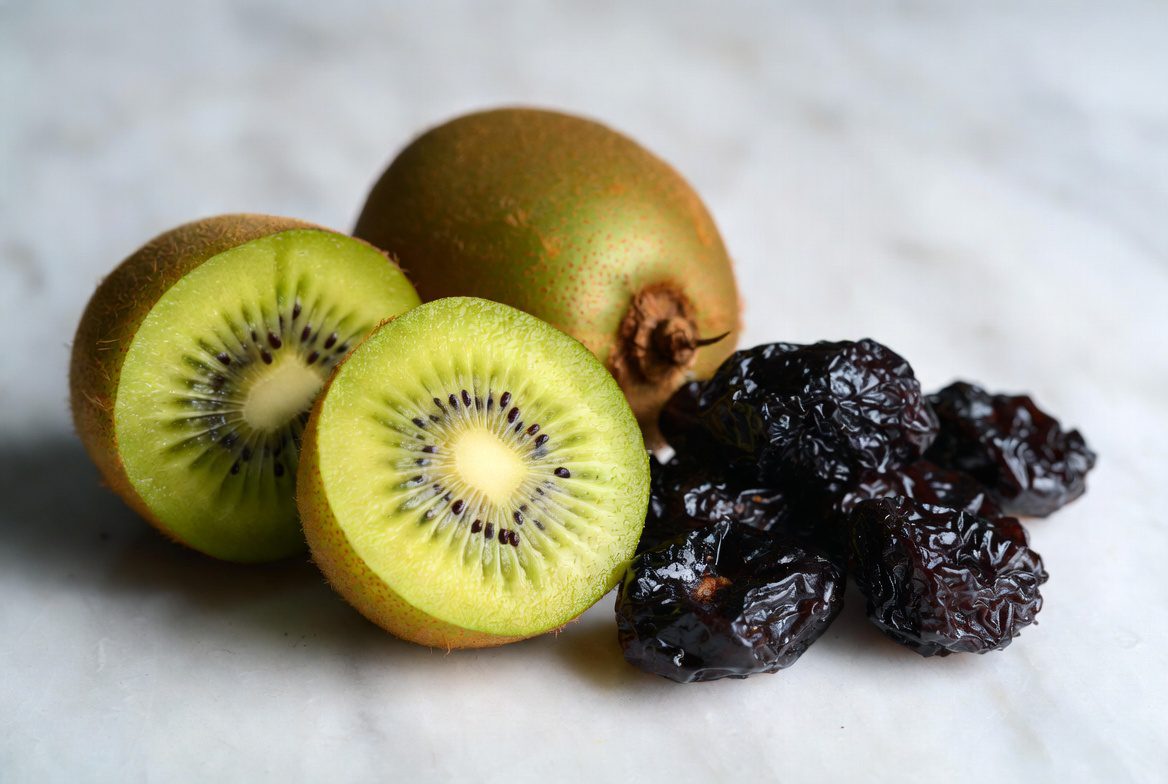
If you’ve been struggling with chronic constipation, you’ve likely heard that prunes are one of the best natural remedies. But in recent years, green kiwifruit has emerged as a strong contender — backed by solid clinical studies.
In this article, we’ll compare prunes vs kiwifruit for constipation head-to-head using the strongest clinical trials so you can decide which one is better for you.
We’ll break down which one increases bowel movements more, which causes less bloating, and which might be the better choice for you.
Quick Summary
When comparing prunes vs kiwifruit for constipation, both come out as effective, research-backed options. Prunes generally produce a stronger increase in stool frequency, largely thanks to their sorbitol content. Kiwifruit wins on tolerability — fewer side effects (especially bloating), better gut comfort, and significantly higher patient satisfaction in clinical trials. It is also low in FODMAPs, making it a better fit for people with IBS-C or sensitive stomachs. A combined approach may work well for people who tolerate both foods.
A Little History: Have People Always Used These for Constipation?
Prunes are dried fruits of the European plum (Prunus domestica), first cultivated around the Caspian Sea roughly 2,000 years ago. It is worth noting that European prunes and Chinese plums are botanically distinct species — so while both cultures used plum-type fruits as digestive aids, they were not using the same fruit. The European Food Safety Authority confirmed in a 2012 review that 100g of European prunes per day effectively supports normal bowel function.
Kiwifruit is native to China, where the fruit appears in Tang dynasty writings (618–906 CE) and was formally recorded in Song dynasty literature (960–1279 CE). Early Chinese pharmacopeia documented it as a remedy for digestive complaints. It reached New Zealand in 1904, entered global markets by the 1950s, and only began attracting serious clinical research from the 2000s onward. Both foods were trusted digestive remedies long before randomized controlled trials confirmed why they work.
Affiliate Disclosure: This article may contain affiliate links. If you purchase through these links, we may earn a small commission at no extra cost to you. Our recommendations are based on research and editorial evaluation, not affiliate partnerships.
How Do Prunes Help with Constipation?
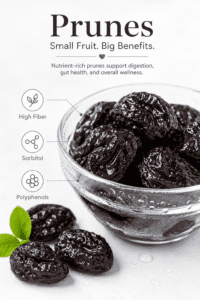
Prunes work through three main pathways, all happening at the same time:
1. Fiber — both soluble and insoluble. Prunes contain approximately 6–7 grams of dietary fiber per 100g. This includes both soluble fiber, which absorbs water and forms a gel that softens stool, and insoluble fiber, which adds bulk and helps move things through the intestines. Together they make stool easier to pass.
2. Sorbitol — the natural laxative sugar. This is what makes prunes work so reliably. Sorbitol is a natural sugar alcohol that the gut absorbs poorly. Instead, it pulls water into the colon through osmosis — the same basic principle behind MiraLax. That extra water softens stool and triggers the urge to go. Dried prunes contain approximately 14–15 grams of sorbitol per 100g, which is enough to produce a meaningful laxative effect in most adults.
3. Polyphenols — gut-activating plant compounds. Prunes are rich in polyphenols like chlorogenic acid and neochlorogenic acid. Research suggests these compounds may help support colonic motility — in plain English, they may help wake up the muscles in your colon and get things moving.
If you want to read more about natural remedies that work similarly, check out our guide on natural constipation relief remedies.
How Does Kiwifruit Help with Constipation?
Kiwifruit works through a distinct set of mechanisms that complement — and in some ways go beyond — what fiber and sorbitol alone can do:
1. Unique fiber structure. Kiwifruit fiber has an exceptional ability to hold water and swell inside the gut. Its cell walls are especially good at retaining water compared to other fruits, which keeps stool soft and bulky all the way through the colon.
2. Actinidin — a digestive enzyme unique to kiwifruit. Actinidin is a proteolytic enzyme (meaning it breaks down proteins) found naturally in kiwifruit — specifically within the Actinidia genus — and not present in most other commonly eaten fruits. It supports protein digestion in the stomach and small intestine, and research suggests it also plays a role in speeding up gastric emptying and overall gut transit — the time it takes food to move through your digestive system.
3. Prebiotic effects. Kiwifruit feeds beneficial bacteria in the gut — particularly Bifidobacterium and Lactobacillus species. A healthier gut microbiome is linked to better bowel regularity. This is something prunes also do to some extent, but kiwifruit’s prebiotic action is particularly well-studied.
4. Low FODMAP. For people with IBS, this is an important practical distinction. Prunes contain sorbitol, a high-FODMAP sugar alcohol that can worsen gas and bloating in people with IBS. Kiwifruit is certified low FODMAP, making it well-suited for people with sensitive digestive systems or IBS-C.
If you’re dealing with constipation alongside IBS or bloating, our article on chronic constipation and probiotic relief also covers complementary strategies worth reading.

What the Research Says: Prunes vs Kiwifruit for Constipation
The strongest case for either food comes from randomized controlled trials — the highest level of evidence in nutrition research. Here are the two most important studies comparing these options directly.
Published in: American Journal of Gastroenterology, Vol. 116(6), pp. 1304–1312
Authors: Samuel W. Chey, William D. Chey, Kenya Jackson, Shanti Eswaran (University of Michigan)
PMID: 34074830
This is the most directly relevant study because it compared all three options — kiwifruit, prunes, and psyllium — in the same trial with the same group of patients. One design note worth knowing: patients could express a treatment preference before being assigned, so it was not fully randomized in the traditional sense. That is a limitation, but the results line up well with other research, and it remains the only study to compare all three options side by side.
How it worked: 79 adults with chronic constipation were divided into three groups — 2 green kiwifruits per day, 100g of prunes per day, or 12g of psyllium per day — for 4 weeks.
What they found:
- All three options helped. Everyone had fewer problems with constipation by the end of the trial.
- Prunes produced the biggest increase in how often people went to the bathroom.
- Kiwifruit caused the fewest side effects — less bloating, gas, and cramping than both prunes and psyllium.
- Only 7 in 100 kiwifruit users said they were unhappy with the results — a much lower dissatisfaction rate than the other two groups.
- About 68 in 100 kiwifruit users said they were satisfied overall — compared to roughly 48 in 100 for prunes and psyllium.
- Kiwifruit was the only option that meaningfully reduced bloating. Prunes and psyllium did not show the same improvement on this measure.
Published in: American Journal of Gastroenterology, Vol. 118(6), pp. 1058–1068
Authors: Gearry R, Fukudo S, Barbara G, et al.
PMID: 36537785
This was a larger trial run across three countries — New Zealand, Italy, and Japan — which makes the findings more applicable to people from different backgrounds and diets.
How it worked: 184 people took part, including those with functional constipation and IBS-C. Everyone ate 2 green kiwifruits per day for 4 weeks, then switched to psyllium for another 4 weeks (or the reverse). This crossover design meant each person tried both options, making the comparison more reliable.
What they found:
- People with functional constipation went to the bathroom about 1.5 more times per week on kiwifruit — enough of a difference that most people would actually notice it in daily life.
- People with IBS-C saw a similar improvement — roughly 1.7 extra bowel movements per week compared to their starting point.
- Gut comfort improved clearly and consistently across constipated groups — participants reported less discomfort, not just more frequency.
- No meaningful side effects were reported.
- When all constipated participants were looked at together, kiwifruit clearly outperformed psyllium — producing nearly twice the improvement in bowel movement frequency.
Prunes vs Kiwifruit: Direct Comparison
| Factor | 🟤 Prunes (100g/day) | 🥝 Kiwifruit (2/day) | Verdict |
|---|---|---|---|
| Stool frequency | Strongest increase of the three options tested | Good, clinically meaningful increase | Prunes WIN |
| Stool softness | Significant improvement | Significant improvement | Tie |
| Straining relief | Strong improvement | Strong improvement | Tie |
| Bloating & gas | More common — sorbitol is a known bloating trigger | Lowest of all three treatments (Chey 2021) | Kiwifruit WIN |
| Side effects overall | Moderate | Lowest in clinical trials | Kiwifruit WIN |
| Patient satisfaction | ~48% satisfied (Chey 2021) | ~68% satisfied (Chey 2021) | Kiwifruit WIN |
| IBS-C friendly | No — sorbitol is high FODMAP | Yes — certified low FODMAP | Kiwifruit WIN |
| Long-term daily use | Can feel heavy or overly sweet over time | Light, fresh — easy to maintain daily | Kiwifruit WIN |
| Bonus nutrition | Potassium, antioxidants, vitamin K | Vitamin C, folate, antioxidants | Tie |
| Convenience | Shelf-stable, no refrigeration needed | Fresh produce — less available in some areas | Prunes WIN |

Dosage: How Much Prunes vs Kiwifruit for Constipation Do You Actually Need?
Prunes
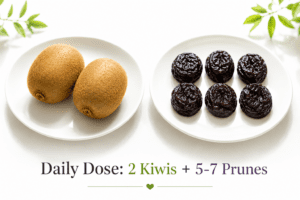
Clinical trials used 100g per day, which equals roughly 5–10 prunes depending on their size. Larger, moister prunes sit at the lower end; smaller, drier ones may mean closer to 10 or more. That is a practical daily amount most people can work into their routine without much effort.
If prunes are new to you, starting with 4–5 per day for the first week is a sensible approach. Gradually increasing from there gives your gut time to adjust comfortably. Drinking a full glass of water alongside prunes helps the fiber and sorbitol do their job. Soaking prunes overnight in water before eating them is an old trick that many people find makes them even gentler on the stomach.
A note on prune juice: it works for many people and is easier to take daily, but the fiber content is significantly lower than whole prunes since the pulp is filtered out during production. If you go the juice route, look for options with no added sugar and start with around 4 oz. Our article on prune juice for constipation relief covers this in detail.
Kiwifruit
Both major clinical trials used exactly 2 green kiwifruits per day — and that is the dose that produced clinically meaningful improvements across multiple studies. Two kiwifruits is a clear, consistent target.
You can eat them with or without the skin. The skin is completely edible and adds extra fiber, but scooping out the flesh works just as well for most people. Morning or evening both work fine — what matters most is eating them consistently every day.
If fresh kiwifruit isn’t available year-round in your area, some people turn to kiwifruit-based supplements like Actazin (a powdered green kiwifruit extract). That said, the clinical evidence is for whole fresh fruit, so whole kiwifruits remain the first choice whenever possible.
Who Should Choose What?
The best choice between prunes vs kiwifruit for constipation depends on your specific symptoms, digestive history, and daily routine. Here is a simple breakdown:
🟤 Choose Prunes If You…
- Need a strong, reliable increase in bowel movement frequency
- Don’t have IBS or a history of bloating from sorbitol
- Want something shelf-stable and convenient (no refrigeration)
- Are traveling or don’t have regular access to fresh produce
🟢 Choose Kiwifruit If You…
- Have a sensitive stomach, bloating, or IBS-C
- Want fewer side effects and higher chance of satisfaction
- Prefer a fresh, light daily food (not heavy or sweet)
- Have tried prunes and experienced gas or cramping
A combined approach may work well for people who tolerate both foods. A practical starting point is 2 kiwifruits per day as a daily foundation, with 4–6 prunes added in after the first week or two for additional frequency support. This layered approach gives you kiwifruit’s tolerability alongside prunes’ stronger laxative effect.
⚠️ Who Should Be Cautious?
-
Kidney disease: Both prunes and kiwifruit are relatively high in potassium. People with impaired kidney function who need to limit potassium intake should consult their healthcare provider before adding large amounts of either food to their diet.
-
Latex allergy: Kiwifruit contains proteins that may cross-react with latex. People with a known latex allergy should speak with their doctor before eating kiwifruit regularly.
-
Severe IBS or sorbitol sensitivity: Prunes contain high levels of sorbitol, a FODMAP that can worsen gas, bloating, and cramping in people with IBS or known sorbitol intolerance. Kiwifruit is generally the safer option in this group.
What to Pair With Them for Better Results
Prunes and kiwifruit work best as part of a broader daily routine. Adding a few of these habits alongside them tends to produce noticeably better and faster results:
Water: Both fiber and sorbitol need adequate hydration to work properly. Aiming for 6–8 cups of water a day supports the laxative mechanisms of both foods. Our article on does dehydration cause constipation explains exactly why hydration matters so much for bowel regularity.
Other high-fiber fruits: Prunes and kiwifruit are two of the strongest options, but figs, pears, apples, and berries all have solid research support as well. Rotating between different fruits keeps things varied and ensures a broader range of fiber types. Our guide to the best fruits for chronic constipation covers all the top options in one place.
Morning routines: Timing matters. Eating kiwifruit or prunes first thing in the morning — especially with warm water — works with your gut’s natural morning activity patterns. Our piece on simple morning habits to relieve constipation walks through five practical habits supported by research.
A fiber-rich diet overall: Vegetables, whole grains, legumes, and fruit together build the foundation for consistent bowel regularity. Our guide on fiber foods for gut health gives a complete breakdown of the best choices by food group.
Movement: Even 20 minutes of light daily walking is enough to stimulate gut motility meaningfully. For something more targeted, our yoga for constipation relief guide covers specific poses shown to help.
Psyllium husk: For those who want additional fiber support on top of whole foods, psyllium husk is one of the most clinically studied options available. Our comparison of psyllium husk vs wheat bran helps you choose the right type.
Products That Make It Easier to Stay Consistent
The biggest challenge with both prunes and kiwifruit is not effectiveness — it is consistency. These products are not necessary for relief, but some people find them convenient for maintaining a daily routine. A few options worth knowing about:
Note: Some links below are affiliate links. If you purchase through them, we earn a small commission at no extra cost to you.
If fresh kiwifruit is hard to find year-round or you prefer not to eat whole prunes daily, Sunsweet Amaz!n Prune Juice is a practical alternative. It is the most widely available prune juice in the US, made from Californian prunes with no added sugar. Because the pulp is filtered out during production, fiber content is lower than whole prunes — but sorbitol is still present, which is responsible for much of the laxative benefit. Starting with 4 oz in the morning is a reasonable starting point for most people.
For whole prunes, the main practical issue is portioning — it is easy to lose track of how many you have eaten. Sunsweet Ones individually wrapped pitted prunes address this directly. Each piece is pre-portioned and pitted, making them convenient for daily use at home or on the go.
If you want to pair your fruit routine with an additional fiber supplement, NOW Psyllium Husk Powder is one of the best-studied options available over the counter. It mixes easily into water or juice and is designed to complement — not replace — fiber from whole foods. The 24 oz size is well priced for daily use.
iHerb also carries a solid range of fiber and digestive health products and may offer more competitive pricing depending on your location.
If you are interested in adding probiotic support alongside dietary changes, our 2026 guide to the best spore-based probiotics is a useful next read — particularly for people who have tried standard probiotic supplements without seeing results.
How Long Before You Notice Results?
One of the most common questions about prunes vs kiwifruit for constipation is how quickly each one works. Prunes tend to act faster — some people notice softer stools within the first few days, largely because sorbitol works through osmotic pressure. Kiwifruit builds more gradually, with most people reporting a noticeable improvement within one to two weeks of consistent daily eating.
Clinical trials that showed statistically significant results ran for 4 weeks. That is a reasonable personal benchmark. Tracking your bowel movement frequency, stool consistency, and comfort in a simple daily note — even just a line in your phone — can help you see patterns and know whether what you are doing is actually working.
If you have not seen improvement after four weeks of consistent use alongside adequate hydration, it may be worth broadening your approach. Our guide on natural ways to relieve constipation fast covers seven evidence-backed strategies to layer in. And for long-standing constipation, our article on science-backed strategies for chronic constipation goes deeper into the clinical picture.
When to Speak With a Healthcare Provider
Prunes and kiwifruit are safe, well-tolerated options for most healthy adults. In most cases, dietary changes are enough to see meaningful improvement. However, certain symptoms alongside constipation are worth discussing with a doctor regardless of what you are eating:
- Blood in your stool or on toilet paper
- Unexplained weight loss
- Constipation that is new and severe, especially after age 50
- Persistent constipation that has not improved after several weeks of dietary and lifestyle changes
- Severe or worsening abdominal pain
These symptoms may point to an underlying condition that needs proper evaluation. A healthcare provider can help determine whether your constipation is functional — meaning no structural cause — or related to something else. For people who need additional support beyond dietary changes, our article on the best OTC laxatives for constipation reviews the most effective and gentlest options available without a prescription.
The Bottom Line on Prunes vs Kiwifruit for Constipation
Both prunes and green kiwifruit are legitimate, research-backed options for relieving constipation — and neither requires a prescription, a supplement, or a drastic diet overhaul.
If your main goal is increasing how often you go, prunes have the edge. Their combination of fiber, sorbitol, and polyphenols produces a reliably strong laxative effect, backed by decades of use and multiple clinical trials.
If your priority is comfort — fewer side effects, less bloating, and higher overall satisfaction — kiwifruit is the better choice. The 2021 Chey trial found 68% of kiwifruit users were satisfied compared to 48% for prunes, and the 2023 Gearry multicenter RCT confirmed kiwifruit’s clinical effectiveness across three countries with no significant adverse events.
For many people, the best approach is not either/or. Some people may find combining both helpful — starting with 2 kiwifruits per day and adding 4–6 prunes if needed gives you the full benefit of both, with kiwifruit acting as a gentle, daily foundation and prunes providing extra push when required. Add consistent hydration, some regular movement, and a diet with a variety of fiber-rich foods, and most people with functional constipation will see real improvement within a few weeks. Dietary approaches tend to work best when used consistently for several weeks rather than intermittently.
Frequently Asked Questions
How many prunes should I eat a day for constipation?
How many kiwifruits should I eat for constipation?
Do prunes or kiwifruit work faster for constipation?
Can I eat both prunes and kiwifruit together for constipation?
Are prunes or kiwifruit better for IBS-C?
Did ancient people use prunes for constipation?
References
- Chey SW, Chey WD, Jackson K, Eswaran S. Exploratory comparative effectiveness trial of green kiwifruit, psyllium, or prunes in US patients with chronic constipation. Am J Gastroenterol. 2021;116(6):1304–1312. PMID: 34074830. DOI: 10.14309/ajg.0000000000001149
- Gearry R, Fukudo S, Barbara G, Kuhn-Sherlock B, Ansell J, Blatchford P, et al. Consumption of 2 green kiwifruits daily improves constipation and abdominal comfort — results of an international multicenter randomized controlled trial. Am J Gastroenterol. 2023;118(6):1058–1068. PMID: 36537785. DOI: 10.14309/ajg.0000000000002124
- Attaluri A, Donahoe R, Valestin J, et al. Randomised clinical trial: dried plums (prunes) vs psyllium for constipation. Aliment Pharmacol Ther. 2011;33(7):822–828. PMID: 21323688
- Bayer SB, Gearry RB, Drummond LN. Putative mechanisms of kiwifruit on maintenance of normal gastrointestinal function. Crit Rev Food Sci Nutr. 2018;58(14):2432–2452. PMID: 28557573
- Chang CC, Lin YT, Lu YT, et al. Kiwifruit improves bowel function in patients with irritable bowel syndrome with constipation. Asia Pac J Clin Nutr. 2010;19(4):451–457. PMID: 21147704
- Stacewicz-Sapuntzakis M, Bowen PE, Hussain EA, et al. Chemical composition and potential health effects of prunes: a functional food? Crit Rev Food Sci Nutr. 2001;41(4):251–286. PMID: 11401245
- European Food Safety Authority (EFSA). Scientific opinion on the substantiation of a health claim related to dried plums and maintenance of normal bowel function. EFSA Journal. 2012;10(6):2712. DOI: 10.2903/j.efsa.2012.2712






[…] Prunes / prune juice […]