
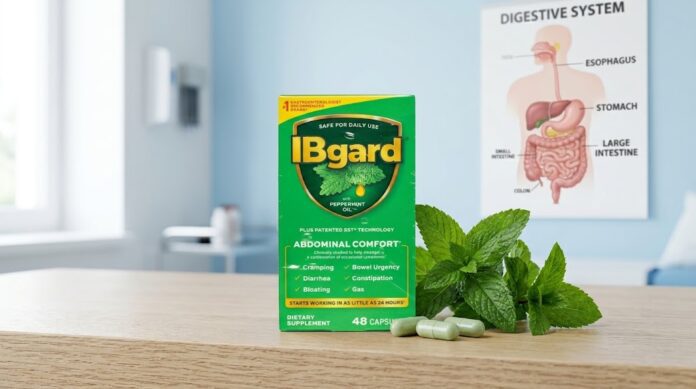
IBgard is a peppermint oil capsule with a clinical trial behind it, but that trial was not built around constipation. IBS-C was actually an exclusion criterion. This guide covers what IBgard is, what the research tested, where the IBS-C evidence is thin, and what has stronger support if constipation is your main problem.
Quick answer on IBgard for IBS-C: IBgard has not been proven to relieve constipation in IBS-C. Its main clinical trial excluded people with IBS-C, so the results cannot show whether it works for this subtype [1]. Peppermint oil in general has modest, low quality evidence for easing overall IBS symptoms, mainly abdominal pain and possibly bloating [3,5]. If constipation is your main symptom, talk with your healthcare professional about options.
What Is IBgard?
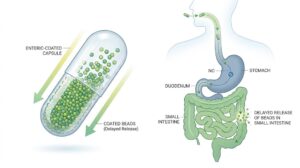
IBgard is sold as a dietary supplement made with ultra purified peppermint oil [8,10]. Each capsule holds tiny coated beads (microspheres) designed to release the oil gradually in the small intestine instead of the stomach, with the aim of limiting the heartburn that older peppermint oil capsules can cause [1].
The trial dose was 180 mg of peppermint oil, taken as two capsules three times a day [1]. Peppermint oil is thought to work as an antispasmodic, meaning it may calm the gut muscle activity that contributes to cramping [6].
IBS-C in Brief
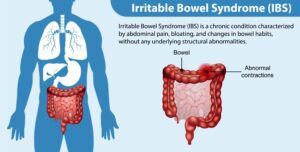
IBS-C is a subtype of irritable bowel syndrome. People have recurrent abdominal pain linked to bowel movements or to changes in how often they go or what the stool looks like, and hard or lumpy stools are the main pattern (more than a quarter of bowel movements hard or lumpy, and fewer than a quarter loose or watery) [3]. Diagnosis depends on the overall symptom pattern, not constipation alone. Our guide to IBS-C vs chronic constipation explains the overlap, and tracking your stools with the Bristol Stool Chart gives your doctor better information.
IBS-C has two problems to solve: the pain and bloating, and the slow, hard stools. A product can help one without touching the other.
What the IBgard Trial Actually Tested
The main trial is called IBSREST. It was a four week study in which people were assigned by chance (randomized), neither they nor the researchers knew who received the real capsule (double blind), and the comparison group received a dummy capsule (placebo controlled). It enrolled 72 adults who met Rome III criteria for IBS with mixed bowel habits (IBS-M) or IBS with diarrhea (IBS-D). People with IBS-C or unsubtyped IBS were excluded [1].
Total IBS symptom scores fell by 40% with peppermint oil versus 24.3% with placebo, and the authors described the capsule as well tolerated [1]. Three caveats apply:
- No IBS-C group. The study population was IBS-M and IBS-D only [1].
- Small and short. Seventy two people over four weeks cannot tell us much about longer term use.
- Industry links. The trial was funded by IM HealthScience, the product’s original developer. One author is listed as a consultant to the company, one as its chief medical advisor and one as its chief innovation officer [1]. That does not make the results wrong, but independent replication would be more reassuring.
What the Wider Research Says About Peppermint Oil
The American College of Gastroenterology (ACG) 2021 IBS guideline suggests peppermint for relief of global IBS symptoms. It is a conditional recommendation based on low quality evidence [3,5]. That recommendation concerns overall IBS symptoms, not constipation in IBS-C.
The National Center for Complementary and Integrative Health (NCCIH) notes that a 2022 review of 10 studies with 1,030 participants found peppermint oil better than placebo for overall symptoms and abdominal pain, with more side effects, mostly mild reflux and indigestion [4,13]. The review authors rated the evidence quality as very low [13], and long term benefit has not been established [5].
A well designed Dutch trial adds caution. It randomized 190 adults with Rome IV IBS, and 189 were analyzed. They took three capsules a day for eight weeks. Neither of the two peppermint oil capsules met the main goal: abdominal pain response was 46.8% and 41.3% versus 34.4% with placebo, not a statistically significant difference. Abdominal pain, discomfort and symptom severity improved with the small intestine release capsule, but the authors treated those as exploratory [2]. That trial used different capsules, not IBgard, so it cannot be applied directly to this product.
A US single center trial in 133 adults with moderate to severe Rome IV IBS tested enteric coated peppermint oil (180 mg three times daily) against placebo for six weeks. Both groups improved substantially on the IBS Severity Scoring System, and the difference between peppermint oil and placebo was not statistically significant [6,14]. Taken together, these trials are a reason to treat peppermint oil as an option with uncertain benefit, not a proven fix.
Does Peppermint Oil Help the Constipation Part?
The evidence is thin and mixed.
- In the IBgard trial itself, the individual symptoms that improved significantly versus placebo after four weeks were abdominal pain or discomfort, bloating, pain at evacuation and urgency. Constipation was not among them [1].
- In the Dutch trial, the researchers said they did not expect peppermint oil to change bowel habits much. Across the whole group, and in the 42 participants with IBS-C, they found no meaningful sustained change in stool frequency or consistency. The only differences by subtype were in IBS-D, at isolated time points [2].
- An open label, single arm Japanese study of a different peppermint oil product reported a small rise in stool frequency score in 18 participants with IBS-C, with no change in stool form [7]. With no placebo group and so few people, this cannot be separated from expectation.
Retail listings describe IBgard as clinically shown to help manage occasional symptoms including constipation [8,10]. That wording appears to rest on the IBSREST trial and a later post hoc look at its 34 IBS-M participants, who have both diarrhea and constipation [11]. It is not based on a trial in IBS-C, so it should not be read as evidence that IBgard relieves IBS-C constipation.
In practice, peppermint oil looks more like a tool for cramping and bloating than a treatment for slow stools. If hard, infrequent stools are your biggest problem, you will probably need something else alongside it.
How IBgard Is Taken
Label directions for adults say to take two capsules, one to three times daily, as needed or as directed by a healthcare provider, 30 to 90 minutes before a meal with water. If the dose before the meal is missed, it can be taken with or after a meal [9,10]. The trial used six capsules a day [1].
The manufacturer’s usage sheet lists a maximum of 8 capsules a day and notes that the product was clinically studied at 6 [9], while a retailer listing of the label says two capsules up to three times a day [10]. Follow the label on the box in your hand. IBgard is labeled for adults.

Side Effects and Who Should Check First
Peppermint oil taken by mouth can cause heartburn, nausea, abdominal pain and dry mouth [4]. In the Dutch trial, half of people on the small intestine release capsule reported heartburn or reflux symptoms, versus 28% on placebo, and about three in ten on each peppermint capsule noticed peppermint scented stool versus almost no one on placebo [2].
Talk with a doctor or pharmacist before using it if any of these apply:
- You have acid reflux or GERD. Peppermint relaxes the lower esophageal sphincter, and one trial excluded people with GERD for that reason [6].
- You are pregnant or nursing, take any medication, or have another medical condition. The label advises checking first [9,10].
- Your symptoms are new, changing or getting worse. The label says to stop and consult a provider if symptoms persist or worsen, or if you have a reaction [9,10].
When to See a Doctor Instead of Self Treating
The ACG guideline favors recognizing IBS from its symptom pattern instead of ruling out every other condition first [3]. That only works when there are no warning signs. Rectal bleeding, black stools, unexplained weight loss, anemia, persistent vomiting, a family history of colon cancer or inflammatory bowel disease, or constipation that begins suddenly later in life all call for medical evaluation. The IBS-C guide linked earlier lists these red flags in more detail.
Options the Guidelines Support for IBS and IBS-C
The ACG guideline gives a useful map of what has been studied. Some of it applies to IBS overall, and only some is specific to IBS-C [3].
For IBS overall (including IBS-C):
- Soluble fiber is suggested, while insoluble fiber is not.
- A limited trial of a low FODMAP diet is recommended.
- Gut directed psychotherapies are suggested.
- Tricyclic antidepressants are recommended. These are prescription medicines.
- Probiotics are suggested against, and antispasmodics as a class are recommended against.
Specific to IBS-C:
- Prescription chloride channel activators and guanylate cyclase activators are recommended. Your doctor can tell you whether they fit your situation.
- PEG products are suggested against by the ACG for overall IBS-C symptoms, while the 2022 AGA guideline for IBS-C conditionally recommends them, so the two societies do not fully agree [12]. These statements concern IBS-C symptoms as a whole and are not a verdict on how PEG performs for everyday constipation. The AGA also conditionally recommends antispasmodics, which the ACG advises against [12]. Ask your clinician which approach fits your symptoms.
Food and habits can still be part of daily care. Start with the best fruits for chronic constipation and a better toilet position. If you are weighing laxatives or magnesium, compare our guides to OTC laxatives and magnesium supplements.
Products Worth Knowing About
The links below are Amazon affiliate links. As an Amazon Associate we earn from qualifying purchases. This does not change the price you pay, and none of these products is a medical recommendation.
If you and your clinician decide to try peppermint oil, these are the two pack sizes to look at. Check the current listing and label before buying.
- IBgard peppermint oil capsules, 12 count: a small pack to see how your stomach tolerates the capsule.
- IBgard peppermint oil capsules, 96 count: the larger pack, which makes more sense once you know it agrees with you.
Frequently Asked Questions
Does IBgard work for IBS-C?
It is not proven. IBgard’s clinical trial enrolled adults with IBS-D or IBS-M and excluded IBS-C, and we did not find a published trial in people with IBS-C. Peppermint oil in general has modest evidence for easing abdominal pain and overall symptoms in IBS, but its effect on constipation is unclear.
What does the guideline say about peppermint oil for IBS?
The 2021 American College of Gastroenterology guideline suggests peppermint for relief of global IBS symptoms. It is a conditional recommendation based on low quality evidence.
This article is for education and is not medical advice. It does not replace an evaluation by a qualified clinician.
References
- Cash BD, Epstein MS, Shah SM. A novel delivery system of peppermint oil is an effective therapy for irritable bowel syndrome symptoms. Dig Dis Sci. 2016;61(2):560-71. doi:10.1007/s10620-015-3858-7. Available from: https://link.springer.com/article/10.1007/s10620-015-3858-7
- Weerts ZZRM, Masclee AAM, Witteman BJM, et al. Efficacy and safety of peppermint oil in a randomized, double blind trial of patients with irritable bowel syndrome. Gastroenterology. 2020;158(1):123-36. doi:10.1053/j.gastro.2019.08.026. Available from: https://doi.org/10.1053/j.gastro.2019.08.026
- Lacy BE, Pimentel M, Brenner DM, et al. ACG clinical guideline: management of irritable bowel syndrome. Am J Gastroenterol. 2021;116(1):17-44. doi:10.14309/ajg.0000000000001036. Available from: https://pubmed.ncbi.nlm.nih.gov/33315591/
- National Center for Complementary and Integrative Health. Peppermint oil. Available from: https://www.nccih.nih.gov/health/peppermintoil
- National Center for Complementary and Integrative Health. Irritable bowel syndrome and complementary health approaches. NCCIH Clinical Digest. April 2023. Available from: https://www.nccih.nih.gov/health/providers/digest/irritable-bowel-syndrome-and-complementary-health-approaches
- O’Dwyer MC. Does peppermint oil improve symptoms of irritable bowel syndrome? NEJM Journal Watch. November 24, 2021. Available from: https://clinician.nejm.org/nejm-jw.NA54317
- Efficacy and safety of peppermint oil for the treatment in Japanese patients with irritable bowel syndrome: a prospective, open label, and single arm study. BioPsychoSocial Medicine. 2024;18:3. doi:10.1186/s13030-024-00302-y. Available from: https://link.springer.com/article/10.1186/s13030-024-00302-y
- IBgard Daily Gut-Health Guard Capsules, product listing with label claims (Wegmans). Available from: https://www.wegmans.com/shop/product/730559-Gut-Health-Guard-Daily-Capsules
- Nestle Health Science. IBgard suggested usage sheet. Available from: https://www.nestlemedicalhub.com/sites/default/files/RUdxey1QehU.pdf
- IBgard Daily Gut-Health Guard Capsules, 48 ct, product listing with directions and warnings (Giant Food). Available from: https://giantfoodstores.com/groceries/health-beauty/digestive-health-nausea/anti-diarrhea-gas-relief-nausea-motion-sickness/ibgard-daily-gut-health-guard-capsules-48-ct-pkg.html
- Healio. IBgard peppermint oil capsules effective in IBS-M (subgroup analysis of the IBSREST trial). September 26, 2017. Available from: https://cm.healio.com/news/gastroenterology/20170926/ibgard-peppermint-oil-capsules-effective-in-ibsm
- Chang L, Sultan S, Lembo A, Verne GN, Smalley W, Heidelbaugh JJ. AGA clinical practice guideline on the pharmacological management of irritable bowel syndrome with constipation. Gastroenterology. 2022;163(1):118-36. doi:10.1053/j.gastro.2022.04.016. Available from: https://pubmed.ncbi.nlm.nih.gov/35738724/
- Ingrosso MR, Ianiro G, Nee J, et al. Systematic review and meta-analysis: efficacy of peppermint oil in irritable bowel syndrome. Aliment Pharmacol Ther. 2022;56(6):932-41. doi:10.1111/apt.17179. Available from: https://eprints.whiterose.ac.uk/190294
- Nee J, Ballou S, Kelley JM, Kaptchuk TJ, Hirsch W, et al. Peppermint oil treatment for irritable bowel syndrome: a randomized placebo-controlled trial. Am J Gastroenterol. 2021;116(11):2279-85. doi:10.14309/ajg.0000000000001395. Available from: https://doi.org/10.14309/ajg.0000000000001395