

This article contains affiliate links. We may earn a small commission if you purchase through them, at no extra cost to you. This is not medical advice; consult your doctor before starting a new fiber supplement, especially if you have IBS, IBD, or another diagnosed digestive condition.
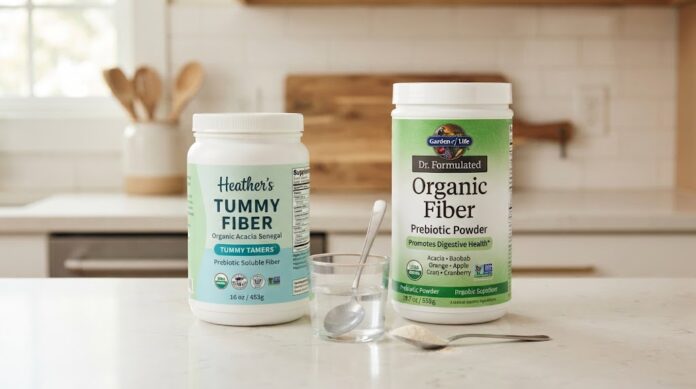
If you have spent any time researching soluble fiber supplements for IBS or general constipation relief, you have probably come across both of these names. Heather’s Tummy Fiber is a single-ingredient acacia senegal powder marketed for IBS, while Garden of Life Dr. Formulated Organic Fiber is a five-ingredient organic superfood blend marketed for general digestive support. On paper they look similar (both are powders, both are psyllium-free, both lean on acacia), but the similarities mostly stop there.
This guide compares Heather’s Tummy Fiber vs Garden of Life Organic Fiber: what is actually in each product, what the research says about acacia senegal, and how the two formulations differ so you can decide which may better match your preferences and needs.
Note: Garden of Life also sells a separate, more insoluble-fiber-heavy product called “RAW Organic Fiber” (flaxseed, chia, and sprouted grains, 9g fiber per scoop, no acacia). This article covers the acacia-based “Dr. Formulated Organic Fiber” specifically, since it is the more direct comparison to Heather’s. If you meant the RAW Organic Fiber blend, the comparison points below will not apply in the same way.
For background on how fiber supplements fit into a broader constipation-relief plan, see our guide on fiber therapy and gut health, and our roundup of 7 natural fiber supplements for chronic constipation.
Quick Comparison Table
| Feature | Heather’s Tummy Fiber | Garden of Life Dr. Formulated Organic Fiber |
|---|---|---|
| Main ingredient | 100% organic acacia senegal | Organic acacia, orange peel, baobab fruit, apple peel, organic cranberry |
| Fiber per serving | 2g soluble fiber per 1-level-teaspoon (2.5g) serving; dosing is individualized and may be gradually increased up to 5 tbsp/day1 | 5g dietary fiber per 1 tbsp (4g soluble, 1g insoluble)2 |
| Psyllium-free | Yes | Yes |
| FODMAP status | Marketed as low-FODMAP3 | Not labeled low-FODMAP; contains several fruit-derived ingredients |
| Marketed for | IBS symptom management3 | General digestive support and occasional constipation |
| Taste | Described by the manufacturer as tasteless and grit-free1 | Unflavored version is designed to be neutral-tasting; citrus version has added stevia2 |
| Container size | 16 oz (453g) pouch or canister | 6.8 oz (192g), 32 servings |
| Typical price | Varies by retailer and package format; check the current listing before buying | $18.39 on the official Garden of Life site at the time of our research; varies by retailer |
| Best for | People looking for a single-ingredient acacia fiber with flexible dosing | People who prefer a multi-ingredient organic fiber blend with a fixed labeled serving |

What Is Heather’s Tummy Fiber?
Heather’s Tummy Fiber is a soluble fiber powder made from 100% acacia senegal, with no added flavors, sweeteners, or fillers.4 The brand markets it as a “medical food” for the dietary management of IBS symptoms and states it is intended for use under a physician’s supervision.4
Because it is a single ingredient, dosing is fully adjustable. The manufacturer’s current directions recommend starting with ½ level teaspoon twice daily and gradually adding another ½ teaspoon every few days, following the current product label, until symptoms stabilize, with a stated maximum of 5 tablespoons a day for adults; the brand notes that some people with constipation may use 4 to 5 tablespoons a day.1
Because label wording can change, follow the exact directions on your current package. This slow build-up mirrors the gradual-introduction approach we outline in our fiber therapy guide, where rushing into a full dose too quickly is one of the most common reasons fiber supplements seem to “not work.”
Key features of Heather’s Tummy Fiber
- 100% organic acacia senegal, no other ingredients
- Marketed as gluten-free and low-FODMAP3
- Non-GMO, CRC Kosher3
- Prebiotic, meaning it may support the growth of beneficial gut bacteria3
- Available as a pouch, refillable canister, or travel stick packs6
- Manufacturer states the product is for adults 12 years and older, with excellent reported GI tolerance for long-term use; use in children under 12 should be discussed with a pediatrician first.3

What Is Garden of Life Dr. Formulated Organic Fiber?
Garden of Life’s Dr. Formulated Organic Fiber, developed with neurologist David Perlmutter, M.D., is a blend of five organic ingredients: acacia (A. senegal), orange peel, baobab fruit, apple peel, and cranberry.2 Each 1-tablespoon serving provides 5 grams of total dietary fiber, made up of 4 grams soluble fiber and 1 gram insoluble fiber, for 20 calories.2 It is sold in unflavored and citrus versions. The citrus version contains organic stevia leaf extract.2
Garden of Life states that the acacia used in this blend is a premium, USDA-organic acacia senegal that is about 90 percent soluble fiber by weight, and that it is “backed by clinical studies” for its prebiotic effect, though the company does not cite a specific study on its product page.2 The product carries USDA Organic, Non-GMO Project Verified, NSF gluten-free, Kosher, and Certified Vegan claims.2
Key features of Garden of Life Organic Fiber
- 5-ingredient organic blend built around acacia
- 5g fiber per tablespoon, with a defined soluble-to-insoluble ratio
- Sugar-free, psyllium-free, made without artificial sweeteners or colors2
- Available unflavored or in citrus flavor2
- Manufactured in a facility that also processes egg, milk, and soy, with possible soy cross-contact2
- Directions state the product is “not intended for children”2, whereas Heather’s Tummy Fiber is manufacturer-labeled for adults and children 12 and older

Fiber Content and Soluble vs Insoluble Ratio
This is where the two products genuinely diverge. Heather’s Tummy Fiber’s nutrition facts list a 2.5 g serving (about one level teaspoon) containing 2 g of soluble fiber, but its dosing instructions are individualized: it is meant to be titrated to your own tolerance and symptom response, starting at half a teaspoon twice daily and increasing gradually up to the stated maximum of 5 tablespoons a day.1,6 Because it is made from 100% acacia senegal, the product is marketed as 100% soluble dietary fiber.6
Garden of Life gives you a fixed, labeled amount: 5 grams of fiber per tablespoon, split 4 grams soluble and 1 gram insoluble.2 That predictability is convenient if you want to track your intake precisely. At one or two labeled servings, Garden of Life provides 5 to 10 grams of dietary fiber, while Heather’s uses individualized dosing that can be gradually increased according to the product label. For general background on soluble versus insoluble fiber and how each behaves in the gut, see our guide on psyllium husk vs wheat bran.
What the Research Says About Acacia Senegal
Acacia senegal (also called gum arabic or acacia gum) is a soluble, fermentable fiber that has been studied for its prebiotic and gastrointestinal effects. A review in Food and Chemical Toxicology summarized research on gum arabic’s biological effects, including its role as a fermentable, prebiotic dietary fiber.5 Because different fibers vary in fermentability and gas production, individual tolerance can differ substantially from person to person, including among people with IBS.
Clinical studies have examined acacia/gum arabic at daily doses ranging from about 10 to 30 grams over periods of four to 12 weeks, although the studies evaluated different populations and outcomes, and acacia generally appeared tolerable in these relatively short trials.7,10,11 A randomized, placebo-controlled trial in adults with type 2 diabetes found that gum arabic supplementation improved visceral adiposity index and blood pressure with good tolerability.7
A separate single-arm, 12-week trial in rheumatoid arthritis patients used 30 grams of gum arabic per day and reported reduced inflammatory markers and disease activity, with no major tolerability issues.10 A mini-review in the Iraqi Journal of Pharmaceutical Sciences similarly described gum arabic as a well-tolerated dietary fiber with prebiotic, cholesterol-lowering, and gut-regulating properties.8
More directly relevant to constipation, and to acacia fiber for IBS-C specifically, is a 2024 randomized, double-blind, placebo-controlled trial involving 180 adults with IBS-C (Rome IV criteria). Participants received either 10 grams of acacia fiber per day, a probiotic (Bifidobacterium lactis BLa80), or a maltodextrin placebo, for 4 weeks. The acacia fiber group had a statistically significant improvement in stool frequency compared with placebo (P<0.001).
However, the improvement in constipation-specific symptom scores (PAC-SYM) was only a trend and did not reach statistical significance (P=0.10), and there were no significant differences in stool consistency, stool mass, or quality-of-life measures between the acacia group and placebo.11
One co-author, Damien Guillemet, was affiliated with Nexira, a company involved in acacia gum, and this affiliation was disclosed in the published paper.11
We did not identify a published clinical trial testing either finished product, Heather’s Tummy Fiber or Garden of Life Organic Fiber, against placebo specifically for constipation outcomes, nor a head-to-head trial comparing the two products. The studies above tested acacia senegal (or, in one case, gum arabic more broadly) as an ingredient, not either branded product as sold, and most were not designed to measure constipation specifically.
FODMAP and IBS Considerations
Heather’s Tummy Care markets its 100 percent acacia senegal fiber as free of FODMAPs and suitable for people with IBS.3 That is the manufacturer’s claim rather than an independent low-FODMAP certification or laboratory analysis.
Garden of Life’s blend adds orange peel, baobab fruit, apple peel, and cranberry alongside the acacia, and the product is not labeled low-FODMAP.2 It is worth being precise here: fermentable fiber and “high-FODMAP” are not the same thing, and the label does not break out how much of each fruit-derived ingredient is present, so we cannot say from the ingredient list alone whether the finished product would trigger symptoms in a FODMAP-sensitive person.
Because Garden of Life contains several fruit-derived ingredients in addition to acacia, people following a strict low-FODMAP diet should review the full ingredient list and discuss individual tolerance with a dietitian rather than assume either way.
Neither of these products is a substitute for a structured low-FODMAP elimination and reintroduction plan supervised by a registered dietitian. If FODMAP sensitivity is a major part of your symptom picture, our guide on the low-FODMAP diet and constipation goes into more detail on how that framework works and when it is (and is not) the right first step.
Taste, Texture, and Mixability
Heather’s directions say to stir the powder into moist foods, or to add it to an empty cup and stir with a fork while gradually adding room-temperature liquid, then let it rest a minute and stir again to dissolve completely. The manufacturer notes that it does not dissolve well in boiling-hot or ice-cold liquids, and describes the product as tasteless and grit-free.1
Garden of Life states that its unflavored powder is designed to have no gritty or gummy texture and to dissolve easily, and that the citrus version contains organic stevia leaf extract.2 Individual experiences may vary. If you prefer a neutral taste, the unflavored version may be the more suitable choice.
Price Comparison
Pricing on both products varies by retailer and fluctuates over time, so treat the figures below as a snapshot rather than a guaranteed current price, and check the listing before buying. At the time of our research (2026), Garden of Life’s official site listed the 6.8 oz unflavored product at $18.39.9
- Heather’s Tummy Fiber (16 oz / 453g): price varies by retailer and package format; check the current listing before buying.
- Garden of Life Organic Fiber (6.8 oz / 192g, 32 servings): listed at $18.39 on the official site at the time of our research, or roughly $0.58 per serving.9
Garden of Life makes daily intake easier to track because its label provides a fixed 5-gram fiber serving, so cost per day is straightforward to estimate up front (one tablespoon a day is roughly $0.58 at the $18.39 price above). Heather’s cost per day depends on the amount used, so the cost per serving cannot be estimated reliably from the package price alone.
Who May Prefer Heather’s Tummy Fiber?
- You have IBS and specifically want a single-ingredient acacia fiber
- You are following a low-FODMAP diet and want fewer ingredients to track (discuss this with your dietitian)
- You want full control over your daily dose rather than a fixed serving size
- You have tried psyllium (Metamucil) and found it too harsh or gas-producing; see our Benefiber vs Metamucil comparison for how acacia-type fibers generally compare to psyllium in tolerability
Who May Prefer Garden of Life Organic Fiber?
- You want general, everyday fiber support rather than a product targeted specifically at IBS
- You prefer a defined, label-based serving size (5g fiber per tablespoon) for tracking intake
- You do not specifically need a low-FODMAP-labeled fiber and prefer a multi-ingredient blend
- You want a citrus-flavored option as an alternative to a fully neutral powder
If neither of these fits your situation exactly, our broader roundups of natural fiber supplements for chronic constipation and sugar-free fiber supplements cover additional options, including psyllium, wheat dextrin, and methylcellulose-based products.
Safety and Side Effects
Acacia-based fiber is generally well tolerated in the clinical studies available, although individual gastrointestinal effects can vary, and neither branded product has been tested on its own in a published trial. Gas, bloating, or mild cramping can occur when fiber intake is increased quickly, particularly in people who are sensitive to fermentable fibers. Taking fiber with adequate water and following each product’s gradual-dosing instructions, rather than jumping straight to a full dose, can help.
Some fiber products carry instructions to separate them from medications because fiber may affect how some medicines are absorbed. Check the product label and ask your pharmacist whether you should separate your medication from the fiber supplement, and by how much, since the right spacing varies by medication rather than following one universal rule.
If you have alarm symptoms such as unintentional weight loss, rectal bleeding, a family history of colorectal cancer, or a significant recent change in bowel habits, seek medical evaluation rather than relying on a fiber supplement. For average-risk adults without symptoms, the U.S. Preventive Services Task Force recommends colorectal cancer screening beginning at age 45.12
If you are pregnant, nursing, on prescription medications, or managing a diagnosed digestive condition such as IBD, talk to your doctor before adding either supplement to your routine.2,4
Frequently Asked Questions
How do Heather’s Tummy Fiber and Garden of Life Organic Fiber differ for IBS?
Neither product has been directly compared with the other in a clinical trial. The main difference is their formulation: Heather’s Tummy Fiber contains only one ingredient, acacia senegal, and is marketed by the manufacturer as suitable for IBS and free of FODMAPs.
Garden of Life Organic Fiber combines acacia with orange peel, baobab, apple peel, and cranberry, and is not labeled low-FODMAP. People following a strict low-FODMAP diet should review the full ingredient list and discuss individual tolerance with a dietitian rather than assume that either product will be suitable.
Which one has more fiber per serving?
Garden of Life Organic Fiber provides 5 grams of dietary fiber per 1-tablespoon serving, with 4 grams soluble and 1 gram insoluble.2 Heather’s Tummy Fiber lists 2 grams of soluble fiber per 1-level-teaspoon serving, but its dosing instructions are individualized and allow gradual increases up to a maximum of 5 tablespoons per day, so total daily fiber intake depends on the dose you work up to.1
Does Garden of Life Organic Fiber contain psyllium?
No. Both Garden of Life Dr. Formulated Organic Fiber and Heather’s Tummy Fiber are psyllium-free. Heather’s is 100 percent acacia senegal, and Garden of Life’s blend is built around acacia, orange peel, baobab, apple peel, and cranberry.2,4
Can I take these fiber supplements every day long term?
Available clinical studies suggest that acacia fiber can be tolerated over several weeks to a few months, but these studies do not establish that every person can safely use high doses indefinitely.7,10,11 As with any fiber supplement, introduce it gradually, drink enough water, and check with your doctor if you have a diagnosed digestive condition or take medications that may interact with fiber.
Conclusion
Both products provide acacia-based soluble fiber, but their formulations are different. Heather’s Tummy Fiber contains only acacia senegal and allows flexible, gradual dose adjustment up to a stated maximum of 5 tablespoons a day. Garden of Life Dr. Formulated Organic Fiber combines acacia with orange peel, baobab, apple peel, and cranberry, and provides a fixed, labeled 5-gram fiber serving per tablespoon.
The choice depends on whether you prefer a single-ingredient, adjustable fiber that is marketed for IBS and carries a manufacturer claim of being free of FODMAPs, or a fixed-dose, multi-ingredient organic blend. Neither product has been directly compared with the other in a clinical trial.
Whichever you choose, introduce it slowly, pair it with adequate water, and use it consistently while following the product’s gradual dosing instructions before deciding whether it is helping, in line with the approach described in our fiber therapy guide.
Disclaimer:This article is for informational purposes only and is not a substitute for professional medical advice, diagnosis, or treatment. Always consult your physician before starting a new fiber supplement, particularly if you have IBS, IBD, or another diagnosed digestive condition, or if you are pregnant or nursing.
References
- Heather’s Tummy Care. Tummy Fiber (organic acacia senegal): directions for use and nutrition facts. heatherstummycare.com. https://www.heatherstummycare.com/p/suplmts_acacia/acacia-fiber-powder-heathers-tummy-fiber/. Accessed September 2026.
- Garden of Life. Dr. Formulated Organic Fiber Unflavored, product page and supplement facts. gardenoflife.com. https://www.gardenoflife.com/dr-formulated-organic-fiber-unflavored. Accessed September 2026.
- Heather’s Tummy Care. Tummy Fiber product description, IBS and FODMAP claims. Amazon.com product listing. https://www.amazon.com/dp/B0002ON8DU. Accessed 2026.
- Heather’s Tummy Care. Tummy Fiber Organic Acacia Senegal for IBS, product description and user reviews. Amazon.com. https://www.amazon.com/dp/B0002ON8DU. Accessed 2026.
- Ali BH, Ziada A, Blunden G. Biological effects of gum arabic: a review of some recent research. Food Chem Toxicol. 2009;47(1):1-8. doi:10.1016/j.fct.2008.07.001. PMID: 18672018.
- Heather’s Tummy Care. Tummy Fiber product catalog, sizes and formats. heatherstummycare.com. https://www.heatherstummycare.com/c/tummy-fiber/. Accessed September 2026.
- Babiker R, Elmusharaf K, Keogh MB, Saeed AM. Effect of Gum Arabic (Acacia Senegal) supplementation on visceral adiposity index (VAI) and blood pressure in patients with type 2 diabetes mellitus (T2DM) as indicators of cardiovascular disease (CVD): a randomized and placebo-controlled clinical trial. Lipids Health Dis. 2018;17(1):56. doi:10.1186/s12944-018-0711-y. PMID: 29558953.
- Jaafar NS. Clinical effects of Gum Arabic (Acacia): A Mini Review. Iraqi J Pharm Sci. 2019;28(2):9-16. doi:10.31351/vol28iss2pp9-16.
- Garden of Life Dr. Formulated Organic Fiber pricing, official Garden of Life store (gardenoflife.com) and iHerb listings. Accessed 2026.
- Kamal E, Kaddam LA, Dahawi M, Osman M, Salih MA, Alagib A, Saeed A. Gum Arabic Fibers Decreased Inflammatory Markers and Disease Severity Score among Rheumatoid Arthritis Patients, Phase II Trial. Int J Rheumatol. 2018;2018:4197537. doi:10.1155/2018/4197537. PMID: 30112005.
- JanssenDuijghuijsen L, van den Belt M, Rijnaarts I, Vos P, Guillemet D, Witteman B, de Wit N. Acacia fiber or probiotic supplements to relieve gastrointestinal complaints in patients with constipation-predominant IBS: a 4-week randomized double-blinded placebo-controlled intervention trial. Eur J Nutr. 2024;63(5):1983-1994. doi:10.1007/s00394-024-03398-8. PMID: 38653808. Free full text: PMC11329592. Correction published 2025: Eur J Nutr. 2025;64(3):135. doi:10.1007/s00394-025-03586-0.
- US Preventive Services Task Force; Davidson KW, Barry MJ, Mangione CM, et al. Screening for Colorectal Cancer: US Preventive Services Task Force Recommendation Statement. JAMA. 2021;325(19):1965-1977. doi:10.1001/jama.2021.6238. Current recommendation: uspreventiveservicestaskforce.org.