

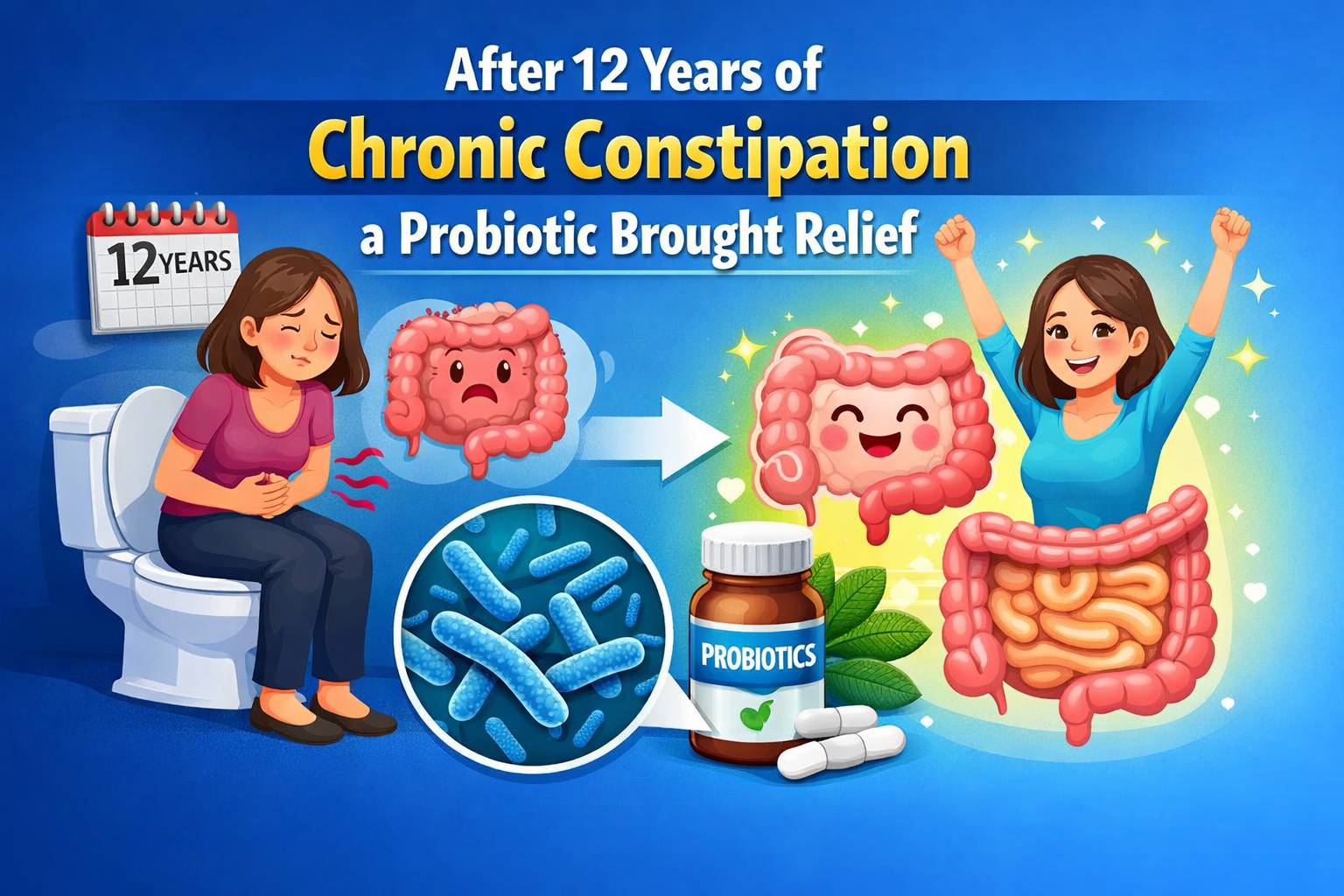
Chronic constipation is one of the most common gastrointestinal disorders worldwide. It is generally defined as having fewer than three bowel movements per week and is often accompanied by symptoms such as straining, hard stools, and a persistent sensation of incomplete evacuation (1,2). According to estimates from the World Gastroenterology Organisation (WGO), chronic constipation affects a significant portion of the global population. Various epidemiological studies suggest that roughly 9% to 20% of people worldwide experience chronic constipation at some point in their lives, highlighting the scale of the problem.
For many people, managing chronic constipation can become a long and frustrating process. Even with dietary changes, regular exercise, and doctor-recommended medications, some patients continue to struggle with irregular bowel movements.
Recently, a story shared on a health-focused Reddit community drew attention to a possible role of probiotics in digestive health. In the post, a woman described how eating probiotic yogurt — and later taking a supplement containing Bifidobacterium lactis — appeared to resolve a constipation problem she had been dealing with for more than a decade.
12-Year Struggle With Chronic Constipation
In the Reddit post, the user explained that she had been suffering from severe constipation for about 12 years.
According to her account, the problem began after a major medical emergency that required multiple surgeries. During her recovery, she underwent months of treatment with strong antibiotics and morphine, medications that can sometimes affect gut function.
After the emergency treatment ended, she noticed that her digestive system never returned to normal.
She wrote that she rarely felt the natural urge to have a bowel movement and often had to depend on laxatives recommended by doctors. However, those treatments did not solve the underlying problem.
Instead, she described a frustrating pattern: several days of constipation followed by diarrhea after taking laxatives.
Some of the products she used included polyethylene glycol, commonly sold as Miralax, as well as magnesium-based laxatives.
While these treatments temporarily relieved symptoms, they did not restore normal bowel function.
Healthy Diet and Active Lifestyle Did Not Help
One of the most discouraging aspects of her experience was that the constipation continued despite maintaining a healthy lifestyle.
According to the post, her diet regularly included:
-
Fruits and vegetables
-
Lentils and legumes
-
Whole grains
-
Fresh salads
She also stayed physically active by walking her dog for around two hours every day and practicing yoga and Pilates several times per week.
Over the years, she experimented with numerous potential remedies.
For example, she tried herbal supplements such as Triphala, an Ayurvedic herbal mixture sometimes used to support digestion. Initially, it seemed to help, but the effect eventually disappeared.
Despite her efforts, the constipation persisted.
An Unexpected Discovery During Vacation
The situation changed unexpectedly during a vacation in Washington State.
While visiting the small town of Bow, she purchased plain, unsweetened yogurt from a local cheese shop and ate it before going to bed.
The next morning, she experienced something she had rarely felt in years — a strong natural urge to have a bowel movement.
She described the experience as completely normal: the bowel movement was soft, easy, and required no laxatives.
Because the yogurt was the only new food she had eaten, she suspected that it might have triggered the improvement.
According to her post, she was so surprised by the change that she later drove three hours back to the shop to buy more of the same yogurt.
After continuing to eat it daily, she reported that her bowel movements became regular again.
Discovering the Role of Bifidobacterium lactis
Curious about why the yogurt seemed to work, she began researching the bacteria commonly found in fermented foods.
That research led her to Bifidobacterium lactis, a probiotic bacterium widely used in fermented dairy products and dietary supplements.
Further reading introduced her to a specific strain known as Bifidobacterium lactis HN019, which has been studied for its possible ability to improve intestinal transit time.
Because the yogurt was not available in her home state of California, she eventually switched to a probiotic supplement containing similar strains.
According to her post, the supplement helped maintain her regular bowel movements.
She wrote that she now experiences a bowel movement every morning and that the improvement has continued for more than a year.
What Scientific Research Says About Bifidobacterium lactis HN019
Scientists continue to investigate whether specific probiotic strains can improve digestive health, particularly in people suffering from functional constipation—a condition characterized by infrequent bowel movements or difficulty passing stool without an identifiable medical cause.
Recent research focusing on the probiotic strain Bifidobacterium lactis HN019 has produced mixed scientific results, with some studies showing limited effects on bowel movement frequency while others suggest potential benefits when the probiotic is combined with additional ingredients.
Large Clinical Trial Found No Significant Improvement in Bowel Movements
One of the largest clinical trials examining the strain Bifidobacterium lactis HN019 was a randomized triple-blind placebo-controlled study conducted in Shanghai, China.
The trial involved 229 adults aged 18 to 70 who met the Rome III diagnostic criteria for functional constipation. At the beginning of the study, participants experienced infrequent bowel movements, a common symptom of chronic constipation.
Participants were randomly assigned to receive either:
-
A probiotic supplement containing Bifidobacterium lactis HN019
-
A placebo supplement
The treatment period lasted eight weeks.
Researchers focused on complete spontaneous bowel movements (CSBMs) as the primary outcome. CSBMs refer to bowel movements that occur naturally without the use of laxatives or other medications, making them an important indicator in constipation research.
By the end of the eight-week trial, both the probiotic group and the placebo group showed some improvement in bowel movement frequency. However, statistical analysis found that the difference between the two groups was not significant.
The researchers therefore concluded that supplementation with Bifidobacterium lactis HN019 at the tested dose did not significantly increase bowel movement frequency compared with placebo in adults with functional constipation.
Probiotic Yogurt Study Reported Faster Intestinal Transit
Another clinical study examining probiotic yogurt reported more encouraging findings when probiotics were combined with other gut-supporting ingredients.
In this study, participants suffering from constipation consumed probiotic yogurt daily for two weeks.
The yogurt contained a combination of:
-
Bifidobacterium lactis HN019
-
Lactobacillus acidophilus NCFM
-
Polydextrose, a prebiotic fiber that supports the growth of beneficial gut bacteria.
Researchers assessed constipation severity using the Agachan Constipation Score, a clinical tool commonly used to measure symptoms such as stool frequency, difficulty during bowel movements, and abdominal discomfort.
The study also evaluated colonic transit time, which measures how quickly food moves through the large intestine.
Results showed that participants who consumed the probiotic yogurt experienced significantly faster intestinal transit compared with the control group. Faster transit time generally indicates improved bowel function and reduced constipation symptoms.
Researchers suggested that the combination of probiotic bacteria and prebiotic fiber may play an important role in improving digestive motility and overall gut health.
Mixed Evidence in Probiotic Research
Taken together, the findings highlight the complexity of probiotic research. While single-strain supplementation with Bifidobacterium lactis HN019 did not significantly improve bowel movement frequency in one large clinical trial, multi-component probiotic foods containing both probiotics and prebiotic fibers may produce more noticeable benefits for people with constipation.
Scientists note that further large-scale studies are needed to better understand how different probiotic strains, dosages, and combinations with prebiotics influence bowel function and digestive health.
Why Probiotic Results May Vary
Experts say several factors may explain why probiotic studies sometimes produce different results.
First, probiotic effects are strain-specific, meaning that benefits depend on the exact bacterial strain used.
Second, combining probiotics with prebiotic fibers may enhance the growth and activity of beneficial bacteria in the gut.
Third, the delivery method may matter. Fermented foods like yogurt can sometimes protect bacteria as they pass through the digestive system.
Finally, every person’s gut microbiome is unique. Because of this, a treatment that works well for one individual may not produce the same results for someone else.
Note: Some commercially available probiotic and synbiotic supplements also contain beneficial strains such as Bifidobacterium lactis, which are often studied for digestive health and bowel function. Readers interested in exploring similar formulations can check probiotic supplements that focus on Bifidobacterium lactis as well as synbiotic products that combine probiotics with prebiotic fibers to support gut microbiota balance. Examples include these probiotic options [Probiotic Product ] and synbiotic formulas [Synbiotic Product].
Growing Interest in the Gut Microbiome
In recent years, researchers have discovered that the gut microbiome plays a crucial role in many aspects of human health.
Gut bacteria influence not only digestion but also metabolism, immune function, and even certain aspects of mental health.
While the Reddit story cannot be considered scientific proof, such personal experiences sometimes highlight areas worth exploring in future research.
For people struggling with long-term constipation, ongoing studies on probiotics such as Bifidobacterium lactis HN019 may eventually help doctors understand who is most likely to benefit from these treatments.
Disclosure: The information on this website is for educational and informational purposes only and is not a substitute for professional medical advice. Some links on this site are affiliate links through which we may earn a commission.
Read more on our website:








[…] people managing chronic constipation find that even after improving their diet significantly, symptoms persist — and overlooked […]
[…] is why, as we covered in our article on chronic constipation and probiotic relief, rebuilding gut bacteria is so important — but that effort is constantly undermined if the […]