

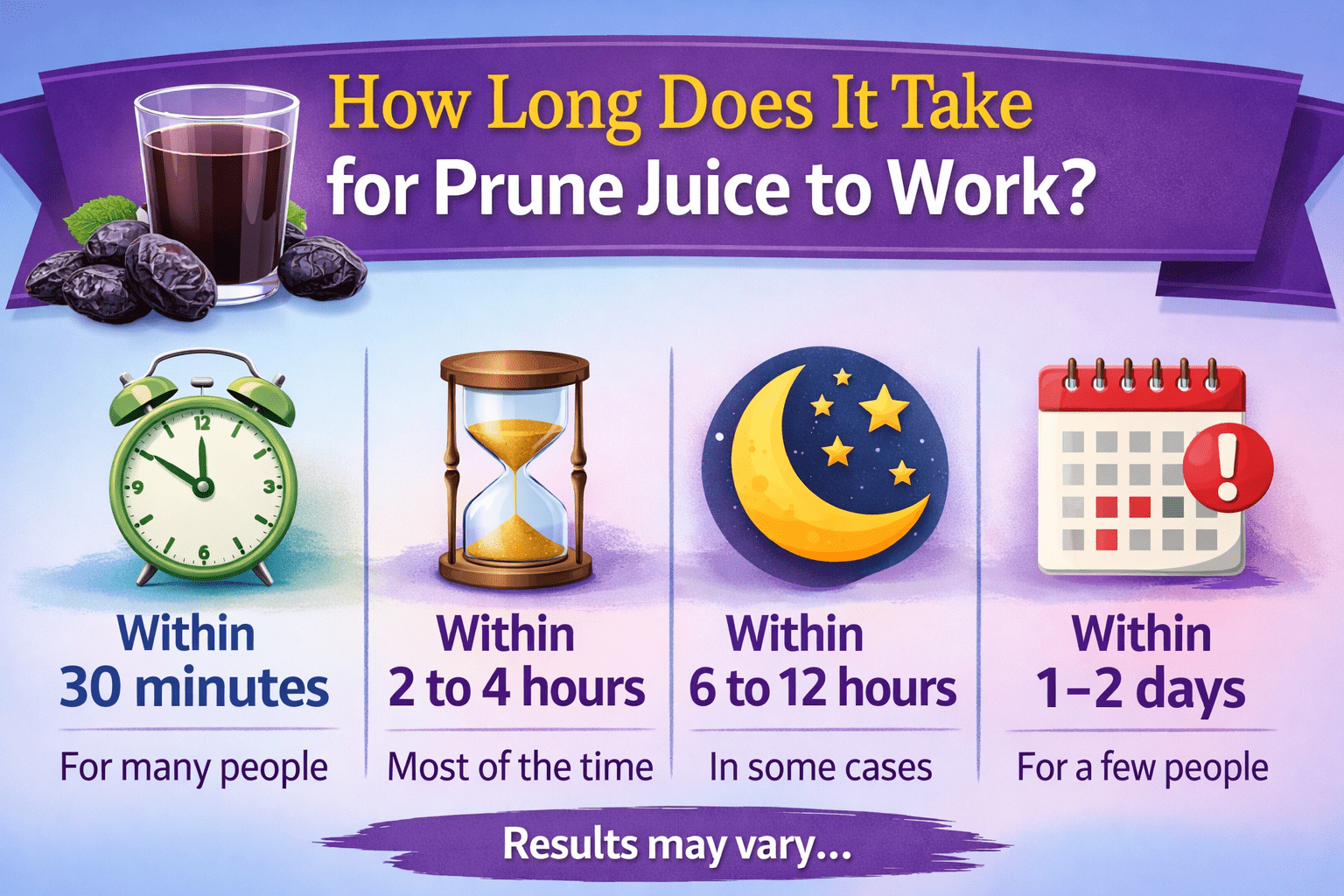
⏱ Quick Answer: Most people experience results within 1–3 hours of drinking 4–8 ounces of prune juice, thanks to its natural laxatives like sorbitol. However, for chronic constipation, full benefits may take 3–7 weeks of consistent daily use. Individual results vary based on metabolism, hydration, and the severity of constipation. PRO TIP: If you’re wondering how long does prune juice take to work for most adults, the magic window is typically 1–3 hours. To hit this target, drink it warm on an empty stomach right after you wake up!
Constipation is one of those problems nobody likes to talk about — but almost everyone experiences at some point. You feel bloated, uncomfortable, and frustrated. You’ve probably heard that prune juice for constipation relief is one of the oldest tricks in the book. But is it actually effective, or just something your grandmother used to say?
Here’s the truth: prune juice is one of the most scientifically validated natural remedies for constipation that exists. It’s not folklore. Researchers have studied it extensively, and the results are consistently positive. But — and this is important — how you use it matters a lot. Drink too little and you won’t feel much difference. Drink too much too fast and you’ll have a different kind of problem entirely. One of the most common questions people have is, ‘how long does prune juice take to work?’ The answer depends on several factors we will discuss.
This guide covers everything you need to know about prune juice for constipation relief: the science behind why it works, exact dosages, how long does prune juice take to work, the best time to drink it, what to combine it with, who should be careful, and what to do when it doesn’t work.
What Exactly Is Prune Juice?
Before diving into the science, it helps to understand what you’re actually drinking.
Prune juice is made from dried plums — called prunes — that have been rehydrated and pressed. The drying process actually concentrates many of the beneficial compounds found in fresh plums, which is why prunes (and their juice) are significantly more effective for digestion than regular plum juice.
One 8 oz (240 ml) glass of prune juice typically contains:
- Calories: ~180
- Natural sugar: ~42 grams
- Fiber: ~2.6 grams
- Sorbitol: ~6–7 grams
- Potassium: ~707 mg (about 15% of daily needs)
- Vitamin K: ~8.7 mcg
- Iron: ~3 mg
The combination of sorbitol, fiber, and polyphenols is what makes prune juice genuinely different from other fruit juices when it comes to constipation relief.
At a Glance: Best Prune Juice Brands for Constipation Relief
If you’re ready to start using prune juice but aren’t sure which bottle to grab, here are the most trusted options worth keeping in your kitchen:
- Best overall: Sunsweet Amazin Prune Juice — America’s most established prune brand since 1917, consistent sorbitol and fiber content, widely available and affordable
- Best organic option: Lakewood Organic Pure Prune Juice — 100% organic, not from concentrate, no added sugar or preservatives, glass-bottled for purity
- Best for sensitive stomachs: R.W. Knudsen Organic Just Prune Juice — USDA-certified organic, mild and smooth flavor, less overpowering than concentrate-based juices
- Best concentrated option (less volume needed): Sunny Fruit Soft Organic Prune Juice— more potent per ounce, useful for people who want a smaller serving size
- Best budget-friendly pick: 365 by Whole Foods Market Organic Prune Juice (Pack of 2) — 100% organic, no added sugar, made from filtered water and organic prune concentrate, good value in a 2-pack
The Science: Why Does Prune Juice Relieve Constipation?
Most people know that prune juice “works,” but very few understand why. There are actually three distinct mechanisms happening simultaneously in your gut when you drink it.
Mechanism 1: Sorbitol Acts as an Osmotic Laxative
Sorbitol is a naturally occurring sugar alcohol found in high concentrations in prunes and their juice. What makes it special is that your small intestine cannot absorb it well. As a result, when sorbitol reaches your colon, it draws water from surrounding tissues into the bowel through a process called osmosis.
This influx of water softens hard, dry stool and increases the overall volume of intestinal contents — which stimulates the urge to go. Because of this direct osmotic action, many people wonder, “how long does prune juice take to work?” Generally, this process is much faster than waiting for solid fiber to digest, typically triggering a response within 1 to 3 hours. It’s essentially the same mechanism used by osmotic laxatives like Miralax (polyethylene glycol), except sorbitol is completely natural and food-derived.
A 240 ml serving of prune juice contains roughly 6 to 7 grams of sorbitol — enough to produce a noticeable laxative effect in most adults without causing diarrhea.[1]
Mechanism 2: Soluble Fiber Bulks and Softens Stool
Prune juice contains pectin, a type of soluble fiber that behaves very differently from the insoluble fiber found in bran or whole grains. Rather than simply adding bulk, pectin dissolves in water to form a soft gel inside your intestines.
This gel coats the walls of the digestive tract, lubricates the passage of stool, and slows down digestion just enough to allow your colon to absorb optimal amounts of water from food — not too much (which hardens stool) and not too little (which causes loose stools). For a deeper look at how dietary fiber works, see our guide on the best fiber foods for gut health.
Although whole prunes contain more fiber than the juice (since some fiber is lost during pressing), the pectin that remains in prune juice is still meaningful, especially when combined with sorbitol.
Mechanism 3: Polyphenols Support Gut Motility
This is the part most articles leave out entirely — and it might actually be one of the most important mechanisms.
Prunes are extraordinarily rich in chlorogenic acids and neochlorogenic acids — types of polyphenols that act as antioxidants but also interact directly with your gut microbiome and enteric nervous system (the network of neurons lining your digestive tract).
Research published in Alimentary Pharmacology & Therapeutics found that polyphenols from prunes increased the population of beneficial gut bacteria like Bifidobacterium and Lactobacillus, while reducing levels of harmful bacteria.[4] A healthier microbiome is directly associated with better gut motility. This is also why probiotics for constipation are gaining attention alongside dietary interventions like prune juice.
Additionally, these polyphenols appear to stimulate the secretion of gut hormones that regulate muscle contractions in the colon, essentially encouraging your bowels to move on their own.
In short: Prune juice softens your stool with sorbitol, lubricates the tract with pectin, and stimulates the natural contractions your colon needs to push waste out. Three mechanisms. One glass.[1][4]
How Much Prune Juice Should You Drink?
This is where most people go wrong. They either drink too little (and see no result) or they down a full glass immediately and end up with cramping and loose stools. According to Harvard Health, drinking one glass of prune juice daily can provide meaningful relief from chronic constipation in most adults.[2]
Here’s a practical, evidence-based dosage guide:
| Who | Starting Dose | Maximum Dose | Frequency |
|---|---|---|---|
| Healthy adults | 4 oz (120 ml) | 8 oz (240 ml) | Once or twice daily |
| First-time users | 4 oz | 4 oz for 2–3 days | Once daily |
| Elderly adults | 4 oz | 6 oz | Once daily |
| Pregnant women | 4 oz | 4–6 oz | Once daily (with OB approval) |
| Children (3–7 yrs) | 2 oz | 4 oz | Once daily (with pediatrician guidance) |
| Infants (4–12 months) | 1 oz | 2 oz | Only under doctor supervision |
The golden rule: start low, go slow.
Quick Reference Guide — How to Use Prune Juice
| Situation | Amount | When to Drink | How Many Days |
|---|---|---|---|
| Mild constipation | 4 oz | Morning, empty stomach | 1–2 days |
| Moderate constipation | 6 oz | Morning + before bed | 2–3 days |
| Chronic constipation | 4 oz daily | Every morning | 1–2 weeks |
| Pregnancy-related | 4 oz | Morning | As advised by doctor |
| Post-surgery | 4 oz | Morning | Only with doctor’s approval |
| Iron supplement-related | 4–6 oz | Morning | Daily while on supplements |
| Elderly adults | 4 oz | Morning with warm water | Daily as needed |
| Children (3–7 yrs) | 2–4 oz | With breakfast | 1–2 days max |
If you’ve never used prune juice before, 4 oz in the morning is the right starting point. Give it 24–48 hours. If you don’t notice adequate relief, you can increase to 6–8 oz. Never jump straight to a large amount — the sorbitol can cause significant gas and cramping if your gut isn’t used to it.[5]
When Is the Best Time to Drink Prune Juice?
Timing can meaningfully affect how quickly you experience relief.
Morning on an Empty Stomach (Most Effective)
Morning on an Empty Stomach (Most Effective) Drinking prune juice first thing in the morning — before coffee, before breakfast — takes advantage of something called the gastrocolic reflex. This is a natural physiological response where eating or drinking anything stimulates muscle contractions in your colon, which triggers the urge to have a bowel movement.
Prune juice amplifies this natural response. If you are asking how long does prune juice take to work when taken on an empty stomach, most people experience results within 1 to 3 hours. This makes it an ideal routine for those who want predictable relief before starting their workday.
Before Bed (Good Second Option)
If mornings are rushed, taking prune juice 30–45 minutes before sleep is your next best option. The sorbitol works slowly overnight, and many people wake up with the urge to go first thing in the morning.
Should You Warm Up Prune Juice?
This is a popular home remedy trick, and there’s actually some logic behind it. Warm liquids generally help relax the smooth muscles of the intestinal wall and stimulate gut motility. While there’s no specific clinical trial comparing warm vs. cold prune juice, warm liquids are consistently associated with improved bowel movement frequency in nursing and gastroenterology literature.[1]
If you find cold prune juice unpleasant, warming it gently on the stove (not microwave) to just above room temperature makes it easier to drink and may enhance its effects slightly.
Prune Juice vs. Whole Prunes: Which Is Better?
Both work — but they work slightly differently, and one isn’t universally superior.
Whole prunes contain significantly more insoluble fiber per serving than juice. A serving of 5–6 prunes gives you about 3.4 grams of fiber compared to 2.6 grams in 8 oz of juice. However, prune juice has a higher concentration of sorbitol relative to fiber, making it work faster and more reliably for acute (sudden) constipation.
When comparing the two, how long does prune juice take to work versus whole prunes? The juice usually triggers a response in 1–3 hours, while the high fiber content in whole prunes may take 6–12 hours to fully process through your digestive system.
Best strategy: Eat 5–6 whole prunes daily for general digestive health and regularity, and use a 4–6 oz glass of prune juice as needed when you’re acutely constipated and want faster relief.
Prune Juice vs Whole Prunes — Comparison
| Factor | Prune Juice (8 oz) | Whole Prunes (6 pieces) |
|---|---|---|
| Fiber | 2.6 grams | 3.4 grams |
| Sorbitol | 6–7 grams | 4–5 grams |
| Calories | 180 | 150 |
| Sugar | ~42 grams | ~38 grams |
| Starts Working | 1–3 hours | 6–12 hours |
| Best For | Acute/sudden constipation | Long-term regularity |
| Ease of Use | Very easy (just drink) | Easy (chew & eat) |
| Who Benefits Most | Elderly, dental issues, busy people | People needing more fiber |
What to Combine With Prune Juice for Faster Results
Prune juice works better when paired with other constipation-fighting strategies. Think of it as the centerpiece of a broader approach, not a standalone cure.
Warm water: Drink a glass of warm water immediately after your prune juice. This adds fluid to your colon and enhances the osmotic effect of sorbitol.
Light movement: A 10–20 minute walk after drinking prune juice can speed up results considerably. Physical activity stimulates intestinal contractions. Sitting still on the couch works against you.
Magnesium-rich foods: Magnesium is a natural muscle relaxant that also draws water into the colon. Foods like spinach, almonds, pumpkin seeds, and dark chocolate complement the effects of prune juice well. Some people also use magnesium citrate supplements alongside prune juice for stubborn constipation.
Avoid dairy and processed foods: On the days you’re using prune juice for relief, try to minimize cheese, red meat, white bread, and fried foods — all of which slow down digestion and can counteract your efforts.
Coffee: Interestingly, moderate coffee consumption (1–2 cups per day) is associated with increased gut motility in research. For many people, the combination of morning coffee followed by prune juice is surprisingly effective.
Prune Juice vs Other Natural Remedies
| Remedy | Effectiveness | Starts Working | Side Effects | Best Time to Use |
|---|---|---|---|---|
| Prune juice (affiliate link) | ⭐⭐⭐⭐⭐ | 1–3 hours | Gas if overconsumed | Morning, empty stomach |
| Olive oil | ⭐⭐⭐ | 3–6 hours | Minimal | Morning with warm water |
| Warm water | ⭐⭐ | 20–30 minutes | None | First thing in morning |
| Kiwi fruit | ⭐⭐⭐⭐ | 12–24 hours | None | With breakfast |
| Magnesium citrate | ⭐⭐⭐⭐ | 30 min–6 hours | Diarrhea if too much | Evening |
| Psyllium husk | ⭐⭐⭐⭐ | 12–72 hours | Bloating | With plenty of water |
| Coffee | ⭐⭐ | 20–30 minutes | Anxiety, acid reflux | Morning only |
Prune Juice for Specific Types of Constipation
Constipation During Pregnancy
Pregnancy-related constipation is extremely common, affecting up to 40% of pregnant women due to hormonal changes (progesterone relaxes smooth muscle, including intestinal muscle) and iron supplementation. Prune juice is widely recommended as a first-line intervention because it’s natural, food-based, and safe.
Stick to 4 oz per day and always inform your OB or midwife. Avoid stimulant laxatives during pregnancy unless specifically prescribed.
Constipation from Iron Supplements
Iron supplements are notorious for causing hard, dark, difficult-to-pass stools. Prune juice pairs particularly well here because it works through osmosis (drawing water in) rather than stimulating muscle contractions — making it gentle enough to use daily alongside your supplement regimen.
Constipation After Surgery
Post-surgical constipation is caused by a combination of anesthesia (which slows the gut), pain medications like opioids (which dramatically reduce gut motility), reduced activity, and dehydration. Prune juice can help gently get things moving again, but always get your surgeon’s clearance before using any laxative — including natural ones — after abdominal surgery. For a full overview of your options, see our guide to OTC laxatives for constipation.
Constipation in Elderly Adults
The elderly are disproportionately affected by constipation due to reduced physical activity, inadequate fluid intake, multiple medications, and decreased intestinal muscle tone. Prune juice is an ideal intervention — it’s gentle, palatable, requires no preparation, and has additional benefits for bone density. For more strategies, read our dedicated guide: immediate constipation relief for elderly at home.
Side Effects & Important Precautions
Prune juice is safe for most people, but it’s not without its considerations.
Gas and bloating: The most common side effect. Sorbitol ferments in the colon, producing gas. Starting with 4 oz and increasing gradually minimizes this significantly.
High sugar content: A full 8 oz serving contains around 40–45 grams of natural sugar, which is comparable to a can of soda. People with type 2 diabetes or insulin resistance should consult their doctor and consider limiting themselves to 4 oz or fewer.
Caloric intake: If you’re watching your weight, the ~180 calories per 8 oz serving adds up. A 4 oz serving cuts this to around 90 calories, which is more manageable.
Drug interactions: Prune juice contains moderate levels of vitamin K, which can interfere with blood-thinning medications like warfarin (Coumadin). If you’re on anticoagulant therapy, speak to your doctor before adding prune juice regularly to your diet.
FODMAP sensitivity: People with IBS who follow a low-FODMAP diet should know that prune juice is high in polyols (of which sorbitol is one). It may trigger IBS symptoms in sensitive individuals.
When Should You Stop and See a Doctor?
Prune juice is appropriate for mild to moderate, occasional constipation. It is not a substitute for medical evaluation when more serious signs are present.
See a doctor if:
- You haven’t had a bowel movement in more than 7 days
- There is blood or mucus in your stool
- You have severe or worsening abdominal pain
- You’ve had unexplained weight loss alongside constipation
- Constipation is a new symptom that started suddenly with no obvious cause
- You’re relying on prune juice or any laxative daily just to have a normal bowel movement
Chronic constipation can be a sign of conditions like hypothyroidism, colorectal disorders, pelvic floor dysfunction, or other issues that need proper diagnosis and treatment.
Frequently Asked Questions
How long does prune juice take to work?
Most people notice results within 1 to 3 hours when drinking 4–6 oz of prune juice on an empty stomach in the morning. For those with more stubborn or chronic constipation, it may take 24–48 hours or 2–3 consecutive days of use to see a significant change in bowel habits.
Can I drink prune juice every single day?
Yes, daily consumption of 4–8 oz is safe for most healthy adults. For long-term use, pair it with dietary fiber and adequate hydration rather than relying solely on prune juice.
Is prune juice better than Miralax?
For mild to moderate constipation, prune juice is a reasonable natural alternative to osmotic laxatives like Miralax, and many gastroenterologists now recommend trying dietary interventions (including prunes) before pharmaceutical laxatives. However, Miralax may be more appropriate for severe cases under medical supervision. See our full comparison of OTC laxatives.
Does prune juice work for IBS-related constipation?
It can — but with caution. The sorbitol in prune juice is a FODMAP compound, which means it may worsen bloating, gas, or cramping in IBS patients. If you have IBS, start with a very small amount (2 oz) and monitor your symptoms carefully.
What’s the difference between prune juice and plum juice?
Prune juice is made from dried plums — a specific variety called d’Agen plums — that have been dehydrated. The drying process significantly concentrates sorbitol and polyphenol content. Regular plum juice has far less sorbitol and is much less effective for constipation.
The Bottom Line
Prune juice isn’t just a home remedy passed down through generations — it’s a clinically supported, multi-mechanism natural laxative that genuinely works for most people dealing with constipation. The combination of sorbitol (osmotic action), pectin (stool softening), and polyphenols (gut motility support) makes it one of the most complete and well-rounded natural interventions available.
Start with 4 oz on an empty stomach in the morning, combine it with warm water and light movement, and be patient for 24–48 hours. For most people, that’s all it takes.
Use it as part of a broader approach — staying hydrated, eating fiber-rich foods, moving your body regularly — and you’ll likely find that constipation becomes a far less frequent problem in your life.
Want more natural constipation remedies? Read our next guide on Constipation Relief: Best Fiber Foods and Fiber Therapy for Gut Health — another surprisingly effective and science-backed solution.
Medical Disclaimer
The information provided in this article is intended for general informational and educational purposes only. It is not a substitute for professional medical advice, diagnosis, or treatment.
Always seek the advice of your physician or other qualified health provider with any questions you may have regarding a medical condition. Never disregard professional medical advice or delay in seeking it because of something you have read on this website.
The remedies and suggestions mentioned in this article may not be suitable for everyone. Individual results may vary. ConstipationRelief.net is not responsible for any adverse effects or consequences resulting from the use of any suggestions or information described herein.
References
- Koyama T, et al. Prune Juice Containing Sorbitol, Pectin, and Polyphenol Ameliorates Subjective Complaints and Hard Feces While Normalizing Stool in Chronic Constipation: A Randomized Placebo-Controlled Trial. American Journal of Gastroenterology, 2022. 🔗 https://pmc.ncbi.nlm.nih.gov/articles/PMC9531972/
- Harvard Health Publishing. Prune Juice for Constipation? A New Study Says Yes. Harvard Medical School, 2023. 🔗 https://www.health.harvard.edu/staying-healthy/prune-juice-for-constipation-a-new-study-says-yes
- Attaluri A, et al. Randomised Clinical Trial: Dried Plums (Prunes) vs. Psyllium for Constipation. Alimentary Pharmacology & Therapeutics, 2011. 🔗 https://pubmed.ncbi.nlm.nih.gov/21323688/
- Dimidi E, et al. Systematic Review and Meta-Analysis: Foods, Drinks and Diets and Their Effect on Chronic Constipation in Adults. Alimentary Pharmacology & Therapeutics, 2023. 🔗 https://onlinelibrary.wiley.com/doi/10.1111/apt.17782
- Leonard J. Prune Juice for Constipation: Can It Help and How to Use It? Medical News Today, Updated February 2025. 🔗 https://www.medicalnewstoday.com/articles/324550
This article is for informational purposes only and does not constitute medical advice. Always consult a healthcare professional for personal medical guidance.
Affiliate Disclosure: This article contains affiliate links to products on Amazon. If you click a link and make a purchase, ConstipationRelief.net may earn a small commission at no additional cost to you. We only recommend products we have independently researched and believe offer genuine value to our readers.






[…] It is widely used as a natural remedy for constipation. Another well-researched natural remedy is prune juice — read: How Long Does Prune Juice Take to Work? […]
[…] How Long Does It Take for Prune Juice to Work? […]
[…] Also read: How Long Does It Take for Prune Juice to Work? (1–3 Hours?) […]
[…] Emma combined coconut water with prune juice at lunch, which adds sorbitol and dihydroxyphenyl isatin — compounds with direct osmotic and stimulant laxative effects. See: How Long Does Prune Juice Take to Work? […]
[…] For a broader overview of oxygen-based cleansers, see our Oxy-Powder safety and daily use guide. For natural prune-based relief as a complementary approach, see our Prune Juice for Constipation guide. […]
[…] 📖 Related: How Long Does It Take for Prune Juice to Work? (1–3 Hours?) […]
[…] Prunes / prune juice […]
[…] How to use: Start with 5–6 prunes daily and gradually increase to 8–12. Soak overnight in warm water and drink the soaking water for additional sorbitol benefit. Learn more about the science-backed benefits of prunes here. […]