


FiberCon for constipation is a common over-the-counter choice among bulk-forming laxatives. Its active ingredient, calcium polycarbophil, absorbs water to bulk and soften stool. This guide covers how it works, the correct dosage, the research behind it, and how it compares with other fiber options.
This article is for informational purposes only and is not a substitute for professional medical advice. Speak with a doctor before starting any new medication or laxative, especially if you have a chronic health condition or take other medications.
Disclosure: This post contains affiliate links. As an Amazon Associate, ConstipationRelief.net earns from qualifying purchases, at no extra cost to you.
What Is FiberCon?
FiberCon is a brand name, over-the-counter bulk-forming laxative. Its active ingredient is calcium polycarbophil, a synthetic bulk-forming laxative (not plant-derived) sold as calcium polycarbophil 625 mg per caplet, equivalent to 500 mg of polycarbophil.[1] It is labeled for occasional constipation in adults and children 12 years of age and older.[1][2][3]
If you already know FiberCon is the one you want to try, you can check current pricing and availability on Amazon.
Unlike Metamucil (psyllium husk) or Benefiber (wheat dextrin), calcium polycarbophil is a synthetic bulk-forming laxative rather than a plant-derived fiber source. For a side-by-side look at how it compares with the two most common fiber brands, see our guides on MiraLAX vs Metamucil and Benefiber vs Metamucil.

How Calcium Polycarbophil Works
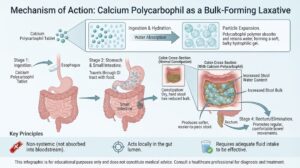
Calcium polycarbophil is classified as a bulk-forming laxative. It absorbs and holds water, increasing stool bulk and helping produce softer, easier-to-pass stools.[2][3][11]
There is an important mechanistic difference worth understanding here. A 1993 study published in Gastroenterology compared psyllium, calcium polycarbophil, and wheat bran in subjects with experimentally induced diarrhea. The researchers found that psyllium measurably increased fecal viscosity and firmed up loose stool, while calcium polycarbophil and wheat bran had no meaningful effect on fecal consistency in that setting.[4]
This experimental study shows that psyllium and calcium polycarbophil can behave differently under specific gastrointestinal conditions. However, findings from an experimentally induced diarrhea model should not be interpreted as direct evidence that one fiber is better than the other for constipation.[4]
What the Research Says
Calcium polycarbophil has a smaller and older evidence base than psyllium, and it is worth being upfront about that. Most of the head-to-head trials date back to the late 1980s and early 1990s, and they tend to be small.
- Versus psyllium for chronic constipation: A randomized crossover study of 68 patients found calcium polycarbophil to be about as effective as psyllium suspension for controlling symptoms of chronic constipation, measured by straining, stool consistency, and stool frequency. Patients preferred the calcium polycarbophil tablets by roughly a two to one margin, although the study was open-label and a preference does not by itself establish greater effectiveness.[5]
- For irritable bowel syndrome with constipation: A six month, randomized, double-blind, placebo-controlled crossover trial in 23 patients found that most participants who expressed a preference chose calcium polycarbophil over placebo, with the clearest benefit in those with constipation, alternating bowel habits, or bloating as a major symptom.[6] This trial is small and dated, so it should be read as preliminary rather than definitive.
- Where it sits in current guidelines: The 2023 joint clinical practice guideline from the American Gastroenterological Association and American College of Gastroenterology (AGA/ACG) conditionally suggests fiber supplementation over no fiber for chronic idiopathic constipation, based on low certainty evidence. Among the fiber supplements evaluated by the guideline, psyllium was the only one that appeared clearly effective, while evidence for bran and inulin was very limited and uncertain.[7] Calcium polycarbophil is not specifically recommended by name in that guideline. Among the OTC therapies evaluated in the guideline, polyethylene glycol (PEG) received a strong recommendation for chronic idiopathic constipation, while fiber received only a conditional recommendation.[7]
Taken together, the honest summary is this: calcium polycarbophil appears to work as a bulk-forming laxative and has some clinical support, if older and limited, but it has not been studied nearly as extensively as psyllium. Current major guidelines conditionally suggest fiber supplementation as a class, with the evidence strongest for psyllium among the fiber options evaluated, and do not specifically recommend calcium polycarbophil by name.
Dosage: How to Take FiberCon
According to the product label and the manufacturer’s own guidance:[1][8]
- Adults and children 12 and older: Take 2 caplets per dose. The dose may be taken up to 4 times daily, but do not exceed 8 caplets in 24 hours unless directed by a doctor.[1]
- Onset: A bowel movement typically occurs within 12 to 72 hours, and the manufacturer notes that continued use for 1 to 3 days is usually needed for full benefit.[1][9]
- Duration: The label advises against use for more than 7 days without a doctor’s direction, which is a standard OTC laxative caution rather than something specific to FiberCon.[9]
Adequate fluid is important. Because calcium polycarbophil absorbs water and swells, taking it without enough liquid can cause it to swell in the throat or esophagus and create a choking risk. The product label specifically warns against use in people with difficulty swallowing.[1]
If you are looking for a broader comparison across laxative categories rather than just fiber options, our complete guide to the best OTC laxatives for constipation breaks down osmotic, stimulant, and bulk-forming choices side by side.
Side Effects and Who Should Be Cautious
FiberCon is generally considered well tolerated when used as directed, but gastrointestinal symptoms and other adverse effects can occur. A few points are worth flagging:
- Gas and bloating: The manufacturer markets FiberCon as unlikely to cause gas or bloating because calcium polycarbophil does not ferment. However, individual gastrointestinal responses can vary, and independent head-to-head evidence comparing these effects with psyllium is limited.[3]
- Difficulty swallowing: FiberCon should not be used by people with trouble swallowing or a narrowed esophagus, since the caplet can swell and worsen a blockage.[1]
- Drug interactions: Product labeling advises taking FiberCon at least two hours before or after other oral medicines because laxatives may affect how other drugs work.[1]
- Not for everyone: People with stomach pain, nausea, or vomiting, rectal bleeding, or a sudden change in bowel habits lasting two weeks or longer should see a doctor rather than self-treating with a bulk-forming laxative.[2][3]
If your constipation is tied to a specific cause rather than being occasional, it is worth reading the more targeted guide that fits your situation, such as our articles on constipation from iron supplements or fiber options for older adults.
FiberCon vs Metamucil vs Benefiber: A Quick Comparison
| Feature | FiberCon (calcium polycarbophil) | Metamucil (psyllium husk) | Benefiber (wheat dextrin) |
|---|---|---|---|
| Active ingredient | Synthetic calcium polycarbophil | Psyllium husk, from Plantago ovata seeds | Wheat dextrin |
| Common forms | Caplets | Powders and other formulations, depending on product | Powder and other formulations, depending on product |
| Gas and bloating | Marketed as unlikely to cause gas or bloating; independent comparative evidence is limited[2] | May cause gas or bloating in some people, particularly when starting[3] | Not independently reviewed for this article; see manufacturer labeling |
| Volume of research | Smaller, older studies[5][6] | Large, extensively studied, referenced in guidelines[7] | Wheat dextrin was not one of the fiber supplements specifically evaluated in the AGA/ACG guideline |
| Practical consideration | No powder to mix; may suit people who dislike gel-forming textures | Forms a viscous gel when mixed with water; best-supported fiber option among those evaluated in the AGA/ACG guideline | Powder formulation; mixes into liquids or soft foods |
For a deeper dive into any one of these comparisons, see our full MiraLAX vs Metamucil and Benefiber vs Metamucil guides, or our roundup of stool softeners and stool-softening laxatives if docusate is also on your list.
If you want to compare current prices, all three are available on Amazon: FiberCon, Metamucil, and Benefiber.
Who Might Consider FiberCon?
It is worth being clear about one distinction: the clinical studies discussed above tested calcium polycarbophil in people with chronic constipation, but the current OTC FiberCon label is written for occasional constipation. With that in mind, FiberCon may suit:
- People who find psyllium’s gel-like texture unpleasant and want a swallowable caplet instead.[5]
- People curious whether a different bulk-forming laxative sits better with them, since FiberCon is marketed as less likely to cause gas or bloating than some fiber products.[2]
- People managing occasional, mild constipation, since the label is intended for short-term (up to 7 days) use without medical supervision.[9]
If your constipation has lasted more than a few weeks, or you suspect an underlying cause such as low dietary fiber, dehydration, or a medication side effect, it is worth discussing a broader range of options with a doctor alongside or instead of FiberCon.
Pregnancy, Breastfeeding, and Children
FiberCon’s label covers adults and children 12 years of age and older; it is not labeled for use in younger children.[1] If you are pregnant or breastfeeding, ask your healthcare provider whether FiberCon is appropriate for you.[3] For fiber options specifically evaluated for younger children, see our guide to fiber gummies for constipated kids.
When to See a Doctor
Fiber supplements like FiberCon are meant for occasional constipation. Contact a doctor rather than continuing self-treatment if you experience any of the following:[2][10]
- You do not have a bowel movement after using FiberCon or another laxative as directed
- Your symptoms have not improved after up to 7 days of use, or you feel you need to keep using it beyond that
- Severe abdominal pain, nausea, or vomiting
- Rectal bleeding or blood in the stool
- A sudden change in bowel habits that lasts two weeks or longer, or unexplained weight loss
Frequently Asked Questions
Is FiberCon the same as Metamucil?
No. Both are bulk-forming laxatives, but FiberCon’s active ingredient is calcium polycarbophil, a synthetic bulk-forming laxative, while Metamucil’s active ingredient is psyllium husk, a natural plant fiber.[1][2] They work through a similar general mechanism (absorbing water to bulk and soften stool) but behave somewhat differently in the gut, and psyllium has a much larger body of clinical research behind it.[4][7]
How long does FiberCon take to work?
FiberCon generally produces a bowel movement within 12 to 72 hours, and the manufacturer recommends continued use for 1 to 3 days to see the full benefit.[1][9]
Can I take FiberCon every day?
The OTC label advises against use for more than 7 days unless directed by a doctor. A doctor may sometimes recommend longer-term or daily use in specific situations, but ongoing constipation is worth having evaluated rather than self-treating indefinitely with any single product.[1][9]
Does FiberCon cause less gas than Metamucil?
FiberCon is marketed as less likely to cause gas or bloating, but independent, head-to-head evidence directly showing that it causes less gas than psyllium is limited. Individual responses can vary.[2]
Can FiberCon interact with medications?
Yes. Product labeling advises taking FiberCon at least two hours before or after other oral medicines because laxatives may affect how other drugs work.[1] Check with a pharmacist or doctor if you take prescription medications regularly.
The Bottom Line
FiberCon (calcium polycarbophil) is an established, over-the-counter bulk-forming laxative with a long history of use and reasonable, if smaller and older, clinical support.[1][5][6] It is an established OTC option for occasional constipation, particularly for people who prefer a caplet over a psyllium powder or who want to see whether a different bulk-forming laxative suits them better.
It is not, however, as heavily studied or as strongly endorsed in current clinical guidelines as psyllium or polyethylene glycol, so if you are managing constipation that is frequent or long-lasting, it is worth discussing a broader treatment plan with a doctor rather than relying on any single OTC product alone.[7]
References
- DailyMed. FiberCon (calcium polycarbophil) tablet, label information. U.S. National Library of Medicine. Available from: https://dailymed.nlm.nih.gov/dailymed/drugInfo.cfm?setid=7992a4bb-5535-4a1d-867d-a99f7e0c1be7
- GoodRx Health. Calcium Polycarbophil (FiberCon): Uses, Side Effects, Dosage and More. Available from: https://www.goodrx.com/calcium-polycarbophil/what-is
- WebMD. Calcium Polycarbophil (FiberCon, Fiber-Lax, and Others): Uses, Side Effects, Interactions. Available from: https://www.webmd.com/drugs/calcium-polycarbophil-fibercon
- Eherer AJ, Santa Ana CA, Porter J, Fordtran JS. Effect of psyllium, calcium polycarbophil, and wheat bran on secretory diarrhea induced by phenolphthalein. Gastroenterology. 1993;104(4):1007-1012.
- Bass P, Clark C, DoPico GA. Comparison of the laxative efficacy and patient preference of calcium polycarbophil tablets and psyllium suspension. Curr Ther Res. 1988;43:770-774.
- Toskes PP, Connery KL, Ritchey TW. Calcium polycarbophil compared with placebo in irritable bowel syndrome. Aliment Pharmacol Ther. 1993;7(1):87-92.
- Chang L, Chey WD, Imdad A, et al. American Gastroenterological Association-American College of Gastroenterology Clinical Practice Guideline: Pharmacological Management of Chronic Idiopathic Constipation. Am J Gastroenterol. 2023;118(6):936-954.
- Medscape. FiberCon, Fiber Lax (polycarbophil): dosing, interactions. Available from: https://reference.medscape.com/drug/fibercon-fiber-lax-polycarbophil-342021
- FiberCon®. Frequently Asked Questions. Available from: https://www.fibercon.com/faqs/
- Mayo Clinic. Laxatives: OTC products for constipation. Available from: https://www.mayoclinic.org/diseases-conditions/constipation/in-depth/laxatives/art-20045906
- Yamada T, Kitayama M, Yamazaki M, Nagata O, Tamai I, Tsuji A. Physicochemical properties of calcium polycarbophil, a water-absorbing polymer. J Pharm Pharmacol. 1996;48(7):665-668.